Shen Kuo
polymathic Chinese scientist and statesman of the Song Dynasty
Years: 1031 - 1095
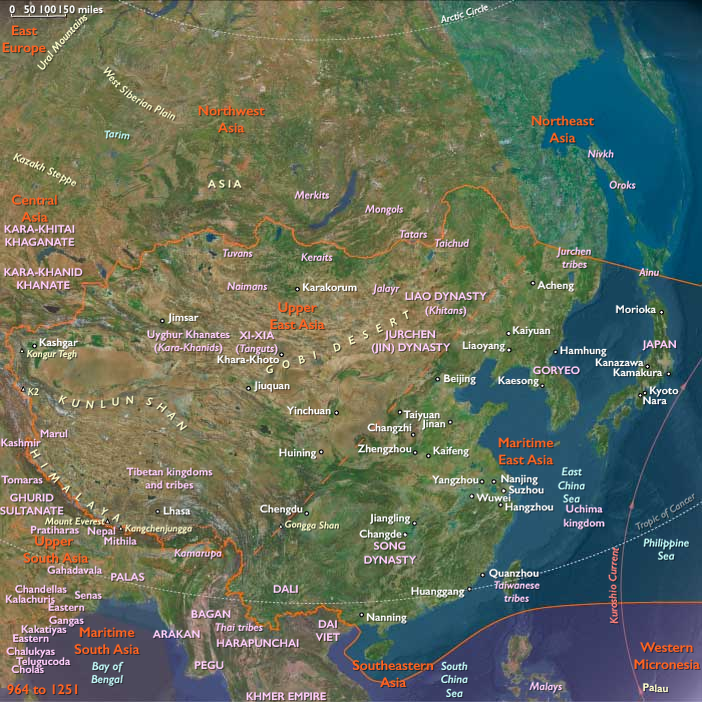
Shen Kuo or Shen Gua (1031–1095), courtesy name Cunzhong and pseudonym Mengqi (now usually given as Mengxi) Weng, is a polymathic Chinese scientist and statesman of the Song Dynasty (960–1279).
Excelling in many fields of study and statecraft, he is a mathematician, astronomer, meteorologist, geologist, zoologist, botanist, pharmacologist, agronomist, archaeologist, ethnographer, cartographer, encyclopedist, general, diplomat, hydraulic engineer, inventor, academy chancellor, finance minister, governmental state inspector, poet, and musician.
He is the head official for the Bureau of Astronomy in the Song court, as well as an Assistant Minister of Imperial Hospitality.
At court his political allegiance is to the Reformist faction known as the New Policies Group, headed by Chancellor Wang Anshi (1021–1086).
In his Dream Pool Essays (Mengxi Bitan) of 1088, Shen is the first to describe the magnetic needle compass, which will be used for navigation (first described in Europe by Alexander Neckam in 1187).
Shen discovers the concept of true north in terms of magnetic declination towards the north pole, with experimentation of suspended magnetic needles and the improved meridian determined by Shen's astronomical measurement of the distance between the polestar and true north.
This is the decisive step in human history to make compasses more useful for navigation, and may have been a concept unknown in Europe for another four hundred years (evidence of German sundials made circa 1450 show markings similar to Chinese geomancer compasses in regards to declination).
Together with his colleague Wei Pu, Shen plans to map the orbital paths of the Moon and the planets in an intensive five-year project involving daily observations, yet this is thwarted by political opponents at court.
To aid his work in astronomy, Shen Kuo makes improved designs of the armillary sphere, gnomon, sighting tube, and invented a new type of inflow water clock.
Shen Kuo devises a geological hypothesis for land formation (geomorphology), based upon findings of inland marine fossils, knowledge of soil erosion, and the deposition of silt.
He also proposes a hypothesis of gradual climate change, after observing ancient petrified bamboos that had been preserved underground in a dry northern habitat that would not support bamboo growth in his time.
He is the first literary figure in China to mention the use of the drydock to repair boats suspended out of water, and also writes of the effectiveness of the relatively new invention of the canal pound lock.
Although Ibn al-Haytham (965–1039) had been the first to describe camera obscura, Shen is the first in China to do so, several decades later.
Shen writes extensively about movable type printing invented by Bi Sheng (990–1051), and because of his written works the legacy of Bi Sheng and the modern understanding of the earliest movable type has been handed down to later generations.
Following an old tradition in China, Shen creates a raised-relief map while inspecting borderlands.
His description of an ancient crossbow mechanism which he himself unearths proved to be a Jacob's staff, a surveying tool which will not be known in Europe until described by Levi ben Gerson in 1321.
Shen Kuo writes several other books besides the Dream Pool Essays, yet much of the writing in his other books has not survived.
Some of Shen's poetry is preserved in posthumous written works.
Although much of his focus is on technical and scientific issues, he has an interest in divination and the supernatural, the latter including his vivid description of unidentified flying objects from eyewitness testimony.
He also writes commentary on ancient Daoist and Confucian texts.