The Middle East: 1480–1491 CE
Realignments, Rivalries, and Imperial Ambitions
Ottoman Expansion and Consolidation
Following their victory over the Aq Qoyunlu in 1473, the Ottomans under Bayezid II (r. 1481–1512) pursue a more cautious but strategic expansion policy. Bayezid's reign contrasts with that of his father, Mehmed II, prioritizing internal stability, administrative consolidation, and diplomatic maneuvering over military conquest. This approach stabilizes Ottoman territorial gains and allows for internal infrastructure development, administrative reforms, and increased trade with both European and Middle Eastern powers.
Ottoman-Mamluk Rivalry and Conflict
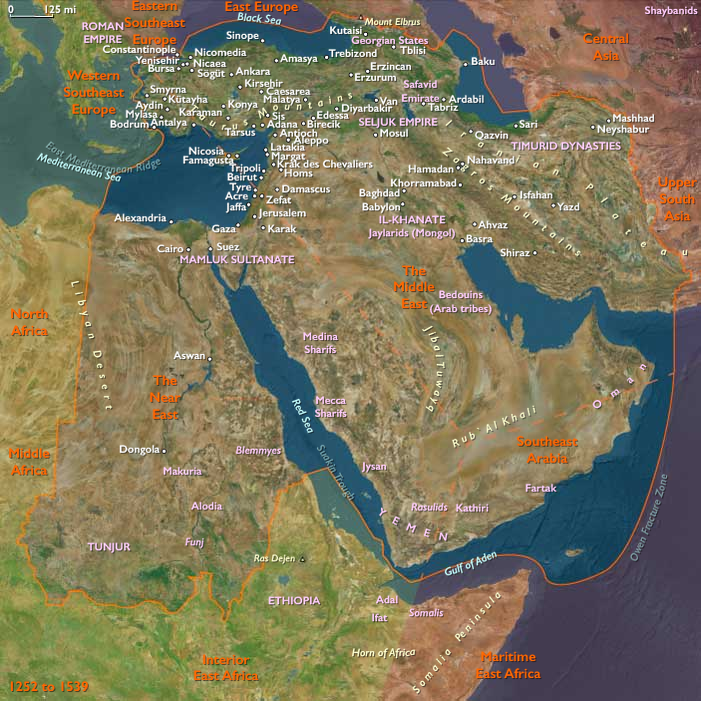
A dispute arises in 1485 over a Turkmen territory ruled by the Mamluk-supported Duldakir dynasty in Cappadocia. The Mamluks—against whom the military leaders of Ottoman sultan Bayezid II press for revenge in retaliation for Mamluk support of his rebellious brother in the recent civil war—interfere in Cappadocia by stirring up eastern Turkmen nomads and asserting authority over Lesser Armenia. The Ottomans initiate a series of six annual campaigns against the Mamluks, five of which end indecisively and one of which ends, in 1488, in a small victory by the Mamluks. Peace negotiations in 1491 gain the Mamluks territorial concessions and suspend fighting.
Continued Decline of the Aq Qoyunlu
After the crushing defeat at Bashkent in 1473, the Aq Qoyunlu confederation enters a period of rapid decline marked by internal dissension, regional rebellions, and external pressures from rival powers, particularly the rising Safavid order and the Ottomans. The death of Uzun Hasan in 1478 exacerbates internal fragmentation, weakening Aq Qoyunlu authority and enabling the emergence of smaller, rival principalities across Persia and eastern Anatolia.
Rise of the Safavid Movement
In this period, the Safavid order, led by the charismatic religious and military leader Sheikh Haydar (d. 1488), begins to assert itself more aggressively. The Safavid followers, known as Qizilbash ("red heads," named for their distinctive red turbans), gain prominence and territorial control in northwestern Persia and parts of the Caucasus. Though Sheikh Haydar is killed in a conflict with the Aq Qoyunlu, his movement continues to grow, setting the stage for the future Safavid Empire.
Mamluk Political and Economic Stability
In contrast to turmoil elsewhere, the Mamluk Sultanate of Egypt and Syria under Sultan Qaitbay (r. 1468–1496) experiences a period of relative stability and prosperity. Qaitbay reinforces the Mamluk position in the Levant through diplomatic engagement, trade expansion, and military preparedness. His reign is notable for extensive architectural patronage, including fortresses, mosques, and public works projects that enhance both defense and civic life.
Georgian Resistance and Cultural Flourishing
The Kingdom of Georgia, despite increasing pressure from both the Ottoman Empire and local Turkmen factions, manages to retain its autonomy through skillful diplomacy and occasional military resistance. Georgian culture continues to flourish, producing significant literary and artistic achievements that underscore the resilience of Georgian identity amid ongoing geopolitical challenges.
Legacy of the Era
From 1480 to 1491, the Middle East witnesses strategic realignments, with the Ottoman Empire reinforcing its control and engaging in protracted rivalry with the Mamluks over regional dominance. The Aq Qoyunlu experiences profound internal collapse, and the Safavid movement rises in prominence. Meanwhile, the Mamluks provide a rare model of stability and prosperity, and Georgia continues its cultural resilience, illustrating the region's complexity amid shifting power dynamics.