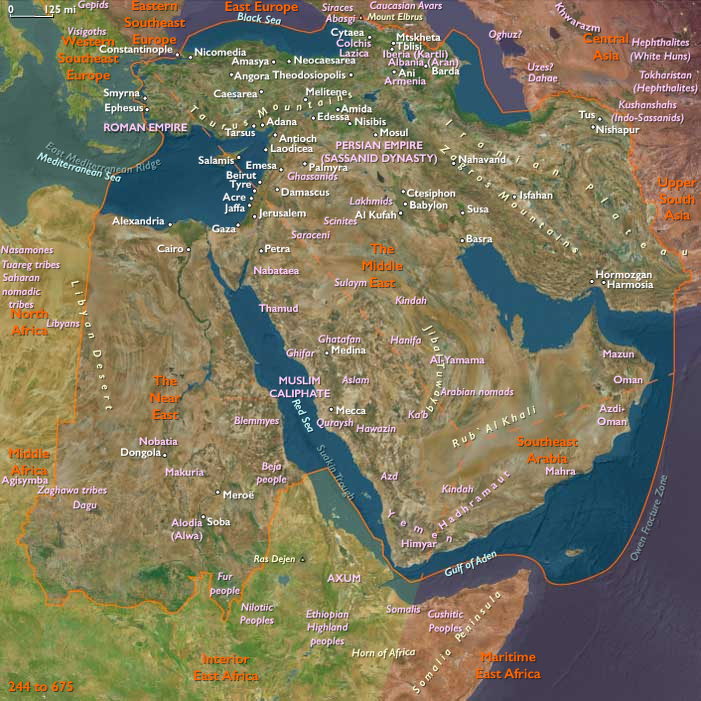
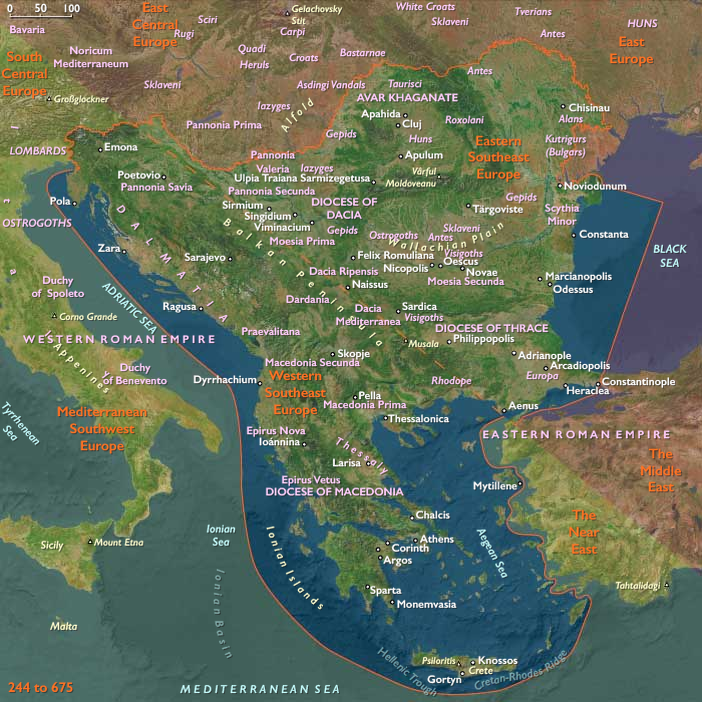
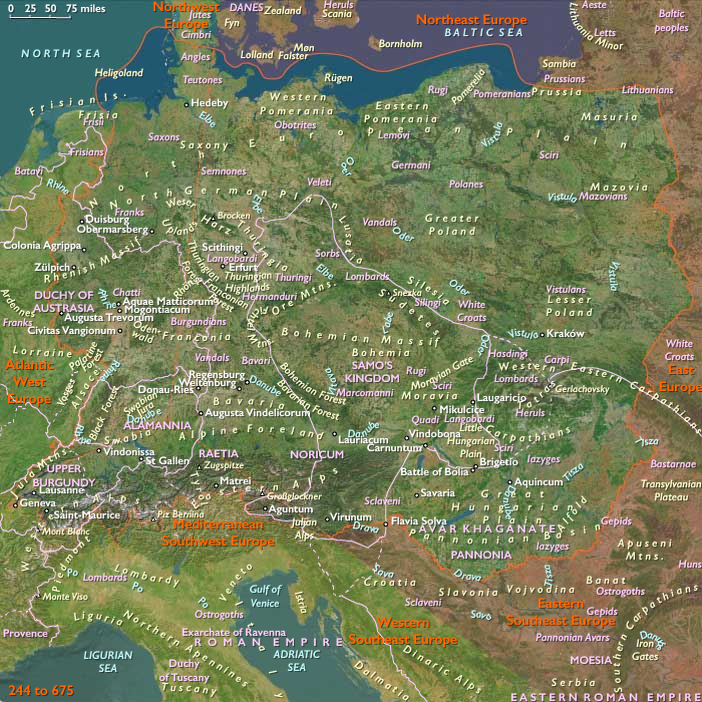
The Avars continue to war against the Romans, in 626 surrounding and almost occupying Constantinople itself with a horde of about eighty thousand men (including large contingents of Slavs, Bulgars, and other "barbarians").
Khosrau II, planning an all-out effort against Constantinople, returns to Anatolia with two armies—of unknown size, presumably more than fifty thousand men each.
He sends one army to besiege Constantinople and another to oppose Heraclius.
The Persian led by Shahin Vahmanzadegan, advance to the Bosporus on the Asiatic side of the city, hoping to join the Avars in their assault on the land walls of Constantinople.
The Theodosian Walls are stormed with the most up-to-date siege equipment in the form of traction trebuchets.
The Avars have also mobile armored shelters (medieval 'sows') and siege towers, the latter covered in hides for fire protection.
The defense of the capital (twelve thousand well-trained imperial troops) is in the hands of patriarch Sergius I and Bonus as magister militum.
During the attack, Sergius maintains the morale of the valiant garrison by proceeding about the walls, bearing the image of Christ to ward off fire, and by painting upon the gates of the western walls images of the Virgin and child to ward off attacks launched by the Avars—the “breed of darkness.”
On July 31, the Avars and Persian allies under Shahrbaraz launch an attack along the entire length of the Theodosian Walls (about 5.7 kilometers), the main effort concentrated against the central section, particularly the low-lying mesoteichion.
After a fierce infantry battle on the walls, the imperial army holds off repeated assaults on the city.
Emperor Heraclius makes arrangements for a new army under his brother Theodore to operate against the Persians in western Anatolia while he returns to his own army in Pontus.
The primitive Avar fleet is to transport Persian units across the Bosporus, but the Avars withdraw when Roman ships defeat the canoes manned by Slavs, upon whom the nomad Avars depend for their naval strength.
On August 7, the Avars, having suffered terrible losses, running short of food and supplies, burn their siege engines, abandon the siege and retreat to the Balkan Peninsula.
The imperial forces achieve an decisive victory at Blachernae under the protection of the Church of the Virgin Mary.
The defenders celebrate their victory by singing Romanos' great hymn Akathistos, with choir and crowd alternating in the chant of the Alleluia.
The hymn (still sung in a Lenten service) commemorates those days when Constantinople survived as a fortress under ecclesiastical leadership, its defenders protected by the icons and united by their liturgy.
This they sing in Greek, as befits a people whose culture is now Greek and no longer Latin.