Shah Jahan
Mughal Emperor
Years: 1592 - 1666
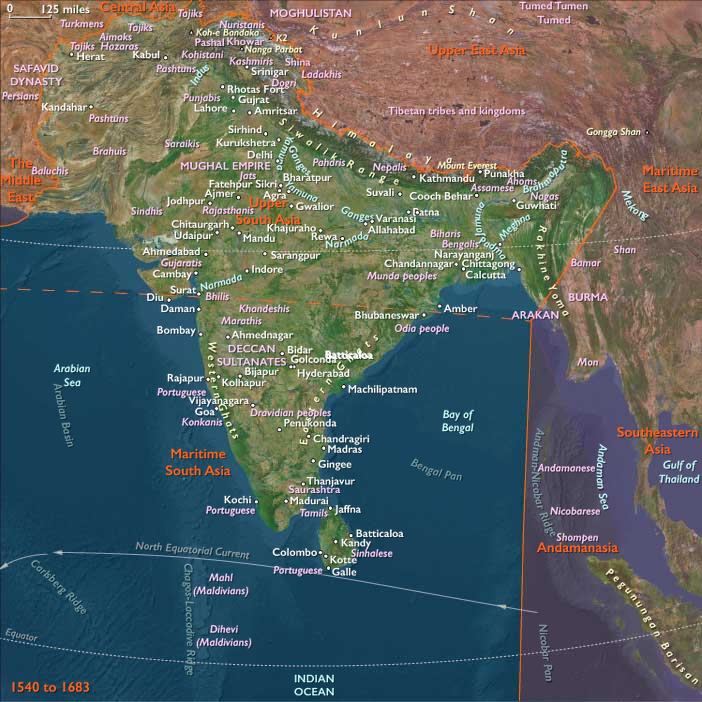
Shahab Uddin Muhammad Shah Jahan I (5 January 1592 – 22 January 1666) is the emperor of the Mughal Empire in India from 1628 until 1658.
The name Shah Jahan comes from Persian meaning "king of the world."
He is the fifth Mughal ruler after Babur, Humayun, Akbar, and Jahangir.
While young, he had been a favorite of his legendary grandfather Akbar the great.
Even while very young, he could be pointed out to be the successor to the Mughal throne after the death of Emperor Jahangir.
He succeeds to the throne upon his father's death in 1627.
He is considered to be one of the greatest Mughals and his reign has been called the Golden Age of Mughals.
Like Akbar, he is eager to expand his empire.
The chief events of his reign are the destruction of the kingdom of Ahmadnagar (1636), the loss of Kandahar to the Persians (1653), and a second war against the Deccan princes (1655).
In 1658 he falls ill, and is confined by his son Emperor Aurangzeb in the citadel of Agra until his death in 1666.
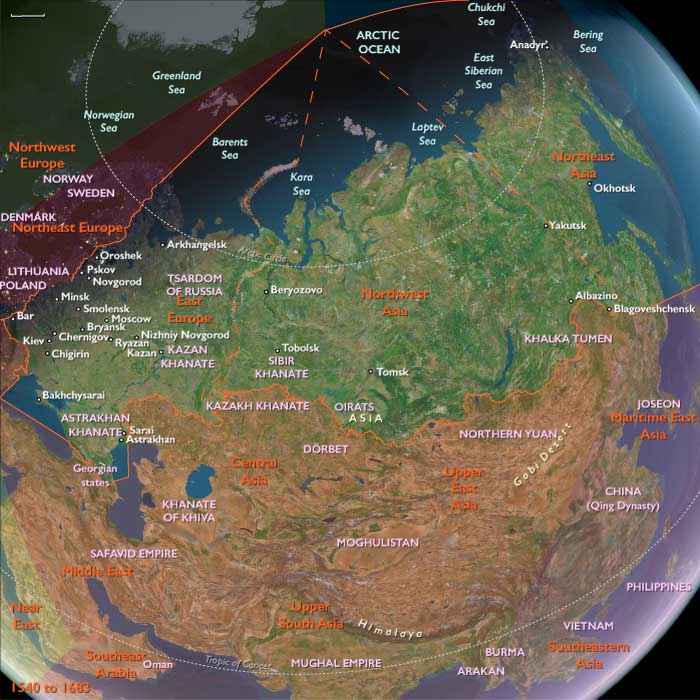
On the eve of his death in 1666, the Mughal Empire spans almost 750,000,000 acres (3,000,000 km2) and he is the most famous and powerful man on earth of the age who has in his empire the biggest and the most prosperous capital (Shahjahanabad) and some of the most delicate architectural masterpieces of the world.
The period of his reign is the golden age of Mughal architecture.
Shah Jahan erects many splendid monuments, the most famous of which is the legendary Taj Mahal at Agra built as a tomb for his wife Empress Mumtaz Mahal (birth name Arjumand Banu Begum).
The Pearl Mosque and many other buildings inside the Red Fort (Qila Mubarak) at Agra, the complete design of Old Delhi (Shahjahanabad), the palaces, the Red Fort and the great mosque at Delhi, mosques in Lahore, buildings in the Lahore fort (present day Pakistan) and a beautiful mosque at Thatta (present day Pakistan) also commemorate him.
The most famous, celebrated and the luxurious throne of the world, the Takht-E-Taus or the Takht-E-Shahanshah-E-Hindustan (Peacock Throne), said to be worth millions of dollars by modern estimates, also dates from his reign.
He is also the founder of Shahjahanabad, now known as 'Old Delhi'.
The important buildings of Shah Jahan are the Diwan-i-Am and Diwan-i-Khas in the fort of Delhi, the Jama Masjid, the Moti Masjid and the Taj.
The Palace of Delhi is arguably the most magnificent in the East.