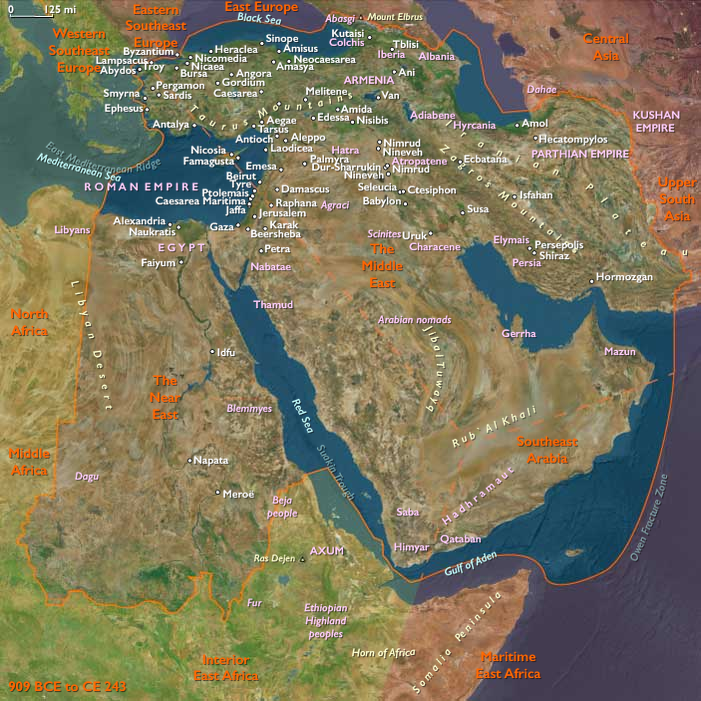
Financial difficulties, created in part by the heavy war indemnity exacted by Rome, have compelled Seleucus IV to pursue a policy devoid of expensive adventures.
His unambitious policy and care are also dictated by the fact that his son and heir, Demetrius, has been sent to Rome as a hostage for his father in exchange for Antiochus, the third son of Antiochus III, who has learned to admire Roman institutions and policies.
Seleucus, having heard that the temple treasury in Jerusalem is wealthy, wonders why some of the tribute is being withheld.
He sends one his chief ministers, Heliodorus, to investigate.
Heliodorus, having possibly found enough wealth to bribe elements in the Seleucid army, returns, assassinates Seleucus, and seizes the throne in 175.
As Seleucus' legitimate heir, Demetrius, is still a hostage in Rome, Antiochus, with the help of King Eumenes II of Pergamon, seizes the throne for himself, proclaiming himself co-regent for another son of Seleucus, an infant named Antiochus (whom he will murder a few years later).
He takes the throne as Antiochus IV Epiphanes (”God Manifest”).
Both economically and socially, Antiochus, a passionate philhellene who pays lip service to the political traditions of both Athens and Rome, makes efforts to strengthen his kingdom—inhabited in the main by Orientals (non-Greeks of Asia Minor and Persia)—by founding and fostering Greek cities.
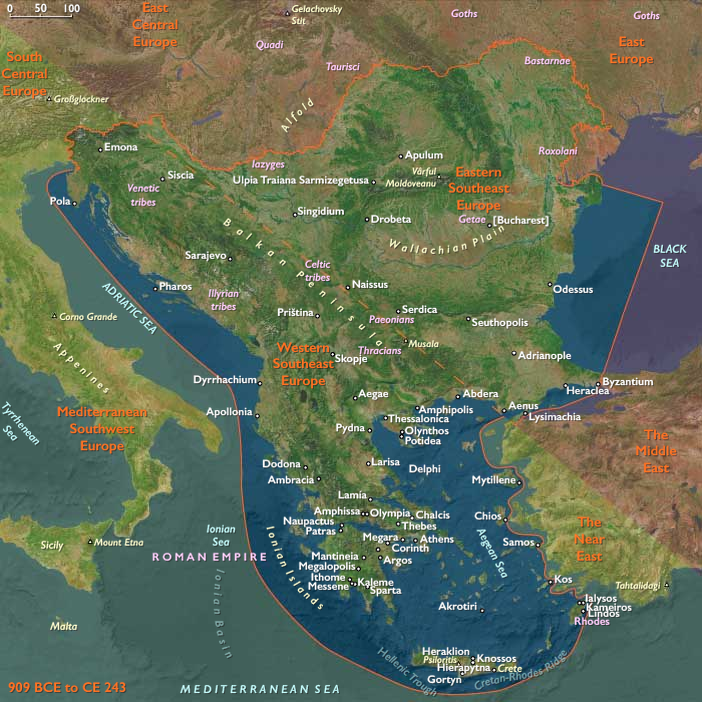
Even before he had begun his reign, he had contributed to the building of the temple of Zeus in Athens and to the adornment of the theater.
He enlarges Antioch on the Orontes by adding a section to the city (named Epiphania after him).
Here he builds an aqueduct, a council hall, a marketplace, and a temple to Jupiter Capitolinus.