Seleucus III Ceraunus
king of the Hellenistic Seleucid Kingdom
Years: 243BCE - 223BCE
Seleucus III Soter, called Seleucus Ceraunus (c. 243 BCE – 223 BCE), is a ruler of the Hellenistic Seleucid Kingdom, the eldest son of Seleucus II Callinicus and Laodice II.
His birth name is Alexander after his great uncle, the Seleucid official Alexander.
Alexander changes his name to Seleucus after he succeeds his father as King.
After a brief reign of three years (225 BCE–223 BCE), Seleucus is assassinated in Anatolia by members of his army while on campaign against Attalus I of Pergamon.
His official byname "Soter" - means "Savior", while his nickname "Ceraunus" means "Thunder".
Related Events
Filter results
Showing 10 events out of 10 total
Near East (237–226 BCE): The Rise of Attalid Pergamon and the Decline of Seleucid Control
During this era, Attalus I of Pergamon, originally a vassal and distant relative of the Seleucid rulers, consolidates his authority in western Anatolia, emerging as a formidable power in the region. A capable military leader and shrewd politician, Attalus significantly enhances Pergamon’s prestige by defeating the Galatians, the Celtic peoples inhabiting central Anatolia. To commemorate this victory, Attalus likely commissions the famous Hellenistic sculpture known as The Dying Gaul (also called The Dying Galatian), originally crafted in bronze around 230–220 BCE and later preserved in Roman marble copies.
Pergamon’s position is challenged again shortly after, when the Galatians ally with Antiochus Hierax, ruler of Seleucid Asia Minor and younger brother of Seleucus II Callinicus. Attalus decisively defeats this coalition at the Battle of Aphrodisium, then secures further victories against Antiochus Hierax alone—first near Sardis in 228 BCE, and later at the decisive battle along the Harpasus River in Caria.
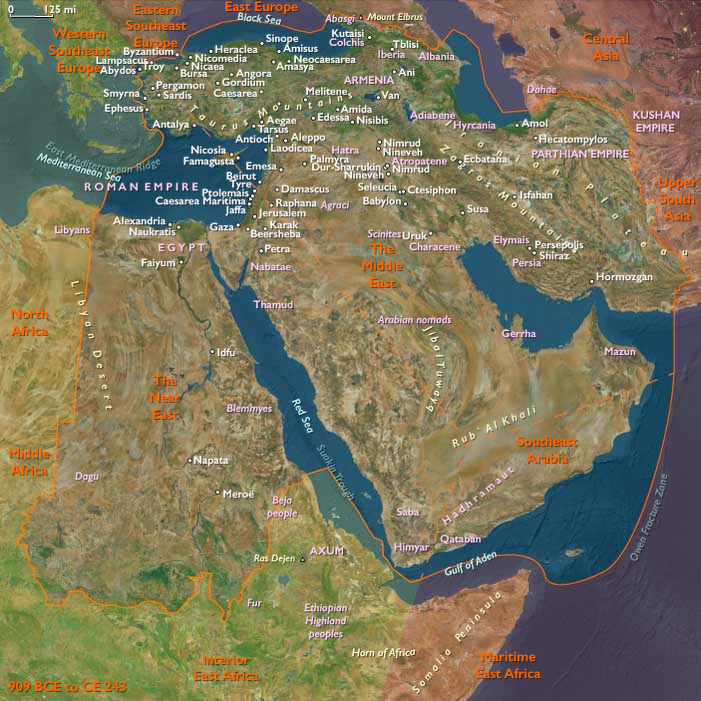
As a result of these campaigns, Attalus gains control over all Seleucid territories in Asia Minor north of the Taurus Mountains. Despite repeated efforts by the Seleucid heir, Seleucus III Ceraunus, to reclaim these regions, Pergamon maintains its hold. Seleucus III’s military campaigns culminate disastrously in 223 BCE when he is assassinated by his own soldiers. Subsequently, his successor Antiochus III the Great appoints Achaeus as governor of Seleucid territories north of the Taurus. Initially loyal, Achaeus soon recaptures all lost territories and declares himself king, further fragmenting Seleucid authority.
Meanwhile, in southern Syria, the Hellenistic cultural influence deepens. The tombs of Hellenized Sidonian military settlers at Marisa in Edom (Idumaea) showcase frescoes depicting vibrant hunting scenes, reflecting the widespread embrace of Greek customs and aesthetics among non-Greek populations across the Near East.
Attalus of Pergamon, ostensibly a vassal-ally of the dominant Seleucid dynasty, to which he is distantly related, consolidates power in western Anatolia.
Proving both a strong protector of the Greek cities of Anatolia and an opportunist in trying to expand Pergamon's territory and power, Attalus scores a major victory over the Galatians, the Celtic or Gaulish people of parts of Anatolia.
The Dying Gaul—also called The Dying Galatian or The Dying Gladiator—an ancient Roman marble copy of a lost Hellenistic sculpture thought to have been executed in bronze, may have been commissioned some time between 230 and 220 BCE by Attalus to celebrate his victory.
Several years after the first victory over the Gauls, Pergamon had again been attacked by the Gauls together with their ally Antiochus Hierax, the younger brother of Seleucus II Callinicus, and ruler of Seleucid Asia Minor from his capital at Sardis.
Attalus had defeated the Gauls and Antiochus at the battle of Aphrodisium and again at a second battle in the East.
Subsequent battles are fought and won against Antiochus alone: in Hellespontine Phrygia, where Antiochus is perhaps seeking refuge with his father-in law, Ziaelas the king of Bithynia; near Sardis in the spring of 228 BCE; and, in the final battle of the campaign, further south in Caria on the banks of the Harpasus, a tributary of the Maeander.
Attalus, as a result of these victories, gains control over all of Seleucid Asia Minor north of the Taurus Mountains.
He is able to hold onto these gains in the face of repeated attempts by Seleucus III Ceraunus, eldest son and successor of Seleucus II, to recover the lost territory, culminating in Seleucus III himself crossing the Taurus, only to be assassinated in 223 BCE by members of his army.
Achaeus, who had accompanied Seleucus III, had assumed control of the army.
He is offered and refuses the kingship in favor of Seleucus III's younger brother Antiochus III the Great, who then makes Achaeus governor of Seleucid Asia Minor north of the Taurus.
Achaeus within two years recovers all the lost Seleucid territories and assumes the title of king.

The Romans, in search of iron, copper, precious metals, slaves, and crops, begin to expand into the Balkan Peninsula in the late third century BCE.
The tax burden on both rural and urban populations of the Hellenistic kingdoms rises as the constant military conflicts raise revenue needs.
The Persians, Parthians, and Bactrians meanwhile threaten from the east; and Roman expansionism in southern Italy and the western Mediterranean sets the stage for repeated clashes between Rome and various Hellenistic rulers.
Conflicts between the Roman Republic and the kingdom of Macedonia from 215 BCE cause increasing involvement by Rome in Greek affairs.
Antiochus III the Great, upon taking the Seleucid throne in 223 BCE, had set himself the task of restoring the lost imperial possessions of Seleucus I Nicator, which extended from Greco-Bactrian Kingdom in the east, the Hellespont in the north, and Syria in the south.
He has by 221 BCE reestablished Seleucid control over Media and Persia, which had been in rebellion.
The ambitious king turns his eyes toward Syria and Hellenistic Egypt.
Egypt has been significantly weakened by court intrigue and public unrest.
The rule of the newly inaugurated Ptolemy IV Philopator begins in 221 BCE with the murder of queen-mother Berenice II.
The young king quickly falls under the absolute influence of imperial courtiers.
His ministers use their absolute power in their own self-interest, to the people's great chagrin.
Antiochus seeks to take advantage of this chaotic situation.
After an invasion in 221 BCE fails to launch, he finally begins the Fourth Syrian War in 219 BCE.
He recaptures Seleucia Pieria as well as cities in Phoenicia, among them Tyre.
Rather than promptly invading Egypt, Antiochus waits in Phoenicia for over a year, consolidating his new territories and listening to diplomatic proposals from the Ptolemaic kingdom.
Ptolemy's minister Sosibius meanwhile begins recruiting and training an army.
The threat from Seleucid Syria is sufficiently grave that, for the first time under the Ptolemaic regime, Sosibus recruits not only from the local Greek population, as Hellenistic armies generally are, but also from the native Egyptians, enrolling at least thirty-thousand natives as phalangites.
This innovation pays off, but it will eventually have dire consequences for Ptolemaic stability.
Ptolemy, after intensive drilling of the reorganized Egyptian army, engages and defeats the long-delayed Antiochus in the summer of 217 BCE in the Battle of Raphia, the largest battle since the Battle of Ipsus over eighty years earlier.
Ptolemy's victory preserves his control over Coele-Syria, and the weak king declines to advance further into Antiochus' empire, even to retake Seleucia Pieria.
The Ptolemaic kingdom will continue to decline over the following years, suffering from economic problems and rebellion.
Antigonus III Doson, reviving the Hellenic Alliance as a confederacy of leagues with himself as president restores internal stability and reestablishes Macedon in a stronger position in Greece than it had enjoyed since the reign of Gonatas.
Antigonus defeats the Achaean League, together with Sparta, but allows a shadow of independence to what appears to be a large body constituting a kind of representative government.
The Social War, or the War of the Allies, fought from 220 BCE to 217 BCE between the Hellenic League under Philip V of Macedon and the Aetolian League, Sparta and Elis, is ended with the Peace of Naupactus.
As a result of the war, Philip V becomes the major military power in Greece.
Philip after 217 turns his attention westward towards the Roman Republic.
He takes Illyria on the westernmost part of the Balkan Peninsula, in 215 allies with Hannibal and Carthage against Rome, and even considers crossing the Adriatic Sea and invading Italy.
The Second Punic War, also referred to as the Hannibalic War (by the Romans), The War Against Hannibal, or "The Carthaginian War", begins in 218 BCE and involves combatants in the western and eastern Mediterranean.
This is the second major war between Carthage and the Roman Republic, with the crucial participation of Numidian-Berber armies and tribes on both sides.
The two states have three major conflicts against each other over the course of their existence.
They are called the "Punic Wars" because Rome's name for Carthaginians is Poeni, derived from Poenici (earlier form of Punici), a reference to the founding of Carthage by Phoenician settlers.
The war is to a considerable extent initiated by Rome, but is marked by Hannibal's surprising overland journey and his costly crossing of the Alps, followed by his reinforcement by Gallic allies and crushing victories over Roman armies in the battle of the Trebia and the giant ambush at Trasimene.
In the following year (216), Hannibal's army defeats the Romans again, this time in southern Italy at Cannae.
In consequence of these defeats, many Roman allies go over to Carthage, prolonging the war in Italy for over a decade.
The Seleucids, weakened by constant wars against the Ptolemies of Egypt and by succession disputes, have now lost much of Anatolia and eastern Iran.
Attalus of Pergamon invades northern Syria in 224 and annexes considerable Seleucid territory.
Seleucus III Ceraunus, the elder son and successor of Seleucus II Callinicus, ruler of the Hellenistic Seleucid kingdom, who had been killed in 225 by a fall from his horse, takes up the task of reconquering Pergamon in Asia Minor from his cousin Attalus I.
Andromachus, dispatched to Pergamon by Seleucus, is decisively defeated by Attalus and captured.
Seleucus III personally leads an army across the Taurus Mountains.
He is assassinated, however, in Phrygia.
After the assassination of Seleucus, his cousin Achaeus, who had accompanied Ceraunus on this expedition against Attalus, revenges his death; and though he might easily have assumed the royal power, he remains faithful to the family of Seleucus.