Sayf al-Dawla
founding Emir of Aleppo
Years: 916 - 967
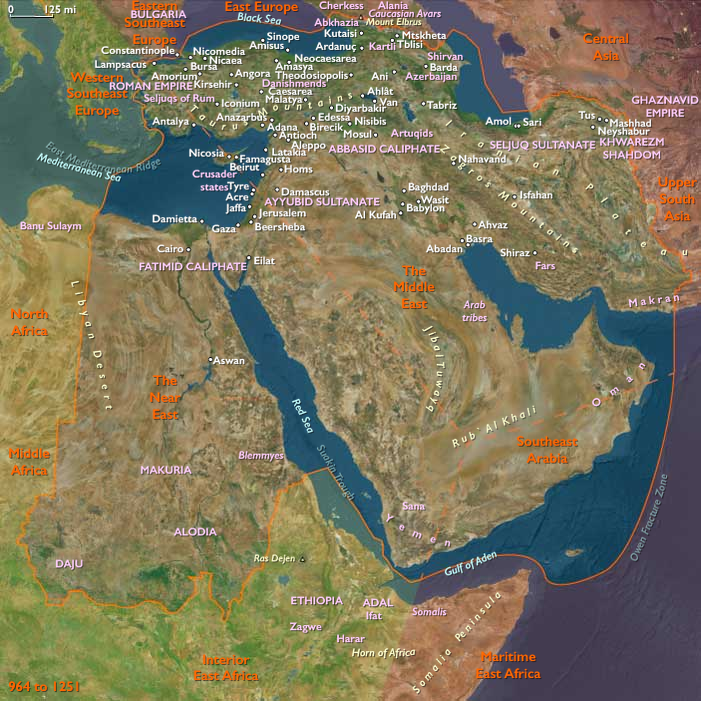
Ali ibn Abu'l-Hayja 'Abdallah ibn Hamdan ibn al-Harith Sayf al-Dawla al-Taghlibi, more commonly known simply by his laqab (honorific epithet) of Sayf al-Dawla ("Sword of the [Abbasid] Dynasty"), is the founder of the Emirate of Aleppo, encompassing most of northern Syria and parts of western Jazira, and the brother of al-Hasan ibn Abdallah ibn Hamdan (better known as Nasir al-Dawla).
The most prominent member of the Hamdanid dynasty, Sayf al-Dawla originally serves under his elder brother in the latter's attempts to establish his control over the weak Abbasid government in Baghdad during the early 940s CE.
After the failure of these endeavors, the ambitious Sayf al-Dawla turns towards Syria, where he confronts the ambitions of the Ikhshidids of Egypt to control the province.
After two wars with them, his authority over northern Syria, centered at Aleppo, and the western Jazira, centered at Mayyafariqin, is recognized by the Ikhshidids and the Caliph.
A series of tribal rebellions plagues his realm until 955, but he is successful in overcoming them and maintaining the allegiance of the most important Arab tribes.
Sayf al-Dawla's court at Aleppo becomes the center of a vibrant cultural life, and the literary cycle he gathers around him, including the great al-Mutanabbi, helps ensure his fame for posterity.
Sayf al-Dawla is widely celebrated for his role in the Arab–Byzantine Wars, facing a resurgent Byzantine Empire that in the early 10th century had begun to conquer Muslim territories.
In this struggle against a much superior enemy, he launches raids deep into Byzantine territory and manages to score a few successes, and generally holds the upper hand until 955.
After that, the new Byzantine commander, Nikephoros Phokas, and his lieutenants spearhead an offensive that breaks Hamdanid power.
The Byzantines annex Cilicia, and even occupy Aleppo itself briefly in 962.
Sayf al-Dawla's final years are marked by military defeats, his own growing disability as a result of disease, and a decline in his authority that leads to revolts by some of his closest lieutenants.
He dies in early 967, leaving a much weakened realm, which by 969 has lost Antioch and the Syrian littoral to the Byzantines and become a Byzantine tributary.