Samuel Russell
American entrepreneur and trader
Years: 1789 - 1862
Samuel Wadsworth Russell, born in Middletown, Connecticut (August 25, 1789 – 1862), is an American entrepreneur and trader, and founder of Russell & Company, the largest and most important American trading house in China from 1842 to its closing in 1891.

Related Events
Filter results
Showing 5 events out of 5 total
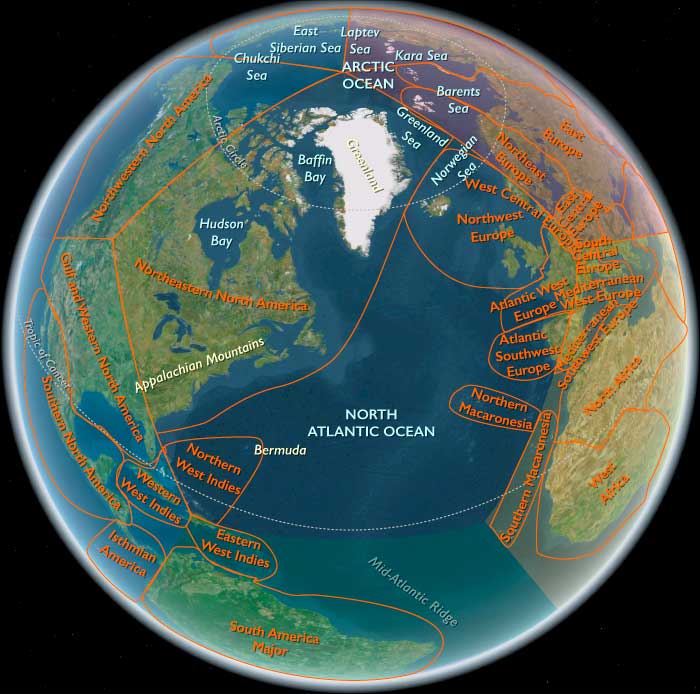
Northeastern North America
(1816 to 1827 CE): Expansion, Industrial Growth, and Rising Tensions
From 1816 to 1827, Northeastern North America experienced rapid territorial expansion, surging industrial and commercial activity, intensifying slavery, and escalating tensions with Indigenous peoples. Although the post-War of 1812 era appeared as a period of national unity—the so-called "Era of Good Feelings"—beneath the surface, profound sectional divisions deepened, driven by economic and cultural forces reshaping the continent.
Territorial Expansion and Military Incursions
Acquisition of Florida and the Gulf Coast
A series of aggressive U.S. military incursions into Spanish-held Florida, notably by General Andrew Jackson, culminated in Spain ceding Florida and Gulf Coast territories to the United States through the Adams-Onís Treaty (1819). This acquisition significantly enhanced American control along the southern frontier and eliminated a refuge for runaway slaves and hostile Indigenous groups.
Transportation Revolution and Infrastructure Development
Canals and the Rise of Steamboats
Expansion was greatly facilitated by revolutionary improvements in transportation. Steamboats now navigated major river systems, dramatically reducing travel times and fueling westward migration. The completion of the Erie Canal (1817–1825) linked New York City directly to the Great Lakes, stimulating unprecedented commercial growth. Similar projects, such as the Illinois and Michigan Canal (I&M), further integrated frontier economies with eastern markets, laying foundations for a unified national economy.
Early Railroads on the Horizon
Although still nascent in the 1820s, railroad construction would soon accelerate, promising even faster, cheaper, and more extensive transportation networks that would further transform the region’s economic landscape.
The Expansion of Slavery and the Cotton Economy
Cotton Boom and the Internal Slave Trade
Despite the 1808 federal prohibition of the international slave trade, the institution of slavery dramatically intensified due to the surging demand for cotton. After 1820, cotton cultivation exploded throughout the Deep South, particularly in the fertile Black Belt region. The cotton gin, invented earlier by Eli Whitney, made short-staple cotton profitable, significantly expanding slave labor.
With international slave imports banned, an internal slave market developed, selling enslaved persons from states such as Virginia and Maryland—where shifting agricultural practices had reduced labor needs—to rapidly expanding cotton plantations in the Deep South. Terms such as "breeding slaves," "child-bearing women," and "breeding period" emerged, reflecting an increasingly brutal commodification of enslaved people, driven by economic necessity and racial anxieties.
South Carolina’s Slave-Based Economy
South Carolina epitomized this expansion. By 1820, enslaved Africans made up nearly half the state’s population. The plantation elite solidified their power through stringent property and slave-ownership qualifications for political participation, reinforcing an economic and social hierarchy based explicitly on slavery.
The Asian and Maritime Fur Trade
American Involvement in Asian Markets
The lucrative Asian trade emerged as a crucial economic driver for the northeastern United States, especially for merchants based in Salem, Boston, Providence, New York, Philadelphia, and Baltimore. The maritime fur trade connected these ports to Asian markets such as Guangzhou (Canton), Kolkata (Calcutta), Chennai (Madras), Manila, Jakarta (Batavia), Mauritius, and Sumatra.
American merchants exported furs, rum, ammunition, ginseng, lumber, ice, salt, silver dollars, iron, tobacco, opium, and tar, while importing Asian commodities like silks, muslins, spices, cassia, porcelain, tea, sugar, and drugs.
Opium Trade and Wealth Accumulation
Bostonian entrepreneurs, including John Perkins Cushing (through his uncles’ firm, J. & T.H. Perkins), Samuel Russell (founder of Russell & Company, 1823), and John Jacob Astor, amassed immense wealth by smuggling Turkish opium into China, where its sale was prohibited. Protected by British naval strength, these American merchants entered this clandestine but lucrative trade, significantly influencing early American industrial capital accumulation.
Industrialization and Textile Manufacturing
Capital Shift: "From Wharf to Waterfall"
Profits from the declining maritime fur trade and Asian commerce provided capital that shifted from shipping ("wharf") to industrial textile production ("waterfall"). New England became the heart of the burgeoning textile industry, facilitated by ample waterpower. This industrialization reshaped the American economy, accelerating technological advancements and urban growth.
Demand for Cotton and Connection to Slavery
Textile manufacturing dramatically increased demand for Southern cotton, binding northern industrialists to southern slaveholders economically. This economic dependency reinforced slavery’s importance nationwide, deepening sectional divides over the institution and sowing the seeds of future conflict.
Frontier Expansion and Indigenous Conflict
Increased Westward Migration and Indigenous Displacement
American settlers poured westward into territories like Ohio, Indiana, Illinois, Kentucky, Tennessee, Missouri, and Alabama. This massive influx led to intensified conflict with Indigenous peoples, who fiercely resisted encroachment on their ancestral lands. Settlers often disregarded treaties, provoking confrontations that escalated violence and displacement.
Mandan, Hidatsa, and Plains Tribes
On the Northern Plains, Indigenous groups like the Mandan and Hidatsa suffered severely from epidemics, notably smallpox, dramatically reducing their populations and social cohesion. Meanwhile, tribes such as the Crow, Assiniboine, Sioux, Blackfeet, and Arikara engaged in fierce competition over territory, resources, and horse herds, reshaping tribal alliances and conflicts.
Social, Religious, and Cultural Developments
Second Great Awakening and Reform Movements
The Second Great Awakening (1790–1840) continued to thrive, especially in frontier regions. Revivalist meetings, such as the famous Cane Ridge Revival of 1801, spread evangelical Christianity widely, energizing reform movements including abolitionism, women’s rights, temperance, and education reform.
Emergence of Temperance Societies
Temperance advocates, responding to rising alcoholism and associated social problems, founded numerous societies urging moderation or abstinence, reflecting a growing concern for moral reform and social improvement.
Political Dynamics and National Identity
Era of Good Feelings and National Unity
Despite the period’s superficial harmony under President James Monroe (1817–1825), unresolved conflicts simmered beneath national unity. The Monroe Doctrine (1823) asserted U.S. dominance over Western Hemisphere affairs, reflecting growing confidence in American national identity and foreign policy aspirations.
Andrew Jackson and Populist Politics
General Andrew Jackson’s military successes, particularly in the First Seminole War and his broader aggressive frontier policies, increased his popularity among western settlers. His emergence foreshadowed a populist, frontier-oriented political realignment soon to challenge eastern elites.
The Legacy of this Era (1816–1827 CE)
Between 1816 and 1827, Northeastern North America underwent transformative change, marked by territorial expansion, accelerating industrial growth, intensified slavery, and escalating tensions over Indigenous displacement. The acquisition of new territories, the explosive growth of the cotton economy, and burgeoning industrialization—financed in part by the lucrative yet morally complex Asian opium and maritime fur trades—redefined American society.
Yet beneath apparent national unity lay deepening sectional tensions and moral contradictions, particularly over slavery. The era set the stage for intensifying conflicts as the United States continued its relentless westward push, ultimately shaping the course of its future development and sectional divisions for decades to come.
Some competition to the East India Company comes from the newly independent United States, whose citizens begins to compete in Guangzhou (Canton), selling Turkish opium there in the 1820s.
In this way, Bostonian sea merchant John Perkins Cushing acquires his wealth, under the employ of his uncles' business, J. & T. H. Perkins.
So, too, does Samuel Russell, who establishes Russell & Company in Boston in 1823.
The company's business involves acquiring opium from Turkey and smuggling it into China, where it is prohibited, under armed protection of the British.
Opium trader Samuel Wadsworth Russell, born in Middletown, Connecticut and orphaned at the age of twelve, had neither received any significant inheritance nor attended college.
Instead, he had begun his career as apprentice clerk for a maritime trade merchant, Whittlesley & Alsop, in Middletown, Connecticut, where he had begun learning his skills as a trader.
In 1810, his apprenticeship having ended, he had moved to New York where he hoped to prosper.
In 1812, he had joined Hull & Griswold, a merchant house based in New York but established by investors with family ties in Connecticut.
He had begun traveling on company ships as supercargo and soon began trading on a commission basis, which had enabled him to found his first company, Russell & Company, a commission trader for Hull & Griswold, in his hometown of Middletown, Connecticut.
Attracted by financial prospects, Russell had set out for China, an assured profitable venture.
He had arrived in Canton, China, in 1819, engaging in trade on behalf of the Providence firm of Edward Carrington & Company in various goods and products including opium, an extremely profitable activity despite being outlawed—yet protected by foreign forces.
The profits made by Russell had enabled him to found Russell & Company in Canton, China, in 1824.
Dealing mostly in silks, teas and opium, Russell & Company has prospered, and in 1830, buys out the Perkins opium syndicate, the source of wealth for the Cabot, Cushing, Forbes, Higginson, Lowell and Sturgis families.
Under the auspices of the Russell Company and its British protectors, Connecticut is to become the U.S. center of the opium trade.
Other families involved with Russell include the Coolidges, Delanos, Forbeses, and Sturgises of Massachusetts, the Alsops of Connecticut, and the Lows of New York.
William H. Russell, second cousin to Russell and Company founder Samuel Russell, founds the Skull and Bones secret society at Yale University in 1832, reportedly drawing inspiration from the Skull and Bones pirate flag.
Know initially as The Brotherhood of Death, "The Order" is formed as an outcome of the old debating societies, Linonia, Brothers in Unity, and Calliope.
The direct cause is a dispute over the Phi Beta Kappa awards.
The Port of Shanghai is opened to foreign trade for the first time on November 17, 1843.
Britain’s Jardine, Matheson & Co. rents the port’s first lot; American Samuel Russell, representing Baring Brothers, rents other lots.