Saint Peter
Christian leader and missionary
Years: 5 - 67
Saint Peter or Simon Peter is an early Christian leader and one of the twelve apostles of Jesus who is featured prominently in the New Testament Gospels and the Acts of the Apostles and who is venerated as a saint.
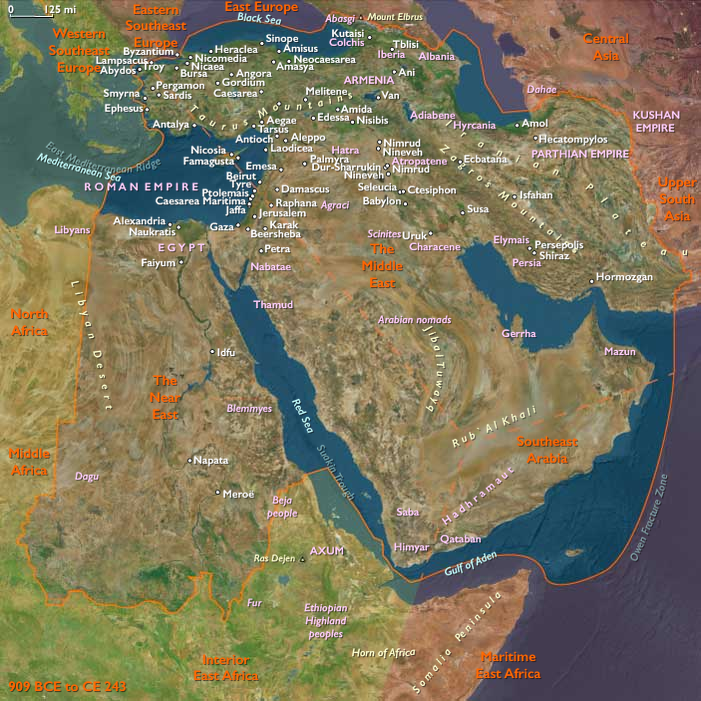
The son of John or of Jonah, he is from the village of Bethsaida in the province of Galilee or Gaulanitis.
His brother Andrew is also an apostle.
Peter is venerated in multiple churches and is regarded as the first Pope by the Catholic Church.
After working to establish the church of Antioch, presiding for seven years as the leader of the city's Christian community, he preaches to scattered communities of believers, Jews, Hebrew Christians and the gentiles.
He then goes to Rome, where he is said to have been put to death at the hand of Emperor Nero.
Peter wrote two General epistles.
The Gospel of Mark is also ascribed to him (as Mark was his disciple and interpreter).
On the other hand, several books bearing his name—the Acts of Peter, Gospel of Peter, Preaching of Peter, Revelation of Peter, and Judgement of Peter—are rejected by the Catholic Church as Apocryphal.
According to New Testament accounts, Peter was one of Twelve Apostles chosen by Jesus from his first disciples.
Originally a fisherman, he was assigned a leadership role by Jesus and was with Jesus during events witnessed by only a few Apostles, such as the Transfiguration.
Cephas (Aramaic) and Peter (Greek) both mean "rock."
Peter confessed Jesus as the Messiah (Matthew 16:16), was part of Jesus' inner circle (Mark 5:37), walked on water (Matthew 14:29), witnessed Jesus' tranfiguration (Luke 9:28), denied Jesus (Luke 22:54-62), was restored by Jesus (John 21:15-19), and preached at Pentecost (Acts 2:14-40).
Peter is said to have been crucified under Emperor Nero, the cross being upside down at his own request since he saw himself unworthy to be crucified in the same way as Jesus Christ.
Catholic tradition holds that Saint Peter's mortal bones and remains are contained in the underground Confessio of the St. Peter's Basilica, a site where Pope Paul VI announced the excavation discovery of a First-century A.D. Roman cemetery in 1968.
Since 1969, a life-size statue of Saint Peter is crowned every year in St. Peter's Basilica with a Papal Tiara, Ring of the Fisherman, and papal vestments every June 29th, commemorating the Holy Feast of Saints Peter and Paul.