Saint Margaret of Scotland
Queen consort of Scotland
Years: 1045 - 1093
Saint Margaret of Scotland (c. 1045 – 16 November 1093), also known as Margaret of Wessex and Queen Margaret of Scotland, is an English princess of the House of Wessex.
Margaret is sometimes called “The Pearl of Scotland”.
Born in exile in Hungary, she is the sister of Edgar Ætheling, the short-ruling and uncrowned Anglo-Saxon King of England.
Margaret and her family return to England in 1057, but flee to the Kingdom of Scotland following the Norman conquest of England of 1066.
Around 1070, Margaret marries Malcolm III of Scotland, becoming his queen consort.
She is a pious woman, and among many charitable works she establishes a ferry across the Firth of Forth for pilgrims traveling to Dunfermline Abbey, which gives the towns of South Queensferry and North Queensferry their names.
Margaret is the mother of three kings of Scotland and a queen consort of England.
According to the Life of Saint Margaret, attributed to Turgot of Durham, she dies at Edinburgh Castle in 1093, just days after receiving the news of her husband's death in battle.
In 1250, she is canonized by Pope Innocent IV, and her remains are reinterred in a shrine at Dunfermline Abbey.
Her relics are dispersed after the Scottish Reformation and subsequently lost.
Related Events
Filter results
Showing 10 events out of 10 total
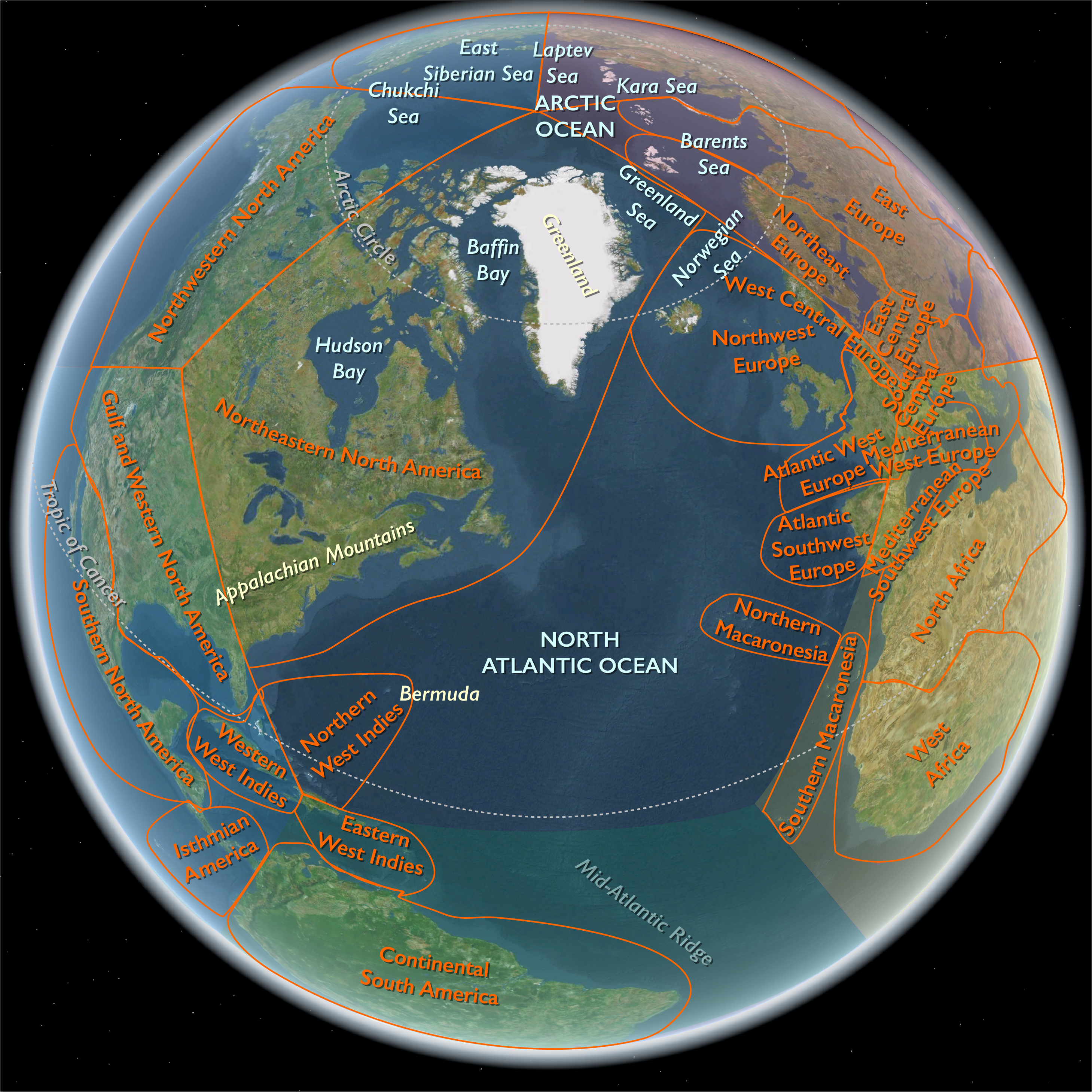
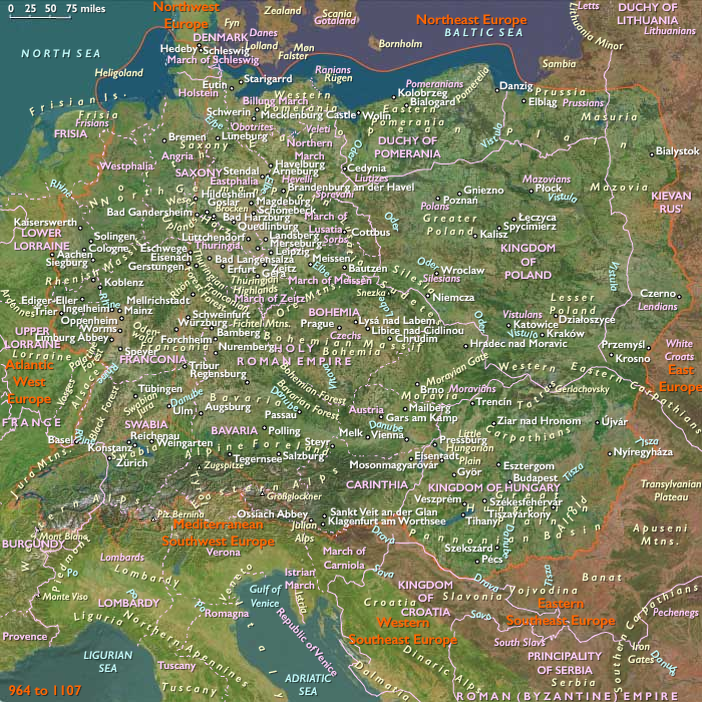
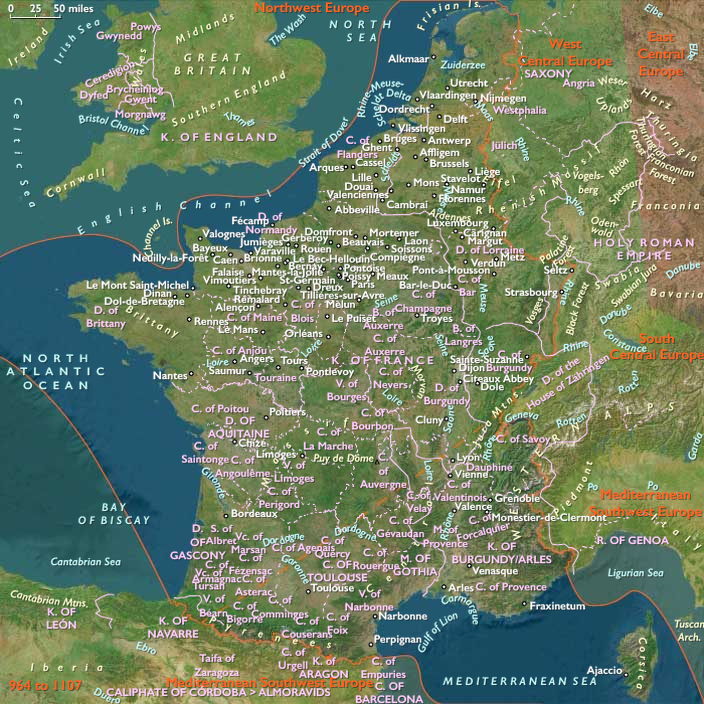
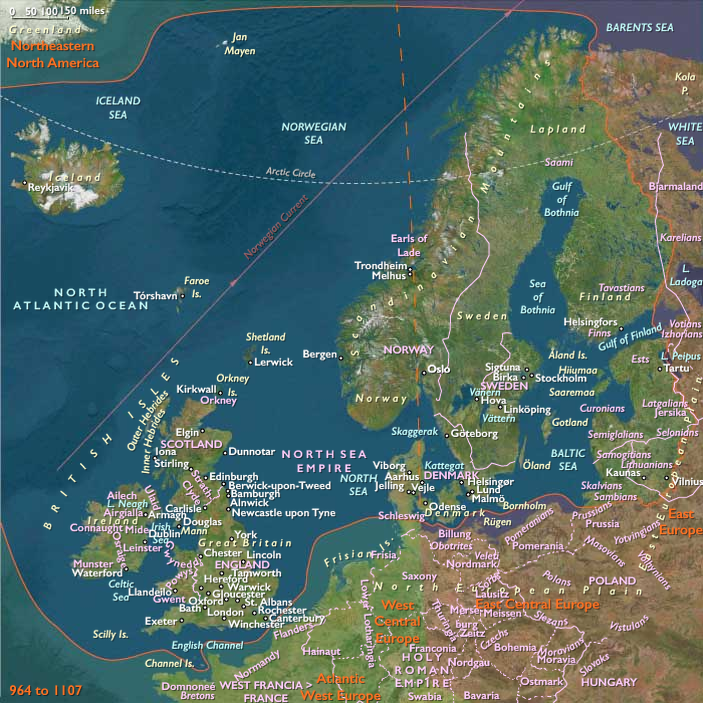
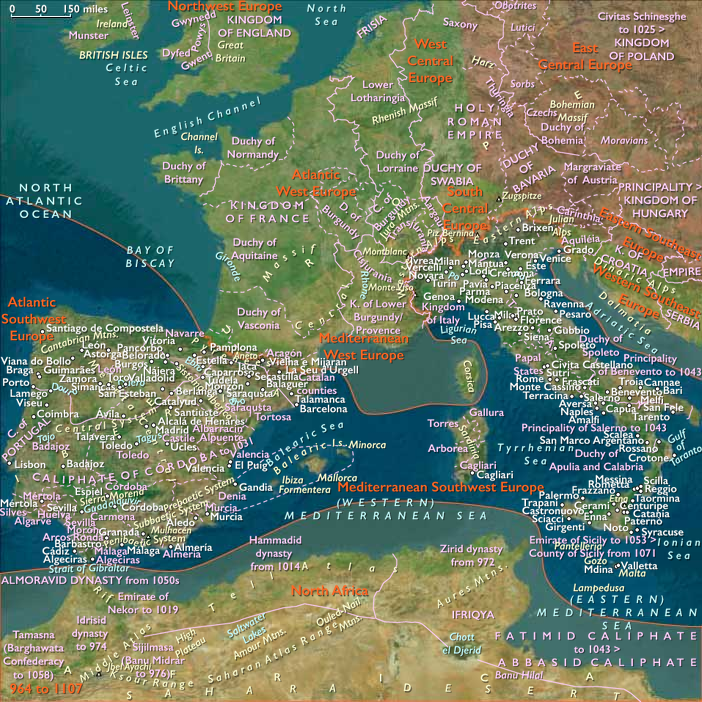
Northwest Europe (1060–1071 CE): The Norman Conquest and Political Transformation
England: The Norman Conquest
The defining event of this era was the Norman Conquest of England (1066). The claim of William II, Duke of Normandy, to the English throne derived from his familial relationship with the childless Anglo-Saxon king, Edward the Confessor, who may have encouraged William’s royal hopes.
Edward died in January 1066, and was succeeded by his powerful brother-in-law, Harold Godwinson, crowned as Harold II. Almost immediately, Harold faced two simultaneous invasions:
In September, the Norwegian king Harald Hardrada invaded northern England, achieving a significant victory at the Battle of Fulford (September 20). However, Harold II swiftly marched north, confronting and decisively defeating Hardrada at the Battle of Stamford Bridge (September 25, 1066), where both Hardrada and Harold’s estranged brother Tostig Godwinson were slain.
Within days, William of Normandy—later called William the Conqueror—landed near Pevensey in southern England, commanding a substantial army comprising Norman, Breton, and other Continental soldiers. Harold quickly marched south to meet William, though a significant portion of his exhausted army remained behind in the north. The armies clashed at the pivotal Battle of Hastings (October 14, 1066). William's forces triumphed; Harold II was killed during the engagement, dramatically shifting the course of English history. William was crowned as King William I of England on Christmas Day, 1066.
William’s reign (1066–1087) transformed England’s political, social, and cultural landscape. Norman-French language, feudal customs, and continental ecclesiastical reforms reshaped English society. Resistance persisted, notably during the brutal Harrying of the North (1069–1070), when William suppressed widespread rebellions with devastating severity.
Scotland: Consolidation Under Malcolm III
In Scotland, Malcolm III Canmore (r. 1058–1093) solidified his power after the defeat of Macbeth. Malcolm offered refuge to Anglo-Saxon exiles fleeing Norman rule, notably through his marriage in 1070 to Margaret of Wessex, sister of Edgar Ætheling, Edward the Confessor’s closest blood relative. Margaret’s arrival significantly shaped Scottish culture and religious practice, reinforcing ties between Scotland and England and bringing Scottish Christianity closer to continental Roman traditions.
Malcolm III supported English rebellions against Norman rule, maintaining Scotland’s distinct political identity and complicating Norman attempts to dominate all of Britain.
Ireland: Fragmentation and Norse-Gaelic Settlements
Ireland remained politically fragmented through this era. Regional kingdoms maintained frequent rivalries and conflicts. Norse-Gaelic towns, such as Dublin, Waterford, Wexford, and Limerick, prospered as independent mercantile hubs. Integration between the Norse settlers and native Irish elites laid foundations for Ireland’s complex socio-political future.
Denmark and Norway: Shifting Power Dynamics
Scandinavia experienced significant changes following Harald Hardrada’s death in 1066. His sons, Magnus II and Olaf III (Olaf Kyrre), inherited a divided Norway, initiating a period of internal stability and reduced foreign military ventures. Olaf III notably established Bergen as a major trading port, enhancing Norway’s commercial prominence.
In Denmark, Sweyn II Estridsson (r. 1047–1076) consolidated his rule through internal administrative and ecclesiastical reforms. He supported repeated, though ultimately unsuccessful, invasions of England (1069–1070) in alliance with Anglo-Saxon rebels against William’s regime.
Iceland and Norse Atlantic Settlements
Iceland maintained stable governance via the Althing, and its cultural and religious life flourished. The era saw increased manuscript production, preserving sagas, histories, and genealogies. The Norse settlements in the Faroe Islands, Orkney, and Shetland likewise thrived as crucial maritime centers facilitating trade and cultural exchange across Northwest Europe.
Religious and Cultural Transformations
The Norman Conquest profoundly reshaped England’s ecclesiastical structures. Norman bishops and abbots promoted continental monastic reforms, aligning English Christianity more closely with broader Gregorian reform movements.
In Scotland, Queen Margaret’s influence enhanced ecclesiastical connections to Rome, initiating significant religious renewal and reform in Scottish churches and monastic foundations.
Legacy of the Era
By 1071 CE, Northwest Europe had undergone profound political and cultural transformations. The Norman Conquest reshaped England, introducing lasting linguistic and social changes. Scotland under Malcolm III embraced both indigenous and Anglo-Saxon influences, strengthening its distinct cultural and political identity. Norway and Denmark experienced a shift toward internal stability and commercial prosperity, while Ireland continued its fragmented yet culturally vibrant existence. Iceland and the Norse Atlantic communities preserved robust trade networks and cultural traditions.
This critical period established foundations that would profoundly shape medieval Europe’s political, cultural, and religious landscape.
Malcolm III of Scotland had given sanctuary to Tostig Godwinson when the Northumbrians drove him out, but he had not been directly involved in the ill-fated invasion of England by Harald Hardrada and Tostig in 1066, which had ended in defeat and death at the battle of Stamford Bridge.
He had granted asylum in 1068 to a group of English exiles fleeing from William of Normandy, among them Agatha, widow of Edward the Confessor's nephew Edward the Exile, and her children: Edgar Ætheling and his sisters Margaret and Cristina.
They were accompanied by Gospatric, Earl of Northumbria.
The exiles were disappointed, however, if they had expected immediate assistance from the Scots.
The exiles had returned to England in 1069 to join a spreading revolt in the north.
Even though Gospatric and Siward's son Waltheof had submitted by the end of the year, the arrival of a Danish army under Sweyn Estridsson seemed to ensure that William's position remained weak.
Malcolm decides on war, and takes his army south into Cumbria and across the Pennines, wasting Teesdale and Cleveland then marching north, loaded with loot, to Wearmouth.
Here Malcolm meets Edgar and his family, who are invited to return with him, but do not.
As Sweyn had by now been bought off with a large Danegeld, Malcolm takes his army home.
In reprisal, William sends Gospatric to raid Scotland through Cumbria.
In return, the Scots fleet raids the Northumbrian coast where Gospatric's possessions are concentrated.
Edgar and his family, perhaps shipwrecked on their way to a European exile, late in the year again arrive in Scotland, this time to remain.
Malcolm by the end of 1070 has married Edgar's sister Margaret of Wessex, the future Saint Margaret of Scotland.
She will introduce a powerful English influence into the country.
William defeats the last rebellion of the north in 1071.
Earl Edwin is betrayed by his own men and killed, while …
…William builds a causeway to subdue the Isle of Ely, where Hereward the Wake and Morcar are hiding.
Hereward escapes, but Morcar is captured, deprived of his earldom, and imprisoned.
Hereward becomes a fugitive after the Normans conquer the region in 1071, and disappears into legends and ballads.
Malcolm III of Scotland, who had lived in England until the Norman Conquest of 1066, becomes, after 1068, a supporter of the claim of his brother-in-law, the Saxon pretender Edgar the Atheling, to the English throne.
Seeking to take advantage in 1070-71 of the unfixed borders between England and Scotland, he had invaded Northumberland and Cumberland.
William I is temporarily unable to respond, as political problems during the winter of 1071-72 require his presence in Normandy.
Northwest Europe (1072–1083 CE): Norman Consolidation and Regional Stabilization
England: Consolidation of Norman Rule
Following the turbulent years after the Norman Conquest, William the Conqueror (r. 1066–1087) spent the decade 1072–1083 further consolidating his control over England. Though his main rivals had been eliminated by 1072, William still faced scattered rebellions and resistance. The lands of the resisting English elite were confiscated, leading many of these elites to flee into exile. To secure control, William redistributed these lands among his followers and built numerous castles, including prominent fortifications such as the Tower of London and Windsor Castle, to establish military strongpoints across the country.
Other profound changes included the introduction of Norman French as the language of the elite, transformations in the composition of the upper classes through feudal landholding directly from the king, and alterations at court and in government administration. However, many Anglo-Saxon forms of government persisted, as the Norman administrators largely adopted pre-existing structures. Gradual transformations affected agricultural communities, notably the formal elimination of slavery—though the direct connection to the invasion remains unclear.
An unusually large number of free peasants, known as "sokemen", notably distinct from serfs, were concentrated in the region of the Danelaw, possibly descendants of earlier Danish settlers. The Norman Conquest proved pivotal, linking England more closely with continental Europe, significantly reducing Scandinavian influence, creating a powerful monarchy, introducing sophisticated governance, and transforming English language and culture. It also established an enduring rivalry with France that persisted for the next millennium.
Scotland: Strengthening of Malcolm III and Margaret’s Influence
In Scotland, Malcolm III Canmore (r. 1058–1093) further solidified his rule, sheltering English refugees fleeing Norman dominance. Alongside Queen Margaret of Wessex, Malcolm fostered cultural and political ties with England. Margaret promoted ecclesiastical reforms, reshaped Scottish religious practices, and encouraged monastic and educational advancements, creating a culturally vibrant Scottish court.
Ireland: Norse-Gaelic Stability and Regional Rivalries
Ireland remained politically fragmented, with Norse-Gaelic cities, especially Dublin, experiencing stability and commercial growth. Norse-Irish rulers increasingly intermarried with prominent Irish families, contributing to cultural integration despite ongoing local rivalries.
Denmark and Norway: Internal Strengthening and Economic Development
In Denmark, Sweyn II Estridsson (r. 1047–1076) stabilized royal authority and encouraged church reforms. After Sweyn’s death in 1076, his son Harald III Hen (r. 1076–1080) emphasized peaceful governance and monetary reform, succeeded by Canute IV (Saint Canute) in 1080, who furthered ecclesiastical policies and centralization.
In Norway, King Olaf III Kyrre (r. 1067–1093) maintained internal peace and economic prosperity, notably establishing Bergen as a significant North Sea trading hub.
Iceland and North Atlantic Norse Settlements: Cultural Flourishing
Iceland's Althing ensured political stability, fostering cultural activities like manuscript production and the preservation of Norse sagas and histories. Norse settlements in the Faroe Islands, Orkney, and Shetland similarly thrived, integral to North Atlantic trade networks.
Religious and Cultural Developments
The Roman church consolidated its influence through the broader Gregorian reforms, founding new monasteries and abbeys across England and Scotland. Under Queen Margaret, Scotland embraced continental Christianity, enhancing religious uniformity.
Legacy of the Era
By 1083 CE, Northwest Europe entered relative stability after significant political shifts. The Norman Conquest reshaped England, transforming its social structure, language, and culture while strengthening monarchical power. Scotland solidified its identity under Malcolm III and Margaret’s rule, while Denmark, Norway, Ireland, and the Norse Atlantic communities flourished culturally and economically. These changes profoundly influenced medieval Europe's subsequent political, cultural, and religious trajectories.
William the Conqueror returns from Normandy in the spring of 1072 and marches his forces through Northumberland and Lothian, confronting the Scots king Malcolm III at Abernathy.
Malcolm, declining to offer battle, acknowledges William’s suzerainty and pays homage, probably giving up his son Duncan as a hostage for the peace.
Perhaps another stipulation of the treaty is the expulsion of Edgar the Ætheling, Malcolm’s brother-in-law, from the Scottish court; he leaves Scotland to seek refuge in Flanders.
Northwest Europe (1084–1095 CE): Dynastic Shifts and Ecclesiastical Expansion
England: Succession and Continued Norman Control
Following the death of William the Conqueror in 1087, England faced significant succession challenges. William divided his realms among his sons: his eldest, Robert Curthose, inherited Normandy; his second son, William Rufus (William II, r. 1087–1100), became king of England. William Rufus consolidated his power swiftly, suppressing rebellions and firmly maintaining Norman rule. His reign, however, was marked by tensions with both the nobility and the church, particularly concerning royal rights over ecclesiastical appointments and revenues.
William Rufus’s reign saw the continued expansion and fortification of Norman castles and infrastructure. However, his strained relationship with the Church, notably with Anselm, Archbishop of Canterbury, highlighted growing conflicts over ecclesiastical independence, foreshadowing later struggles between Church and Crown.
Scotland: The End of Malcolm III’s Reign
Scotland witnessed the end of an influential era with the deaths of Malcolm III and Queen Margaret in 1093. Malcolm’s reign had significantly strengthened Scottish unity and identity, largely due to Margaret’s cultural and religious influence. Their deaths led to a period of instability marked by internal struggles over succession among their sons and continued border conflicts with England.
Ireland: Urban and Commercial Growth
Ireland continued to experience relative stability, with Norse-Gaelic towns like Dublin, Waterford, and Limerick further developing as commercial and trade centers. These settlements continued to blend Norse and Gaelic cultural elements, enhancing urbanization and trade networks that connected Ireland more closely to continental Europe.
Denmark and Norway: Centralization and Ecclesiastical Influence
In Denmark, King Canute IV (Saint Canute, r. 1080–1086) attempted to centralize royal power and enforce the authority of the church, resulting in increased tensions with the nobility. His efforts culminated in rebellion, and he was killed in 1086 at the Church of St. Alban in Odense. He was succeeded by his brother, Olaf I Hunger (r. 1086–1095), whose reign was marked by famine and internal instability.
Norway, under King Olaf III Kyrre (r. 1067–1093), enjoyed relative peace, and Olaf’s policies fostered prosperity, particularly in trading centers like Bergen. Upon his death in 1093, Olaf was succeeded by his son Magnus III Barefoot (r. 1093–1103), who pursued an aggressive expansionist policy, notably towards the Hebrides and the Irish Sea.
Iceland and North Atlantic Norse Settlements: Continued Prosperity
Iceland’s Althing remained stable, further strengthening the island’s political and cultural life. Literary and scholarly activities continued to thrive, preserving Norse heritage. The Norse settlements of the Faroe Islands, Orkney, and Shetland experienced continued economic growth and prosperity, benefiting from increased trade within North Atlantic networks.
Religious and Cultural Developments
The ecclesiastical landscape of Northwest Europe continued to evolve significantly. England experienced tension between royal authority and Church autonomy, reflecting broader European conflicts linked to the Gregorian reforms. In Scotland, despite political upheaval following the deaths of Malcolm III and Margaret, the religious reforms and monastic foundations they established continued to influence Scottish society profoundly.
Legacy of the Era
By 1095 CE, Northwest Europe had witnessed significant dynastic changes and continued ecclesiastical expansion. England’s Norman monarchy was firmly entrenched despite succession challenges and ecclesiastical disputes. Scotland entered a period of uncertainty following the deaths of Malcolm III and Margaret, shaping its future political landscape. Ireland enjoyed stable urban growth, while Denmark and Norway navigated internal tensions and leadership shifts. Iceland and North Atlantic communities continued cultural and economic prosperity. This era set the stage for ongoing tensions between secular and ecclesiastical powers that characterized much of the subsequent medieval period.
The events leading up to the next invasion are unclear, but in November 1093, Malcolm leads an army into Northumbria and begins to besiege Alnwick.
Malcolm is accompanied by Edward, his eldest son by Margaret and probable heir-designate (or tánaiste), and by Edgar.
Even by the standards of the time, the ravaging of Northumbria by the Scots is seen as harsh.
At this time, Robert de Mowbray is Earl of Northumbria, having been pardoned following his part in the Rebellion of 1088, against William II.
He is also governor of Bamburgh Castle, a stronghold on the Northumbrian coast.
Mowbray does not have a sufficient force at his command to oppose the Scottish army in open battle.
However, he sets out to try to relieve Alnwick.
He arrives here with his forces on November 13 (known as St. Brice’s Day) and catching the Scottish army by surprise, the English knights attack them before the ramparts of Alnwick.
While marching north again, Malcolm is ambushed near Alnwick on November 13, 1093, by Robert de Mowbray, whose lands he has devastated.
Here he is killed by Arkil Morel, steward of Bamburgh Castle.
The conflict becomes known as the Battle of Alnwick.
Edward is mortally wounded in the same fight.
With Malcolm’s death, the Scottish army finds itself leaderless, and heads back to Scotland.
Malcolm's body is taken to Tynemouth Priory for burial.
The king's body is sent north for reburial, in the reign of his son Alexander, at Dunfermline Abbey, or possibly Iona.
Malcolm’s death is soon followed by that of his queen, Margaret of Wessex, just days after receiving the news of her husband's death in battle.
The death of Malcolm and his heir means that there is a dispute over the succession between Malcolm’s surviving sons and his younger brother Donald Bane.
Donald's activities during the reign of his elder brother Malcolm III (Máel Coluim mac Donnchada) are not recorded.
It appears that he was not his brother's chosen heir, contrary to earlier custom, but that Malcolm had designated Edward, his eldest son by Margaret of Wessex, as the king to come If this was Malcolm's intent, his death and that of Edward have confounded his plans.
John of Fordun reports that Donald invaded the kingdom after Margaret's death "at the head of a numerous band", and laid siege to Edinburgh with Malcolm's sons by Margaret inside.
Fordun has Edgar Ætheling, concerned for his nephews' well-being, take the sons of Malcolm and Margaret—Edmund and his younger brothers Edgar, Alexander and David—to England.
Andrew of Wyntoun's much simpler account has Donald become king and banish his nephews.
The Anglo-Saxon Chronicle records only that Donald was chosen as king and expelled the English from the court.
The event allows Duncan, the eldest son of Malcolm and his first wife Ingibiorg Finnsdottir, given over as a hostage by his father in 1072, to lay claim to the throne.
In his attempt to depose his uncle, he has the support of William II, in exchange of an oath of fealty to his patron.
Duncan’s father, who had many sons, appears to have made no effort to obtain Duncan's return.
He had been raised in the Anglo-Norman court of William I, becoming familiar with the culture, education, and institutions of his hosts.
Trained as a Norman knight, he had participating in the campaigns of William I.
According to Florence of Worcester, in 1087, when William I died, and his eldest surviving son Robert Curthose succeeded him as Duke of Normandy, Robert released Duncan from custody and had him officially knighted.
Allowed to leave the Duchy of Normandy, Duncan chose to join the court of Robert’s younger brother William Rufus.
Edward, the eldest paternal, half-brother of Duncan had been designated heir in his absence.
Duncan had notably chosen to stay with his adoptive culture, partly due to the influence of fifteen years of Norman life, partly in pursuit of personal wealth and glory.
Donald III has been unable to gain the support of certain landowners and church officials of the Scottish Lowlands, who had ties to the regime of his predecessor.
Duncan takes advantage, negotiating alliances with these disgruntled supporters of his fathers.
Gaining essential military and financial support for his cause.
While William II himself has no intention to join in the campaign, he lends Duncan part of the Norman army.
Duncan is able to recruit further levies from local barons and towns of England, and buys support with promises of land and privilege, estates and title.