Rudolph of France
King of Western Francia
Years: 880 - 936
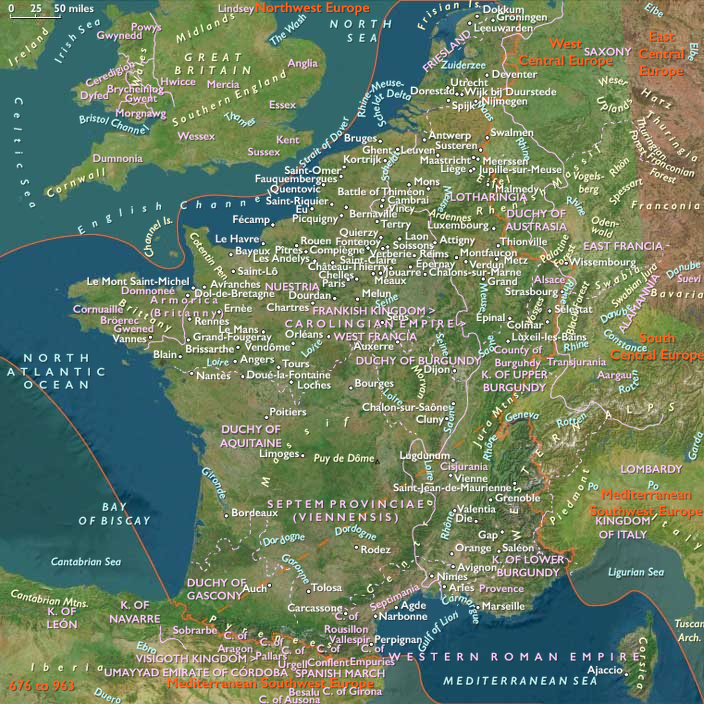
Rudolph (also Radulf, Ralph, or Raoul) (c. 880/890 – 14/15 January 936) is the Duke of Burgundy between 921 and 923 and King of West Francia after that date until his death.
Hugh is the son of Duke Richard of Autun and Adelaide of Auxerre, and has inherited the Duchy of Burgundy from his father, also known as Richard the Justiciar.
He marries Emma of France, daughter of Robert I of France and Béatrice of Vermandois.

Related Events
Filter results
Showing 10 events out of 34 total
Atlantic West Europe (916–927): Emergence of Regional Powers and Continued Carolingian Decline
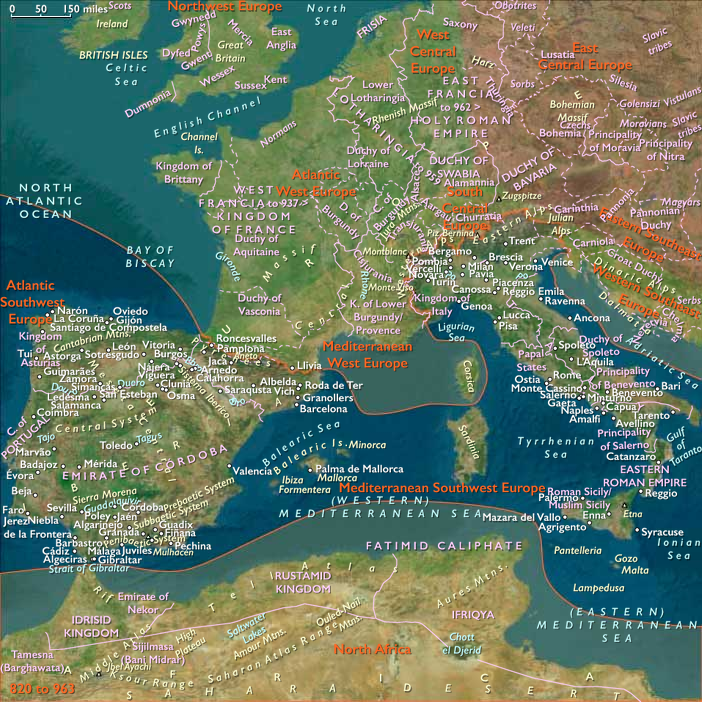
Between 916 and 927, Atlantic West Europe witnessed the continued erosion of Carolingian royal authority, the consolidation and expansion of regional powers, especially Normandy, Flanders, Aquitaine, Anjou, and the Burgundian kingdoms, and the beginnings of political stabilization following the era of Viking raids.
Political and Military Developments
-
West Francia: Enduring Instability
- King Charles the Simple (r. 898–922) struggled against increasingly powerful nobles, ultimately losing his throne after being deposed in 922, leading to civil unrest and further fragmentation of royal power.
- Robert I, count of Paris, briefly became king (922–923) but was killed in battle against Charles’ supporters; Rudolph of Burgundy succeeded him, bringing Burgundy into a more prominent political role in West Francia.
-
Normandy: Consolidation under Rollo
- Duke Rollo (r. 911–927) successfully transformed the Viking-controlled territory into the stable Duchy of Normandy, integrating local populations and establishing Rouen as a major center of power and trade.
-
Flanders and Anjou: Strengthening Territorial Control
- Arnulf I of Flanders (r. 918–965) solidified territorial gains, enhancing Flanders' military and economic capabilities, particularly through fortifications and expanding trade networks.
- In Anjou, Fulk I the Red (r. 898–942) reinforced his authority through strategic marriages and aggressive territorial expansion along the Loire.
-
Aquitaine: Stability and Cultural Patronage
- William II of Aquitaine (r. 918–926) continued his predecessor's efforts, reinforcing regional governance, supporting religious institutions, and providing stability in southern and western France.
-
Upper and Lower Burgundy: Internal Stability
- Rudolph II of Upper Burgundy (r. 912–937) managed internal stability, while Lower Burgundy (Provence) under Louis the Blind (until 928) experienced weakening central control, allowing regional nobles greater independence.
Economic and Social Developments
-
Growth of Regional Economies
- Economic revival was evident, particularly in Normandy, Flanders, and Aquitaine, where stability fostered agricultural improvements, trade expansion, and urban growth.
- Rouen, Bruges, Tours, and Nantes strengthened their roles as commercial hubs and fortifications, benefiting from growing local markets and increased political stability.
-
Integration of Viking Settlers
- In Normandy, the integration of Norse settlers encouraged agricultural and commercial development, leading to improved economic conditions and increased cultural blending with local Frankish populations.
Religious and Cultural Developments
-
Expansion of Cluniac Influence
- The Abbey of Cluny, founded in 910, significantly increased its influence, promoting monastic reform and religious independence, particularly across Burgundy, Aquitaine, and the Loire Valley.
-
Monastic and Scholarly Revival
- Monastic centers continued to preserve classical and religious manuscripts, supporting early signs of intellectual revival and education, especially in prominent monasteries like Saint-Martin of Tours and Cluny Abbey.
Legacy and Significance
By 927, Atlantic West Europe was increasingly characterized by powerful regional principalities rather than centralized royal control:
- The weakening Carolingian monarchy ceded practical authority to regional rulers in Normandy, Flanders, Anjou, Aquitaine, and Burgundy.
- The Duchy of Normandy firmly established itself, foreshadowing its later expansionist role, notably the Norman conquest of England in the following century.
- Regional economic stabilization, particularly through revived trade and fortified towns, paved the way for the urban revival of the High Middle Ages.
- Cluniac monasticism deepened religious reform and cultural vitality, significantly shaping medieval European spirituality.
This era set critical foundations for the political, economic, and cultural contours that defined Atlantic West Europe through the High Middle Ages.
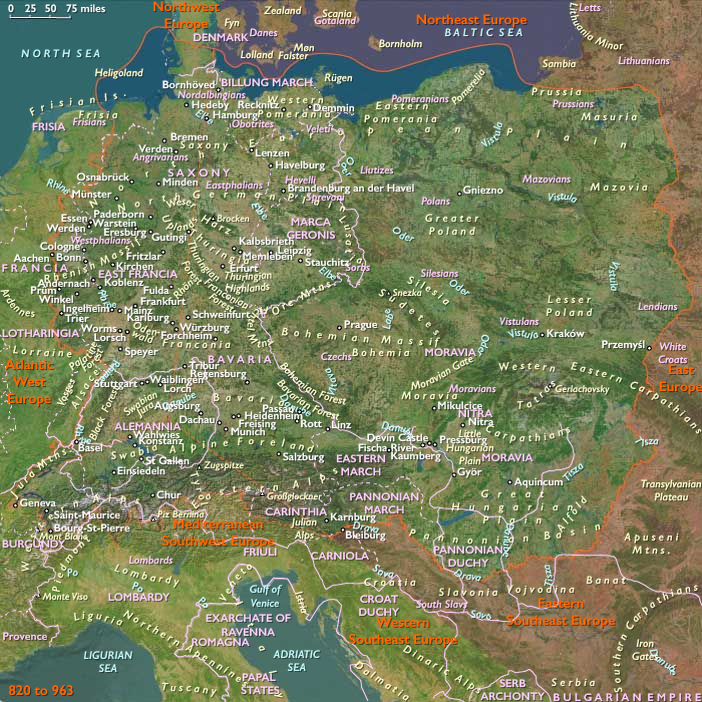
The Magyars raid Alsace in 917.
Toulouse had by the end of the ninth century become the capital of an independent county, the county of Toulouse, ruled by the dynasty founded by Frédelon, who in theory was under the sovereignty of the king of France, but in practice was totally independent.
The counts of Toulouse had had to fight to maintain their position at first.
They were mostly challenged by the dynasty of the counts of Auvergne, ruling over the northeastern part of the former Aquitaine, who claimed the county of Toulouse as their own, and even temporarily ousted the counts of Toulouse from the city of Toulouse.
However, in the midst of these Dark Ages, the counts of Toulouse had managed to preserve their own, and unlike many local dynasties that disappeared, have achieved survival.
Their county is just a small fraction of the former Aquitaine, the southeastern part of it, in fact.
However, at the death of Count William the Pious of Auvergne (Guillaume le Pieux) in 918, they had come into the possession of Gothia, which had been in the family of the counts of Auvergne for two generations.
Thus, they have more than doubled their territory, once again reuniting Toulouse with the Mediterranean coast from Narbonne to Nîmes.
The county of Toulouse takes its definitive shape, from Toulouse in the west to the Rhone River in the east, a unity that will survive until the French Revolution as the province of Languedoc.
Toulouse will never again be part of the Aquitaine polity, whose capital in later times will become Poitiers, then Bordeaux.
At first though, the memories of Aquitaine live strong in Toulouse.
A sign of William's independence of rule in Aquitaine is that he had a deniers minted in his own name at Brioude.
He is buried in the monastery of Saint-Julien there.
He had no sons of his own and is succeeded by a nephew, William the Younger, son of his sister Adelinda and Acfred I of Carcassonne.
Magyar Raid on Alsace (917): The Eastern Frankish Kingdom Under Attack
In 917, the Magyars, nomadic warriors from the Hungarian plains, launch a raid into Alsace, continuing their devastating incursions into East Francia. This attack is part of a broader wave of Magyar invasions that threaten the crumbling Carolingian realm in the early 10th century.
Context: The Magyar Raids into East Francia
- The Magyars had emerged as a dominant force in Central Europe, taking advantage of the fragmentation of East Francia following the death of Louis the Child (911).
- Lacking a strong central ruler, East Francia was vulnerable to external attacks, and the Magyars frequently raided into Bavaria, Swabia, and Lotharingia.
- The raid on Alsace in 917 follows previous incursions into Germany, Italy, and Burgundy, as the Magyars exploit weak defenses along the Rhine frontier.
The Raid on Alsace
- The Magyars, known for their swift horse-mounted warfare, penetrate deep into Alsace, targeting towns, monasteries, and trade routes.
- The raiders plunder villages and religious sites, taking slaves and loot before retreating to their strongholds in the Hungarian plains.
- The East Frankish nobility struggles to mount a coordinated defense, as the kingdom is divided among powerful dukes, each focused on securing their own territories.
Consequences of the 917 Magyar Raid
-
Continued Weakness of East Francia
- The raid highlights the vulnerability of the eastern frontier, as local rulers fail to repel the invaders effectively.
- The Carolingian system of decentralized rule makes a unified military response difficult, allowing the Magyars to raid almost at will.
-
The Need for Stronger Defenses
- The attacks lead to greater reliance on local ducal leadership, particularly in Bavaria, Swabia, and Franconia, which begin to fortify their regions.
- This foreshadows the rise of the Ottonian dynasty, which will later develop military strategies to counter the Magyar threat.
-
Prelude to Further Magyar Raids
- The Magyar raid of 917 is one of many incursions into East Francia and signals continued instability in the region.
- Their attacks will intensify throughout the 920s and 930s, culminating in the Battle of Lechfeld in 955, where they will finally be defeated by Otto I of Germany.
Conclusion: The Growing Magyar Threat
The 917 raid on Alsace demonstrates the ongoing weakness of the East Frankish kingdom, which is unable to effectively resist the Magyars. The fragmentation of Carolingian authority ensures that these raids will continue, pushing East Francia toward military reform and centralized ducal leadership, ultimately paving the way for the rise of the Holy Roman Empire.
The Fall of Charles the Simple and the Rise of Rudolph of Burgundy (923)
The struggle for control of West Francia reaches a turning point in 923, as Charles the Simple attempts to reclaim his throne from the usurper Robert I, leading to a decisive battle near Soissons. Despite Charles’ military success, the political landscape shifts against him, resulting in his capture and imprisonment, while Rudolph of Burgundy is elected king.
Failed Diplomacy: The Treaty of Bonn and Henry the Fowler’s Role
- The Treaty of Bonn, initially meant to ensure peace between Charles the Simple and Henry the Fowler (King of East Francia), proves ineffective as Henry aligns with Robert I in early 923.
- In an effort to restore relations, Charles sends Henry a holy relic—the gold-encased, gem-studded hand of St. Dionysius the Areopagite—as a symbol of faith and a pledge of perpetual alliance (as described by Widukind of Corvey).
- Charles likely hopes to remind Henry of the Treaty of Bonn and lure him away from supporting Robert, but Henry does not change his allegiance.
Robert I’s Struggles and Rollo’s Loyalty to Charles
- Robert I’s rule is contested not only by Charles but also by the Viking leader Rollo, who had settled in Normandy in 911 under Charles’ authority.
- Unlike other nobles, Rollo remains loyal to Charles, as his land grants and recognition depended on the Carolingian king.
- This further weakens Robert’s position, as his legitimacy is challenged by both Charles and the Normans.
The Battle of Soissons (June 15, 923): The Death of Robert I
- Charles gathers an army and marches against Robert I, seeking to reclaim his throne.
- In a fierce battle near Soissons on June 15, Robert I is killed in combat, but his army wins the battle, forcing Charles to retreat.
- With Robert dead, the nobles quickly rally behind another leader—Rudolph (Raoul) of Burgundy, who is married to Robert’s daughter, Emma of France.
Rudolph of Burgundy Elected King (923)
- Shortly after the battle, the nobles convene and elect Rudolph as King of West Francia to succeed his father-in-law, Robert I.
- He is crowned by Walter, Archbishop of Sens, at the Abbey of Saint-Médard in Soissons on Sunday, July 13, 923.
- Upon assuming the throne, he transfers the Duchy of Burgundy to his younger brother, Hugh the Black, in 925.
The Capture and Imprisonment of Charles the Simple (923–929)
- Charles continues to claim the throne, refusing to accept Rudolph’s rule.
- However, Herbert II of Vermandois, Charles’ distant cousin and former ally, tricks Charles into meeting him, only to take him prisoner.
- Charles is held in captivity for six years, dying in 929.
Eadgifu and the Flight of Louis to England
- Charles’ wife, Eadgifu, the daughter of King Edward the Elder of England, flees with her three-year-old son, Louis, to her father’s court in England.
- This ensures that the Carolingian bloodline survives, as Louis (later Louis IV) will eventually return to reclaim his father’s kingdom.
Conclusion: The Fall of the Carolingians and the Rise of the Robertians
- The events of 923 mark the effective end of Carolingian rule in West Francia, though Charles the Simple remains alive in captivity.
- Rudolph of Burgundy begins his struggle to consolidate power, facing challenges from both Normans and rebellious nobles.
- Herbert II of Vermandois emerges as a key power broker, having imprisoned the last Carolingian king and positioned himself as a kingmaker in the kingdom’s future.
- The young Carolingian heir, Louis IV, survives in English exile, setting the stage for his later return to the Frankish throne in 936.
The Battle of Soissons (923) and its aftermath cement the power of the Robertian faction, shaping the course of West Francia’s transition from the Carolingians to the Capetians in the following century.
Rudolph of Burgundy’s Campaign Against Henry I of Germany and the Struggle for Lotharingia (923–924)
Upon his election as King of West Francia in 923, Rudolph of Burgundy’s first major act is to confront Henry I of Germany, the newly crowned King of East Francia, over the disputed region of Lotharingia (Lorraine). This reflects the continued struggle between East and West Francia over control of the former Middle Kingdom of Lothair II.
Background: Henry I’s Claim to Lotharingia
- Lotharingia had historically been a contested region, shifting between East and West Francia since the Treaty of Meerssen (870) and the Treaty of Ribemont (880).
- Before the death of Robert I, Henry I had made a compact with King Robert at Jülich in early 923, possibly negotiating peace over Lorraine.
- However, Rudolph, as the new king, does not honor this agreement and instead seeks to reassert West Frankish control over the region.
Rudolph’s Campaign and the Confrontation with Henry I (923–924)
- Rudolph marches into Lotharingia with a sizable army, seeking to annex the duchy into West Francia.
- Henry I, unwilling to let Lotharingia fall into West Frankish hands, gathers his forces to meet Rudolph in battle.
- Both armies face off in what seems to be a significant military engagement, but rather than escalating into war, the two kings negotiate peace again.
Outcome: A Renewed Peace Between West and East Francia
- Rudolph and Henry I reach a diplomatic settlement, though the terms remain unclear.
- Henry maintains control over Lotharingia, preventing its annexation into West Francia.
- The balance of power between the two kingdoms remains tense, as neither king is willing to allow full control of Lotharingia to the other.
Significance of Rudolph’s Failed Attempt to Annex Lorraine
- Continues the long-standing Carolingian-era struggle over Lotharingia, which remains a contested regionfor centuries.
- Prevents an outright war between West and East Francia, preserving a fragile peace in the early years of both kings’ reigns.
- Establishes Henry I as the stronger monarch, as his ability to defend Lotharingia reinforces East Francia’s dominance over the region.
Conclusion: A Diplomatic Defeat for Rudolph
While Rudolph’s attempt to take Lotharingia fails, his early military actions set the tone for his reign—one marked by struggles to consolidate power against both external threats like East Francia and internal challenges from feudal lords and Vikings. Meanwhile, Henry I strengthens East Francia’s position, setting the stage for its evolution into the Holy Roman Empire under his successors.
Williiam II of Aquitaine makes war on the Burgundians and Normans, who have refused to accept Rudolph as king of France.
His support of the king, however, is insincere.
He will later revolt and Rudolph will lead an army into Aquitaine until soon called back to defend the Rhine from the Magyars.
William dies soon after.
Viking Raids in West Francia and Rudolph’s Ambush at Fauquembergues (924)
By 924, Viking raiders launch a fresh wave of attacks on West Francia, continuing their persistent threat to the weakened Frankish kingdom. Their incursions target key regions, forcing King Rudolph of West Francia to finally take action. However, his delayed response, lack of noble support, and personal injury in battle expose the fragility of his rule.
The Viking Raids of 924
-
Initial Raids on the Loire Valley
- The Vikings launch a new round of raids, advancing from their strongholds in the Loire Valley.
- Their movements threaten Hugh the Great, the powerful Duke of the Franks and brother of Queen Emma, but Rudolph does nothing to intervene.
-
The Viking Assault on Burgundy
- The Norsemen shift their attacks toward Burgundy, the domain of Rudolph’s own brother, but they are repulsed.
- Pushed back, the Vikings move north toward Melun, dangerously close to the royal demesne, forcing Rudolph to act.
Rudolph’s Response and the Ambush at Fauquembergues
-
Recruiting Forces to Confront the Vikings
- Only Herbert II of Vermandois and Rudolph’s ecclesiastical vassals initially support him, revealing the weakness of his noble alliances.
- Hugh the Great, after some persuasion, eventually joins him, ensuring that the king has a larger military force to confront the Norse invaders.
-
Viking Withdrawal and the Battle at Fauquembergues
- The Vikings, seeing the gathering Frankish forces, withdraw from Melun.
- However, as they retreat, they are ambushed near Fauquembergues (near modern Pas-de-Calais).
- The battle is fierce:
- King Rudolph is wounded in the fighting.
- The Count of Ponthieu is killed.
- Many Normans are left dead on the battlefield, marking one of the few significant Frankish victories against the Vikings.
Rudolph and Louis the Blind Discuss the Magyar Threat (924)
- In the same year, Rudolph meets with Louis the Blind, King of Provence, to discuss the growing menace of the Magyars.
- The Magyars, newly arrived in Europe, pose a serious threat to Italy, Germany, and Burgundy, conducting devastating raids into the heart of the Frankish world.
- This meeting signals that West Francia is beginning to recognize the Magyar threat, though it will take decades before an effective response is mounted.
Consequences of the 924 Viking Raids and the Battle of Fauquembergues
-
Rudolph Proves Militarily Competent but Struggles for Noble Support
- His delayed response to Viking raids, particularly his initial inaction in the Loire Valley, weakens his standing among the nobility.
- However, his leadership in battle and personal injury at Fauquembergues enhance his military reputation.
-
West Francia Remains Politically Weak
- The disunity of the Frankish nobles continues to hinder effective responses to external threats.
- The Viking raids persist, taking advantage of Frankish instability.
-
The Emerging Magyar Threat
- With Viking activity still ongoing, the Magyars present an additional danger to Francia’s eastern and southern borders.
- This foreshadows the future conflicts that will consume East Francia and Italy, leading to major battles against the Magyars in the mid-10th century.
Conclusion: A Fragile Victory and a Kingdom Under Siege
The events of 924 highlight the continuing instability of West Francia under Rudolph’s reign. Though he manages to repulse the Vikings at Fauquembergues, his wounded authority and reliance on hesitant nobles show that royal power is declining. Meanwhile, as the Magyars threaten the borders of Europe, new challenges will soon overshadow the Viking menace, pushing the Carolingian successor states into greater military and political turmoil.
Rollo’s Expansion Westward: The Growth of Normandy (922–924)
Following the Treaty of Saint-Clair-sur-Epte (911), Rollo, the Viking ruler of Normandy, had fulfilled his oath to defend the shores of the Seine River from further Viking incursions. However, his loyalty was tied to King Charles the Simple, and after Charles was deposed by Robert I in 922, Rollo considered his obligations void, leading him to pursue his own expansionist policies.
Rollo’s Continued Raids on Flanders
- Even after settling in Normandy, Rollo continued raiding into Flanders, expanding his influence into Carolingian territories.
- His attacks targeted Flemish settlements, including monasteries and trade routes, further destabilizing West Francia during its period of political upheaval.
Rollo’s Expansion Westward (924): The Seizure of Bessin
- With Charles the Simple no longer in power, Rollo looked westward to expand his control beyond the Seine Valley.
- French barons, seeking peace and an alliance with the Normans, negotiated with Rollo, ultimately ceding him Le Mans and ...