Rudolph II of Burgundy
King of Burgundy
Years: 880 - 937
Rudolph II (died July 11, 937) is king of Upper Burgundy (912–937), Lower Burgundy (Provence) (933–937), and Italy (effective, 922–926—claim abandoned 933).
He is the son of Rudolph I, king of Upper Burgundy, and it is presumed that his mother was his father's known wife, Guilla of Provence.
He marries Bertha of Swabia.
Related Events
Filter results
Showing 10 events out of 13 total
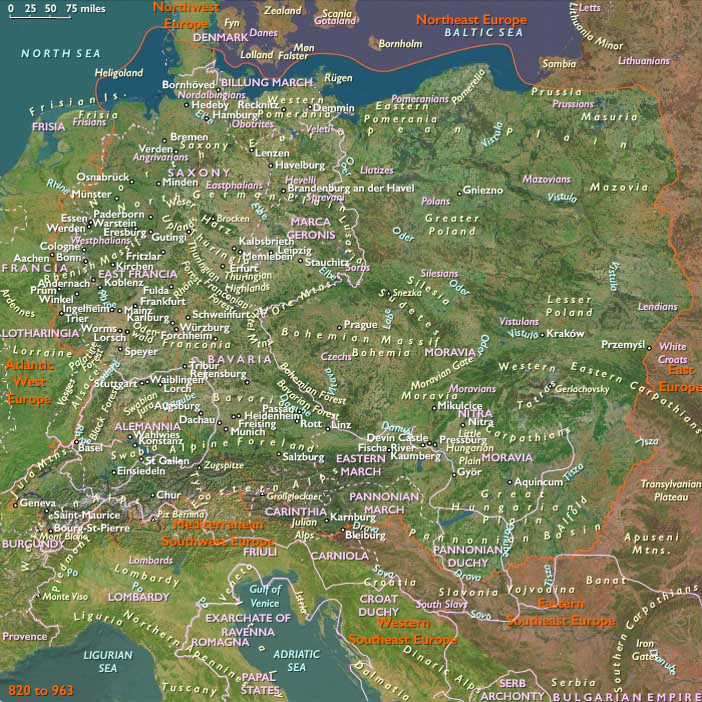
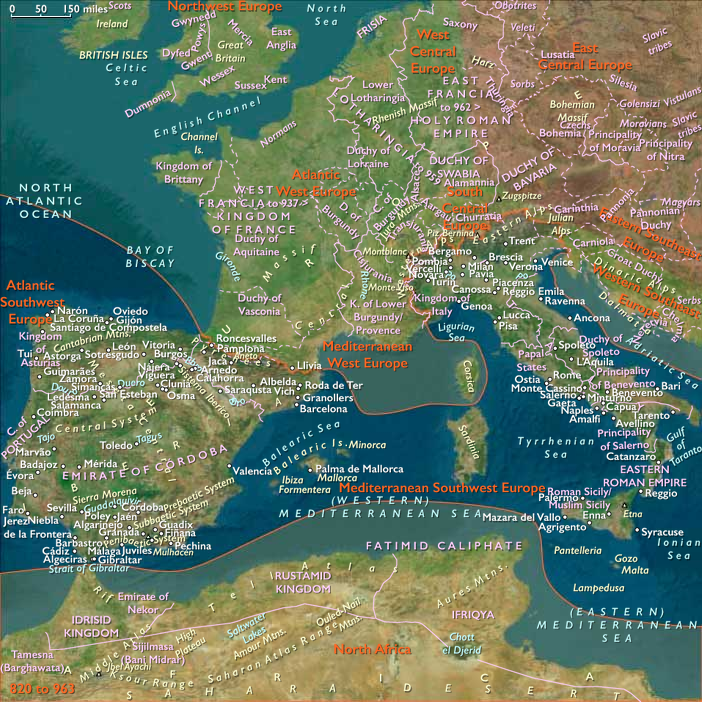
Atlantic West Europe (916–927): Emergence of Regional Powers and Continued Carolingian Decline
Between 916 and 927, Atlantic West Europe witnessed the continued erosion of Carolingian royal authority, the consolidation and expansion of regional powers, especially Normandy, Flanders, Aquitaine, Anjou, and the Burgundian kingdoms, and the beginnings of political stabilization following the era of Viking raids.
Political and Military Developments
-
West Francia: Enduring Instability
- King Charles the Simple (r. 898–922) struggled against increasingly powerful nobles, ultimately losing his throne after being deposed in 922, leading to civil unrest and further fragmentation of royal power.
- Robert I, count of Paris, briefly became king (922–923) but was killed in battle against Charles’ supporters; Rudolph of Burgundy succeeded him, bringing Burgundy into a more prominent political role in West Francia.
-
Normandy: Consolidation under Rollo
- Duke Rollo (r. 911–927) successfully transformed the Viking-controlled territory into the stable Duchy of Normandy, integrating local populations and establishing Rouen as a major center of power and trade.
-
Flanders and Anjou: Strengthening Territorial Control
- Arnulf I of Flanders (r. 918–965) solidified territorial gains, enhancing Flanders' military and economic capabilities, particularly through fortifications and expanding trade networks.
- In Anjou, Fulk I the Red (r. 898–942) reinforced his authority through strategic marriages and aggressive territorial expansion along the Loire.
-
Aquitaine: Stability and Cultural Patronage
- William II of Aquitaine (r. 918–926) continued his predecessor's efforts, reinforcing regional governance, supporting religious institutions, and providing stability in southern and western France.
-
Upper and Lower Burgundy: Internal Stability
- Rudolph II of Upper Burgundy (r. 912–937) managed internal stability, while Lower Burgundy (Provence) under Louis the Blind (until 928) experienced weakening central control, allowing regional nobles greater independence.
Economic and Social Developments
-
Growth of Regional Economies
- Economic revival was evident, particularly in Normandy, Flanders, and Aquitaine, where stability fostered agricultural improvements, trade expansion, and urban growth.
- Rouen, Bruges, Tours, and Nantes strengthened their roles as commercial hubs and fortifications, benefiting from growing local markets and increased political stability.
-
Integration of Viking Settlers
- In Normandy, the integration of Norse settlers encouraged agricultural and commercial development, leading to improved economic conditions and increased cultural blending with local Frankish populations.
Religious and Cultural Developments
-
Expansion of Cluniac Influence
- The Abbey of Cluny, founded in 910, significantly increased its influence, promoting monastic reform and religious independence, particularly across Burgundy, Aquitaine, and the Loire Valley.
-
Monastic and Scholarly Revival
- Monastic centers continued to preserve classical and religious manuscripts, supporting early signs of intellectual revival and education, especially in prominent monasteries like Saint-Martin of Tours and Cluny Abbey.
Legacy and Significance
By 927, Atlantic West Europe was increasingly characterized by powerful regional principalities rather than centralized royal control:
- The weakening Carolingian monarchy ceded practical authority to regional rulers in Normandy, Flanders, Anjou, Aquitaine, and Burgundy.
- The Duchy of Normandy firmly established itself, foreshadowing its later expansionist role, notably the Norman conquest of England in the following century.
- Regional economic stabilization, particularly through revived trade and fortified towns, paved the way for the urban revival of the High Middle Ages.
- Cluniac monasticism deepened religious reform and cultural vitality, significantly shaping medieval European spirituality.
This era set critical foundations for the political, economic, and cultural contours that defined Atlantic West Europe through the High Middle Ages.
Bertha, the eldest daughter of Berengar I of Italy, had become abbess of San Salvatore in Brescia, where her aunt had once been a nun, by 915.
In that year, the following year, and in 917, Berengar had endowed her monastery with three privileges to build or man fortifications.
Berengar retreats to Verona and has to watch, sidelined, as the Magyars pillage the country.
Berengar’s younger daughter, Gisela, had married Adalbert I of Ivrea as early as 898 (and no later than 910), but this had failed to spark an alliance with the Anscarids.
She was dead by 913, when Adalbert remarried.
Adalbert, one of Berengar's earliest internal enemies after the defeat of Louis of Provence, has called on Hugh of Arles between 917 and 920 to take the Iron Crown.
Hugh had invaded Italy, with his brother Boso, and advanced as far as Pavia, where Berengar had starved them into submission, but allowed them to pass out of Italy freely.
Dissatisfied with the emperor, who had ceased his policy of grants and family alliances in favor of paying Magyar mercenaries, several Italian nobles—led by Adalbert and many of the bishops—invite Rudolph II of Upper Burgundy, king from 912, to take the Italian throne in 921.
Moreover, his own grandson, Berengar of Ivrea, rises up against him, incited by Rudolph.

John, Bishop of Pavia, surrenders his city to Rudolph in 922; it will be sacked by the Magyars in 924.
Rudolph is here crowned King of the Lombards.
The forces of Rudolph, Adalbert, and Berengar of Ivrea meet those of Berengar on July 29, 923, and defeat him in the Battle of Fiorenzuola, near Piacenza.
The battle is decisive and Berengar is de facto dethroned and replaced by Rudolf.
Berengar is murdered in 924, possibly at the instigation of Rudolph.
He leaves no sons, only a single surviving daughter (the aforementioned Bertha) and an anonymous epic poem, the Gesta Berengarii Imperatoris, about the many happenings of his troublesome reign.
Rudolph now rules Upper Burgundy and Italy together, residing alternately in both kingdoms.
The Italian nobility, turning against Rudolph in 926, requests that Hugh of Arles, the effective ruler of Provence (or Lower Burgundy), rule them instead.
Rudolph returns to Upper Burgundy to protect himself, assuring Hugh's coronation as King of Italy in the process.
Burchard II had married his daughter Bertha to King Rudolph II of Upper Burgundy in 922 and affirmed the peace of three years prior.
Burchard had then accompanied Rudolph into Italy when he was elected king by opponents of the Emperor Berengar.
When, in 926, Hugh of Arles is elected by his partisans to oppose Rudolph, Burchard attacks Novara, defended by the troops of Lambert, Archbishop of Milan.
Here he is killed, probably on April 29.
His widow, Regelinda (d. 958), remarries to Burchard's successor, Herman I.
The Magyars devastate Burgundy in 937, overcoming French defenders led by Burgundy’s King Rudolph, who dies in this year, and is succeeded by his son Conrad.