Rudolf of Rheinfelden
Duke of Swabia
Years: 1025 - 1080
Rudolf of Rheinfelden (c. 1025 – 15 October 1080) is Duke of Swabia (1057–1079) and brother-in-law of King Henry IV of Germany.
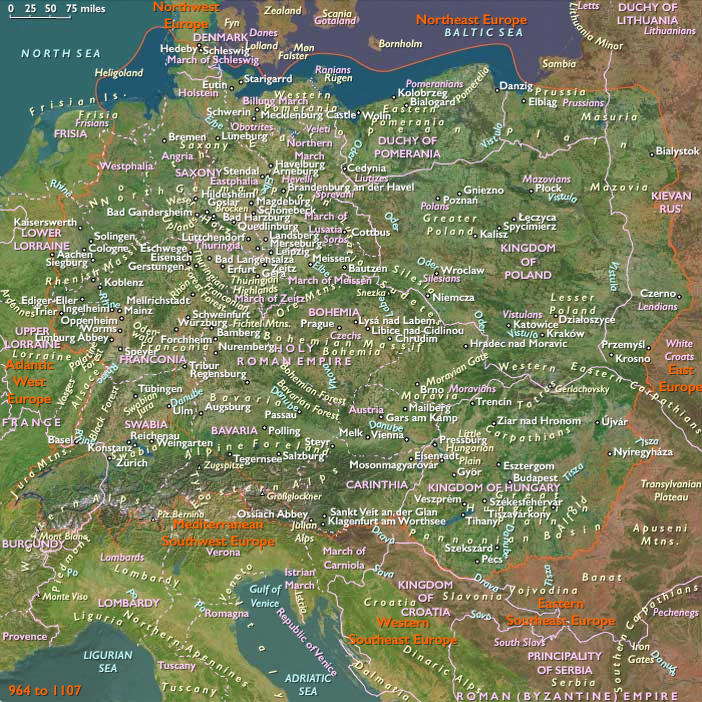
In 1077, upon the outbreak of the Investiture Controversy, Duke Rudolf is elected alternative king or German antiking by the politically oriented anti-Henry German aristocrats, whose rebellion becomes known as the Great Saxon Revolt.
In the struggle for supremacy in the Holy Roman Empire, he dies as a result of battlefield injuries as his faction meets Henry's forces and defeats them in the Battle of Elster.
Related Events
Filter results
Showing 9 events out of 9 total
The struggle between the Salian dynasty ruling the Holy Roman Empire and the rebel Saxons during the reign of King Henry IV of Germany reaches its climax in the period from summer 1073 until the end of 1075, in a rebellion that involves several clashes of arms.
The ensuing civil war from 1077 and 1088 is led by a group of opportunistic German princes who elect as their figurehead the duke of Swabia and anti-king Rudolf of Rheinfeld, a two-way brother-in-law of the young Henry IV, Holy Roman Emperor (Henry had been crowned at the age of six and assumed his offices at sixteen).
The Conflict Over Holland and Frisia (1063–1076): Dirk V, Robert the Frisian, and the Imperial Struggle
The struggle for Holland and Frisia in the mid-11th century was shaped by dynastic disputes, imperial intervention, and religious conflict. Dirk V, the young Count of Holland, faced aggression from the Bishop of Utrecht, while his stepfather, Robert the Frisian, maneuvered for control of Flanders, Holland, and Frisia. The broader European conflict between Pope Gregory VII and Emperor Henry IV further intensified the regional war, culminating in the assassination of Duke Godfrey IV of Lower Lorraine and the death of Bishop William of Utrecht in 1076.
Early Conflict: Bishop William of Utrecht Seizes Holland (1063–1064)
- Upon the death of Floris I in 1061, his son Dirk V inherited the County of Holland, but as he was a minor, his mother, Gertrude of Saxony, served as regent.
- William I, Bishop of Utrecht, seized the opportunity to occupy disputed lands in Holland, claiming them for the bishopric.
- Emperor Henry IV confirmed William’s claim through charters issued on April 30 and May 2, 1064, recognizing his authority over the disputed territory.
- Dirk V and Gertrude retreated to Zeeland, where they could hold out against Utrecht’s forces.
Robert the Frisian’s Rise and the Flemish Civil War (1063–1071)
- In 1063, Gertrude married Robert the Frisian, the second son of Baldwin V of Flanders, bringing Dirk under Robert’s protection.
- Baldwin granted Dirk Imperial Flanders as an appanage, including the Frisian islands west of the Scheldt.
- Robert expanded his power, temporarily conquering Kennemerland (North Holland), though his hold on it was brief.
- Following the death of Baldwin VI in 1070, a civil war erupted in Flanders between Robert and Richilde of Mons and Hainaut, widow of Baldwin VI.
- Robert secured victory at the Battle of Cassel (February 1071), where Arnulf III of Flanders was killed, confirming Robert’s rule over Flanders and Frisia.
The Revolt in Holland and the Imperial Intervention (1075–1076)
- From 1075 onwards, the conflict in Holland and Frisia became entangled with the larger Investiture Controversy, as:
- Pope Gregory VII excommunicated Emperor Henry IV.
- The Bishop of Utrecht supported the emperor, while Dirk V and Robert the Frisian backed Pope Gregory VII and anti-king Rudolph of Swabia.
- While Robert was preoccupied in Flanders, Dirk’s supporters launched an uprising to reclaim Holland from the Bishop of Utrecht.
- Emperor Henry IV ordered Duke Godfrey IV ("the Hunchback") of Lower Lorraine to suppress the rebellion.
- Godfrey’s army crushed the revolt, restoring Episcopal rule in Holland.
The Assassination of Godfrey IV and the Death of Bishop William (1076)
- In 1076, Bishop William of Utrecht requested Duke Godfrey IV to visit his domains along the Frisian borderlands.
- While in Delft on February 26, 1076, Godfrey was assassinated by rebels, marking a major setback for imperial control in the region.
- Shortly after, Bishop William of Utrecht died on April 17, 1076, further weakening imperial influence in Holland and Frisia.
Consequences and Shift in Power
- With the deaths of Godfrey IV and Bishop William, imperial authority in Holland collapsed, giving Dirk V and Robert the Frisian a renewed opportunity to assert control.
- Robert’s position as Count of Flanders and overlord of Frisia solidified his power in both Flanders and the Low Countries.
- The events of 1076 marked a major turning point, as the balance of power shifted away from imperial-backed bishops and toward regional counts and anti-imperial factions.
The revolt in Holland (1075–1076), the assassination of Duke Godfrey IV, and the death of Bishop William of Utrecht weakened Emperor Henry IV’s hold over the region, paving the way for the resurgence of Dirk V and Robert the Frisian as dominant figures in the Low Countries.
Dirk V Reclaims Holland: The Capture of Bishop Conrad of Utrecht (1076–1077)
Following the assassination of Duke Godfrey IV of Lower Lorraine and the death of Bishop William of Utrecht in 1076, Dirk V of Holland saw a golden opportunity to reclaim his ancestral lands from imperial control. With the support of his stepfather, Robert I of Flanders ("the Frisian"), Dirk raised an army and launched a decisive campaign against Bishop Conrad of Utrecht, William's successor.
Dirk V’s Counteroffensive Against Conrad of Utrecht (1076–1077)
- Now fully managing his own estate, Dirk V quickly mobilized forces to take back the lands lost to the Bishopric of Utrecht.
- With Robert’s military support, Dirk besieged Bishop Conrad at Ysselmonde, a strategic castle that controlled access to Holland.
- The siege was successful, and Conrad was captured, marking a significant victory for Dirk and a severe blow to imperial authority in the region.
The Bishop’s Ransom and Dirk’s Restoration of Holland
- Bishop Conrad was forced to ransom himself, negotiating for his release by surrendering all claims to the disputed lands.
- With this agreement, Dirk V regained full control over Holland, reversing the imperial-backed annexation by Bishop William of Utrecht in 1064.
- The capture of Ysselmonde and the bishop’s surrender ensured that the County of Holland was now independent of Utrecht’s influence.
Consequences and Significance
- Dirk V’s successful campaign permanently ended the Bishop of Utrecht’s territorial ambitions in Holland.
- The balance of power in the Low Countries shifted away from imperial-backed bishops and toward secular counts like Dirk and Robert I of Flanders.
- This event further weakened Emperor Henry IV’s authority in the region, as anti-imperial forces continued to gain ground.
- Dirk V had not only restored his county but had done so through military strength and political cunning, solidifying his position as an independent ruler in the Low Countries.
By 1077, Dirk V had fully reclaimed Holland, marking the end of imperial influence in the region and securing his dynastic legacy, which would shape the future of the County of Holland for generations to come.
Henry, his offices declared vacant and all his all feudal vassals released from their oaths of fealty, is rapidly losing popular support, and the situation has become extremely critical for the king.
As a result of the agitation, which is zealously fostered by the papal legate Bishop Altmann of Passau, the princes meet in October at Trebur to elect a new German ruler.
Henry, who is stationed at Oppenheim on the left bank of the Rhine, is only saved from the loss of his throne by the failure of the assembled princes to agree on the question of his successor.
Their dissension, however, merely induces them to postpone the verdict.
Henry, they declare, must make reparation to Gregory and pledge himself to obedience; and they decide that, if, on the anniversary of his excommunication, he still lies under the ban, the throne should be considered vacant.
At the same time, they decide to invite Gregory to Augsburg to decide the conflict.
These arrangements show Henry the course to be pursued.
It is imperative under any circumstances and at any price to secure his absolution from Gregory before the period named, otherwise he can scarcely foil his opponents in their intention to pursue their attack against him and justify their measures by an appeal to his excommunication.
At first he attempts to attain his ends by an embassy, but when Gregory rejects his overtures he takes the celebrated step of going to Italy in person.
Gregory VII has already left Rome and had intimated to the German princes that he would expect their escort for his journey on January 8 to Mantua.
But this escort has not appeared when he receives the news of the Henry's arrival.
Henry, who has traveled through Burgundy, has been greeted with enthusiasm by the Lombards, but resists the temptation to employ force against Gregory.
He chooses the unexpected course of forcing Gregory to grant him absolution by doing penance before him at Canossa, where he has taken refuge.
The Walk to Canossa soon becomes legendary.
The reconciliation is only effected after prolonged negotiations and definite pledges on the part of Henry, and it is with reluctance that Gregory at length gives way, considering the political implications.
If Gregory grants absolution, the diet of princes in Augsburg in which he might reasonably hope to act as arbitrator will either become useless, or, if it meets at all, will change completely in character.
It is impossible, however, to deny the insincere but shrewd penitent reentrance into the Church, and Gregory's religious obligations override his political interests.
The removal of the ban does not imply a genuine reconciliation, and no basis is gained for a settlement of the main question that divides Henry and Gregory: that of investiture.
A new conflict is inevitable from the very fact that Henry considers the sentence of deposition repealed along with that of excommunication.
Gregory, on the other hand, is intent on reserving his freedom of action and gives no hint on the subject at Canossa.
Welf, turning against the emperor, changes sides during the Investiture Controversy—supporting Pope Gregory VII as well as lending his support for the election of Rudolf of Rheinfelden as anti-king in March 1077.
Pope and emperor had been superficially reconciled in 1076, but the following year had seen them again engaged in active hostilities.
Henry, in consequence of these repeated acts of rebellion, declares Welf deposed in his newly acquired duchy.
However, supported by his faithful Bavarians, and aided by his father in Italy, Welf is able to maintain his place, and openly defy the ban of the empire in May 1077.
Welf joins the discontented princes who support he standard of Rudolph, at a time when any who refuse to follow the pope's direction can expect to be excommunicated by the church—a potent and effective threat in the social and political conditions of the time.
The excommunication of Henry IV had simply been a pretext for the opposition of the rebellious German nobles, who had not only persisted in their policy after his absolution, but had taken the more decided step of setting up a rival ruler in the person of Duke Rudolf of Swabia at Forchheim in March 1077.
The papal legates present at the election had observed the appearance of neutrality, and Gregory himself has sought to maintain this attitude during the subsequent years.
His task is made easier in that the two parties are of fairly equal strength, each trying to gain the upper hand by getting the pope on their side, but the result of his noncommittal policy is that he has largely lost the confidence of both parties.
Finally, he decides for Rudolf of Swabia after his victory at the Battle of Flarchheim on January 27, 1080.
Under pressure from the Saxons, and misinformed as to the significance of this battle, Gregory abandons his waiting policy and again pronounces the excommunication and deposition of King Henry at the Lenten Synod of March 7, 1080, but the papal censure now proves a very different thing from the one four years before.
It is widely felt to be an injustice, and people begin to ask whether an excommunication pronounced on frivolous ground is entitled to respect.
Although the anti-Hohenstaufen Welf faction gains Pope Gregory’s support in 1080, most German nobles back Henry and form the Waiblingen party (named for a primary castle of Henry’s Hohenstaufen family).
To make matters worse, Rudolf dies on October 16 of the same year.
The conflict between church and state over the right to make ecclesiastical investitures has become more intense by 1080, when Robert Guiscard chooses to reconcile himself with Gregory VII, entering into the Concordat of Ceprano, which confirms the commitments of the earlier Council of Melfi.
Henry IV is trying to unite his forces from southern and western Germany with those of Bohemia and Meissen.
To do so Henry has to bypass the Saxon allies of Rudolf.
Henry successfully draws off the Saxons by feigning a move toward Goslar, while his main army crosses Thuringia eastwards along Saxony's southern border.
Henry is hoping to meet up with the other half of his forces on the Saale or Elster Rivers.
Rudolf's army soon realizes its mistake and pursues Henry.
Rudolf catches Henry's army on the western bank of the Elster near Hohenmölsen.
While his Bavarian contingent may have joined him, the contingents from Bohemia and Meissen are still on the far bank.
Henry retreats to a swampy valley called the Grona.
The battle begins with knights from both armies trading insults.
Henry is initially protected from Rudolf's army by the swampy ground.
Nearby is the bridge over the Elster to the town of Zeitz.
The bridge is being held against Henry, probably by the townsmen.
To meet up with his other forces, Henry will either have to force the bridge or build his own crossing.
Meanwhile Rudolf wants to prevent Henry's escape.
The long pursuit has weakened the cavalry.
Rudolf orders the knights with tired horses to dismount and strengthen the infantry.
Otto of Nordheim leads these forces on a direct assault across the swampy Grona as the remains of Rudolf's knights attempt to circle the swamp.
While Henry and Rudolf's knights fight on the periphery of the swamp, Otto is able to force his way through Henry's screening force and breaks into Henry's camp.
Otto retains control of his force and prevents them from plundering the camp.
Otto's force then falls on the remains of Henry's army engaged with the rest of Rudolf's forces.
Henry's army breaks; many of his warriors drown in the Elster.
Henry is able to escape.
The Battle on the Elster is a military defeat for Henry, but Rudolf, with a lost right hand and a mortal wound in his belly, dies the next day at nearby Merseburg.
With Rudolf no longer a threat, the rebellion has lost its focus.
However, the struggle will continue on in effect into 1085, with a final flare up in 1088 under Rudolph's successor, the second antiking, Herman of Luxembourg.