Roger II of Sicily
King of Sicily
Years: 1095 - 1154
Roger II (Mileto, Calabria 22 December 1095 – Palermo, Sicily 26 February 1154) is King of Sicily, son of Roger I of Sicily and successor to his brother Simon.
He begins his rule as Count of Sicily in 1105, later becomes Duke of Apulia and Calabria (1127), then King of Sicily (1130).
By the time of his death at the age of 58, Roger has succeeded in uniting all the Norman conquests in Italy into one kingdom with a strong centralized government.
Related Events
Filter results
Showing 10 events out of 112 total
Count Roger, politically supreme in Sicily, has also become master of the insular church.
The Papacy, favoring a prince who had recovered Sicily from Greeks and Muslims, had in 1098 granted Roger and his heirs the Apostolic Legateship of the island.
Roger has created new Latin bishoprics at Syracuse, and …
…has turned the archbishopric of Palermo into a Catholic see.
He practices general toleration towards Arabs and Greeks.
In the cities, the Muslims, who had generally secured such rights in their terms of surrender, retain their mosques, their kadis, and freedom of trade; in the country, however, they have become serfs.
When Roger I dies in 1101, his young son, Simon of Hauteville, becomes Count, with his mother Adelaide del Vasto as regent.
…Girgenti and elsewhere, nominating the bishops personally, while …
King Sigurd is to lead a Norwegian crusade in 1107 in support to the newly established crusader Kingdom of Jerusalem.
At first it had been disputed among the two kings, Eystein and Sigurd, about who should lead the contingent and who should remain home, to rule the kingdom.
Sigurd had eventually been chosen, possible because he was a more adequate and experienced traveler.
The first Scandinavian king to participate in the Crusade, he leads a force to the Holy Land.
Sailing for the Holy Land in autumn 1107 with sixty ships, he leaves his elder brother Eystein to rule Norway.
Sigurd and his men arrive in autumn in England, where Henry I is king, and will remain here the entire winter.
The Christian Reconquest and the Shifting Centers of Jewish Life (12th–13th Centuries)
During the 12th and 13th centuries, the Christian kingdoms of Iberia intensify their Reconquista, reclaiming former caliphal territories of Córdoba from Muslim rule.
New Centers of Jewish Life in the Mediterranean
As political and religious landscapes shift, active Jewish cultural and intellectual centers flourish around the Mediterranean, particularly in:
-
North Africa:
- Alexandria (Egypt)
- Kairouan (Tunisia)
- Fez (Morocco)
-
Sicily (under Norman rulers Roger II and Frederick II)
- Palermo becomes a major hub of Jewish scholarship and commerce
-
Southern France:
- Montpellier, Avignon, and Orange serve as important centers for Jewish learning and trade
-
Italy:
- Pisa, Rome, and Lucca host thriving Jewish communities engaged in commerce, medicine, and scholarship
Impact of the Reconquista and Mediterranean Jewish Life
As the Reconquista progresses, many Jewish communities in Iberia remain influential, but others migrate to these Mediterranean centers. These cities become key locations for Jewish intellectual and commercial activity, fostering the exchange of scientific, philosophical, and religious ideas across Christian and Muslim lands.
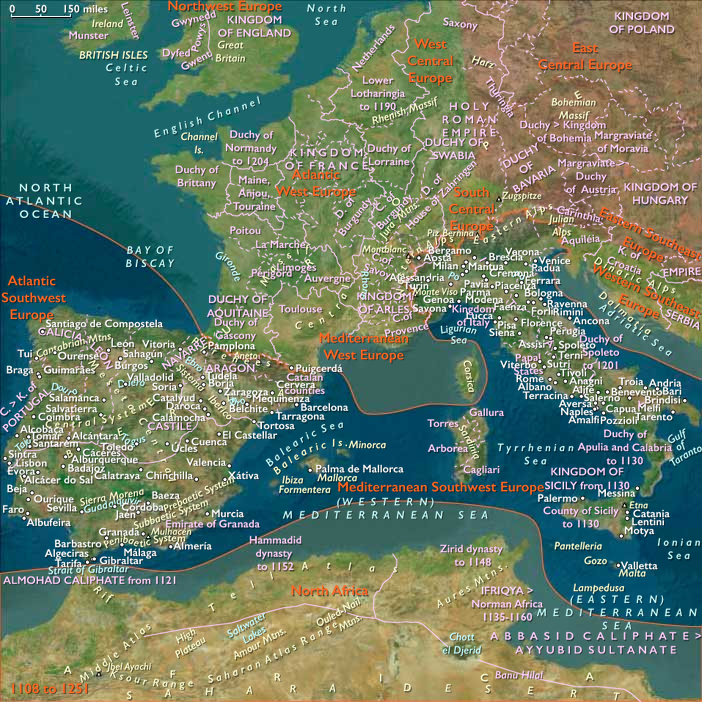
Southwest Europe (1108 – 1251 CE): Iberian Reconquest and the Mediterranean Crown
Between 1108 and 1251 CE, Southwest Europe—stretching from the Pyrenees to Sicily and from the Atlantic to the Adriatic—entered an age of expansion and maritime integration.
The Crown of Aragon united Catalonia’s merchants with Iberia’s crusading frontier; Portugal secured its independence; Castile and León advanced across the Meseta; and Frederick II’s Sicily became the intellectual and administrative jewel of the Mediterranean.
Across these realms, irrigation, shipbuilding, and law combined to create the foundations of Europe’s first commercial empires.
Geographic and Environmental Context
Southwest Europe joined the western Mediterranean with the Atlantic façade—a continuum of mountain valleys, river basins, and maritime corridors.
-
Mediterranean sphere: Catalonia, Valencia, Murcia, Andalusia, Provence’s western marches, and the islands of the Balearics, Sardinia, and Sicily.
-
Atlantic sphere: Portugal, Galicia, León, Castile, Navarre, and the Basque coast.
The Ebro, Guadalquivir, and Douro rivers served as inland arteries, while the Strait of Gibraltar linked the Atlantic to the Mediterranean.
This geography united irrigated gardens, vine terraces, and maritime forests into a single, resource-rich ecosystem that fueled both agrarian and naval growth.
Climate and Environmental Shifts
The Medieval Warm Period provided stability, though droughts periodically stressed Iberian interiors.
-
Irrigation in Valencia, Murcia, and Sicily countered dryness, sustaining year-round cultivation.
-
Atlantic coasts remained temperate and wet, supporting fisheries and viticulture.
-
Forests of the Cantabrian and Pyrenean ranges supplied timber for expanding shipyards.
Regional diversity fostered complementary economies—cereals and sugar in the south, wine and wool in the north, and maritime exports along both coasts.
Societies and Political Developments
Aragon and the Western Mediterranean:
The Crown of Aragon emerged in 1137 from the union of Aragon and Barcelona, forming a powerful maritime polity.
Its kings extended dominion over Catalonia, Roussillon, and by 1229–1235, the Balearic Islands; Valencia fell in 1238 after the decisive Christian victory at Las Navas de Tolosa (1212) broke Almohad strength.
Andorra remained under Catalan suzerainty.
Aragonese fleets reached Sardinia, while Barcelona became a hub of Mediterranean credit and commerce.
Portugal and the Atlantic Kingdoms:
Afonso I (r. 1139–1185) achieved independence from León, securing Lisbon (1147) and the Algarve by the 1240s.
Royal charters (for Lisbon, Coimbra, Porto) encouraged merchant autonomy and agricultural colonization.
Portugal’s stable frontiers and coastal wealth established it as Europe’s first enduring Atlantic monarchy.
Castile, León, and Navarre:
Alternating unions and separations between Castile and León defined 12th-century politics; kings Alfonso VII and Alfonso VIII expanded southward into Toledo and La Mancha.
Frontier towns like Madrid, Salamanca, and Burgos became centers of law and trade.
Navarre maintained independence as a Pyrenean crown; Basque valleys retained their fueros (local charters) and self-governing institutions.
The Almohads and al-Andalus:
The Almohad Caliphate replaced the Almoravids in the early 12th century, revitalizing Islamic scholarship and urban life in Seville, Córdoba, and Granada.
Despite Almohad reformism, internal divisions weakened resistance; after 1212, Muslim rule contracted to Granada, which survived as a tributary emirate.
Urban irrigation systems and craftsmanship in Andalusia and Valencia influenced Christian urban economies long after conquest.
Sicily and the Hohenstaufen Empire:
Under Frederick II (r. 1197–1250), Sicily became the Mediterranean’s most advanced polity.
From Palermo, the emperor codified law (the Constitutions of Melfi, 1231), founded universities, and patronized Arabic, Greek, and Latin scholarship.
Sardinia drew Aragonese interest, while Malta remained a Sicilian outpost controlling Mediterranean sea lanes.
Frederick’s court epitomized cultural fusion—where Muslim science, Latin administration, and Norman architecture met.
Economy and Trade
Agrarian and Industrial Production:
-
Irrigated estates (huertas) of Valencia, Murcia, and Sicily produced sugar, rice, citrus, and silk.
-
Castile and León supplied wool and grain to northern markets.
-
Portugal’s Minho and Douro valleys cultivated vineyards; fisheries at the Algarve and Galicia sustained Atlantic trade.
-
Basque ironworks and shipyards produced anchors, nails, and ocean-ready hulls.
Trade and Commerce:
-
Mediterranean: Venice, Genoa, and Pisa dominated Levantine routes, while Barcelona and Valencia expanded in western circuits.
-
Atlantic: Lisbon, Porto, and Cantabrian ports traded wine, salt fish, and timber with England, Brittany, and Flanders.
-
Sicily and Apulia exported grain and sugar to Italy; Andalusian ports exported textiles, fruit, and ceramics.
Notarial contracts, maritime insurance, and public shipyards standardized economic exchange across the region.
Belief and Symbolism
Christian–Islamic Convergence:
The frontier of Iberia was both battlefield and bridge.
Crusading ideology sanctified conquest, while Islamic architecture, science, and agriculture profoundly influenced Christian society.
Cathedral building in Toledo, Valencia, and Burgos echoed both Gothic and Moorish design.
Frederick II’s Rational Court:
In Palermo, Greek and Arabic scholars translated Aristotle and Euclid; falconry, astronomy, and law flourished under imperial patronage.
His court symbolized a Mediterranean humanism centuries ahead of its time.
Pilgrimage and Devotion:
The Camino de Santiago united Iberia’s kingdoms spiritually and commercially, sustaining Santiago de Compostela as a pan-European shrine.
Monastic orders—the Cistercians, Knights of Calatrava, and Orders of Santiago and Aviz—defended and colonized the frontiers.
Subsistence and Technology
-
Irrigation systems (qanats and acequias) revitalized agriculture in Aragon and al-Andalus.
-
Hydraulic mills and riverine warehouses improved grain processing.
-
Basque and Portuguese shipyards refined stern rudders and clinker hulls, precursors to oceanic vessels.
-
Portolan charts and magnetic compasses circulated through Italian pilots.
-
Architectural innovation: coral masonry in Sicily, ribbed vaulting in Iberia, and civic loggias in Aragonese ports.
Technology bound rural production to maritime ambition, transforming the peninsula into a laboratory of navigation and law.
Movement and Interaction Corridors
-
Mediterranean sea-lanes: Barcelona ⇄ Marseille ⇄ Genoa ⇄ Palermo ⇄ Alexandria.
-
Atlantic routes: Lisbon ⇄ Bristol ⇄ Flanders ⇄ Bordeaux.
-
Inland arteries: Ebro, Douro, and Guadalquivir rivers connecting highland farms to seaports.
-
Pyrenean and Rhône passes: Catalonia and Provence’s gateways to France and Italy.
-
Straits and narrows: Messina, Otranto, and Gibraltar—the gateways of empire.
These corridors bound the region into Europe’s dual maritime economy: Mediterranean and Atlantic.
Adaptation and Resilience
-
Irrigation and terrace farming stabilized food production under variable rainfall.
-
Urban autonomy and municipal charters balanced royal power with local initiative.
-
Maritime diversification (Atlantic and Mediterranean fleets) buffered commerce from political upheavals.
-
Cross-cultural exchange—Muslim science, Christian law, and Jewish finance—enriched statecraft and learning.
Resilience in this region stemmed from adaptability: an ability to absorb, reform, and synthesize across faiths, climates, and seas.
Long-Term Significance
By 1251 CE, Southwest Europe had become Europe’s hinge between the Atlantic and the Mediterranean:
-
Aragon anchored a western maritime empire; Barcelona and Valencia rose as centers of trade and law.
-
Portugal emerged as an independent Atlantic kingdom with enduring stability.
-
Castile and León consolidated the Meseta, preparing for Andalusian conquest.
-
Sicily, under Frederick II, stood as a beacon of learning and centralization.
-
Venice and Genoa extended their reach into Iberian and Maghrebi waters.
Here, the fusion of Islamic irrigation, Latin legalism, and nautical science forged the intellectual and technological foundations for Europe’s coming age of exploration.
Mediterranean Southwest Europe (1108 – 1251 CE): Almohads, Aragon’s Union, and Hohenstaufen Sicily
Climate and Environmental Shifts
-
Productive regimes persisted with localized dryness in Iberia; irrigation buffered Valencia, Murcia, Andalusia, Sicily.
Societies and Political Developments
-
Crown of Aragon (union 1137 of Aragon and Barcelona) expanded into Catalonia, Roussillon, and the Balearics’ approaches; Andorra remained within Catalan orbit.
-
Almohads superseded Almoravids in al-Andalus; Christian advances paused until Las Navas de Tolosa (1212) opened the Guadalquivir. Valencia (1238) and the Balearics (1229–1235) fell to King James I.
-
Portugal consolidated Algarve and Alentejo frontiers; Castile/León held Toledo and pushed La Mancha; Madrid grew as a frontier town.
-
Hohenstaufen Sicily under Frederick II (r. 1197–1250) centralized law and science; Sardinia drew Aragonese interest; Venice led Adriatic power and eastern ventures.
-
Malta attached to the Sicilian crown.
Economy and Trade
-
Venice, Genoa, Pisa dominated Levantine–western circuits; Barcelona–Valencia fleets grew in western routes.
-
Sicily/Apulia exported grain, sugar, and citrus; Andalusia/Valencia irrigated gardens sustained urban markets; Algarve fisheries and salt fed Atlantic–Mediterranean trade.
Subsistence and Technology
-
Hydraulic estates in al-Andalus and Sicily; notarial–credit instruments in Italian and Catalan cities; communal shipyards standardized galleys.
Movement and Interaction Corridors
-
Rhône–Ligurian pivot into Genoa and Venice; Ebro–Pyrenees to Barcelona; Guadalquivir/Segura/Turiariver basins supplied Seville–Valencia ports; Strait of Messina and Otranto gates for Sicilian–Italian flows.
Belief and Symbolism
-
Almohad reformism; Latin cathedral building—Burgos (nearby, outside core) influenced Toledo, Valencia; Frederick II’s court culture blended Arabic–Latin–Greek learning; crusading mobilizations flowed through Italian/Iberian ports.
Long-Term Significance
By 1251, Aragon anchored a western thalassocracy; Venice led the Adriatic; Frederick II’s Sicily structured the central Med; Iberia’s Christian kingdoms were poised for decisive 13th-century gains.
Mediterranean Southwest Europe (1108–1119 CE): Rise of Maritime Republics, Norman Sicily, and Cultural Flourishing
The era 1108–1119 CE in Mediterranean Southwest Europe witnesses the emergence of powerful Italian maritime republics, significant political developments in Norman Sicily, and a remarkable cultural synthesis in Palermo.
Rise of Italian Maritime Republics
Venice, strategically located at the head of the Adriatic Sea, solidifies its position as one of the prominent Italian city-states, or Repubbliche Marinare, alongside Genoa, Pisa, and Amalfi. Venice thrives as a vital center of trade between Western Europe, the Eastern Roman (Byzantine) Empire in Constantinople, and the Islamic world. This era sees Venice laying crucial foundations for its naval and commercial power, significantly enhancing its economic prosperity and political influence.
Simultaneously, northern Italy transitions from feudal rule by princes to an era dominated by city-states and autonomous communes. Notably, Florence evolves into a prominent commercial power, beginning its transformation into one of Europe's most influential economic and cultural hubs.
Norman Sicily and the Kingdom Transition
In Sicily, Norman rule begins its transformation from the County of Sicily into the Kingdom of Sicily. In 1110 CE, the crusading King Sigurd of Norway grants Norman ruler Roger Guiscard royal authority, symbolically marking Sicily’s elevation to kingdom status. Under the Hauteville dynasty, Palermo becomes the prosperous capital of this culturally diverse and politically dynamic realm.
Cultural Flourishing in Norman Palermo
The Norman rulers, descendants of Vikings, enthusiastically adopt and appreciate the rich multicultural heritage of Sicily, incorporating elements of Arab and Byzantine cultures into their governance and personal practices. Norman rulers in Palermo adopt attributes typical of Muslim courts, including dress, language, literature, eunuchs, and, according to some sources, harems. Mirroring the multicultural vibrancy of the earlier Caliphate of Córdoba, the court of Roger II emerges as one of the Mediterranean’s leading cultural centers.
Palermo attracts scholars, scientists, poets, artists, and skilled artisans from Europe, North Africa, and the Middle East, fostering a cosmopolitan atmosphere that stimulates extraordinary artistic and architectural achievements. Norman Sicily remains heavily influenced by Arab culture, with governance conducted through multilingual laws, reflecting the diverse communities living harmoniously under Norman rule. The emphasis on justice and the rule of law creates a stable and prosperous society where Muslims, Jews, Greeks from the Byzantine Empire, Lombards, and Normans collaborate effectively.
Continued Scholarly and Cultural Exchange
The era continues to witness vibrant intellectual exchanges and cultural synthesis, reflecting the broader trends of the period. Mozarabic and Jewish scholarship remain influential, facilitating intercultural dialogue and furthering intellectual and scientific advancement.
Economic Prosperity and Technological Continuity
Economic stability persists throughout the region, supported by sustained technological innovations, notably maritime and metallurgical advances, ensuring continued prosperity and urban growth.
Legacy of the Era
The era 1108–1119 CE significantly shapes Mediterranean Southwest Europe through the establishment of powerful maritime republics, the rise of Norman Sicily, and the flourishing of multicultural and intellectual life in Palermo. These developments set the stage for ongoing transformations in the region’s political, cultural, and economic landscapes.