Robert Louis Stevenson
Scottish novelist, poet, essayist, and travel writer
Years: 1850 - 1894
Robert Louis Balfour Stevenson (13 November 1850 – 3 December 1894) is a Scottish novelist, poet, essayist, and travel writer.
His most famous works are Treasure Island, Kidnapped, and Strange Case of Dr Jekyll and Mr Hyde.
A literary celebrity during his lifetime, Stevenson now ranks among the 26 most translated authors in the world His works have been admired by many other writers, including Jorge Luis Borges, Ernest Hemingway, Rudyard Kipling, Marcel Schwob, Vladimir Nabokov, J. M. Barrie,[5] and G. K. Chesterton, who said of him that he "seemed to pick the right word up on the point of his pen, like a man playing spillikins."
Chesterton, Gilbert Keith (1913).
The Victorian Age in Literature.
London: Henry Holt and Co.. p.
246.)
Related Events
Filter results
Showing 10 events out of 10 total
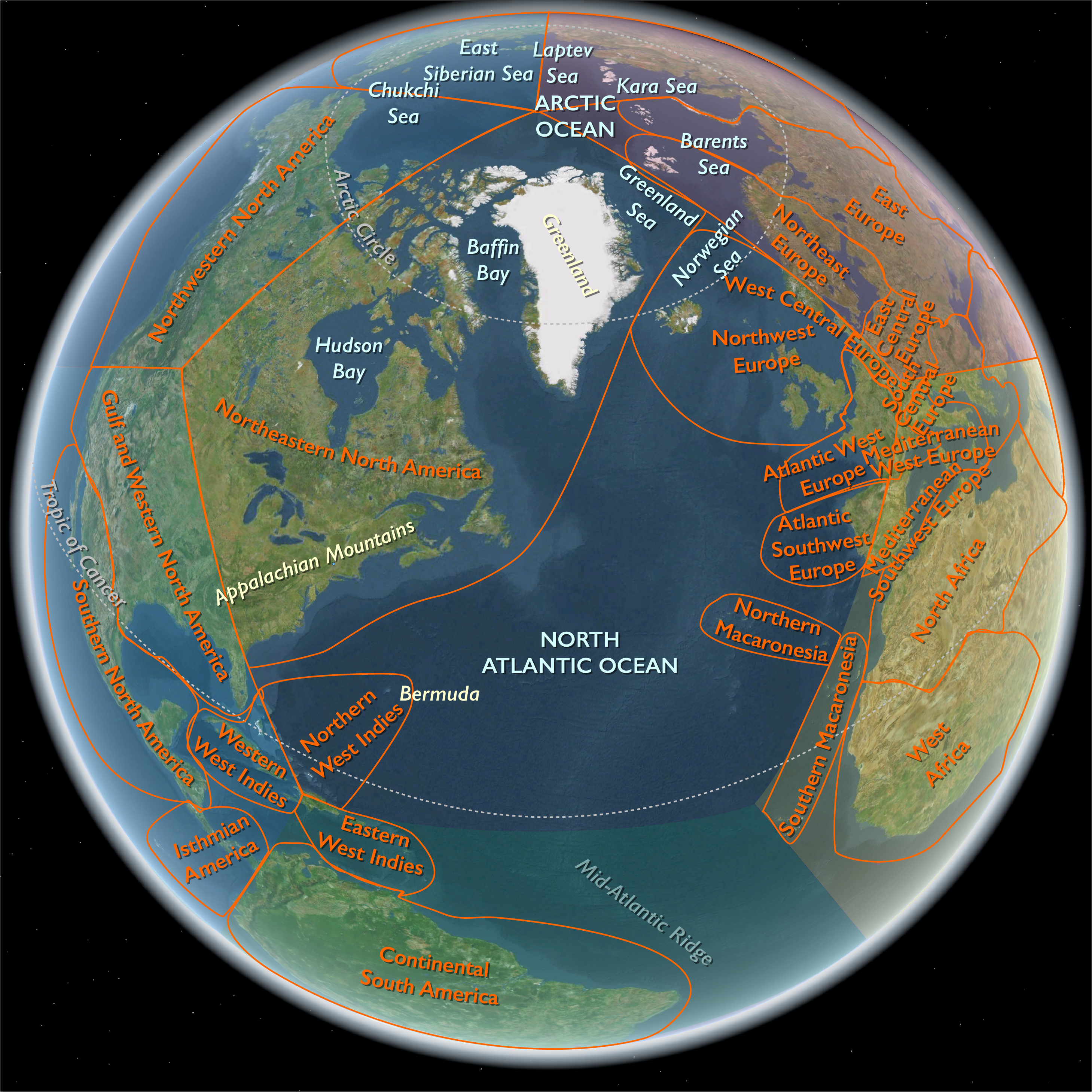
Northwest Europe (1876–1887): The Imperial Zenith, Gladstone and Disraeli, and Reform at Home
Imperial Peak: Victoria’s Diamond Jubilee and Global Expansion
Between 1876 and 1887, Britain reached the apex of its imperial grandeur, symbolically marked by Queen Victoria’s Diamond Jubilee in 1887. Celebrating sixty years on the throne, the Jubilee underscored Britain's unparalleled global dominance. The British Empire expanded dramatically in Asia, Africa, and the Pacific, prominently exemplified in Africa by the ambition to have the Union Jack flying uninterrupted "from Cairo to Cape Town." This era of imperial expansion, known as the "Scramble for Africa," consolidated British control over extensive territories, secured through a dominant Royal Navy—then the world’s preeminent maritime force—and supported by a small, professional army, uniquely sustained without conscription, unlike other European powers.
Queen Victoria herself played a limited role politically, yet became the enduring symbolic embodiment of British national pride, imperial grandeur, and societal propriety. Her restrained demeanor, common sense, and directness mirrored national virtues that made Britain globally preeminent. As a female sovereign, her evolving public image—from innocent young woman, devoted wife, and mother, to grieving widow and grandmotherly matriarch—conveyed powerful moral symbolism, deeply influencing Victorian ideals of domesticity and endurance. Victoria’s emblematic legacy extended beyond Britain, defining a moral image of Empire and domestic propriety that profoundly shaped national identity.
Disraeli and Gladstone: Giants of Victorian Politics
British politics during this era were dominated by two towering figures: Conservative Benjamin Disraeli and Liberal William Ewart Gladstone. Their rivalry defined what historians later termed Britain’s "golden age of parliamentary government."
Benjamin Disraeli (1804–1881), prime minister in 1868 and from 1874 to 1880, emerged as an iconic Conservative statesman. Disraeli reshaped Conservatism into a broadly appealing force through his concept of "one-nation" Tory democracy. Known for his international assertiveness and charismatic leadership, he enjoyed significant support from Queen Victoria, contrasting sharply with Gladstone’s contentious relationship with the monarch. Disraeli’s foreign policy was robust and patriotic, exemplified by his assertive diplomacy at the Congress of Berlin (1878) during the Russo-Turkish War, successfully limiting Russian expansion into Ottoman territories, thus securing British strategic interests. His personal charm and political insight made him a lasting hero to Conservatives, though historians have subsequently critiqued his imperialist ambitions and rhetorical excess.
William Ewart Gladstone (1809–1898), Disraeli’s great Liberal counterpart, served as prime minister four times (1868–1874, 1880–1885, 1886, 1892–1894). Gladstone, the moral conscience of British liberalism, shaped politics through exceptional oratory, evangelical religiosity, and fierce commitment to progressive reforms. His famous Midlothian Campaign (1879–1880) pioneered modern political campaigning, rallying public opinion against Ottoman atrocities in Bulgaria. Gladstone’s foreign policy idealism envisioned a Europe built on international law, cooperation, and mutual trust, directly challenging Bismarck’s system of militarized alliances and calculated tensions—a vision ultimately defeated by German Realpolitik.
Gladstone’s reforms had profound domestic impacts. His first ministry (1868–1874) successfully introduced landmark measures including the Irish Church Act (1869), disestablishing the Protestant Church of Ireland, ending centuries-old sectarian burdens upon Irish Catholics. Additionally, Gladstone championed:
-
The Education Act of 1870: introducing compulsory elementary education nationwide, significantly raising literacy and educational standards.
-
The Judicature Act of 1873: unifying Britain’s chaotic court system into a single, streamlined judiciary.
-
The Secret Ballot Act of 1872: safeguarding electoral integrity by preventing vote-buying and intimidation.
-
The Trade Union Act of 1871: legally securing unions, diminishing employer intimidation, and providing legal protections for trade-union funding.
-
Civil service reforms: replacing aristocratic patronage with merit-based examinations, emphasizing talent over birthright.
Gladstone’s vision of government-driven social fairness and expanded liberty resonated profoundly with Britain’s lower middle classes and working people, earning him the affectionate title, "Grand Old Man."
Yet Gladstone’s passionate advocacy for Irish Home Rule in 1886 deeply divided his party, splitting it irreversibly. Joseph Chamberlain formed the breakaway Liberal Unionist faction, aligning with Conservatives against Home Rule, leaving the Liberal Party politically fragmented for decades.
Ireland and Home Rule Conflict
Ireland’s quest for autonomy intensified in the 1880s, led by nationalist politician Charles Stewart Parnell. His Irish Parliamentary Party grew into a major parliamentary presence, pressing for self-government under the British Crown. Gladstone’s introduction of the first Home Rule Bill in 1886 split the Liberals and prompted fierce resistance from Unionists, particularly in Protestant-majority Ulster, who feared Catholic-nationalist domination. Although the bill failed, its divisive legacy permanently reshaped British and Irish politics, paving the way for later nationalist struggles.
Army Reforms and Military Modernization
While Britain’s Royal Navy dominated globally, the army suffered from outdated structures, unfair practices, and ineffective organization. Gladstone’s war secretary, Edward Cardwell, launched significant military reforms during this period:
-
Reducing enlistment terms from twenty-one years to six active years plus six reserve years.
-
Organizing regiments by territorial districts for streamlined mobilization.
-
Equipping regiments with advanced rifles.
-
Eliminating the purchase of officers’ commissions, emphasizing meritocracy.
-
Abolishing flogging in peacetime, reflecting changing attitudes toward military discipline.
Although incomplete, due to lingering aristocratic privileges like those enjoyed by the Duke of Cambridge, these reforms substantially modernized and professionalized Britain's army.
Gender Roles, Fashion, and Cultural Shifts
Socially, the late Victorian period witnessed subtle yet significant shifts, especially regarding gender norms. By the 1870s, women associated with the artistic Aesthetic Movement adopted uncorseted dress styles, gently challenging conventional restrictions. While mainstream fashion remained corseted, the growing aesthetic movement anticipated broader shifts toward comfort and personal freedom in women's fashion.
Conversely, men's attire became increasingly standardized, reflecting middle-class aspirations toward gentlemanly respectability and social conformity.
Technological and Industrial Advances
Britain’s technological and industrial dominance continued robustly. Railways expanded steadily, facilitating commerce and communication, while telegraph networks integrated global markets. British industries leveraged standardized manufacturing techniques, precision engineering, and mass production to sustain global leadership, despite economic challenges from the "Long Depression" (1873–1896).
Education, Leisure, and Cultural Life
Educational reforms steadily raised literacy and numeracy standards nationwide, contributing to Britain’s economic resilience and social stability. Middle-class leisure grew extensively, with organized tourism popularized by entrepreneurs like Thomas Cook, now commonplace, opening domestic and international travel to broad social groups.
Victorian literature thrived, represented by authors such as Thomas Hardy, Henry James, and Robert Louis Stevenson, addressing social and moral themes. However, fine arts continued to receive less attention compared to Britain’s celebrated industrial and technological achievements.
Diplomacy, International Relations, and European Affairs
Britain maintained diplomatic neutrality amid European tensions, notably during the Russo-Turkish War (1877–1878)and the subsequent Congress of Berlin (1878). Prime Minister Disraeli successfully limited Russian territorial gains, preserving Britain's strategic interests in the Eastern Mediterranean and access to India.
Relations with the United States significantly improved following the resolution of wartime disputes (Alabama Claims, Treaty of Washington, 1871). Nevertheless, Britain remained wary of continental ambitions, particularly Germany’s growing power under Chancellor Otto von Bismarck, whose complex alliance system undermined Gladstone’s idealistic vision of European harmony.
Scandinavia and Icelandic Nationalism
In Northern Europe, Iceland’s nationalist movement gained steady momentum under leader Jón Sigurðsson, inspired by romantic nationalism and earlier trade liberalization. Norway maintained its distinct national identity within its union with Sweden, while Denmark recovered cautiously from territorial losses of the 1864 Schleswig War, reinforcing stable domestic development.
From 1876 to 1887, Northwest Europe, notably Victorian Britain, reached its imperial and economic apex, symbolized by Queen Victoria’s Diamond Jubilee. Britain’s global expansion, parliamentary dynamism led by Disraeli and Gladstone, substantial domestic reforms, and evolving social norms defined this era. Despite increasing challenges—Irish nationalism, economic pressures, diplomatic complexities—Britain's confident imperial identity and parliamentary vibrancy profoundly shaped this influential historical period.
The Black Arrow: A Tale of the Two Roses, by Scottish author Robert Louis Stevenson, first appears as a serial, with the subtitle "A Tale of Tunstall Forest", in Young Folks; A Boys' and Girls' Paper of Instructive and Entertaining Literature.
Stevenson will complete he novel at the end of summer in France.
It is printed under the pseudonym Captain George North.
His main literary source is the Paston Letters, a collection of letters and papers consisting of the correspondence of members of the Paston family of Norfolk gentry, and others connected with them in England, between the years 1422 and 1509.
Treasure Island, an adventure novel by Robert Louis Stevenson, narrating a tale of "buccaneers and buried gold", is first published as a book on May 23, 1883.
It had originally been serialized in the children's magazine Young Folks between 1881–82 under the title Treasure Island or, the mutiny of the Hispaniola with Stevenson adopting the pseudonym Captain George North, with Jim Hawkins as the main character in the story.
Traditionally considered a coming-of-age story, Treasure Island is an adventure tale known for its atmosphere, characters and action, and also as a wry commentary on the ambiguity of morality—as seen in Long John Silver—unusual for children's literature now and then.
It is one of the most frequently dramatized of all novels.
The influence of Treasure Island on popular perceptions of pirates is enormous, including treasure maps marked with an "X", schooners, the Black Spot, tropical islands, and one-legged seamen carrying parrots on their shoulders.
King Solomon's Mines tells of a search of an unexplored region of Africa by a group of adventurers led by Allan Quatermain for the missing brother of one of the party.
Written by Sir H. Rider Haggard, it is the first English adventure novel set in Africa, and is considered to be the genesis of the Lost World literary genre.
Haggard had written the novel as a result of a five-shilling wager with his brother, namely whether he could write a novel half as good as Robert Louis Stevenson's Treasure Island (1883).
He wrote it in a short time, somewhere between six and sixteen weeks between January and 21 April 1885.
However, because the book is a complete novelty, it is rejected by one publisher after another.
When, after six months, King Solomon's Mines finally is published, the book becomes the year's best seller; the only problem (much to the chagrin of those who had rejected the manuscript) is how to print copies fast enough.
The book is first published in September 1885 amid considerable fanfare, with billboards and posters around London announcing "The Most Amazing Book Ever Written".
By the late nineteenth century, explorers are uncovering ancient civilizations around the world, such as Egypt's Valley of the Kings, and the empire of Assyria.
Inner Africa remains largely unexplored and King Solomon's Mines, the first novel of African adventure published in English, captures the public's imagination.
In the process, King Solomon's Mines creates a new genre, known as the "Lost World", which will inspire Edgar Rice Burroughs' The Land That Time Forgot, Arthur Conan Doyle's The Lost World, Rudyard Kipling's The Man Who Would Be King and HP Lovecraft's At the Mountains of Madness.
Lee Falk's The Phantom will initially be written in this genre.
A much later Lost World novel is Michael Crichton's Congo, which involves a quest for King Solomon's lost mines, supposedly located in a lost African city called Zinj.
Arthur Conan Doyle's first significant piece of writing, A Study in Scarlet, is taken by Ward Lock & Co. on November 20, 1886, giving Doyle twenty-five pounds for all rights to the story.
The piece appears later this year in the Beeton's Christmas Annual and receives good reviews in The Scotsman and the Glasgow Herald.
The story features the first appearance of Watson and Sherlock Holmes, partially modeled after his former university teacher Joseph Bell.
Conan Doyle wrote to him, "It is most certainly to you that I owe Sherlock Holmes... [R]ound the centre of deduction and inference and observation which I have heard you inculcate I have tried to build up a man." (Independent, 7 August 2006.)
Robert Louis Stevenson was able, even in faraway Samoa, to recognise the strong similarity between Joseph Bell and Sherlock Holmes: "[M]y compliments on your very ingenious and very interesting adventures of Sherlock Holmes. ... [C]an this be my old friend Joe Bell?" (Letter from R L Stevenson to Conan Doyle 5 April 1893 The Letters of Robert Louis Stevenson Volume 2/Chapter XII.)
Other authors sometimes suggest additional influences—for instance, the famous Edgar Allan Poe character C. Auguste Dupin.
Arthur Conan Doyle was born on May 22, 1859 at 11 Picardy Place, Edinburgh, Scotland.
His father, Charles Altamont Doyle, was English of Irish descent, and his mother, born Mary Foley, was Irish.
They married in 1855.
In 1864, the family had dispersed due to Charles's growing alcoholism and the children were temporarily housed across Edinburgh.
In 1867, the family had reunited and lived in the squalid tenement flats at 3 Sciennes Place.
Although he is now referred to as "Conan Doyle", the origin of this compound surname is uncertain.
The entry in which his baptism is recorded in the register of St. Mary's Cathedral in Edinburgh gives "Arthur Ignatius Conan" as his Christian name, and simply "Doyle" as his surname.
It also names Michael Conan as his godfather.
Supported by wealthy uncles, Conan Doyle had been sent to the Roman Catholic Jesuit preparatory school Hodder Place, Stonyhurst, at the age of nine (1868-1870), and had then gone on to Stonyhurst College until 1875.
From 1875 to 1876, he was educated at the Jesuit school Stella Matutina in Feldkirch, Austria.
From 1876 to 1881, he had studied medicine at the University of Edinburgh, including a period working in the town of Aston (now a district of Birmingham) and in Sheffield, as well as in Shropshire at Ruyton-XI-Towns.
While studying, Conan Doyle began writing short stories.
His earliest extant fiction, "The Haunted Grange of Goresthorpe", was unsuccessfully submitted to Blackwood's Magazine.
His first published piece, "The Mystery of Sasassa Valley", a story set in South Africa, had been printed in Chambers's Edinburgh Journal on September 6, 1879.
Later that month, on September 20, he published his first nonfictional article, "Gelsemium as a Poison" in the British Medical Journal.
Following his term at university, he had been employed as a doctor on the Greenland whaler Hope of Peterhead in 1880 and, after his graduation, as a ship's surgeon on the SS Mayumba during a voyage to the West African coast in 1881.
He had completed his doctorate on the subject of tabes dorsalis in 1885.
In 1882, he had joined former classmate George Turnavine Budd as his partner at a medical practice in Plymouth, but their relationship proved difficult, and Conan Doyle soon left to set up an independent practice.
Arriving in Portsmouth in June of that year with less than ten pounds (seven hundred pounds today) to his name, he set up a medical practice at 1 Bush Villas in Elm Grove, Southsea.
The practice was initially not very successful.
While waiting for patients, Conan Doyle had again begun writing stories and composed his first novels, The Mystery of Cloomber, not published until 1888, and the unfinished Narrative of John Smith, which will go unpublished until 2011.
He has amassed a portfolio of short stories including "The Captain of the Pole-Star" and "J. Habakuk Jephson's Statement", both inspired by Doyle's time at sea.
Doyle has struggled to find a publisher for his work.
Robert Louis Stevenson has searched in vain for a place of residence suitable to his state of health from 1880 to 1887, spending his summers at various places in Scotland and England, including Westbourne, Dorset, a residential area in Bournemouth.
It was during his time in Bournemouth that he wrote the story Strange Case of Dr Jekyll and Mr Hyde, naming one of the characters Mr. Poole after the town of Poole which is situated next to Bournemouth.
In Westbourne, he named his house Skerryvore after the tallest lighthouse in Scotland, which his uncle Alan had built (1838-1844).
In the wintertime, Stevenson travels to France and lives at Davos-Plat and the Chalet de Solitude at Hyères, where, for a time, he had enjoyed almost complete happiness.
In spite of his ill health, he has produced the bulk of his best-known work during these years: Treasure Island, his first widely popular book; Kidnapped; Strange Case of Dr Jekyll and Mr Hyde, the story that has established his wider reputation; The Black Arrow; and two volumes of verse, A Child's Garden of Verses and Underwoods.
At Skerryvore he had given a copy of Kidnapped to his friend and frequent visitor Henry James.
When his father died in 1887, Stevenson felt free to follow the advice of his physician to try a complete change of climate, and he started with his mother and family for Colorado.
But after landing in New York, they decide to spend the winter at Saranac Lake, New York, in the Adirondacks at a cure cottage now known as Stevenson Cottage.
During the intensely cold winter Stevenson writes some of his best essays, including Pulvis et Umbra, begins The Master of Ballantrae, and lightheartedly plans, for the following summer, a cruise to the southern Pacific Ocean.
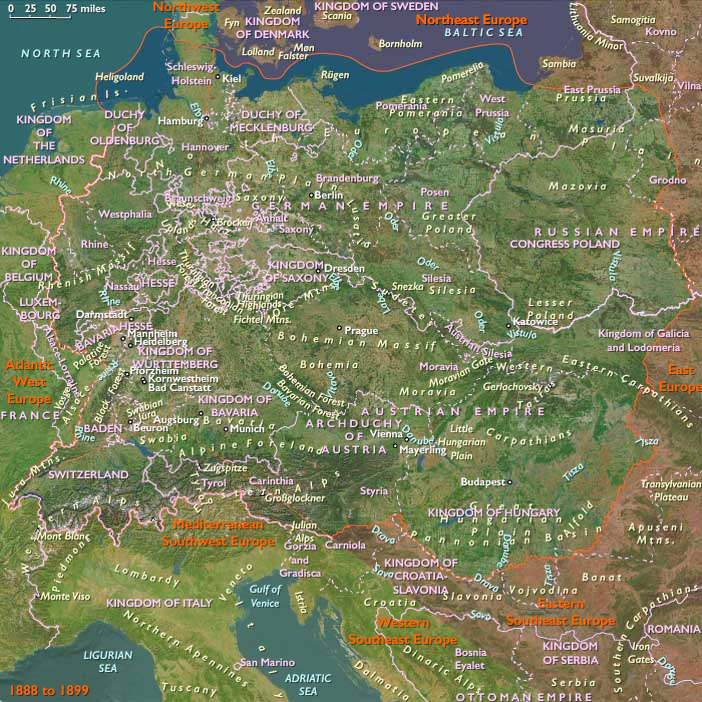
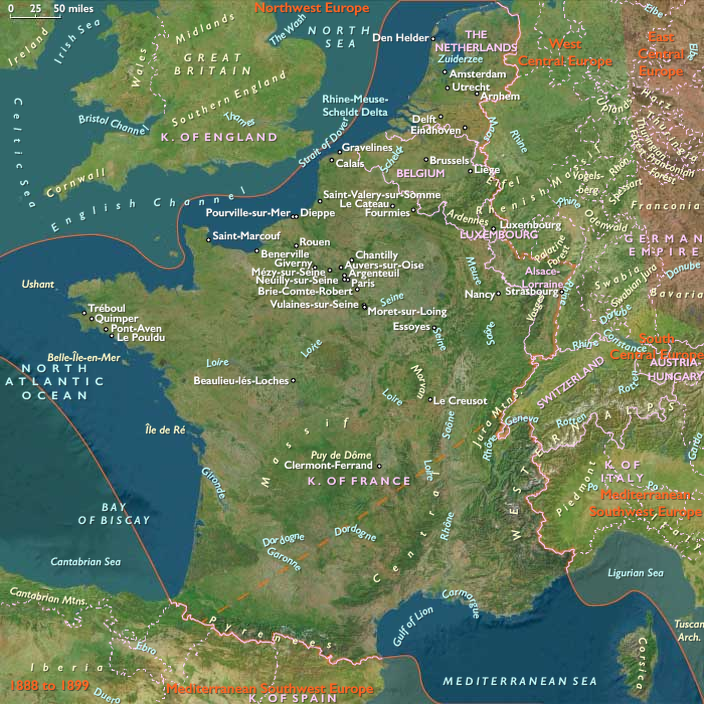
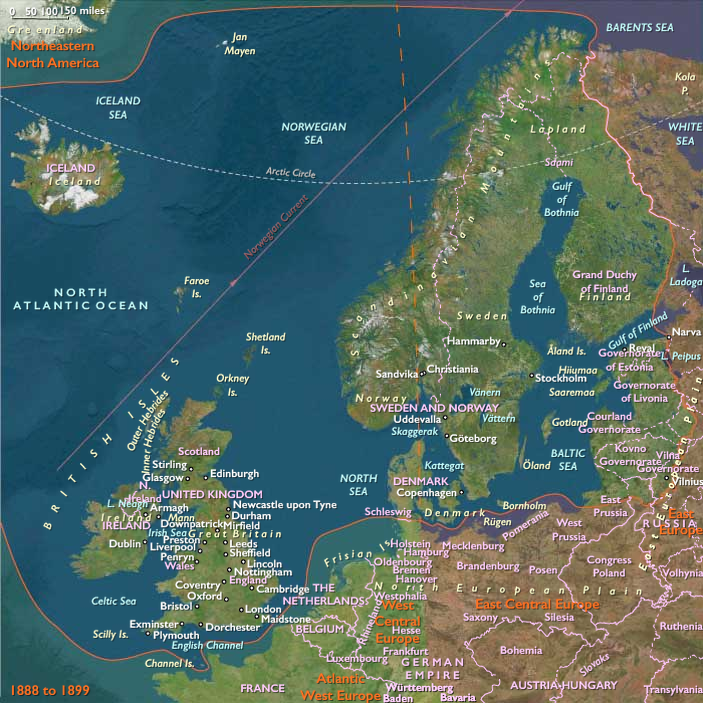
Northwest Europe (1888–1899): Late Victorian Britain, Imperial Strains, and Political Transformations
Imperial Strength and Victorian Symbolism
Between 1888 and 1899, Britain continued as a leading global power, its imperial influence and cultural prestige underscored by Queen Victoria’s symbolic stature. Though politically passive, Victoria remained the emblem of British stability, domestic virtue, and imperial dignity. Yet, beneath this confident façade, Britain faced intensifying political, economic, and social tensions, marking the slow end of the unchallenged Victorian era.
Political Realignment: The Liberal Split and Rise of Conservative Dominance
Britain’s political landscape shifted dramatically following Prime Minister William Ewart Gladstone’s commitment to Irish Home Rule. Historically, Britain’s aristocracy had been politically divided between the Conservative and Liberal parties. However, Gladstone’s embrace of Home Rule caused many aristocrats and upper-class voters to abandon the Liberals, resulting in a permanent Conservative majority in the House of Lords. London's high society, following Queen Victoria’s personal disdain for Home Rule, ostracized prominent Home Rulers, further marginalizing the Liberal party socially.
A key event in this realignment occurred when influential Liberal Joseph Chamberlain broke decisively with Gladstone over Home Rule, taking with him a substantial faction of upper-class Liberal supporters. This group formed the Liberal Unionist Party, aligning closely with the Conservatives, and ultimately merging with them. This shift ensured long-term Conservative dominance, relegating Liberals to political opposition for much of the following two decades.
Gladstonian Liberals and The Newcastle Programme
In response, the remaining Gladstonian Liberals adopted the ambitious Newcastle Programme in 1891, proposing extensive reforms including:
-
Home Rule for Ireland
-
Disestablishment of the Church of England in Wales and Scotland
-
Stricter liquor regulations
-
Extensive factory reform
-
Significant democratic political reforms
The Programme resonated powerfully with middle-class Nonconformist Liberals who felt newly liberated from the dominance of aristocratic influence, reshaping the Liberal party’s social and political foundations.
The Boer War and Imperial Tensions in South Africa
Simultaneously, Britain faced rising imperial tensions in South Africa. British control of the region, established after the Napoleonic Wars, had continuously provoked resistance from Dutch-speaking settlers, or "Boers" (Afrikaners). The Boers established two independent republics—the Transvaal and the Orange Free State—resisting British attempts to assert greater control.
By the late 1890s, the British government, influenced significantly by cabinet minister Joseph Chamberlain, protested against discriminatory policies enacted by Boer leader Paul Kruger in the Transvaal Republic. Historian Andrew Roberts later described Kruger’s administration as oppressive, labeling it a "quasi-police state," noting it refused political rights to nonwhites, Catholics, Jews, and British "Uitlanders" who provided eighty percent of the republic's tax revenues. Despite a population of over fifty thousand British residents, Johannesburg was denied local governance, the English language was banned in official matters, public meetings were outlawed, newspapers censored, and citizenship strictly controlled.
Chamberlain highlighted Uitlander grievances, intensifying tensions. In response to escalating British pressure, the Boers declared war on October 20, 1899, beginning the Second Boer War (1899–1902). Despite numbering only 410,000, the Boer fighters employed effective guerrilla tactics against Britain’s larger and better-equipped forces. Ultimately, overwhelming British numbers, superior equipment, and often harsh military strategies secured a costly British victory, but at significant financial, human, and reputational cost, foreshadowing future imperial challenges.
Rising German Ambitions and Diplomatic Strains
On the broader international stage, the rise of a unified Germany after 1871 increasingly challenged British dominance. Initially, Chancellor Otto von Bismarck’s diplomatic strategy had maintained a peaceful European balance of power. However, after Kaiser William II ascended the German throne in 1888, he dismissed Bismarck, embracing aggressive rhetoric and a naval buildup explicitly designed to rival Britain’s global naval supremacy.
Germany’s expanding industrial strength threatened Britain's traditional industrial and commercial dominance, creating anxiety within Britain’s political and business communities. Germany's ambitions in Africa and the Pacific exacerbated imperial rivalries, gradually leading Britain toward diplomatic isolation and ultimately prompting reconsideration of its long-held policy of "splendid isolation."
Arts, Crafts, and the Cultural Legacy of William Morris
Culturally, Britain witnessed the transformative influence of the Arts and Crafts Movement, led by the influential designer, poet, and early socialist William Morris. Morris’s designs for furniture, fabrics, stained glass, wallpapers, and decorative arts revolutionized Victorian aesthetics, championing craftsmanship, simplicity, and beauty in reaction to industrial mass-production. Morris’s philosophy profoundly reshaped Victorian tastes and contributed to broader cultural shifts toward simpler, more naturalistic designs.
Late Victorian Society: Gender, Fashion, and the “New Woman”
Socially, Britain continued grappling with shifting gender roles. The emergence of the "New Woman" challenged traditional Victorian notions, advocating increased educational opportunities, economic independence, and eventually suffrage for women. Although mainstream fashion continued to favor restrictive corseting, the uncorseted styles promoted by the Aesthetic Movement and other progressive groups gradually influenced broader perceptions of women's autonomy.
Technological Innovation and Industrial Competition
Britain maintained global leadership in industries such as shipbuilding, finance, and communications. The telegraph and rail systems continued facilitating international trade, but Britain faced mounting industrial competition from Germany and the United States, increasingly challenging its industrial supremacy. Economic pressures from the continuing Long Depression period intensified these competitive anxieties.
Lord Salisbury and Gladstone’s Final Years
Politically, Britain’s leadership transitioned between two dominant figures in this era. Conservative Lord Salisbury, characterized by his full beard and patrician bearing, served as Prime Minister multiple times (briefly until January 1886, again from November 1886 to 1892, and once more starting in 1895), offering stable but cautious leadership through a turbulent era.
In contrast, Liberal icon William Ewart Gladstone, known for his sparse beard and charismatic moral leadership, served his fourth and final ministry between 1892 and 1894, attempting once again to pass Irish Home Rule before retiring due to age. Gladstone died in 1898, symbolizing the passing of an era of dynamic, moral-driven reformism in British politics.
Military Reforms and Lingering Challenges
Despite earlier reforms by Gladstone’s War Secretary, Edward Cardwell, the British Army remained plagued by organizational inefficiencies and outdated practices, exposed painfully during the Boer War. The army's voluntary nature, though admired domestically, proved challenging when confronting sustained guerrilla tactics overseas. These weaknesses highlighted critical military vulnerabilities Britain would later need to address.
Scandinavian Stability and Icelandic Nationalism
Scandinavia continued enjoying internal stability. Norway further solidified its distinct national identity within the union with Sweden, setting the stage for later independence movements. Denmark focused inwardly, consolidating after earlier territorial losses.
In Iceland, nationalist sentiments deepened, building on the earlier intellectual and political legacy of nationalist figure Jón Sigurðsson, laying the groundwork for greater autonomy.
Leisure, Tourism, and Victorian Culture
Middle-class leisure expanded steadily, driven by improved transport and rising incomes. Tourism, popularized by entrepreneurs such as Thomas Cook, broadened significantly, facilitating increased international and domestic travel. Literary culture remained vibrant, represented by figures like Oscar Wilde, Arthur Conan Doyle, and Rudyard Kipling, whose works examined social anxieties, imperial tensions, and shifting cultural norms. Wilde’s dramatic 1895 trial, in particular, illustrated tensions within traditional Victorian morality, marking broader cultural transformations at century’s end.
Conclusion: Imperial Confidence, Domestic Strains, and Emerging Modernity
From 1888 to 1899, Britain’s imperial dominance persisted, but underlying domestic and international tensions became increasingly pronounced. Political realignment driven by the Irish Home Rule crisis, challenges posed by the Boer War, rising German ambitions, shifting gender roles, and economic competition from emerging industrial powers defined this critical era. Simultaneously, cultural shifts epitomized by William Morris’s influential designs, rising feminist consciousness, and vibrant literary expressions signaled transformative changes.
This period marked the final years of confident Victorian dominance, revealing strains that would profoundly reshape Britain and Northwest Europe as they entered the twentieth century.
Tensions caused in part by the conflicting interests of the German traders and plantation owners and British business enterprises and American business interests led to the first Samoan Civil War.
The war was fought roughly between 1886 and 1894, primarily between Samoans though the German military intervened on several occasions.
The United States and the United Kingdom opposed the German activity which led to a confrontation in Apia Harbour in 1887.
Robert Louis Stevenson, in A Footnote to History: Eight Years of Trouble in Samoa (1892), details the activities of the great powers battling for influence in Samoa—the United States, Germany and Britain —and the political machinations of the various Samoan factions within their indigenous political system.
Even as they descend into ever greater interclan warfare, what most alarms Stevenson is the Samoans' economic innocence.
In 1894 just months before his death, he addresses the island chiefs:
There is but one way to defend Samoa. Hear it before it is too late. It is to make roads, and gardens, and care for your trees, and sell their produce wisely, and, in one word, to occupy and use your country... if you do not occupy and use your country, others will. It will not continue to be yours or your children’s, if you occupy it for nothing. You and your children will in that case be cast out into outer darkness".
He had "seen these judgments of God," in Hawaii where abandoned native churches stood like tombstones "over a grave, in the midst of the white men’s sugar fields".
The Second Samoan Civil War reaches a head in 1898 when Germany, the United Kingdom, and the United States are locked in dispute over who should control the Samoan Islands.