Robert II of France
King of the Franks
Years: 972 - 1031
Robert II (27 March 972 – 20 July 1031), called the Pious (French: le Pieux) or the Wise (French: le Sage), is King of the Franks from 996 until his death.
The second reigning member of the House of Capet, he is born in Orléans to Hugh Capet and Adelaide of Aquitaine.




Related Events
Filter results
Showing 10 events out of 39 total
Atlantic West Europe (988–999): Consolidation of Capetian Rule and Regional Dynamics
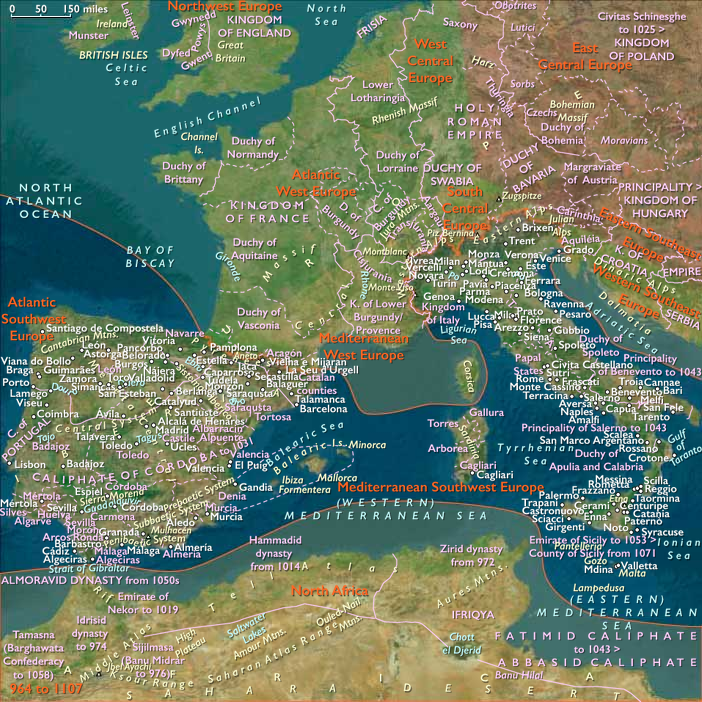
Between 988 and 999, Atlantic West Europe—including the Low Countries, Normandy, Brittany, Aquitaine, Burgundy, central France, Alsace, and Franche-Comté—saw the early consolidation of Capetian authority, continued growth in regional autonomy, and strengthening of ecclesiastical influence, all against the backdrop of increasing feudal decentralization.
Political and Military Developments
-
France: Capetian Consolidation
- Hugh Capet (r. 987–996) firmly established Capetian authority, securing his dynasty's succession by crowning his son Robert II as co-king in 987, thus beginning a hereditary monarchy.
- Robert II (the Pious, r. 996–1031) began his reign by reinforcing royal influence over the nobility, although central authority remained limited outside Île-de-France.
-
Normandy: Ducal Power and Stability
- Richard I of Normandy (r. 942–996) maintained internal cohesion and secured his Duchy's frontiers, preparing the path for the prosperous reign of his successor, Richard II (r. 996–1026).
-
Aquitaine and Burgundy: Local Autonomy
- William IV of Aquitaine (r. 963–990) and William V (r. 990–1030) managed their territories with significant independence, emphasizing stability and economic prosperity.
- Otto-William, Count of Burgundy, strengthened local control, maintaining effective autonomy and regional stability despite nominal loyalty to Capetian rule.
-
Brittany: Struggle for Internal Control
- Brittany experienced internal conflicts after Conan I’s death (992), complicating efforts to maintain regional autonomy against increasing external influences from Normandy and Capetian France.
Economic and Social Developments
-
Feudal Decentralization
- Feudalism deepened throughout the region, reinforcing the power of local counts and dukes who managed estates with minimal royal interference.
- Peasant populations increased in stability as agricultural techniques improved, supporting gradual demographic growth.
-
Commercial and Urban Development
- Maritime trade expanded significantly in the Low Countries, particularly in Bruges, which served as a burgeoning trade hub linking Northern and Southern Europe.
Cultural and Intellectual Developments
- Monastic Revival and Scholarship
- Cluniac monasteries expanded significantly, becoming major centers of intellectual activity, manuscript production, and theological study.
- Monastic scriptoria preserved ancient texts and produced religious literature that deeply influenced Western Christendom.
Religious Developments
- Expansion of Cluniac Reforms
- The influence of the Abbey of Cluny expanded widely, advocating for greater clerical independence from secular powers, and reforming ecclesiastical governance.
- These reforms reshaped religious practice and institutional autonomy across Atlantic West Europe.
Legacy and Significance
The era 988–999 was crucial for setting long-term regional patterns:
- The Capetian dynasty secured its hold on the French throne, laying the foundation for enduring stability.
- Regional rulers maintained substantial autonomy, shaping distinct political identities for Normandy, Aquitaine, Brittany, and Burgundy.
- The continued rise of feudalism shaped the socio-economic landscape for centuries to come.
- Cluniac reforms significantly impacted the religious and cultural life of the region, influencing European Christianity far beyond its borders.
Hugh Capet and the Founding of the Capetian Dynasty (987)
By 986, Hugh Capet had become king in all but name, having carefully positioned himself as the dominant noble in West Francia through strategic alliances with the Holy Roman Empire and the Archbishop of Reims. His rise marked the end of Carolingian rule and the beginning of the Capetian dynasty, a lineage that would shape the course of French history for centuries.
The Path to the Throne
From 977 to 986, Hugh allied himself with:
- Emperor Otto II and later Otto III, supporting their efforts to keep Lotharingia under imperial control.
- Archbishop Adalberon of Reims, one of the most powerful churchmen in France, who favored the Capetian claim over the declining Carolingians.
- Gerbert of Aurillac (the future Pope Sylvester II), a key intellectual figure who opposed Carolingian attempts to seize Lorraine from the empire.
By the time King Lothair and his son, Louis V, died in early 987, Hugh had already consolidated enough support to secure the throne.
Election and Coronation (July 3, 987)
Following the deaths of Lothair and Louis V, Adalberon and Gerbert convened an assembly of nobles, ensuring that Hugh Capet was elected and crowned Rex Francorum (King of the Franks) at Noyon in Picardy on July 3, 987. His crowning by the Archbishop of Reims was a decisive moment, marking the formal end of the Carolingian dynasty and the beginning of Capetian rule.
The Coronation of Robert II (December 25, 987)
Hugh quickly sought to secure his dynasty, pressing for the coronation of his son, Robert II, later known as Robert the Pious.
- Hugh justified this by citing his planned expedition to aid Borrel II of Barcelona against Moorish incursions—an invasion that ultimately never took place.
- He argued that two kings were necessary to ensure stability should he perish on campaign.
- Robert II was crowned co-king on December 25, 987, establishing the Capetian tradition of hereditary succession, which helped ensure dynastic stability.
The Birth of a Dynasty
Hugh’s reign marked the beginning of modern France, as he centered royal power in Paris, his base as Count of Paris. Though his early rule was limited in scope, the Capetians would gradually consolidate control over France, transforming the feudal patchwork into a centralized monarchy.
The House of Capet (987–1328) would rule directly for over three centuries, with its Valois (1328–1589) and Bourbon (1589–1792, 1814–1830) cadet branches continuing to rule thereafter. Even today, Capetian bloodlines remain on European thrones:
- Spain, through the House of Bourbon (King Juan Carlos I and his successors).
- Luxembourg, through the House of Nassau-Weilburg, another Capetian branch.
With the Capetians establishing a dynasty that endured for over a thousand years, Hugh Capet’s coronation in 987remains one of the most significant turning points in French and European history.
The Council of Mousson and the Struggle for the Archbishopric of Reims (995–996)
Following the contested deposition of Archbishop Arnulf of Reims by Hugh Capet’s synod in 991, Pope John XVsought to settle the matter through a broader council that would include both French and German bishops. However, Capetian resistance to papal interference led to a stalemate, highlighting the growing conflict between royal authority and papal supremacy.
The Council of Mousson: French Obstruction and German Support
- The Papal Legate, sent by John XV, was tasked with convening a council of bishops from both France and the Holy Roman Empire at Mousson, a neutral site near the imperial border.
- However, only the German bishops managed to attend; the French bishops were blocked by Hugh Capet and Robert II, who prevented their participation, fearing a ruling against the Capetian-backed Archbishop Gerbert of Aurillac.
- Despite this obstruction, the German bishops, under imperial influence, ruled that Arnulf’s deposition was illegal, effectively nullifying the decisions made at the Synod of Reims (991).
Gerbert’s Suspension and His Defense
- As a result of the ruling, Gerbert of Aurillac, who had been installed as Archbishop of Reims by Hugh Capet, was suspended from his episcopal office.
- Gerbert, a brilliant scholar and political strategist, argued that the decree against him was unlawful, appealing to imperial and theological authorities in his defense.
- Despite his efforts, he lost official recognition as Archbishop of Reims, forcing him to seek support from Emperor Otto III, who would later play a decisive role in his career.
Aftermath: Papal and Imperial Maneuvering
- The failure of the French bishops to attend Mousson demonstrated the Capetians' growing defiance of papal authority, foreshadowing future conflicts between the French monarchy and the papacy.
- Gerbert’s alignment with the Holy Roman Empire led to his eventual rise as Pope Sylvester II (999–1003), where he would continue to champion imperial-papal cooperation against Capetian interests.
- Meanwhile, Arnulf was restored in name, but his authority in Reims remained weak and contested, reflecting the Capetians’ firm grip on ecclesiastical appointments in their realm.
Significance
The Council of Mousson marked a turning point in the struggle for control over the French Church, revealing both the Capetians' determination to dominate episcopal appointments and the papacy’s limited ability to enforce its rulings within France. While the Holy Roman Empire upheld papal legitimacy, the Capetians successfully cemented their control over the French episcopate, setting a precedent for the future Gallican Church and the French monarchy’s increasing independence from Rome.
The Death of Hugh Capet and the Restoration of Arnulf (996)
On October 24, 996, Hugh Capet, the first king of the Capetian dynasty, died, marking the end of his reign and the beginning of Robert II’s sole rule. His death led to political shifts in the French Church, particularly the restoration of Arnulf of Reims, and sparked anti-Jewish sentiment due to false accusations surrounding his passing.
The Restoration of Arnulf of Reims
- Arnulf, the deposed Archbishop of Reims, had been imprisoned following his Carolingian sympathies and role in aiding Charles of Lorraine against Hugh.
- Upon Hugh’s death, Arnulf was released and soon restored to his ecclesiastical office, as the political climate shifted under Robert II.
- His return to power symbolized the weakening of the strict Capetian control over the French Church, at least temporarily.
The False Accusation Against Hugh’s Physician
- A Jewish physician who had attended Hugh Capet was falsely accused of poisoning the king.
- This accusation was exploited by anti-Jewish factions, leading to renewed arguments that Jews should not hold important positions in the kingdom.
- Although there was no credible evidence of foul play, the claim fueled anti-Semitic sentiment, setting a precedent for later discrimination against Jewish communities in medieval France.
Hugh’s Burial and the Continuation of the Capetian Dynasty
- Hugh Capet was interred at the Basilica of Saint-Denis, the traditional burial site of French kings, reinforcing the Capetians' claim to Carolingian legitimacy.
- His son, Robert II ("the Pious"), who had already been crowned co-king in 987, assumed full royal authority.
- Soon after, Robert married his cousin, Bertha of Burgundy, a politically significant but ultimately controversial union that would be contested by the Church.
Legacy
Hugh Capet’s death in 996 marked a turning point for the Capetian dynasty. His careful groundwork had ensured the continuity of Capetian rule, but challenges remained, particularly in securing the monarchy’s authority against powerful nobles and navigating conflicts with the papacy over Robert’s marriage. Meanwhile, the reintegration of Arnulf and the anti-Jewish accusations surrounding Hugh’s death reflected the ongoing struggles between royal power, religious authority, and societal prejudices in medieval France.
Robert II of France: Conflict with the Papacy and Forced Submission (996–1003)
Early in his reign, Robert II ("the Pious") sought to assert greater royal authority over the French Church, particularly in the appointment of bishops. His insistence on controlling ecclesiastical appointments and his controversial marriage to Bertha of Burgundy brought him into direct conflict with Pope Gregory V, culminating in a severe papal response that forced him to submit.
Royal Authority vs. Papal Supremacy
- As king, Robert continued the Capetian policy of asserting control over the French episcopate, appointing bishops loyal to the monarchy.
- This practice challenged the papacy’s authority, as bishops traditionally required papal approval for their consecration.
- Pope Gregory V (r. 996–999) responded by pressuring Robert to abandon this practice, leading to a growing power struggle between the French monarchy and the Church.
The Controversial Marriage to Bertha of Burgundy
- After the death of his father, Hugh Capet, in 996, Robert sought to strengthen his political position by marrying Bertha of Burgundy, his cousin.
- The union was condemned by the Church as incestuous, violating canon law on consanguinity.
- Despite repeated warnings, Robert refused to repudiate Bertha, further intensifying papal opposition.
Excommunication and Submission
- In response to both the bishopric dispute and Robert’s refusal to annul his marriage, Pope Gregory V placed the Kingdom of France under an interdict, enforcing a sentence of excommunication on Robert.
- The excommunication was rigorously enforced, effectively isolating the king, weakening his support among the nobility and clergy.
- Facing mounting pressure, Robert was ultimately forced to back down:
- He abandoned his claims over episcopal appointments, allowing papal influence in the selection of bishops.
- He reluctantly put aside Bertha, submitting to the Church’s demands.
Aftermath and Legacy
- Robert later remarried Constance of Arles, a politically advantageous but troubled union.
- The conflict between French royal authority and the papacy foreshadowed later investiture struggles and the Capetian monarchy’s growing independence from Rome.
- Though forced to submit, Robert II’s reign demonstrated the Capetians’ ongoing ambition to control the French Church, a struggle that would define much of medieval French history.
Robert II’s confrontation with Pope Gregory V was an early test of Capetian rule, revealing the limits of royal power in the face of papal authority but also setting the stage for future conflicts between the monarchy and the Church.
Atlantic West Europe (1000–1011): Dynastic Crisis and the Struggle for Burgundy
Between 1000 and 1011, Atlantic West Europe—which includes the Low Countries, Brittany, Normandy, Aquitaine, Burgundy, central France, Alsace, and Franche-Comté—experienced significant dynastic turmoil, notably in Burgundy, alongside ongoing consolidation of feudal territories.
Political and Military Developments
-
Burgundy: Succession Crisis (1002)
Following the death of Henry the Venerable, Duke of Burgundy (r. 965–1002), a bitter dynastic conflict erupted between his nephew, King Robert the Pious of France, and his stepson and adopted heir, Otto-William, Count of Burgundy and Mâcon.- Robert the Pious asserted his claim based on royal overlordship and blood kinship, aiming to incorporate Burgundy firmly into the French sphere.
- Otto-William, backed by his son-in-law Landry, Count of Nevers, contested this claim, envisioning a unified Burgundy (combining both the duchy and county), potentially aligned with the Holy Roman Empire, which would have profoundly shifted regional geopolitics.
-
France: Capetian Consolidation
King Robert the Pious (r. 996–1031) sought to strengthen royal authority, but his reign was strained by noble revolts and the Burgundy conflict, limiting effective centralization elsewhere. -
Normandy and Aquitaine
Normandy enjoyed stability under Duke Richard II (r. 996–1026), consolidating territorial authority.
Aquitaine under William V (r. 995–1030) remained internally prosperous, although tensions persisted with neighboring feudal lords.
Religious and Cultural Developments
- Monastic Reform Movements
The Cluniac reform movement, emanating from Burgundy, continued to spread, reinforcing ecclesiastical authority and spiritual renewal across Western Europe.
Atlantic West Europe (1012–1023): Burgundy's Fate and the Capetian Settlement
Between 1012 and 1023, Atlantic West Europe witnessed the resolution of the Burgundian succession crisis, consolidating French influence in the region while definitively preventing the creation of a unified Burgundian state under imperial influence.
Political and Military Developments
-
Resolution of the Burgundian Conflict (1015)
After thirteen years of protracted and destructive warfare, Robert the Pious emerged victorious, securing the Duchy of Burgundy firmly within the Kingdom of France.- The territories west of the Saône, including the strategic city of Dijon, came under definitive Capetian control.
- Otto-William, retaining only the County of Burgundy (Franche-Comté) east of the Saône, saw his ambitions to unify the two Burgundies dashed, ensuring that the duchy would remain French and the county influenced more by the Holy Roman Empire.
-
Capetian Territorial Redistribution (1016–1032)
Initially, Robert the Pious incorporated the duchy directly into the French royal domain. However, acknowledging practical administrative challenges and family politics, Robert granted the territory to his younger son and namesake, Robert, around 1016.- The arrangement became definitive in 1032 under King Henry I (r. 1031–1060), formally recognizing his brother Robert as Duke of Burgundy, allowing the duchy to be passed down within the Capetian lineage while owing feudal allegiance to the French crown.
-
Normandy and Brittany
Duke Richard II continued his stable rule in Normandy, strengthening ties with England and Scandinavia. Brittany maintained internal stability under Geoffrey I (r. 992–1008) and Alan III (r. 1008–1040), emphasizing regional autonomy amid surrounding tensions.
Economic and Social Developments
- Trade and Urban Development
Despite regional conflict, urban economies—especially Dijon, Auxerre, Tours, and Orléans—continued to grow as agricultural surpluses expanded markets.
Religious and Cultural Developments
- Growth of Cluniac Influence
The Cluniac movement continued its spiritual and cultural expansion, profoundly influencing monastic life, church reform, and European spirituality from its Burgundian heartland.
The Marital Affairs of Robert II of France: Dynastic Strategy and Papal Opposition (989–1001)
As the Capetian dynasty sought to establish its legitimacy and secure powerful alliances, Robert II of France was repeatedly entangled in politically driven marriages, often encountering papal resistance. His early marriages reflect the complex diplomatic maneuvering of the period, as well as the growing influence of the papacy over royal unions.
First Marriage: Rozala-Susanna of Italy (989–996)
- Around 989, Hugh Capet, having failed to secure an imperial bride from Constantinople for his son, arranged for Robert to marry Rozala (Susanna), the daughter of Berengar II of Italy.
- Rozala, already a widow of Arnulf II of Flanders, was many years older than Robert and brought with her substantial Flemish territories, strengthening Capetian control in the north.
- However, this union was short-lived. After Hugh Capet’s death in 996, Robert divorced Rozala, discarding the Flemish alliance in favor of a Burgundian connection.
Second Marriage: Bertha of Burgundy and Papal Excommunication (996–1000)
- Robert then pursued Bertha of Burgundy, daughter of Conrad of Burgundy and widow of Odo I of Blois.
- This match was politically advantageous, reinforcing Capetian claims in Burgundy and countering the power of the House of Blois.
- However, Bertha was Robert’s cousin, and Pope Gregory V refused to sanction the marriage on grounds of consanguinity.
- Despite this, Robert persisted in the union, leading to his excommunication by the pope.
- The excommunication weakened his position, forcing him into lengthy negotiations with Gregory’s successor, Sylvester II, who eventually annulled the marriage.
Final and Lasting Marriage: Constance of Arles (1001)
- In 1001, Robert entered into his final and longest-lasting marriage with Constance of Arles, the daughter of William I of Provence.
- This union cemented Capetian ties with southern France, an increasingly wealthy and influential region.
- Constance proved to be a strong-willed and politically assertive queen, often at odds with Robert’s courtiers but ultimately securing her family’s influence at court.
Impact and Legacy
- Robert’s turbulent marital history highlights the Capetians’ struggle to consolidate power while navigating the growing influence of the papacy.
- His excommunication and forced annulment demonstrated the Church’s increasing authority over royal marriages, a conflict that would later resurface in French history.
- Ultimately, his union with Constance of Arles produced several heirs, securing the Capetian dynasty’s future stability.
Robert’s marital missteps illustrate the fragile balance of dynastic ambition, papal authority, and feudal politics in the early Capetian era, as France slowly transformed into a more centralized medieval monarchy.
Robert II’s Expansionist Ambitions and the Failed Invasion of the County of Burgundy (1003)
Upon inheriting the Capetian throne in 996, Robert II ("the Pious") ruled over a relatively small and fragmented kingdom, with his direct authority largely confined to Île-de-France. To expand his power, Robert aggressively pursued vacant feudal lands, asserting royal claims wherever possible. This often led to conflict with regional lords, as seen in his failed invasion of the County of Burgundy in 1003.
Robert’s Territorial Aspirations
- The Capetian kings of the early 11th century had little control over the powerful feudal duchies and countiesthat made up much of what is now France.
- Unlike later French kings, Robert did not inherit a strong centralized monarchy but instead relied on dynastic claims and feudal conflicts to expand his direct influence.
- His strategy was to assert Capetian rights over any feudal land that became vacant, leading to military campaigns against rival claimants.
The Invasion of the County of Burgundy (1003)
- In 1002, the death of Otto-William, Count of Burgundy, left a succession dispute over the Free County of Burgundy (Franche-Comté).
- Seeing an opportunity to extend Capetian control eastward, Robert II launched an invasion in 1003.
- However, local resistance, likely led by Otto-William's allies and supported by Holy Roman Empire-backed forces, thwarted the Capetian advance.
Consequences of the Failed Campaign
- Robert II’s inability to seize Burgundy highlighted the limitations of Capetian power in this era.
- The failure of the invasion reinforced the autonomy of the region, which remained outside Capetian control.
- This setback demonstrated that Capetian authority was not yet strong enough to impose direct rule over the great feudal lords, a challenge that would persist for centuries.
Legacy
Though unsuccessful, Robert II’s aggressive feudal claims laid the groundwork for future Capetian expansion. Later kings, particularly Philip II Augustus, would adopt similar strategies but with greater success, gradually consolidating royal authority over France’s fragmented feudal territories.
The Turbulent Marriage of Robert II and Constance of Arles: Intrigue and Murder (1007)
The marriage between Robert II of France ("the Pious") and Constance of Arles, finalized in 1001, quickly became a source of conflict at the French court. While it provided the Capetian dynasty with southern French connections, it also created deep resentment among the northern nobility, who despised Constance’s Provençal customs and kinfolk.
Court Tensions and Political Intrigue
- Constance of Arles, the daughter of William I of Provence, introduced southern influences into the Parisian court, which were viewed with suspicion and hostility by the established Frankish nobility.
- Many of Robert II’s courtiers, still loyal to his former wife, Bertha of Burgundy, openly opposed Constance, creating factions within the royal court.
- Among Constance’s most outspoken opponents was Hugh of Beauvais, one of Robert’s closest advisors, who resented the influence of her Provençal relatives.
The Assassination of Hugh of Beauvais (1007)
- In 1007, Hugh of Beauvais attempted to persuade Robert II to repudiate Constance, possibly hoping to reinstate Bertha of Burgundy or secure a new political marriage for the king.
- Shortly after, twelve knights—all reportedly linked to Fulk III, Count of Anjou, a powerful ally of Constance’s family—murdered Hugh of Beauvais, likely at Constance’s instigation.
- The brutal assassination shocked the French court and further deepened the divisions between the northern nobles and Constance’s Provençal allies.
Aftermath and Political Consequences
- Robert II did not repudiate Constance, but tensions between them persisted for years.
- The murder weakened Robert’s control over his court, as many of his traditional allies saw him as being manipulated by his wife and her southern kin.
- The House of Anjou’s role in the assassination signaled a growing rivalry between northern and southern noble factions, which would continue to destabilize the Capetian court in the following years.
Legacy
The marital discord between Robert II and Constance of Arles, combined with political murders and court rivalries, highlighted the fragile authority of the early Capetian monarchy. Constance’s assertive influence, though controversial, helped shape the future of Capetian rule, demonstrating the power struggles between the king, his noble advisors, and an ambitious queen determined to protect her family’s interests.
The Anti-Jewish Persecutions in France Under Robert II ("the Pious") (1007–1009)
Between 1007 and 1009, a wave of violent persecution against Jews swept across France, instigated by King Robert II ("the Pious"). This period marked the first large-scale anti-Jewish violence in medieval France, characterized by forced conversions, massacres, and state-sponsored oppression.
Robert II’s Role in the Persecutions
- Robert, known for his rigid religious orthodoxy and intolerance, is credited with ordering forced conversionsof Jews within his realm.
- According to a Hebrew pamphlet from the period, Robert conspired with his vassals to eliminate all Jews who refused baptism, resulting in widespread deaths, including executions and mass suicides.
- The learned Rabbi Senior is listed among the martyrs who perished during these persecutions.
- Jewish communities in major urban centers, including Orléans, Rouen, and Sens, likely faced mob violenceand expulsions.
Context and Religious Intolerance
- Robert II was well known for his harsh stance against heretics, reinstating the Roman imperial custom of burning heretics at the stake.
- His religious fervor extended beyond anti-Jewish persecution; he promoted Church reform and strengthened royal authority over ecclesiastical matters, often in conflict with the papacy.
- His intolerance set a precedent for later Capetian policies, foreshadowing future waves of anti-Jewish violence in medieval France.
Legacy and Consequences
- The persecutions of 1007–1009 were among the earliest known incidents of systematic anti-Jewish violence in medieval Europe, preceding the massacres of the First Crusade (1096).
- They deepened Jewish-Christian tensions, pushing Jewish communities to seek protection from local feudal lords or the Holy Roman Empire, where imperial policies toward Jews were often more pragmatic.
- Robert II’s religious policies reinforced his reputation as an enforcer of Christian orthodoxy, though at the cost of further alienating religious minorities.
While the Capetian monarchy would later temper its treatment of Jewish communities for economic and political reasons, Robert II’s actions marked a dark chapter in the history of medieval France, illustrating the intersection of royal authority, religious zeal, and intolerance.