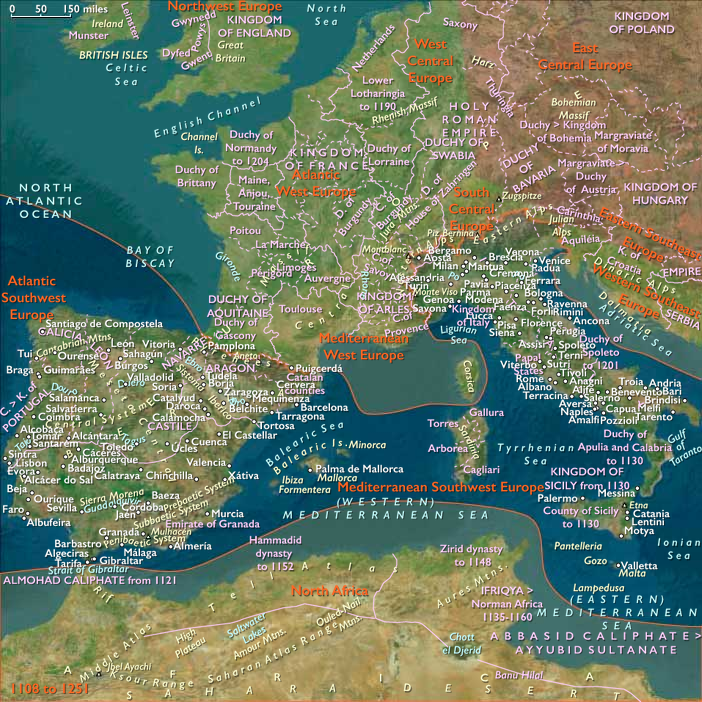
Roger, in shock, wheels his army around and turns instead for Nocera, the greatest fortified city of the prince of Capua, other than Capua itself.
The retreat over the Apennines is miraculously quick, but the rebels move equally speedily to meet the royal army at Nocera; however, Roger destroys the sole bridge spanning the river Sarno.
The rebels, with rapidity equally miraculous, construct a temporary bridge and move in on the Noceran siege.
Roger raises his siege at the coming of the rebel army and Ranulf sends two hundred and fifty knights ahead to the city walls to divert a fraction of the royal troops.
The rebel army forms into two wings.
Robert of Capua heads up the left wing and Ranulf the right.
Each of the rebel wings is itself deployed into three divisions.
Robert's divisions are formed in column, with mounted troops in the first and third lines, and foot soldiers in the second line.
Ranulf forms his all-cavalry wing with his divisions in line.
King Roger forms his army into eight divisions.
These are deployed opposite Robert's wing in a column, that is, one division behind the other.
The royal army, which includes Muslim infantry, is said to have three thousand cavalry and forty thousand infantry.
On July 24, a Sunday, Roger initiates the engagement, charging the prince's knights.
The royal troops breaks Robert's first and second lines.
The Capuan infantry retreats over the makeshift bridge, which collapses and a thousand supposedly drown.
The Capuan third division holds firm and counterattacks.
By this time, the second royal division has been sent into the contest.
Roger orders a second charge, which is initially successful, pushing back the remaining Capuans.
At this moment, Ranulf joins the fray with five hundred of the mounted men from his center.
He hits Roger's left flank and the royalists begin to waver.
Before reinforcements can be sent to help them, Ranulf sends in his right and then his left divisions.
The royal troops crumble.
Roger himself tries to inspire them, but they are already in retreat, the flight of the first two divisions having panicked the others.
The king barely escapes to Salerno, guarded by only four knights.
The rebel victory is absolute.
Seven hundred knights are captured and twenty-four loyalist barons, along with the royal camp.
The royal infantry suffers heavy losses in the rout.
The booty is immense, according to chroniclers sympathetic to the rebels (Falco of Benevento), and those sympathetic to the royalists (Henry, Bishop of Saint Agatha).
Among the booty is the bull of Antipope Anacletus II granting Roger the royal title.
The battle is of little long-term importance, however, because Pope Innocent II and Emperor Lothair II do not continue past Rome and thus the rebels, without further assistance, lose many of their gains and will be forced to surrender by July 1134.