Alan III of Brittany and His Struggle Against Norman Suzerainty (1008–1030s)
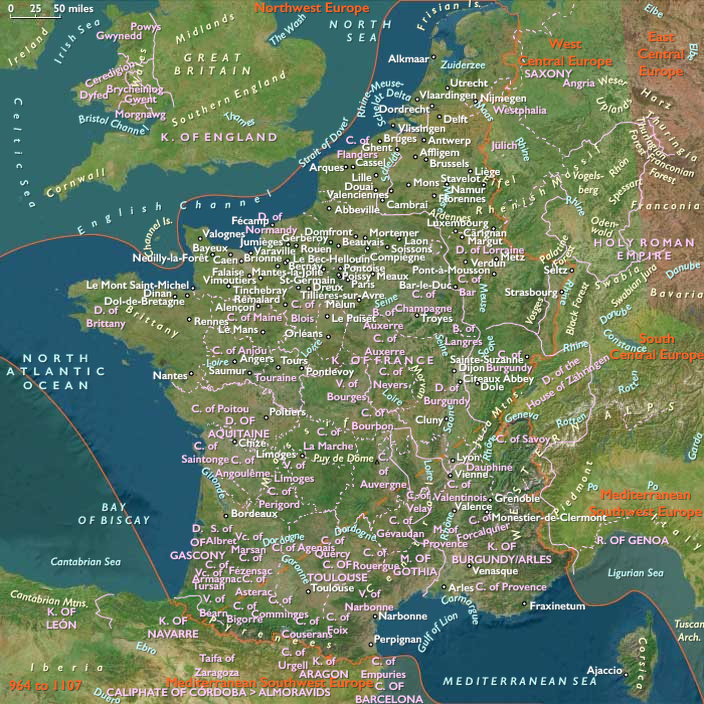
Alan III of Brittany, the son of Duke Geoffrey I and Hawise of Normandy, succeeded as Duke of Brittany in 1008. However, as he was still a minor, his mother acted as regent, while Richard II, Duke of Normandy—his maternal uncle—assumed guardianship over Brittany. This early connection with Normandy played a crucial role in shaping Alan’s later conflicts as he sought to assert Brittany’s independence.
Early Rule and Marriage Alliance (1008–1018)
- While his mother, Hawise of Normandy, governed Brittany as regent, Alan was raised under the influence of the Norman ducal court.
- In 1018, Alan married Bertha of Blois, daughter of Odo II, Count of Blois, and Ermengarde of Auvergne, solidifying an alliance with the House of Blois, a long-time rival of Normandy.
- This marriage strengthened Brittany’s political position and provided Alan with an influential continental allyagainst Norman expansion.
Break from Norman Suzerainty (1026–1030s)
- When Richard III of Normandy died in August 1026, his brother Robert I succeeded him. The transition sparked political unrest in Normandy.
- Alan III, seeing an opportunity, attempted to break free from Norman overlordship, effectively declaring Brittany’s independence from Norman control.
Conflict Between Alan III and Robert I of Normandy (1030s)
- The conflict escalated into a series of raids and counter-raids between Brittany and Normandy:
- Early 1030s: Robert I of Normandy launched an attack on Dol, an important Breton stronghold.
- In retaliation, Alan III raided Avranches, but his forces were repulsed, leading to continued border skirmishes between Brittany and Normandy.
- The situation worsened as Robert prepared for a full-scale invasion, planning a land assault alongside a fleet attack on Brittany.
The Truce at Mont Saint-Michel (1033–1034)
- As tensions mounted, Robert, Archbishop of Rouen—uncle to both Alan and Robert I—stepped in to mediatebetween his nephews.
- A truce was negotiated at Mont Saint-Michel, a symbolically neutral site between Brittany and Normandy.
- As part of the agreement:
- Alan III swore fealty to Robert I, acknowledging Norman suzerainty.
- In return, Normandy halted its invasion plans, stabilizing the region for the time being.
Legacy and Impact
- Alan III’s attempt at independence from Norman overlordship ultimately failed, though he preserved Brittany’s territorial integrity.
- The truce at Mont Saint-Michel ensured temporary peace, but Brittany remained under Norman influence for the remainder of Alan’s reign.
- His alliance with Blois placed Brittany in a strategic position between France and Normandy, a factor that would continue to shape Breton politics in the 11th century.
Alan III’s rebellion and subsequent truce reflected the delicate balance of power in feudal Europe, where dukes and counts continually maneuvered between autonomy and vassalage, depending on the shifting fortunes of war and diplomacy.