Robert I, Duke of Normandy
Years: 1000 - 1035
Robert the Magnificent (French: le Magnifique)[a] (22 June 1000 – 1–3 July 1035), is the Duke of Normandy from 1027 until his death.
Owing to uncertainty over the numbering of the Dukes of Normandy, he is usually called Robert I, but sometimes Robert II with his ancestor Rollo as Robert I.
He is the father of William the Conqueror, who becomes in 1066 King of England and founds the House of Normandy.

Related Events
Filter results
Showing 5 events out of 5 total
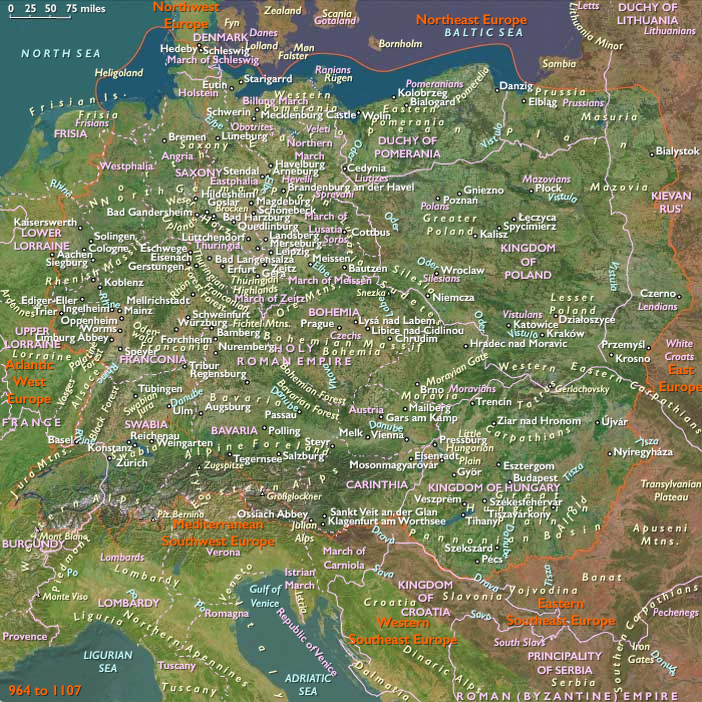
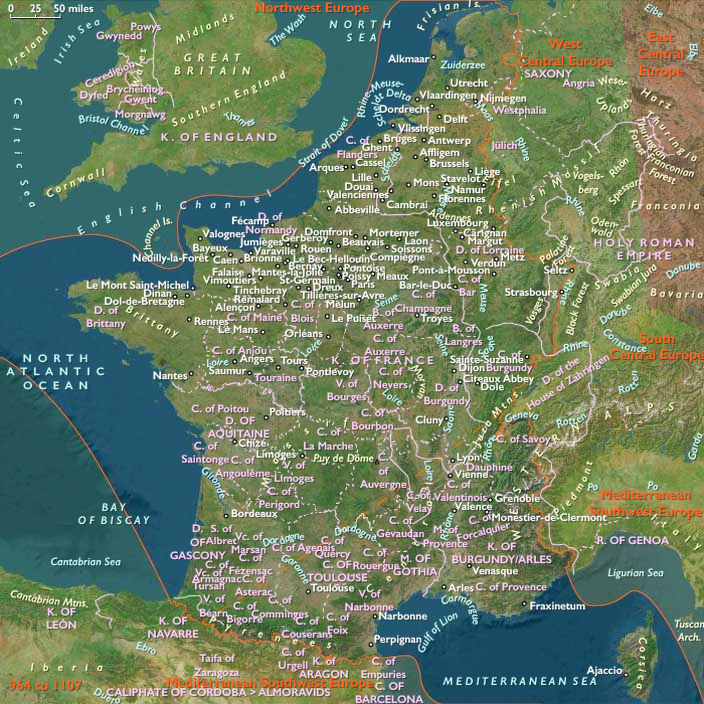
Atlantic West Europe (1024–1035): Consolidation of Power, Regional Stability, and the Emergence of Capetian Burgundy
The era from 1024 to 1035 in Atlantic West Europe—which includes the Low Countries, Brittany, Normandy, Aquitaine, Burgundy, central France, Alsace, and Franche-Comté—was defined by ongoing consolidation of power, strategic alliances, territorial stabilization, and the pivotal establishment of Capetian Burgundy.
Political and Military Developments
-
France: Capetian Consolidation and Stability
-
King Robert II (the Pious, r. 996–1031) maintained domestic stability, strengthened central authority, and secured regional loyalties through strategic marriages and alliances.
-
His successor, Henry I (r. 1031–1060), initially faced internal conflicts and noble revolts but gradually consolidated royal authority through tactical diplomacy and territorial concessions.
-
-
Duchy of Burgundy: Formation of Capetian Burgundy
-
Following the succession crisis after Duke Henry the Venerable’s death in 1002, the prolonged dispute between Robert II and Otto-William ended in favor of Robert by around 1015, definitively placing the Duchy of Burgundy under French influence.
-
In 1032, King Henry I solidified this arrangement by formally granting the Duchy of Burgundy to his younger brother, Robert I, marking the beginning of the Capetian Dukes of Burgundy, distinct from the County of Burgundy (Franche-Comté), which remained under the sphere of the Holy Roman Empire.
-
-
County of Burgundy (Franche-Comté): Distinct Identity
-
Otto-William and his descendants retained the County of Burgundy, which became increasingly oriented toward the Holy Roman Empire, diverging politically and culturally from the Duchy.
-
-
Normandy and Brittany: Regional Power Dynamics
-
Duke Richard III of Normandy’s short reign (1026–1027) led to internal disputes, quickly resolved under his brother Robert I (r. 1027–1035), who stabilized the duchy and extended Norman influence.
-
Brittany remained relatively autonomous, managing external pressures from Normandy and strengthening its internal cohesion.
-
Economic and Social Developments
-
Continued Agricultural Expansion
-
Technological improvements in agriculture, including crop rotation and the widespread use of heavy plows, further enhanced productivity and supported growing populations.
-
-
Urban Revival and Trade Networks
-
Urban centers such as Paris, Rouen, and Dijon continued expanding economically, benefiting from improved trade routes and local production.
-
Religious and Cultural Developments
-
Monastic Reforms and Cluniac Influence
-
Cluny Abbey and its affiliated monasteries strengthened their spiritual and political roles, spreading Cluniac reforms throughout the region and beyond.
-
-
Cultural Flourishing and Manuscript Production
-
Monastic scriptoria continued to produce illuminated manuscripts, fostering literary and intellectual growth across Atlantic West Europe.
-
Legacy and Significance
The period 1024 to 1035 significantly shaped the political landscape of Atlantic West Europe. The establishment of Capetian Burgundy under Duke Robert I clarified regional political alignments, distinguishing the French-aligned Duchy from the Holy Roman-oriented County. This political delineation influenced subsequent territorial and diplomatic dynamics across the region, laying foundations for future developments in Atlantic West Europe.
Alan III of Brittany and His Struggle Against Norman Suzerainty (1008–1030s)
Alan III of Brittany, the son of Duke Geoffrey I and Hawise of Normandy, succeeded as Duke of Brittany in 1008. However, as he was still a minor, his mother acted as regent, while Richard II, Duke of Normandy—his maternal uncle—assumed guardianship over Brittany. This early connection with Normandy played a crucial role in shaping Alan’s later conflicts as he sought to assert Brittany’s independence.
Early Rule and Marriage Alliance (1008–1018)
- While his mother, Hawise of Normandy, governed Brittany as regent, Alan was raised under the influence of the Norman ducal court.
- In 1018, Alan married Bertha of Blois, daughter of Odo II, Count of Blois, and Ermengarde of Auvergne, solidifying an alliance with the House of Blois, a long-time rival of Normandy.
- This marriage strengthened Brittany’s political position and provided Alan with an influential continental allyagainst Norman expansion.
Break from Norman Suzerainty (1026–1030s)
- When Richard III of Normandy died in August 1026, his brother Robert I succeeded him. The transition sparked political unrest in Normandy.
- Alan III, seeing an opportunity, attempted to break free from Norman overlordship, effectively declaring Brittany’s independence from Norman control.
Conflict Between Alan III and Robert I of Normandy (1030s)
- The conflict escalated into a series of raids and counter-raids between Brittany and Normandy:
- Early 1030s: Robert I of Normandy launched an attack on Dol, an important Breton stronghold.
- In retaliation, Alan III raided Avranches, but his forces were repulsed, leading to continued border skirmishes between Brittany and Normandy.
- The situation worsened as Robert prepared for a full-scale invasion, planning a land assault alongside a fleet attack on Brittany.
The Truce at Mont Saint-Michel (1033–1034)
- As tensions mounted, Robert, Archbishop of Rouen—uncle to both Alan and Robert I—stepped in to mediatebetween his nephews.
- A truce was negotiated at Mont Saint-Michel, a symbolically neutral site between Brittany and Normandy.
- As part of the agreement:
- Alan III swore fealty to Robert I, acknowledging Norman suzerainty.
- In return, Normandy halted its invasion plans, stabilizing the region for the time being.
Legacy and Impact
- Alan III’s attempt at independence from Norman overlordship ultimately failed, though he preserved Brittany’s territorial integrity.
- The truce at Mont Saint-Michel ensured temporary peace, but Brittany remained under Norman influence for the remainder of Alan’s reign.
- His alliance with Blois placed Brittany in a strategic position between France and Normandy, a factor that would continue to shape Breton politics in the 11th century.
Alan III’s rebellion and subsequent truce reflected the delicate balance of power in feudal Europe, where dukes and counts continually maneuvered between autonomy and vassalage, depending on the shifting fortunes of war and diplomacy.
The Birth and Early Years of William of Normandy (1027/1028–1035)
William of Normandy, later known as William the Conqueror, was born in late 1028 at Falaise, Normandy. He was the only son of Duke Robert I of Normandy and Herleva, the daughter of Fulbert of Falaise, who may have been a tanner or embalmer. William’s illegitimacy would later shape his early challenges and struggles for power.
William’s Parentage and Family Connections
- His mother, Herleva, was possibly a member of the ducal household but never married Robert.
- After William’s birth, Herleva married Herluin de Conteville, with whom she had two more sons:
- Odo of Bayeux (later Bishop of Bayeux and one of William’s key allies).
- Robert, Count of Mortain (another future supporter of William).
- One of Herleva’s brothers, Walter, would become an important protector of William during his minority.
- Robert also had a daughter, Adelaide of Normandy, by another mistress.
Robert I’s Controversial Accession (1027)
- Robert I became Duke of Normandy on August 6, 1027, succeeding his elder brother Richard III, who had ruled for only a year.
- Robert and Richard had been at odds over the succession, and Richard’s sudden death in 1027 led some to accuse Robert of murdering his brother, a plausible but unproven charge.
- Normandy, already unstable, was further weakened by internal feuds and external threats, including:
- Noble families seizing Church lands.
- Alan III of Brittany waging war against the duchy, possibly attempting to take control of Normandy.
Norman Political Landscape and Supporters
By 1031, Robert had secured the loyalty of several key noblemen, who would later play major roles in William’s rise:
- Robert, Archbishop of Rouen, Robert’s uncle, who had initially opposed him.
- Osbern, a nephew of Gunnor, wife of Duke Richard I, who became William’s steward and guardian.
- Count Gilbert of Brionne, a grandson of Richard I, another future protector of William.
Robert continued to support the exiled English princes, Edward and Alfred, in their bid to reclaim the English throne. There are indications that he may have been briefly betrothed to a daughter of King Cnut, but no marriage took place.
William’s Status as Heir and Robert’s Pilgrimage (1035)
- Earlier Norman dukes had been illegitimate, so William’s status as Robert’s only son made him the likely heir.
- William’s association in ducal charters suggests that he was already recognized as Robert’s successor.
- In 1034, Robert, possibly seeking penance for past actions, began to donate generously to the poor and undertook to rebuild Rouen Cathedral.
- That same year, Robert decided to go on pilgrimage to Jerusalem, despite his nobles urging him not to go.
- In January 1035, Robert convened a council of Norman magnates and had them swear fealty to William as his heir before departing for the Holy Land.
- Before leaving, Robert appointed his cousin, Alan III of Brittany, as guardian of young William.
Robert I’s Death and William’s Precarious Succession (1035)
- Robert died in early July 1035 at Nicaea, on his way back from Jerusalem.
- His death left William, a boy of about seven or eight, as Duke of Normandy, setting the stage for one of the most dangerous and chaotic minorities in medieval history.
William’s early years as Duke would be marked by anarchy, as rival Norman nobles contested his rule, leading to decades of instability before his eventual consolidation of power.
Atlantic West Europe (1036–1047): Consolidation of Royal Authority and Shifts in Regional Power
The era from 1036 to 1047 in Atlantic West Europe—including the Low Countries, Normandy, Brittany, Aquitaine, the Duchy of Burgundy, the Franche-Comté (County of Burgundy), Alsace, and central France—witnessed significant political consolidation, regional tensions, emerging dynastic rivalries, and notable cultural and ecclesiastical developments.
Political and Military Developments
-
France: Strengthening Capetian Rule
- King Henry I (r. 1031–1060) consolidated royal authority, overcoming earlier instability caused by feudal rebellions. He secured alliances with key magnates, notably granting considerable autonomy to his brother Robert I, Duke of Burgundy, stabilizing eastern territories.
- The arrangement with Burgundy reinforced the Capetian dynasty's regional authority while setting a pattern for future semi-independent ducal governance.
-
Normandy: Instability and Consolidation
- Duke William II of Normandy (later known as William the Conqueror) endured a turbulent minority following the death of his father, Robert I (1035). Powerful nobles contested his inheritance, creating prolonged internal strife.
- By 1047, William, with crucial aid from King Henry I of France, decisively crushed rebellious barons at the Battle of Val-ès-Dunes (1047), restoring ducal authority and laying foundations for his future dominance.
-
Brittany: Emergence of Ducal Power
- Duke Alan III of Brittany (r. 1008–1040) maintained Breton autonomy amid external pressures from Normandy and internal noble disputes. His successor, Conan II (r. 1040–1066), continued navigating regional conflicts, balancing Norman, Angevin, and French influences.
-
Aquitaine: Power and Influence Under William VII
- William VII (the Brave) (r. 1039–1058) consolidated Aquitaine and Poitou, facing challenges from ambitious nobles and reinforcing central ducal power through strategic marriages and military force.
-
Burgundy (Duchy and County): Diverging Paths
- The Duchy of Burgundy, under Robert I (r. 1032–1076), remained firmly within the French orbit, cultivating stable governance and securing dynastic longevity.
- The County of Burgundy (Franche-Comté), ruled by Renaud I (r. 1026–1057), became increasingly oriented toward the Holy Roman Empire, deepening its divergence from the French-aligned Duchy of Burgundy.
Economic and Social Developments
-
Urban Expansion and Trade Growth
- Continued commercial expansion in the Low Countries (Bruges, Ghent, Antwerp) bolstered regional economic strength, fostering trade connections across Europe and supporting urban population growth.
- Burgundy and Alsace saw economic prosperity through enhanced trade routes connecting Germany, Italy, and northern Europe.
-
Feudal Society and Noble Influence
- Increased feudal decentralization required Capetian kings and regional rulers to skillfully balance noble ambitions with the preservation of central authority.
Religious and Cultural Developments
-
Monasticism and Church Reform
- Monastic reform movements, notably the expansion of Cluny Abbey under Abbot Odilo (994–1049), significantly influenced religious and political culture, advocating stricter spiritual discipline and promoting ecclesiastical independence.
- Bishops and abbots across France increasingly served as vital intermediaries in maintaining political stability and cultural advancement.
-
Cultural and Intellectual Flourishing
- Regional scriptoria and monastic libraries, particularly in Burgundy and the Loire valley, continued copying classical texts and liturgical manuscripts, laying groundwork for later scholarly advances.
Legacy and Long-term Significance
The years 1036–1047 saw crucial political stabilization and shifts in Atlantic West Europe:
- King Henry I’s consolidation of royal power provided a foundation for future Capetian territorial expansion.
- Normandy, under William, reasserted ducal control, ultimately setting the stage for the Norman Conquest of England (1066).
- Divergence between the French-aligned Duchy of Burgundy and Empire-oriented County of Burgundy (Franche-Comté) shaped long-term regional political dynamics.
- Monastic reforms contributed to cultural and ecclesiastical renewal, influencing European religious life into the High Middle Ages.
This era established critical precedents for territorial governance, noble power dynamics, and cultural-religious developments, profoundly impacting subsequent medieval Atlantic West Europe.
Atlantic West Europe (1048–1059): Ducal Dominance, Royal Challenges, and Ecclesiastical Reforms
The era 1048–1059 in Atlantic West Europe—including the Low Countries, Normandy, Brittany, Aquitaine, the Duchy of Burgundy, the Franche-Comté (County of Burgundy), Alsace, and central France—was marked by ducal consolidation, royal efforts to reassert authority, continued ecclesiastical reform, and intensified regional rivalries.
Political and Military Developments
-
France: Henry I’s Struggle for Centralization
- King Henry I (r. 1031–1060) faced ongoing resistance from powerful regional nobles, notably William of Normandy and Geoffrey Martel of Anjou. The king sought alliances and employed diplomacy to maintain Capetian authority, though direct royal control remained limited outside the royal demesne around Paris.
-
Normandy: Strengthening Ducal Power under William
- Duke William II of Normandy (r. 1035–1087) firmly consolidated his authority following the decisive victory at the Battle of Val-ès-Dunes (1047), stabilizing Normandy through strategic castle-building and securing noble loyalty. His authority grew increasingly independent from royal oversight.
-
Aquitaine: Expansion under William VII and Guy-Geoffrey
- Duke William VII (r. 1039–1058) expanded control over Aquitaine and Poitou, notably clashing with rebellious vassals. Upon his death, Guy-Geoffrey (William VIII, r. 1058–1086) succeeded, pursuing aggressive territorial expansion and maintaining relative regional independence.
-
Brittany: Ducal Consolidation
- Conan II (r. 1040–1066) navigated diplomatic tensions between Normandy and Anjou, preserving Breton independence through careful political maneuvering, though pressures from neighboring principalities intensified.
-
Burgundy: Stability and Regional Independence
- Duke Robert I of Burgundy (r. 1032–1076) enjoyed relative autonomy, reinforcing ducal authority and carefully balancing ties with the French crown.
- The County of Burgundy (Franche-Comté) under Count Renaud I (r. 1026–1057), followed by William I the Great (r. 1057–1087), increasingly gravitated toward imperial influence, deepening the distinction from its French counterpart.
-
Alsace and the Low Countries
- Alsace maintained economic and political stability as a crucial conduit between France and the Holy Roman Empire.
- The Low Countries—especially Flanders—continued flourishing under Count Baldwin V (r. 1035–1067), whose astute governance enhanced trade, urban growth, and regional influence.
Economic and Social Developments
-
Urban Growth and Trade Networks
- The Flemish cities of Bruges, Ghent, and Ypres grew as vital textile-producing and trade hubs, connecting Atlantic West Europe with broader European markets.
- Increasing trade along the Rhine and Saône rivers boosted economic prosperity in Alsace and Burgundy.
-
Feudal Dynamics and Social Structures
- Noble power remained considerable, limiting direct royal control, with regional lords securing extensive autonomy in return for nominal allegiance to the crown.
Religious and Cultural Developments
-
Cluniac Reform and Monastic Expansion
- The powerful monastic network centered on Cluny continued to expand rapidly, promoting ecclesiastical reform and independence from secular influence, significantly shaping regional religious life.
- Reform-minded bishops and abbots gained prominence, influencing local and regional politics.
-
Architectural and Cultural Advancements
- Construction of Romanesque churches and monasteries proliferated, especially in Burgundy, Alsace, and Aquitaine, reflecting increased wealth and religious devotion.
Legacy and Long-term Significance
Between 1048 and 1059, key developments included:
- The consolidation of ducal power in Normandy under William II, establishing conditions that would later enable the Norman conquest of England (1066).
- Continued challenges to Capetian royal authority, exemplifying the decentralized feudal nature of French political life.
- Strengthening of regional identities, particularly in Burgundy, Brittany, and Aquitaine.
- Ongoing ecclesiastical reform that influenced future religious and political landscapes.
This era deepened regional autonomy, solidified powerful ducal states, and underscored the complex relationship between secular authority and ecclesiastical influence, setting important precedents for subsequent decades.