Robert I, Count of Artois
Years: 1216 - 1250
Robert I of Artois (1216 – 8 February 1250), called the Good, is the first Count of Artois, the fifth (and second surviving) son of Louis VIII of France and Blanche of Castile.


Related Events
Filter results
Showing 10 events out of 10 total
Beatrice, the youngest daughter of Raymond Berenguer IV of Provence and Beatrice of Savoy, had been married on January 31, 1246, to Charles of France, Count of Anjou and Maine, the youngest brother of King Louis IX of France.
Charles was born in 1226, shortly before the death of his father, King Louis VIII.
The affection of his mother Blanche seems largely to have been bestowed upon his brother Louis; and Louis tends to favor his other younger brothers, Robert of Artois and Alphonse of Toulouse.
The self-reliance this has engendered in Charles may account for the drive and ambition he will show in his later life.
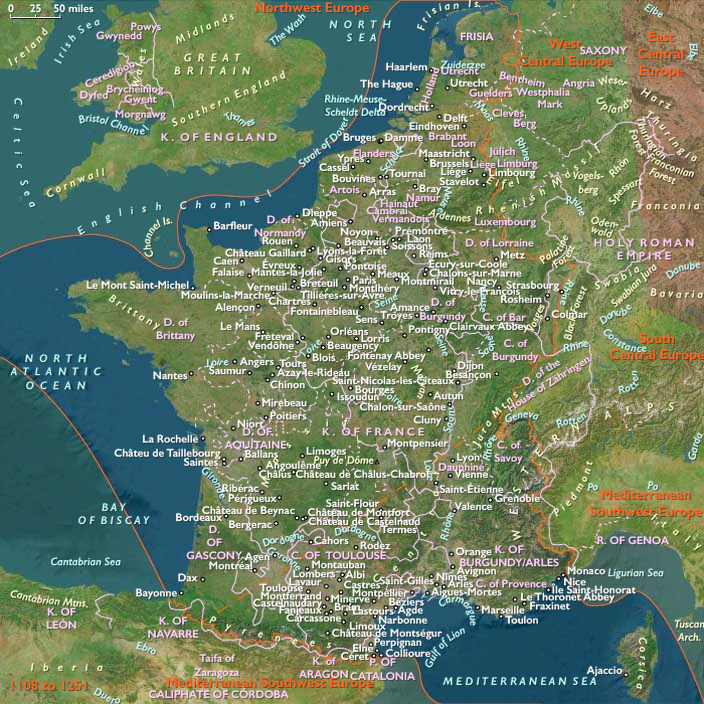
Upon his accession as Count of Provence and Forcalquier in 1246, Charles had rapidly found himself in difficulties.
His sisters-in-law felt cheated by their father's will, and his mother-in-law, the Dowager Countess Beatrice of Savoy, claims the entire County of Forcalquier and the usufruct of Provence as her jointure.
Furthermore, while Provence is technically a part of the Kingdom of Burgundy and hence of the Holy Roman Empire, in practice it is free of central authority.
The recent counts had governed with a light hand, and the nobles and cities (three of which, Marseille, Arles, and Avignon are Imperial cities technically separate from the county) have enjoyed great liberties. (Charles, in contrast, is disposed towards a rigid administration; he will order inquests in 1252 and again in 1278 to ascertain his rights.)
Charles breaks the traditional powers of the great towns (Nice, Grasse, Marseille, Arles, Avignon) and arouses considerable hostility by his punctilious insistence on enjoying his full rights and fees.
In 1247, while Charles has gone to France to receive the Counties of Anjou and Maine, the local nobility (represented by Barral of Baux and Boniface of Castellane) join with Beatrice and the three Imperial cities to form a defensive league against him.
Unfortunately for Charles, he has promised to join his brother on the Seventh Crusade.
For the time being, Charles' only recourse is to compromise with Beatrice, allowing her to have Forcalquier and a third of the Provençal usufruct.
Wealthy Provence provides the funds that support his wider career.
His rights as landlord are, on the whole, of recent establishment, but his rights as sovereign entitles him to revenues on the gabelles (mainly salt), from alberga (commutation of gîte) and cavalcata (commutation of the duties of military service) and quista ("aids").
From the Church, unlike his brothers in the north, he receives virtually nothing.
Charles' agents are efficient, the towns are prosperous, the peasants are buying up the duties of corvée and establishing self-governing consultates in the villages: Provence flourishes.
Louis IX of France, a man of great piety and a strong pacifist in dealing with fellow Christians, is bitterly intolerant of heretics and non-Christians.
France is perhaps the strongest state in Europe at this time, as the Albigensian Crusade had brought Provence into Parisian control.
Poitou is ruled by Louis IX's brother Alphonse of Poitiers, who in 1245 had joined him on his crusade.
Another brother, Charles I of Anjou, had also joined Louis.
Louis has for the past three years collected an ecclesiastical tenth (mostly from church tithes), and he and his approximately fifteen thousand-strong army, which includes three thousand knights and five thousand crossbowmen, had on August 25, 1248, sailed on thirty-six ships from the ports of Aigues-Mortes, which had been specifically built to prepare for the crusade, and Marseille.
Louis IX's financial preparations for this expedition are comparatively well organized, and he has been able to raise approximately one million five hundred thousand livres tournois.
However, many nobles who join Louis on the expedition have had to borrow money from the royal treasury, and the crusade turns out to be very expensive.
Louis's wife and children accompany him, since he prefers not to leave the mother and daughter-in-law alone together.
Also joining Louis are his brothers Robert d'Artois and Charles d'Anjou, many distinguished French nobles, and a small contingent of English.
He leaves his capable mother, Blanche de Castile, to rule as regent; his favorite, twenty-four-year-old French chronicler Jean, sire de Joinville, accompanies him.
A man of great piety and a strong pacifist in dealing with fellow Christians, Louis is bitterly intolerant of heretics and non-Christians.
He tells Joinville, for example, that the only way in which a good Christian should argue with a Jew is by driving his sword up to the hilt in the Jew's entrails.
Louis's objective is simple: he intends to land in Egypt, seize the principal towns of the country, and use them as hostages to be exchanged for Syrian cities.
As-Salih Ayyub, before he became sultan, had purchased Shajar al-Durr in the Levant as a bondmaid; of Turkic origin, she is described by contemporary historians as a beautiful, pious and intelligent woman.
She had in 1239 accompanied him with his Mamluk Baibars (not Baibars who would later become a Sultan) at Al Karak during his detention.
Later, when he became Sultan in 1240, she had gone with him to Egypt and delivered their son Khalil, who will later be called al-Malik al-Mansour.
Ayyub, who had been gravely ill in Syria, returns in April 1249 to Egypt and stays in Ashmum-Tanah, near Damietta, after he hears that King Louis IX of France has assembled a crusade army in Cyprus and is about to launch an attack against Egypt.
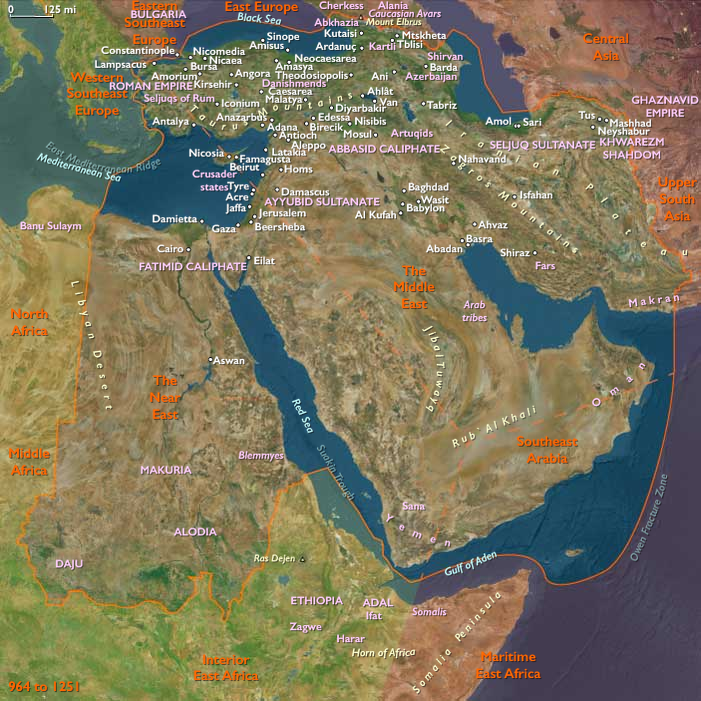
The Seventh Crusade, having wintered in Cyprus, lands in June 1249 near Damietta, Egypt.
The King is one of the first to leap onto land, where he plants the oriflamme of St. Denis on Muslim territory.
Louis IX sends a letter to as-Salih Ayyub.
Although the town and port of Damietta are strongly fortified,Emir Fakhr ad-Din Yussuf, the commander of the Ayyubid garrison, retreats to the camp of the Sultan in Ashmum-Tanah, causing a great panic among the inhabitants of Damietta, who flee the town, leaving intact the bridge that connects the west bank of the Nile with Damietta.
The crusaders on June 6, 1249, cross the river over the bridg eand occupy the deserted town.
Upon hearing the news of the fall of Damietta, the Ayyubid government declares a general emergency and commoners from Cairo and from all over Egypt begin to move to the battle zone.
Louis has pushed on toward Cairo, but the rain-swollen waters of the Nile and its canals had stopped him for several months.
As-Salih Ayyub had been carried on a stretcher to his palace in the better protected town soon to be known as al-Mansurah (”the Victory”, which had originated in 1219 as the camp of Saladin's nephew, al-Adil I of the Ayyubid dynasty.
As-Salih dies on November 22, 1249, after having his leg amputated in an attempt to save his life from a serious abscess affliction.
Shajar al-Durr informs Emir Fakhr ad-Din Yussuf Ben Shaykh (commander of all the Egyptian army) and Tawashi Jamal ad-Din Muhsin (the chief eunuch who controls the palace) of the Sultan's death, but as the country is under the attack, they decide to conceal his death.
The body of the Sultan is transported by boat in secret to the castle of al-Rudah island in the Nile.
Although As-Salih Ayyubn had left no testament concerning who should succeed him after his death, Faris ad-Din Aktai is sent to Hasankeyf in Anatolia to recall al-Muazzam Turanshah, the son of the deceased Sultan.
The late Sultan had signed thousands of blank papers, which are used by Shajar al-Durr and Emir Fakhr ad-Din in issuing Sultanic decrees and orders.
They succeed in convincing the people and the other government officials that the Sultan is only ill—not dead.
She continues to have food prepared for the sultan and has it brought to his tent.
High officials, Sultanic Mamluks and soldiers are ordered—by the will of the “ill” Sultan—to give oath to the Sultan, his heir Turanshah and the Atabeg Fakhr ad-Din Yussuf.
The French army has been strengthened by the arrival, in late October, of troops under Alphonse de Poitiers, the third brother of king Louis IX, at Damietta.
The crusaders, encouraged by the news of the death of the Ayyubid Sultan as-Salih Ayyub, begin their march towards Cairo.
The crusaders, after several attempts, finally build a pontoon bridge.
A force led by Louis IX's brother Robert I of Artois succeeds in crossing the Canal of Ashmum (known today by the name al-Bahr al-Saghir) and launches a surprise attack against the Egyptian camp in Gideila, two miles away from Al Mansurah.
Emir Fakhr ad-Din is killed during the sudden attack and the Egyptian troops retreat to Al Mansurah as the crusaders proceed towards the town.
The leadership of the Egyptian force passes to the Mamluk commandants Faris ad-Din Aktai and Baibars al-Bunduqdari, who succeed in reorganizing the retreating troops.
Shajar al-Durr, who is in full charge of Egypt, agrees to Baibars’ plan of defense.
Saladin, the first sultan of the Ayyubid Dynasty, had followed what had by his time constituted a tradition in Muslim military practice by including a slave corps—the Mamluks—in his army in addition to Kurdish, Arab, Turkmen, and other free elements.
His successors have also followed this practice.
As-Salih Ayyub is reputedly the dynasty's largest purchaser of enslaved people, chiefly Turkish, as a means of protecting his sultanate both from Ayyubid rivals and from the crusaders.
Baybars, born in 1223, north of the Back Sea, had been one of a number of Kipchak Turks sold as slaves to the Mongols in about 1242.
Mamluks, who have become the military backbone of most Islamic states, are highly prized, and eventually Baybars had come into the possession of Sultan as-Salih.
Eventually appointed commander of a group of the sultan's bodyguard, Baybars leads the Ayyubid army's defense of the city of al-Mansurah against the crusaders' army led by Louis IX.
As-Salih had also purchased an enslaved man, Qalawun, who was called al-Alfi ['the Thousand-man'] because he was bought for a thousand dinars of gold.
Qalawun will become an important Sultan in the Bahri dynasty of Mamlukes.
Baibars orders the opening of a gate to let the knights of the crusaders enter the town.
The crusaders rush into the town, which they believe to be deserted, only to find themselves trapped inside.
Besieged from all directions by the Egyptian forces and the town's population, the crusaders suffer heavy losses.
Robert de Artois (brother of Louis IX), who had taken refuge in a house, and William of Salisbury are among those killed in Al Mansurah.
Only five Knights Templar survive the battle.
The crusaders are forced to retreat in disorder to Gideila, where they camp within a ditch and wall.
The Muslim forces launch an offensive against the Franks' camp early in the morning of February 11.
The outcome of the struggle is for a long time undecided, and the King's brother Robert d'Artois is killed, along with many knights.
Louis finally gains control of the situation through his energy and self-possession, but his army is exhausted.