Richard of York
3rd Duke of York
Years: 1411 - 1460
Richard Plantagenet, 3rd Duke of York, 6th Earl of March, 4th Earl of Cambridge, and 7th Earl of Ulster, conventionally called Richard of York (21 September 1411 – 30 December 1460) is a leading English magnate, great-grandson of King Edward III.
He inherits great estates, and serves in various offices of state in France at the end of the Hundred Years' War, and in England, ultimately governing the country as Lord Protector during Henry VI's madness.
His conflicts with Henry's queen, Margaret of Anjou, and other members of Henry's court are a leading factor in the political upheaval of mid-fifteenth-century England, and a major cause of the Wars of the Roses.
Richard eventually attempts to claim the throne but is dissuaded, although it is agreed that he would become King on Henry's death.
Within a few weeks of securing this agreement, he dies in battle.
Although Richard never becomes king, he is the father of Edward IV and Richard III.

Related Events
Filter results
Showing 10 events out of 36 total
The last Mortimer dies in 1425, and Richard, duke of York, the fourteen-year-old son of Anne Mortimer and the executed Richard, earl of Cambridge, inherits that family's claim to the throne, which is based on descent from Lionel, duke of Clarence, the third son of English king Edward III.
Northwest Europe (1444–1455 CE): Dynastic Tensions and Cultural Advances
England: Growing Tensions and Prelude to Civil War
The reign of Henry VI became increasingly fraught, characterized by worsening political instability and the deterioration of English holdings in France. Losses such as Normandy in 1450 deepened discontent among nobles and commoners alike, contributing to internal strife. Henry VI, England’s Lancastrian king, proved ineffectual and unstable as he matured, prompting those dissatisfied with government by his favorites to rally around Richard, Duke of York, head of the rival House of York. Armed clashes had occurred previously between supporters of Henry and Richard, but the first open fighting broke out in 1455, marking the onset of the Wars of the Roses.
Scotland: Stability and Cultural Growth
Following the reforms initiated by James I, Scotland enjoyed relative stability under his successor, James II. James II, ascending to the throne as a child in 1437, gradually consolidated his rule throughout the 1440s and early 1450s. His reign saw the continued growth of royal authority, further weakening the power of the nobility. Cultural activities flourished, reflecting broader European influences and enhancing the country's literary and artistic heritage.
Ireland: Gaelic Autonomy and Cultural Flourishing
Gaelic lordships continued to assert their dominance across Ireland, maintaining their autonomy and cultural identity against limited English authority. The O’Neill and O’Brien clans solidified their regional power bases, and Irish literary traditions thrived, marked by vibrant poetry and annalistic writing that preserved and celebrated Gaelic heritage. English control remained limited primarily to The Pale, with attempts at expansion encountering persistent resistance.
Scandinavia: Instability within the Kalmar Union
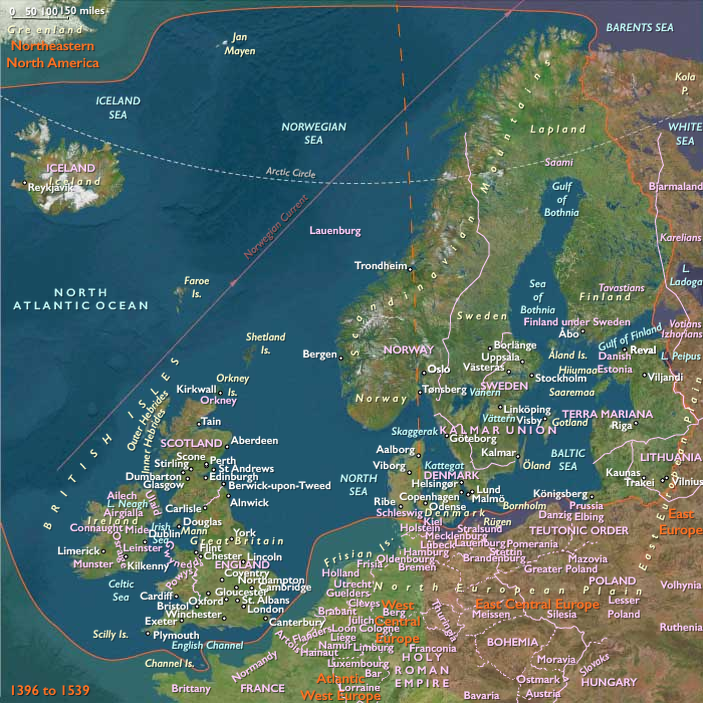
The Kalmar Union, under King Eric of Pomerania and later under King Christopher of Bavaria and then Christian I, experienced persistent internal tensions. Sweden's dissatisfaction with union policies increased, sparking periodic revolts and political unrest. Despite these ongoing challenges, the union persisted, albeit tenuously, through diplomatic maneuvers and fragile agreements.
Iceland: Literary and Cultural Vigor
Within the broader Scandinavian political context, Iceland maintained its cultural vitality. The island continued to produce significant literary works, particularly historical sagas and chronicles that documented its rich past and preserved its distinct identity. Icelandic literature served not only as historical records but also as symbols of cultural pride and resilience in a changing political landscape.
Cultural and Artistic Developments
The period witnessed significant cultural developments across Northwest Europe. Architectural advancements, notably at York Minster, continued to exemplify the evolving Perpendicular Gothic style. The innovative compositions of John Dunstaple and contemporaries continued to shape European music, spreading harmonically rich practices centered around intervals of thirds and sixths. These artistic achievements highlighted the region's continued intellectual vibrancy amid political uncertainty.
Legacy of the Era
By 1455 CE, Northwest Europe stood on the brink of transformative upheaval. England faced imminent civil war, Scotland enjoyed strengthened central authority and cultural growth, Ireland continued its robust Gaelic traditions, and the Kalmar Union grappled with internal dissent. These complex dynamics were balanced by impressive cultural advances, showcasing the region's resilience and creativity during this turbulent period.
Northwest Europe (1444–1455 CE): Dynastic Tensions and Cultural Advances
England: Growing Tensions and Prelude to Civil War
The reign of Henry VI became increasingly fraught, characterized by worsening political instability and the deterioration of English holdings in France. Losses such as Normandy in 1450 deepened discontent among nobles and commoners alike, contributing to internal strife. Henry VI, England’s Lancastrian king, proved ineffectual and unstable as he matured, prompting those dissatisfied with government by his favorites to rally around Richard, Duke of York, head of the rival House of York. Armed clashes had occurred previously between supporters of Henry and Richard, but the first open fighting broke out in 1455, marking the onset of the Wars of the Roses.
Scotland: Stability and Cultural Growth
Following the reforms initiated by James I, Scotland enjoyed relative stability under his successor, James II. James II, ascending to the throne as a child in 1437, gradually consolidated his rule throughout the 1440s and early 1450s. His reign saw the continued growth of royal authority, further weakening the power of the nobility. Cultural activities flourished, reflecting broader European influences and enhancing the country's literary and artistic heritage.
Ireland: Gaelic Autonomy and Cultural Flourishing
Gaelic lordships continued to assert their dominance across Ireland, maintaining their autonomy and cultural identity against limited English authority. The O’Neill and O’Brien clans solidified their regional power bases, and Irish literary traditions thrived, marked by vibrant poetry and annalistic writing that preserved and celebrated Gaelic heritage. English control remained limited primarily to The Pale, with attempts at expansion encountering persistent resistance.
Scandinavia: Instability within the Kalmar Union
The Kalmar Union, under King Eric of Pomerania and later under King Christopher of Bavaria and then Christian I, experienced persistent internal tensions. Sweden's dissatisfaction with union policies increased, sparking periodic revolts and political unrest. Despite these ongoing challenges, the union persisted, albeit tenuously, through diplomatic maneuvers and fragile agreements.
Iceland: Literary and Cultural Vigor
Within the broader Scandinavian political context, Iceland maintained its cultural vitality. The island continued to produce significant literary works, particularly historical sagas and chronicles that documented its rich past and preserved its distinct identity. Icelandic literature served not only as historical records but also as symbols of cultural pride and resilience in a changing political landscape.
Cultural and Artistic Developments
The period witnessed significant cultural developments across Northwest Europe. Architectural advancements, notably at York Minster, continued to exemplify the evolving Perpendicular Gothic style. The innovative compositions of John Dunstaple and contemporaries continued to shape European music, spreading harmonically rich practices centered around intervals of thirds and sixths. These artistic achievements highlighted the region's continued intellectual vibrancy amid political uncertainty.
Legacy of the Era
By 1455 CE, Northwest Europe stood on the brink of transformative upheaval. England faced imminent civil war, Scotland enjoyed strengthened central authority and cultural growth, Ireland continued its robust Gaelic traditions, and the Kalmar Union grappled with internal dissent. These complex dynamics were balanced by impressive cultural advances, showcasing the region's resilience and creativity during this turbulent period.
Henry VI, England’s Lancastrian king, has proven to be ineffectual and unstable as grows up, and those dissatisfied with the government by his favorites rally around Richard, Duke of York, head of the rival House of York.
Armed clashes had occurred previously between supporters of Henry and Richard, but the first open fighting breaks out in 1455.
The Anglo-French truce arranged by William de la Pole has brought him to the peak of his influence.
With the deaths in 1447 of Humphrey, Duke of Gloucester and Cardinal Beaufort, Suffolk had become the principal power behind the throne of the weak and compliant Henry VI.
In short order he had been appointed Chamberlain, Admiral of England, and to several other important offices.
He was created Earl of Pembroke in 1447 and in 1448 he had been made first duke of Suffolk.
However, Suffolk is later suspected of being a traitor.
He meets in secret on July 16 with Jean, the Bastard of Orleans, and comte de Dunois at his mansion of the Rose in Candlewick street.
The first of several meetings in London, they plan a French invasion.
Suffolk passes Council minutes to Dunois, the French hero of the siege of 1429 at Orleans.
It is rumored that Suffolk never paid his ransom of twenty thousand pounds owed to Dunois.
Lord Treasurer Ralph Cromwell wants heavy taxes from Suffolk; the duke's powerful enemies include the Pastons and Sir John Fastolf.
Many blame Suffolk's retainers for lawlessness in East Anglia.
The English violation of the unpopular peace agreement—probably with Suffolk's approval—has enabled French armies to seize all English holdings in northern France except for Calais.
Suffolk cannot avoid taking the blame for these failures, partly because of the loss of Maine and Anjou through his marriage negotiations regarding Henry VI.
He is arrested on January 28, 1450, and imprisoned in the Tower of London.
Impeached in Parliament by the House of Commons, he is banished for five years, but on his journey to Calais his ship is intercepted, and on May 2 he is executed.
It is suspected that his archenemy the Duke of York was responsible for his beheading on the gunwales of one of his boats and his body was thrown overboard.
He is later found on the seashore near Dover and the body is brought to a Church in Suffolk, possibly Wingfield, for burial, seemingly at the wishes of his wife Alice.
A well-organized uprising of small property owners in 1450 led by John, or Jack, Cade, who assumes the name John Mortimer and declares himself a cousin of Richard, Duke of York, reveals the widespread social discontent that obtains in England.
Cade’s rebellion demands lower taxes and prices, the dismissal of some of Henry VI’s ministers, an end to royal corruption, and the recall from Ireland of the exiled Richard, Henry’s arch-rival.
Cade’s forces, drawn largely from Sussex and Kent, defeat a royalist army at Sevenoaks on June 18, then occupy London, where they execute the much-despised lord treasurer, who the rebels hold responsible for all war losses in France.
After a few weeks of arson and pillage by the rebels, Londoners on July 6 drive them from the city.
Most of the rebels disperse upon receiving a governmental pardon, but Cade continues his rebellion until a mortal wound results in his capture.
Several rebel, including Cade, are later executed.
Henry’s queen, Margaret of Anjou, strong-willed in contrast to her feeble husband, has established an ascendancy at the court, together with the powerful Beaufort family, headed by Edmond Beaufort, Duke of Somerset.
Cade’s rebellion, though unsuccessful in its aims, had eroded royal authority, enabling Richard, Duke of York, to return in autumn 1450 from his new post as Lieutenant of Ireland to England, where he had been recognized as heir to the childless King Henry VI.
He had marched on London, demanding Somerset's removal and reform of the government.
At this stage, few of the nobles support such drastic action, and York had been forced to submit to superior force at Blackheath.
He has been imprisoned for much of 1452 and 1453 but is released after swearing not to take arms against the court.
The loss of Bordeaux in 1453 has turned the English towards the Yorkists and against the Lancastrian Beaufort family.
The increasing discord at court is mirrored in the country as a whole, where noble families engage in private feuds and show increasing disrespect for the royal authority and for the courts of law.
The Percy-Neville feud is the best-known of these private wars, but others are being conducted freely.
In many cases, they are fought between old-established families, and formerly minor nobility raised in power and influence by Henry IV in the aftermath of the rebellions against him.
The quarrel between the Percys—long the Earls of Northumberland—and the comparatively upstart Nevilles follows this pattern, as does the feud between the Courtenays and Bonvilles in Cornwall and Devon.
A factor in these feuds is the presence of large numbers of soldiers discharged from the English armies that had been defeated in France.
Nobles engage many of these to mount raids, or to pack courts of justice with their supporters, intimidating suitors, witnesses and judges.
This growing civil discontent, the abundance of feuding nobles with private armies, and corruption in Henry VI's court form a political climate ripe for civil war.
With the king so easily manipulated, power rests with those closest to him at court, in other words Somerset and the Lancastrian faction.
Richard and the Yorkist faction, who tend to be physically placed further away from the seat of power, find their power slowly being stripped away.
Royal power also starts to slip, as Henry is persuaded to grant many royal lands and estates to the Lancastrians.
Margaret’s position is greatly reinforced in October 1453 by the birth of a son, Edward, whose status as royal heir presents a problem for the Yorkist claim.
However, Henry suffers the first of several bouts of complete mental collapse, during which he fails even to recognize his newborn son.
A Council of Regency is set up in April 1454, headed by the Duke of York, who still remains popular with the people, as Lord Protector.
York soon asserts his power with ever-greater boldness (although there is no proof that he had aspirations to the throne at this early stage).
He imprisons Somerset and backs his Neville allies (his brother-in-law, the Earl of Salisbury, and Salisbury's son, the Earl of Warwick), in their continuing feud with the Earl of Northumberland, a powerful supporter of Henry.
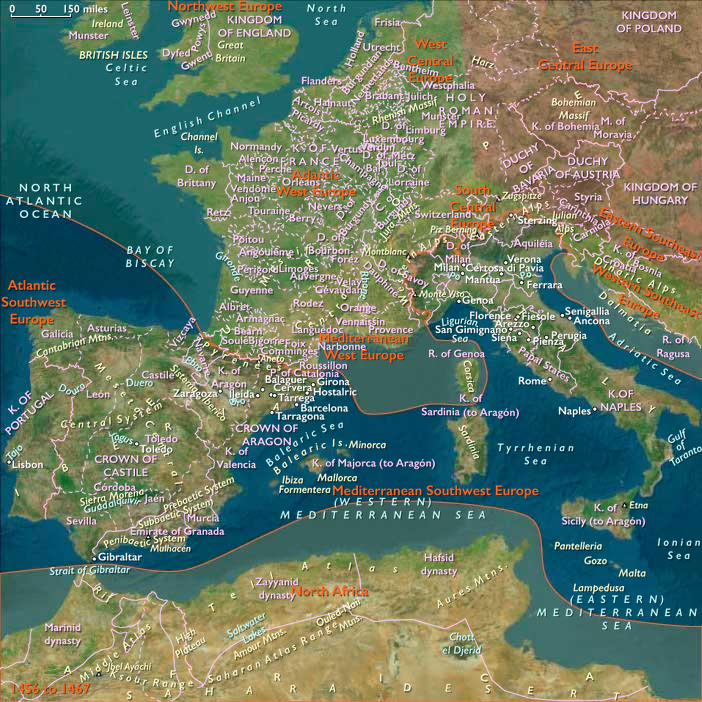
Northwest Europe (1456–1467 CE): Conflicts and Cultural Developments
England: Escalating Civil War
The Wars of the Roses intensified significantly, with major battles shaping the political landscape. The Yorkist victory at the Battle of Towton in 1461, the largest and bloodiest encounter of the conflict, led to the deposition of the Lancastrian king Henry VI and the crowning of Edward IV as king. Despite Edward's initial triumph, Lancastrian resistance persisted, leading to ongoing instability. The civil war had resumed in 1459, driven largely by Henry VI's queen, Margaret of Anjou, who inspired renewed conflict. Richard, Duke of York, initially became Protector but was dissuaded from claiming the throne outright. By the end of 1460, Richard was killed in battle, paving the way for Edward IV's proclamation as king in early 1461.
Scotland: Consolidation and Cultural Flourishing
In Scotland, James III (1460–1488) assumed power as a minor following the sudden death of his father, James II, in 1460. A regency council initially governed, with significant influence wielded by powerful nobles. Despite political challenges, James III’s reign witnessed the flourishing of Scottish art and architecture, with increased patronage contributing to cultural advancements and closer diplomatic ties to the European mainland.
Ireland: Gaelic Revival and English Constraints
Ireland continued to experience Gaelic resurgence, limiting English control strictly to The Pale. Prominent Gaelic families such as the Fitzgeralds, O'Briens, and O’Neills expanded their territories and influence, while simultaneously resisting English attempts at consolidation. Irish culture, law, and poetry experienced significant growth, reinforcing traditional Gaelic identity.
Scandinavia: Tensions in the Kalmar Union
The Kalmar Union faced ongoing internal tensions, particularly during the reign of Christian I (1448–1481). Sweden continued to push against Danish domination, and while armed rebellions were sporadic, political discontent persisted. Christian I maintained fragile control over the union through diplomacy and occasional military action, but unity remained tenuous.
Iceland: Literary Preservation
Iceland preserved its unique cultural heritage despite political integration into the Kalmar Union. Icelanders continued to produce and maintain their literary traditions, ensuring the survival of sagas, annals, and poetic forms. These efforts strengthened Icelandic identity, maintaining a vibrant cultural continuity amid broader Nordic political instability.
Cultural and Artistic Evolution
Throughout Northwest Europe, artistic and cultural developments continued to flourish. The English composer John Dunstaple maintained his prominence, influencing musical practices with innovative harmonies. Architectural projects progressed, including the ongoing construction and embellishment of York Minster in the increasingly prevalent Perpendicular Gothic style. Social changes, including new individuals rising to positions of power from various parts of society, also contributed to linguistic evolution in England.
Legacy of the Era
By 1467 CE, Northwest Europe was deeply influenced by intense political rivalries and remarkable cultural growth. England remained embroiled in civil conflict despite Edward IV's reign, Scotland navigated the challenges of minority kingship with cultural advancement, Ireland saw a strengthened Gaelic identity, and Scandinavia continued to grapple with internal divisions. These developments left an enduring imprint on the region, shaping political and cultural trajectories in subsequent decades.