Richard II, Duke of Normandy
Duke of Normandy
Years: 978 - 1026
Richard II (978/83 -1026), called the Good (French: Le Bon), is the eldest son and heir of Richard I the Fearless and Gunnora.

Related Events
Filter results
Showing 10 events out of 17 total
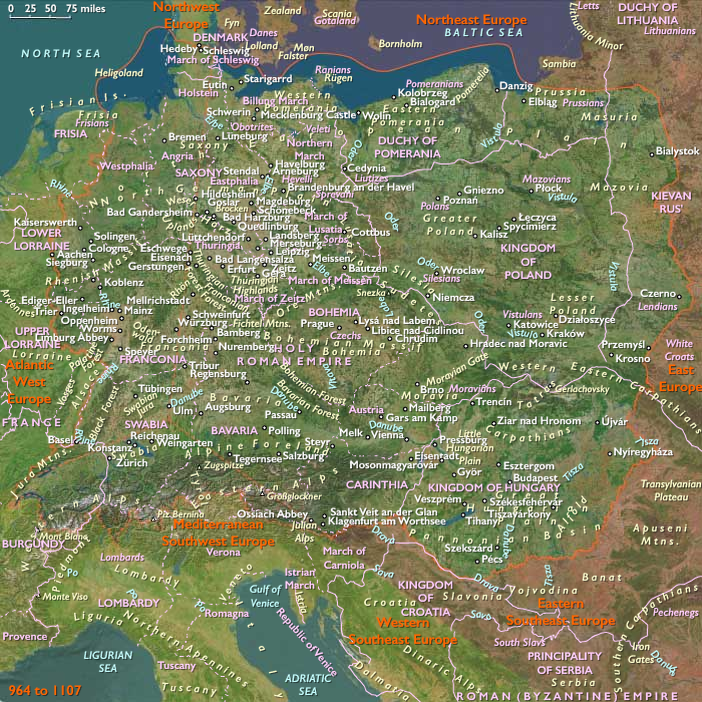
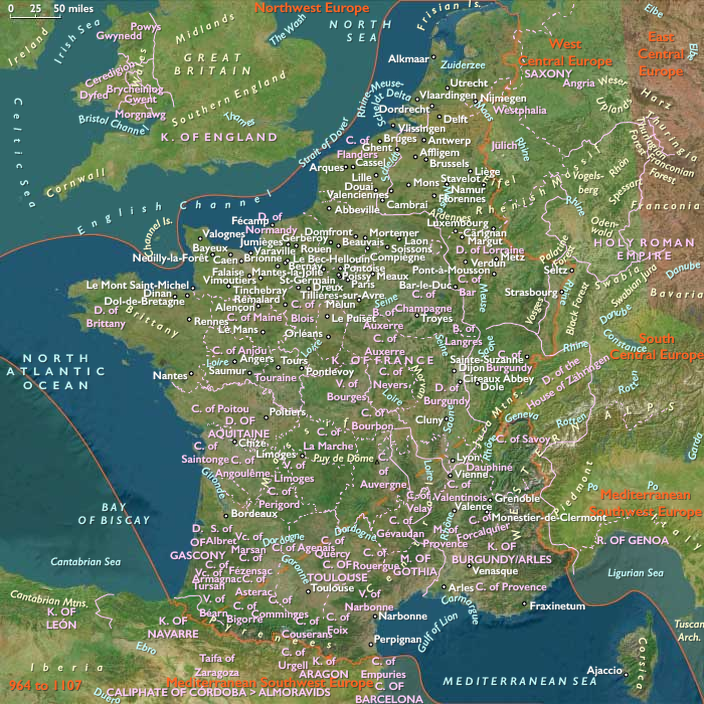
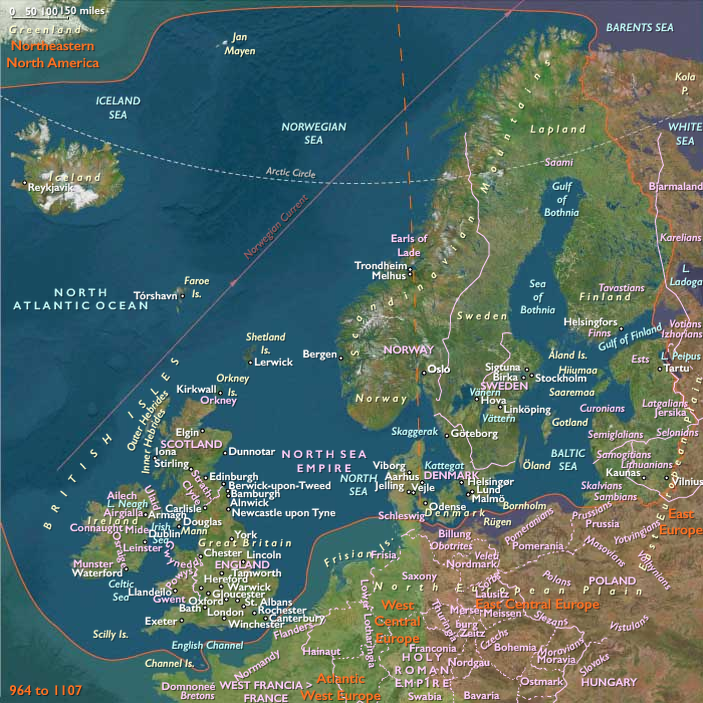
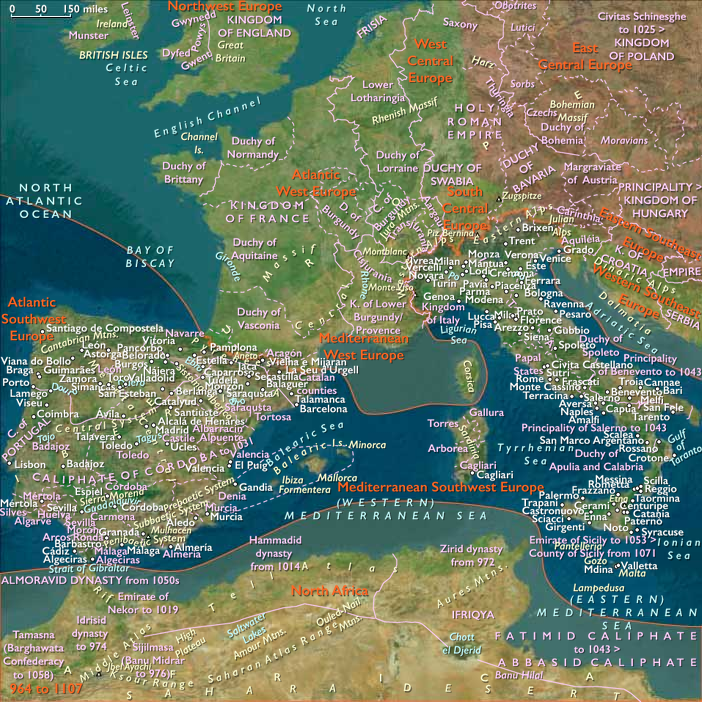
Atlantic West Europe (964 – 1107 CE): Capetian Takeoff, Norman and Breton Power, and the Poitou–Bordeaux Arteries
Geographic and Environmental Context
-
Anchors: Paris–Seine, Upper Loire (Orléans–Blois–Tours), Poitou–La Rochelle, Bordeaux–Gironde–Bayonne, Brittany/Normandy coasts, Flanders/Artois and Low Countries.
Climate and Environmental Shifts
-
Warm, stable conditions favored grain/vine expansion; new embankments and dikes reclaimed Flanders and the Aunis/Saintonge marsh fringe.
Societies and Political Developments
-
Capetian monarchy (from Hugh Capet, 987) consolidated the Île-de-France.
-
Normandy matured into a ducal powerhouse; William the Conqueror’s victory (1066) bound the Channel world.
-
Anjou under Fulk III “Nerra” (d. 1040) and successors castle-built across Anjou–Touraine–Maine, reshaping frontier lordship.
-
Duchy of Aquitaine (Poitiers–Bordeaux) reached cultural and political prominence under William IX and X.
-
Flanders prospered through comital patronage and urban charters.
Economy and Trade
-
La Rochelle and Bordeaux developed as wine–salt ports; Nantes exported salt fish and grain; Rouen handled Seine riverine commerce.
-
Flanders/Low Countries: cloth industry based on English wool; canal networks multiplied.
Belief and Symbolism
-
Romanesque abbeys and pilgrim routes (the Via Turonensis through Tours and Poitiers) to Santiago de Compostela energized the west.
Long-Term Significance
By 1107, Capetians anchored the Seine–Loire heartland; Normans dominated the Channel; Aquitaine flourished; Flanders led Europe’s cloth—setting up the 12th-century surge.
Atlantic West Europe (988–999): Consolidation of Capetian Rule and Regional Dynamics
Between 988 and 999, Atlantic West Europe—including the Low Countries, Normandy, Brittany, Aquitaine, Burgundy, central France, Alsace, and Franche-Comté—saw the early consolidation of Capetian authority, continued growth in regional autonomy, and strengthening of ecclesiastical influence, all against the backdrop of increasing feudal decentralization.
Political and Military Developments
-
France: Capetian Consolidation
- Hugh Capet (r. 987–996) firmly established Capetian authority, securing his dynasty's succession by crowning his son Robert II as co-king in 987, thus beginning a hereditary monarchy.
- Robert II (the Pious, r. 996–1031) began his reign by reinforcing royal influence over the nobility, although central authority remained limited outside Île-de-France.
-
Normandy: Ducal Power and Stability
- Richard I of Normandy (r. 942–996) maintained internal cohesion and secured his Duchy's frontiers, preparing the path for the prosperous reign of his successor, Richard II (r. 996–1026).
-
Aquitaine and Burgundy: Local Autonomy
- William IV of Aquitaine (r. 963–990) and William V (r. 990–1030) managed their territories with significant independence, emphasizing stability and economic prosperity.
- Otto-William, Count of Burgundy, strengthened local control, maintaining effective autonomy and regional stability despite nominal loyalty to Capetian rule.
-
Brittany: Struggle for Internal Control
- Brittany experienced internal conflicts after Conan I’s death (992), complicating efforts to maintain regional autonomy against increasing external influences from Normandy and Capetian France.
Economic and Social Developments
-
Feudal Decentralization
- Feudalism deepened throughout the region, reinforcing the power of local counts and dukes who managed estates with minimal royal interference.
- Peasant populations increased in stability as agricultural techniques improved, supporting gradual demographic growth.
-
Commercial and Urban Development
- Maritime trade expanded significantly in the Low Countries, particularly in Bruges, which served as a burgeoning trade hub linking Northern and Southern Europe.
Cultural and Intellectual Developments
- Monastic Revival and Scholarship
- Cluniac monasteries expanded significantly, becoming major centers of intellectual activity, manuscript production, and theological study.
- Monastic scriptoria preserved ancient texts and produced religious literature that deeply influenced Western Christendom.
Religious Developments
- Expansion of Cluniac Reforms
- The influence of the Abbey of Cluny expanded widely, advocating for greater clerical independence from secular powers, and reforming ecclesiastical governance.
- These reforms reshaped religious practice and institutional autonomy across Atlantic West Europe.
Legacy and Significance
The era 988–999 was crucial for setting long-term regional patterns:
- The Capetian dynasty secured its hold on the French throne, laying the foundation for enduring stability.
- Regional rulers maintained substantial autonomy, shaping distinct political identities for Normandy, Aquitaine, Brittany, and Burgundy.
- The continued rise of feudalism shaped the socio-economic landscape for centuries to come.
- Cluniac reforms significantly impacted the religious and cultural life of the region, influencing European Christianity far beyond its borders.
Richard I of Normandy: The Fearless Duke and the Feudalization of Normandy (942–996)
Richard I, known as "Richard the Fearless" (Richard Sans Peur), ruled as Duke of Normandy from 942 until his death on November 20, 996. He is regarded as the first true Duke of Normandy, as he successfully consolidated Norman identity, governance, and military power, transforming the region into a strong feudal state.
Early Life and Education
- Born in 933 in Fécamp, Richard was the son of William Longsword, the second ruler of Normandy, and a Norman mother of uncertain identity.
- He was bilingual, having been educated at Bayeux, where he mastered both Old Norse and Old French, reflecting Normandy’s transition from a Scandinavian colony to a Frankish duchy.
- At the age of ten, he became Duke after his father’s assassination in 942, facing challenges from Louis IV of France and Hugh the Great, but ultimately securing his position through diplomacy and military prowess.
Marriage and the Rise of the House of Crepon
- In 960, Richard married Emma, daughter of Hugh "The Great" of France, but she died childless eight years later.
- According to Robert of Torigni, Richard, while hunting, became enamored of a forester’s wife, Seinfreda, who instead encouraged him to court her unmarried sister, Gunnor.
- Gunnor, of Danish descent, became Richard’s mistress, and later his wife, legitimizing their twelve children.
- The Crepon family rose to prominence under Richard’s rule, with Herefast de Crepon, Gunnor’s brother, playing a significant role in Norman administration and possibly involved in a controversial heresy trial.
Normandy’s Transformation Under Richard I
Richard I oversaw the full integration of Normandy into Frankish feudal society, achieving several key reforms:
- Gallicization and Christianization: By the end of his reign, Normandy had fully adopted Frankish customs, language, and religion, shedding its pagan Norse identity.
- Introduction of Feudalism: He was instrumental in introducing the feudal system, turning Normandy into one of the most thoroughly feudalized states in Europe.
- Military Reorganization: He restructured the Norman army, placing heavy emphasis on cavalry, which would later play a decisive role in William the Conqueror’s campaigns.
- Loyalty to the Danes: Despite his Frankish alliances, Richard remained sympathetic to his Danish subjects, ensuring strong trade and cultural connections with Scandinavia.
Richard as Guardian of Young Hugh Capet
- After the death of Hugh the Great in 956, Richard became guardian of young Hugh, the future Hugh Capet, fostering ties that would later aid the Capetian rise to power.
Death and Succession
Richard I died of natural causes on November 20, 996, in his birthplace of Fécamp, at the age of sixty-three. His eldest son, Richard II ("Richard the Good"), succeeded him as Duke, continuing his father’s policies and strengthening Normandy’s political and military dominance.
Legacy
Richard I’s rule cemented Normandy’s stability, ensuring that it would remain a strong feudal state and an emerging powerhouse in Western Europe. His military and administrative reforms laid the groundwork for Norman expansion, culminating in the Norman Conquest of England in 1066.
Atlantic West Europe (1000–1011): Dynastic Crisis and the Struggle for Burgundy
Between 1000 and 1011, Atlantic West Europe—which includes the Low Countries, Brittany, Normandy, Aquitaine, Burgundy, central France, Alsace, and Franche-Comté—experienced significant dynastic turmoil, notably in Burgundy, alongside ongoing consolidation of feudal territories.
Political and Military Developments
-
Burgundy: Succession Crisis (1002)
Following the death of Henry the Venerable, Duke of Burgundy (r. 965–1002), a bitter dynastic conflict erupted between his nephew, King Robert the Pious of France, and his stepson and adopted heir, Otto-William, Count of Burgundy and Mâcon.- Robert the Pious asserted his claim based on royal overlordship and blood kinship, aiming to incorporate Burgundy firmly into the French sphere.
- Otto-William, backed by his son-in-law Landry, Count of Nevers, contested this claim, envisioning a unified Burgundy (combining both the duchy and county), potentially aligned with the Holy Roman Empire, which would have profoundly shifted regional geopolitics.
-
France: Capetian Consolidation
King Robert the Pious (r. 996–1031) sought to strengthen royal authority, but his reign was strained by noble revolts and the Burgundy conflict, limiting effective centralization elsewhere. -
Normandy and Aquitaine
Normandy enjoyed stability under Duke Richard II (r. 996–1026), consolidating territorial authority.
Aquitaine under William V (r. 995–1030) remained internally prosperous, although tensions persisted with neighboring feudal lords.
Religious and Cultural Developments
- Monastic Reform Movements
The Cluniac reform movement, emanating from Burgundy, continued to spread, reinforcing ecclesiastical authority and spiritual renewal across Western Europe.
Atlantic West Europe (1012–1023): Burgundy's Fate and the Capetian Settlement
Between 1012 and 1023, Atlantic West Europe witnessed the resolution of the Burgundian succession crisis, consolidating French influence in the region while definitively preventing the creation of a unified Burgundian state under imperial influence.
Political and Military Developments
-
Resolution of the Burgundian Conflict (1015)
After thirteen years of protracted and destructive warfare, Robert the Pious emerged victorious, securing the Duchy of Burgundy firmly within the Kingdom of France.- The territories west of the Saône, including the strategic city of Dijon, came under definitive Capetian control.
- Otto-William, retaining only the County of Burgundy (Franche-Comté) east of the Saône, saw his ambitions to unify the two Burgundies dashed, ensuring that the duchy would remain French and the county influenced more by the Holy Roman Empire.
-
Capetian Territorial Redistribution (1016–1032)
Initially, Robert the Pious incorporated the duchy directly into the French royal domain. However, acknowledging practical administrative challenges and family politics, Robert granted the territory to his younger son and namesake, Robert, around 1016.- The arrangement became definitive in 1032 under King Henry I (r. 1031–1060), formally recognizing his brother Robert as Duke of Burgundy, allowing the duchy to be passed down within the Capetian lineage while owing feudal allegiance to the French crown.
-
Normandy and Brittany
Duke Richard II continued his stable rule in Normandy, strengthening ties with England and Scandinavia. Brittany maintained internal stability under Geoffrey I (r. 992–1008) and Alan III (r. 1008–1040), emphasizing regional autonomy amid surrounding tensions.
Economic and Social Developments
- Trade and Urban Development
Despite regional conflict, urban economies—especially Dijon, Auxerre, Tours, and Orléans—continued to grow as agricultural surpluses expanded markets.
Religious and Cultural Developments
- Growth of Cluniac Influence
The Cluniac movement continued its spiritual and cultural expansion, profoundly influencing monastic life, church reform, and European spirituality from its Burgundian heartland.
The Anti-Jewish Persecutions in France Under Robert II ("the Pious") (1007–1009)
Between 1007 and 1009, a wave of violent persecution against Jews swept across France, instigated by King Robert II ("the Pious"). This period marked the first large-scale anti-Jewish violence in medieval France, characterized by forced conversions, massacres, and state-sponsored oppression.
Robert II’s Role in the Persecutions
- Robert, known for his rigid religious orthodoxy and intolerance, is credited with ordering forced conversionsof Jews within his realm.
- According to a Hebrew pamphlet from the period, Robert conspired with his vassals to eliminate all Jews who refused baptism, resulting in widespread deaths, including executions and mass suicides.
- The learned Rabbi Senior is listed among the martyrs who perished during these persecutions.
- Jewish communities in major urban centers, including Orléans, Rouen, and Sens, likely faced mob violenceand expulsions.
Context and Religious Intolerance
- Robert II was well known for his harsh stance against heretics, reinstating the Roman imperial custom of burning heretics at the stake.
- His religious fervor extended beyond anti-Jewish persecution; he promoted Church reform and strengthened royal authority over ecclesiastical matters, often in conflict with the papacy.
- His intolerance set a precedent for later Capetian policies, foreshadowing future waves of anti-Jewish violence in medieval France.
Legacy and Consequences
- The persecutions of 1007–1009 were among the earliest known incidents of systematic anti-Jewish violence in medieval Europe, preceding the massacres of the First Crusade (1096).
- They deepened Jewish-Christian tensions, pushing Jewish communities to seek protection from local feudal lords or the Holy Roman Empire, where imperial policies toward Jews were often more pragmatic.
- Robert II’s religious policies reinforced his reputation as an enforcer of Christian orthodoxy, though at the cost of further alienating religious minorities.
While the Capetian monarchy would later temper its treatment of Jewish communities for economic and political reasons, Robert II’s actions marked a dark chapter in the history of medieval France, illustrating the intersection of royal authority, religious zeal, and intolerance.
Jewish Persecutions in Normandy Under Richard II and the Papal Intervention (1007)
In 1007, the Jewish community of Rouen suffered under severe persecutions instigated by Richard II, Duke of Normandy. The violence was so extreme that many Jewish women, seeking to escape the fury of the mob, drowned themselves in the river rather than face capture or forced conversion.
Jacob ben Jekuthiel's Plea to Pope John XVIII
- A prominent Talmudic scholar and communal leader, Jacob ben Jekuthiel, sought to intercede on behalf of persecuted Jews in Lorraine and Normandy.
- He undertook a journey to Rome in an attempt to gain support from Pope John XVIII to halt the persecutions.
Imprisonment and Escape
- Before reaching Rome, Jacob and his family were imprisoned by Duke Richard II of Normandy, placing them in grave danger.
- His eldest son, Judah, was left as a hostage with Richard, while Jacob, his wife, and their three remaining sons managed to continue to Rome, narrowly escaping death.
Papal Intervention in France
- In Rome, Jacob made a substantial donation to the pope—seven gold marks and two hundred pounds—securing an audience with John XVIII.
- In response, the pope issued a direct order to King Robert II of France, instructing him:
"Not to kill, injure, or rob Jews, nor to deprive them of their religion."
- This intervention represented a rare papal effort to curb anti-Jewish violence, though it is unclear how effectively the decree was enforced.
Aftermath and Significance
- While Pope John XVIII's order may have temporarily eased the severity of the persecutions, anti-Jewish sentiment in Normandy and France persisted, often fueled by royal and ecclesiastical intolerance.
- The event demonstrated the precarious position of Jewish communities, who often had to rely on diplomacy and financial contributions to secure protection from Christian rulers.
- Jacob ben Jekuthiel’s efforts reflected the desperate measures Jewish leaders took to advocate for their communities, engaging even the highest levels of Christian authority in their struggle for survival.
This episode underscores the fragility of Jewish life in medieval Europe, where legal status could rapidly deteriorate under shifting political and religious pressures, requiring constant negotiation, intervention, and resilience.
Atlantic West Europe (1012–1023): Burgundy's Fate and the Capetian Settlement
Between 1012 and 1023, Atlantic West Europe witnessed the resolution of the Burgundian succession crisis, consolidating French influence in the region while definitively preventing the creation of a unified Burgundian state under imperial influence.
Political and Military Developments
-
Resolution of the Burgundian Conflict (1015)
After thirteen years of protracted and destructive warfare, Robert the Pious emerged victorious, securing the Duchy of Burgundy firmly within the Kingdom of France.- The territories west of the Saône, including the strategic city of Dijon, came under definitive Capetian control.
- Otto-William, retaining only the County of Burgundy (Franche-Comté) east of the Saône, saw his ambitions to unify the two Burgundies dashed, ensuring that the duchy would remain French and the county influenced more by the Holy Roman Empire.
-
Capetian Territorial Redistribution (1016–1032)
Initially, Robert the Pious incorporated the duchy directly into the French royal domain. However, acknowledging practical administrative challenges and family politics, Robert granted the territory to his younger son and namesake, Robert, around 1016.- The arrangement became definitive in 1032 under King Henry I (r. 1031–1060), formally recognizing his brother Robert as Duke of Burgundy, allowing the duchy to be passed down within the Capetian lineage while owing feudal allegiance to the French crown.
-
Normandy and Brittany
Duke Richard II continued his stable rule in Normandy, strengthening ties with England and Scandinavia. Brittany maintained internal stability under Geoffrey I (r. 992–1008) and Alan III (r. 1008–1040), emphasizing regional autonomy amid surrounding tensions.
Economic and Social Developments
- Trade and Urban Development
Despite regional conflict, urban economies—especially Dijon, Auxerre, Tours, and Orléans—continued to grow as agricultural surpluses expanded markets.
Religious and Cultural Developments
- Growth of Cluniac Influence
The Cluniac movement continued its spiritual and cultural expansion, profoundly influencing monastic life, church reform, and European spirituality from its Burgundian heartland.
Odo II of Blois: The Battle of Pontlevoy and the Struggle Against Fulk III of Anjou (1016)
Odo II of Blois, son of Odo I and Bertha of Burgundy, was the first to unite Blois and Champagne, consolidating a powerful feudal domain. However, his ambitions brought him into continuous conflict with neighboring lords and his Capetian overlords, as he sought to expand his influence through war and strategic marriages. One of the most significant setbacks of his career came at the Battle of Pontlevoy (1016), where he suffered a devastating defeat at the hands of Fulk III of Anjou and Herbert I of Maine.
Early Conflicts with Normandy and King Robert II (1005–1007)
- Odo’s first marriage to Matilda of Normandy (daughter of Duke Richard I) ended abruptly in 1005, leaving him without an heir from the union.
- Richard II of Normandy, Matilda’s brother, demanded the return of her dowry, which included half the county of Dreux.
- Odo refused, leading to war with Normandy, which lasted until King Robert II of France intervened in 1007.
- The arbitration awarded Odo the castle of Dreux, while Richard retained the surrounding lands, preventing a full-scale Norman-Blois war.
- Odo remarried quickly, taking Ermengarde of Auvergne, securing an alliance in southern France.
Rivalry with Fulk III of Anjou and the Battle of Pontlevoy (1016)
Odo’s expansionist ambitions clashed directly with those of Fulk III "Nerra" of Anjou, another aggressive feudal lord whose conquests threatened Odo’s territorial claims. Their rivalry culminated in a decisive battle at Pontlevoy on July 6, 1016.
Prelude to the Battle
- Odo, planning to attack the fortress of Montrichard, marched his forces into Angevin territory.
- Fulk III, recognizing the threat, allied with Herbert I of Maine, ensuring that Odo’s advance would be blocked from multiple directions.
- The Angevin-Maine forces split, with Fulk and one part of the army positioned to intercept Odo directly, while Herbert maneuvered separately.
The Battle of Pontlevoy (July 6, 1016)
- Odo’s larger force initially gained the upper hand, overwhelming Fulk’s troops.
- Fulk III was thrown from his horse, nearly captured or killed, as Odo’s cavalry pressed their advantage.
- Seeing the imminent collapse of the Angevin army, a messenger reached Herbert I of Maine, urging him to attack immediately.
- Herbert struck Odo’s left flank, throwing the Blois army into total confusion.
- Odo’s cavalry fled the battlefield, abandoning their infantry, who were slaughtered by Fulk and Herbert’s forces.
- The battle resulted in a crushing defeat for Odo, who would be unable to challenge Fulk for nearly a decade.
Aftermath and Consequences
- Odo’s defeat halted his ambitions against Anjou, forcing him into a period of military inactivity.
- Herbert I of Maine’s reputation soared, marking him as a rising power in western France.
- The battle strained relations between Fulk III and Herbert, as Herbert’s intervention had ultimately saved Fulk, highlighting a power imbalance between the two allies.
Legacy
The Battle of Pontlevoy solidified Fulk III’s dominance in Anjou and Maine, while Odo’s defeat weakened his ability to expand his territories further. However, Odo would later return to challenge his enemies, continuing his lifelong feudal struggles. The Capetian monarchy, meanwhile, benefited from these feudal rivalries, as they prevented any single vassal from becoming too powerful.
Norman adventurers had begun a prolonged and haphazard migration to Sicily and southern Italy early in the eleventh century, serving the local nobility as mercenaries fighting the Arabs.
In 999, according to Amatus of Montecassino, pilgrims returning from Jerusalem had called in at the port of Salerno, when a Saracen attack occurred.
The Normans had fought so valiantly that Prince Guaimar III had begged them to stay, but they had refused and instead offered to tell others back home of the prince's request.
The Lombard nobleman Melus and his brother-in-law Dattus had rebelled against Constantinople in 1009 and quickly taken Bari itself, and Ascoli and Troina the following year, but the new catepan, Basil Mesardonites, had gathered a large army.
When Bari fell on June 11, 1011, Melus had fled to the protection of Prince Guaimar III of Salerno and Dattus to the Benedictine abbey of Montecassino, where the anti-Greek monks, at the insistence of Pope Benedict VIII, had given him a fortified tower on the Garigliano.
Melus' family, however, had been captured and carted off to Constantinople.
According to the Norman chronicler William of Apulia, Melus had gone to the shrine of Saint Michael at Monte Gargano in 1016 to intercept some Norman pilgrims.
There he had petitioned Rainulf Drengot and a band of Norman exiles to aid in his rebellion, assuring them of the ease of victory and the abundance of spoils.
By 1017, Norman adventurers are already heading south.
Osmond Buatère, according to some sources, or his brother Gilbert, according to others, had in 1016 killed one William Repostel, a relative of Duke Richard II of Normandy, in revenge for his sleeping with one of Osmond's daughters.
The duke had pardoned his life, but exiled him.
Osmond and his four brothers—Gilbert, Asclettin, Ralph, and Ranulf—travel to the Mediterranean to assist the Lombards in their revolt against imperial pretensions.
The Development of Norman Architecture: The Early Romanesque Foundations (10th–11th Century)
Norman architecture, a distinctive regional variant of Romanesque architecture, began to develop in Normandy in the late 10th and early 11th centuries. This architectural style was influenced by both Carolingian traditions and early Romanesque forms, eventually evolving into the grand, fortress-like structures that would later characterize Norman castles and cathedrals across Europe.
Early Romanesque Churches in Normandy
Two of the earliest examples of Norman Romanesque architecture include:
- Saint-Pierre at Jumièges (mid-10th century), one of the first fully Romanesque churches in the region.
- The Abbey Church of Bernay, on which construction began in 1017, reflecting early Romanesque structural and decorative elements.