Richard de Clare
2nd Earl of Pembroke
Years: 1130 - 1176
Richard de Clare, 2nd Earl of Pembroke (of the first creation), Lord of Leinster, Justiciar of Ireland (1130 – 20 April 1176).
Like his father, he is also commonly known by his nickname Strongbow (Norman French: Arc-Fort).
He is a Cambro-Norman lord notable for his leading role in the Norman invasion of Ireland.
Related Events
Filter results
Showing 10 events out of 12 total
An expedition of Cambro-Norman knights with an army of about six hundred lands at Bannow Strand in present-day County Wexford on May 1, 1169.
It is led by Richard de Clare, called Strongbow due to his prowess as an archer.
The invasion, which coincides with a period of renewed Norman expansion, is at the invitation of Dermot Mac Murrough, the king of Leinster.
In 1166, Mac Murrough had fled to Anjou, France, following a war involving Tighearnán Ua Ruairc, of Breifne, and sought the assistance of the Angevin king, Henry II, in recapturing his kingdom.
In 1171, Henry arrives in Ireland in order to review the general progress of the expedition.
He wants to re-exert royal authority over the invasion, which is expanding beyond his control.
Henry successfully re-imposes his authority over Strongbow and the Cambro-Norman warlords and persuades many of the Irish kings to accept him as their overlord, an arrangement confirmed in the 1175 Treaty of Windsor.
The invasion is legitimized by the provisions of the Papal Bull Laudabiliter, issued by Adrian IV in 1155.
The bull had encouraged Henry to take control in Ireland in order to oversee the financial and administrative reorganization of the Irish Church and its integration into the Roman Church system.
Some restructuring had already begun at the ecclesiastical level following the Synod of Kells in 1152.
There has been significant controversy regarding the authenticity of Laudabiliter, and there is no general agreement as to whether the bull was genuine or a forgery.
In 1172, the new pope, Alexander III, further encourages Henry to advance the integration of the Irish Church with Rome.
Henry is authorized to impose a tithe of one penny per hearth as an annual contribution.
This church levy, called Peter's Pence, is extant in Ireland as a voluntary donation.
In turn, Henry accepts the title of Lord of Ireland, which Henry confers on his younger son, John Lackland, in 1185.
When Henry's successor dies unexpectedly in 1199, John inherits the crown of England and retains the Lordship of Ireland.
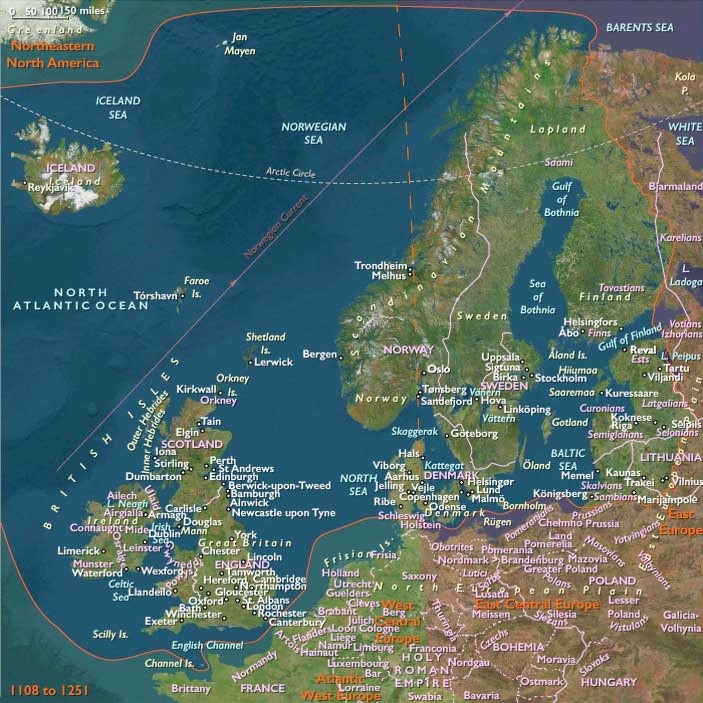
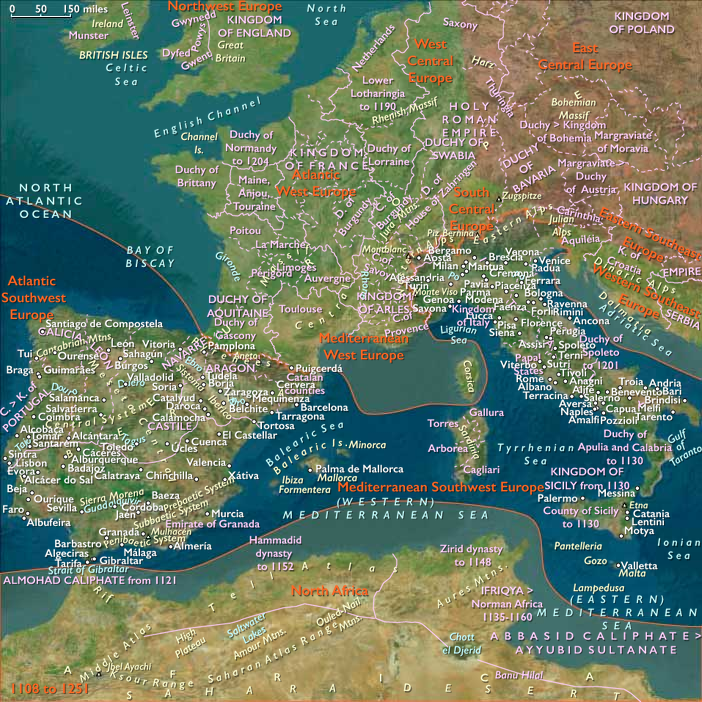
Northwest Europe (1168–1179 CE): Expansion, Conflict, and Cultural Evolution
England: Legal and Political Reforms
Under Henry II (r. 1154–1189), England experienced notable advances in legal and administrative reform. By 1170, Henry's efforts culminated in significant developments in common law, laying foundations for modern judicial practice. The infamous murder of Thomas Becket, Archbishop of Canterbury, in 1170 by knights loyal to Henry, however, severely tarnished his reputation. Becket's martyrdom sparked widespread outrage and eventually forced Henry into public penance, highlighting tensions between secular and ecclesiastical authority. The Revolt of 1173–74 ended in victory for Henry, who reconciled with his sons and other rebels, consolidating his rule.
Scotland: Further Consolidation under William the Lion
William I of Scotland, known as William the Lion (r. 1165–1214), focused his early reign on solidifying royal authority. In 1174, his support for a rebellion against Henry II of England resulted in his capture and subsequent imprisonment at Falaise in Normandy. Under the Treaty of Falaise (1174), Scotland was temporarily reduced to English vassalage, requiring William to acknowledge Henry as his feudal overlord and transfer several Scottish castles, including Berwick and Edinburgh, to English control. Although humiliating, William's eventual return to Scotland enabled him to strengthen central authority domestically.
Ireland: Norman Incursions and Expanding Influence
Ireland witnessed a significant turning point with the Cambro-Norman invasion initiated in 1169 by Richard de Clare (Strongbow), invited by the exiled king of Leinster, Diarmait Mac Murchada. This invasion, originating from Wales, marked the beginning of sustained Anglo-Norman dominance in Ireland. By 1171, English King Henry II himself led an expedition to assert dominance, establishing the Lordship of Ireland as part of his northwest European empire. This period marked profound political and cultural shifts within Ireland, setting the stage for centuries of Anglo-Irish conflict and cooperation.
Denmark: Stability and Expansion under Valdemar I
Valdemar I (the Great) continued consolidating Danish power, stabilizing internal governance after decades of conflict. His reign was characterized by increased influence over the Baltic region, notably demonstrated by successful military campaigns against the pagan Wends. Valdemar promoted the spread of Christianity, aligning closely with the Church to bolster royal authority, thereby stabilizing and strengthening the Danish kingdom.
Norway: Continued Civil Unrest and Royal Strife
Norway remained mired in ongoing internal conflicts, with various claimants vying for royal power. King Magnus V Erlingsson continued his struggle to establish centralized control, supported by influential ecclesiastical and aristocratic factions. The era was marked by intermittent violence and limited progress towards stable governance.
Iceland and the North Atlantic: Cultural Flourishing
In Iceland, cultural and literary traditions continued to flourish. The Althing provided stable governance, preserving local autonomy and maintaining continuity in societal practices. The literary corpus continued to grow, with Icelandic sagas and historical writings capturing regional culture and preserving the memories of past generations.
Religious and Cultural Expansion
Monasticism continued to thrive throughout Northwest Europe, driven primarily by Cistercian and Benedictine orders. New monasteries appeared regularly, playing critical roles in agriculture, education, and the preservation of knowledge. The martyrdom of Thomas Becket, in particular, spurred pilgrimage movements and devotional practices that further strengthened ecclesiastical influence.
Legacy of the Era
By 1179 CE, Northwest Europe had undergone significant political and cultural transformations. England's legal and administrative reforms under Henry II laid enduring governmental foundations, despite ecclesiastical tensions. Scotland and Ireland experienced critical shifts in power dynamics influenced by English and Norman incursions. Denmark enjoyed increased stability and expansion under Valdemar I, while Norway continued to grapple with internal strife. Meanwhile, Iceland remained culturally vibrant and stable, unaffected by broader geopolitical struggles, reinforcing its unique role in preserving the region’s heritage.
Richard de Clare—called, like his father, Strongbow—is the son of Gilbert de Clare, first Earl of Pembroke, and Isabel de Beaumont.
Richard's father died in about 1148, when he was about eighteen years old, and Richard had inherited the title Earl of Pembroke.
It is probable that this title was not recognized in 1154 at Henry II's coronation.
As the son of the first Earl, he had succeeded to his father's estates in 1148, but had been deprived of the title by King Henry II of England in 1154 for siding with King Stephen of England against Henry’s mother, the Empress Matilda.
Richard is called by his contemporaries Earl Striguil, for his marcher lordship of Striguil where he has a fortress at a place now called Chepstow, in Monmouthshire on the River Wye.
He sees an opportunity to reverse his bad fortune in 1168 when he meets Diarmait Mac Murchada, the deposed King of Leinster.
Fitz-Stephen, on returning to Wales, had helped Diarmait Mac Murchada to organize a mercenary army of Norman and Welsh soldiers, including Richard de Clare, second Earl of Pembroke, alias Strongbow.
The first Norman knight to land in Ireland had been Richard fitz Godbert de Roche in 1167, but it is not until May 1, 1169, that Robert leads the vanguard of Diarmait Mac Murchada's Cambro-Norman auxiliaries to Ireland, thereby precipitating the Norman invasion of Ireland.
The main invasion party lands near Bannow strand, County Wexford with a force of thirty knights, sixty man-at-arms and three hundred archers.
The next day, Maurice de Prendergast lands at the same bay with ten knights and sixty archers.
This force merges with about five hundred soldiers commanded by Diarmait.
In return for capturing Wexford, MacMurrough grants Fitz-Stephen a share in two cantreds, Bargy and Forth which comprises all the land between Bannow and the town of Wexford.
The cantreds are to be held jointly with Maurice FitzGerald, Lord of Lanstephan, his half-brother.
The Siege of Wexford lasts only two days.
The first attack is repulsed at the loss of eighteen Normans and three defenders.
These are believed to have been the only deaths during the siege.
Fitz-Stephen then orders his men to burn all the ships in the town's harbor.
The next morning, the attack on Wexford begins again.
Shortly afterward, the defenders send envoys to Diarmait.
The defenders agree to surrender and renew their allegiance to Diarmait.
It is claimed that they were persuaded to surrender by two bishops who were in the town at the time.
He is accompanied at the siege by Robert de Barry, the eldest son of his half-sister Angharad de Windsor. (Nest then, is the mother of Robert, Maurice and Angharad.)
Within a short time, Leinster has been conquered, and the Viking-established towns of Wexford, …
…Waterford and …
…Dublin are under Diarmait's control.
Henry has allowed the expedition of barons from South Wales to establish Anglo-Norman supremacy in Leinster, but will later levy a fine of one hundred shillings on one Joyce of Gloucester for lending money to Strongbow for his expedition.
Joyce had done nothing illegal, but Henry is nervous about the use of Jewish loans to finance any independent actions or policies.
Strongbow himself arrives in August 1170.
He soon marries Diarmait's daughter, Aoife, and is named as heir to the Kingdom of Leinster.
This latter development causes consternation to Henry II, who fears the establishment of a rival Norman state in Ireland.
Accordingly, he resolves to visit Leinster to establish his authority.
Diarmuid Mac Murchada dies in May 1171, and his son, Donal MacMurrough-Kavanagh claims the kingdom of Leinster in accordance with his rights under the Brehon Laws.
The Earl of Striguil also claims the kingship in the right of his wife.
The old king's death is the signal of a general rising, and Richard barely manages to keep Rory O'Connor out of Dublin.
At this time, Strongbow sends his uncle, Hervey de Montmorency, on an embassy to Henry.
This is necessary to appease the King, who is growing restive at the Earl's increasing power.
Upon his return, de Montmorency conveys the King's terms—the return of Strongbow's lands in Normandy, England and Wales as well as leaving him in possession of his Irish lands.
De Clare in return surrenders Dublin, Waterford and other fortresses to the King.
Henry lands with a large fleet at Waterford in 1171, becoming the first King of England to set foot on Irish soil.
This marks the beginning of English and later British rule in Ireland.
Both Waterford and Dublin are proclaimed Royal Cities.
Henry accepts the submission of the Irish kings in Dublin in November.