Richard Chancellor
English explorer and navigator
Years: 1521 - 1556
Richard Chancellor (died 1556) is an English explorer and navigator; the first to penetrate to the White Sea and establish relations with Russia.
Related Events
Filter results
Showing 10 events out of 10 total
The three-ship expedition under the command of English navigator Sir Hugh Willoughby had sailed north from England in June, 1553, in search of a Northeast Passage connecting the Atlantic and Pacific oceans along the northern shores of Eurasia.
The ships, funded by London merchants, had made their way north to the Lofoten Islands off the coast of northern Norway the following month, but there a violent storm had separated them.
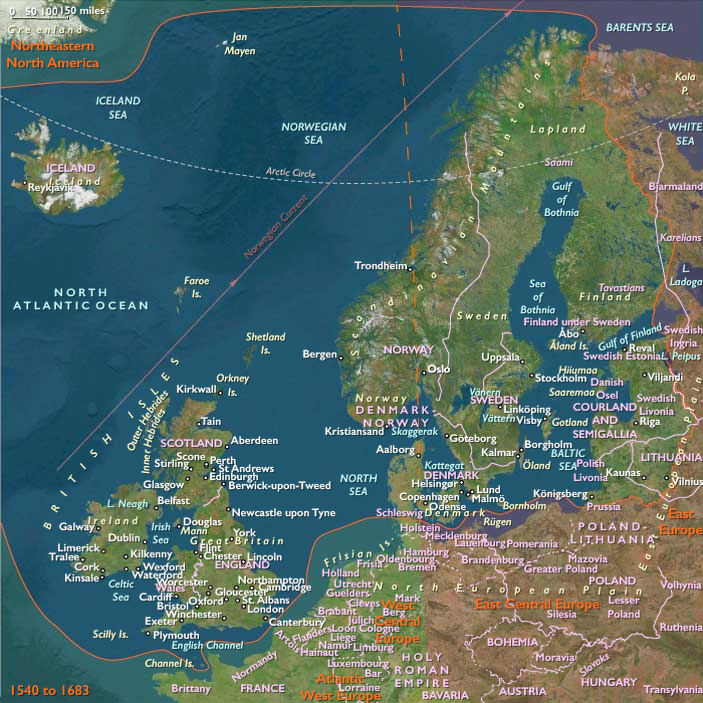
The three English ships were to rendezvous at the port of Vardø, the easternmost town in Norway, but the Edward Bonaventure is the only ship to arrive here.
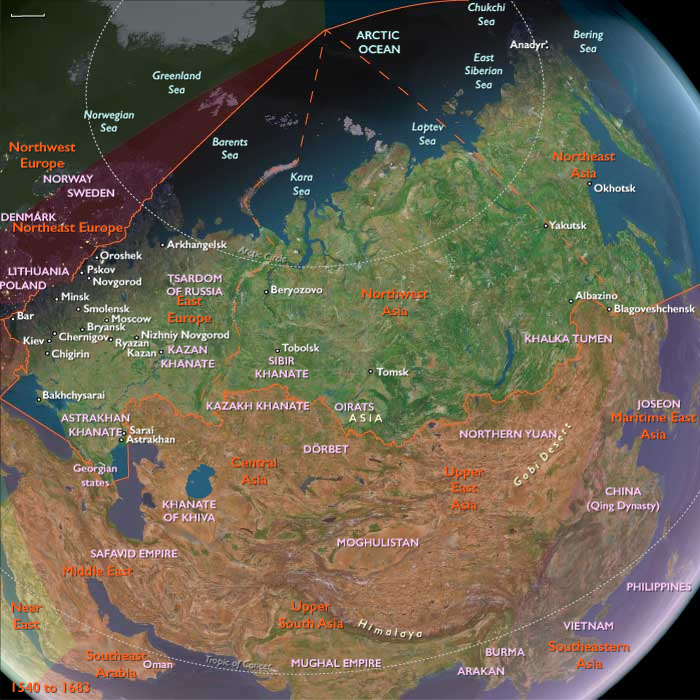
The ship’s master, the navigator Stephen Borough, becomes the first Englishman to sight and sail around the North Cape of Norway and to reach the White Sea, an arm of the Barents Sea.
The English expedition under the command of navigator Sir Hugh Willoughby had reached the Barents Sea, but there they had had run into trouble, one ship having become separated from the other two by "terrible whirlwinds" in the Norwegian Sea.
They had then sailed an erratic course, perhaps going as far east as Novaya Zemyla, and on September 14, 1553, the Bona Esperanza, with Willoughby aboard, and the Bona Confidentia, had entered a harbor in Lapland on the Kola Peninsula near the present border between Finland and Russia, where Willoughby had decided to remain during the bitter Arctic winter.
With no food, however, the crews of both ships soon perish.
(Their bodies, the ships, and Willoughby's journal will be found by fishermen a year or so later.)
It has also been suggested that Willoughby and his crew had been killed by carbon monoxide poisoning, following their decision to insulate their ship from the bitter Arctic cold.
During the voyage, Willoughby had thought he had seen islands to the north.
Based on his description, these will subsequently be depicted on maps as Willoughby's Land and Macsinof or Matsyn Island.

Willoughby’s chief navigator and second-in-command Richard Chancellor, with the ship Edward Bonaventure, had found the entrance to the White Sea and anchored at the port of Archangel.
Tsar Ivan, upon hearing of Chancellor's arrival, had immediately invited the exotic guest to visit the capital for an audience at the royal court.
Chancellor makes the journey of over six hundred miles (over one thousand kilometers) through snow and ice covered country to Moscow, finding the city large (much larger than London) and primitively built, most houses being constructed of wood.
The palace of the Tsar is however very luxurious, as are the dinners he offers Chancellor.
The Tsar is pleased to open the sea trading routes with England and other countries, as Russia does not yet have a connection with the Baltic Sea at the time and the entire area is contested by the neighboring powers of Poland, Lithuania, and Sweden.
In addition, the Hanseatic League has a monopoly on the trade between Russia and Central and Western Europe.
Chancellor is no less optimistic, finding a good market for his English wool, and receiving furs and other Russian goods in return.
The Tsar gives him letters for England inviting traders and promising commercial privileges.
Borough and Richard Chancellor, pilot general of the expedition, had continued on into the White Sea, where Chancellor had accepted an invitation to travel overland to Moscow. (It turns out that the Arctic waters traversed by Chancellor are already well known to Russian sailors, who have used the route around North Cape to western Europe as early as 1496, but this is not generally known at the time.)
Chancellor had received warm hospitality from Tsar Ivan IV, who had given him a letter granting the English favorable conditions for trade with Russia.
Rejoining his ship in the summer of 1554, Chancellor returns to England.
No stigma had attached to Chancellor on his return to London in the summer of 1554, despite King Edward having died and his successor Mary having executed Northumberland for attempting to place Lady Jane Grey on the throne.
The Muscovy Company, as the association of London merchants is now called, has sent Chancellor again to the White Sea.
He has learned on this voyage what had happened to Willoughby, recovered his papers, and found out about the discovery of Novaya Zemlya.
Chancellor spends the summer of 1555 dealing with the Tsar, organizing trade, and trying to learn how China might be reached by the northern route.
The successful negotiations by English navigator Richard Chancellor with Russian Tsar Ivan IV in 1554 result in the formation of the Muscovy Company, founded in 1555 by celebrated cartographer, navigator, and explorer Sebastian Cabot and various London merchants; the elderly Cabot is appointed governor for life.
The joint-stock company’s objective is to exploit the contacts, as well as to continue the search for the Northeast Passage.
The company in October dispatches Chancellor on a second trading mission to Moscow.
English navigator Stephen Borough, a thirty-one-year-old veteran of the Willoughby expedition, sails as commander of the Searchthrift for the Muscovy Company in 1556.
In his attempt to reach the Ob River, he sails as far as the island of Novaya Zemlya, unmapped but probably known to Norse sailors and Novgorod hunters since the eleventh century.
Probably the first Englishman to sail this far east, he is turned back at the entrance to the Kara Sea by ice storms and fog.
Borough’s former shipmate Chancellor meanwhile departs for England, taking with him the first Russian ambassador to his country, Osep Nepeja.
They leave Archangel in autumn; the fleet consists of Willoughby's ships (relaunched), the Phillip and Mary and the Edward Bonadventure.
Chancellor’s fleet tries in October/November 1556 to winter in Trondheim.
The Bona Esperanza sinks, the Bona Confidentia appears to have entered the fjord but is never heard of again, and the Phillip and Mary successfully winters in Trondheim to arrive in London next April the 18th.
The Edward does not attempt to enter, instead reaching the Scottish coast and being wrecked at Pitlago on the seventh of November.
Chancellor drowns but Osep Nepeya, the Russian envoy, manages to reach the coast, where he is taken hostage by the Scots for a few months before being able to travel on to London.