Rhys ap Gruffydd
Proprietary Prince of Deheubarth
Years: 1132 - 1197
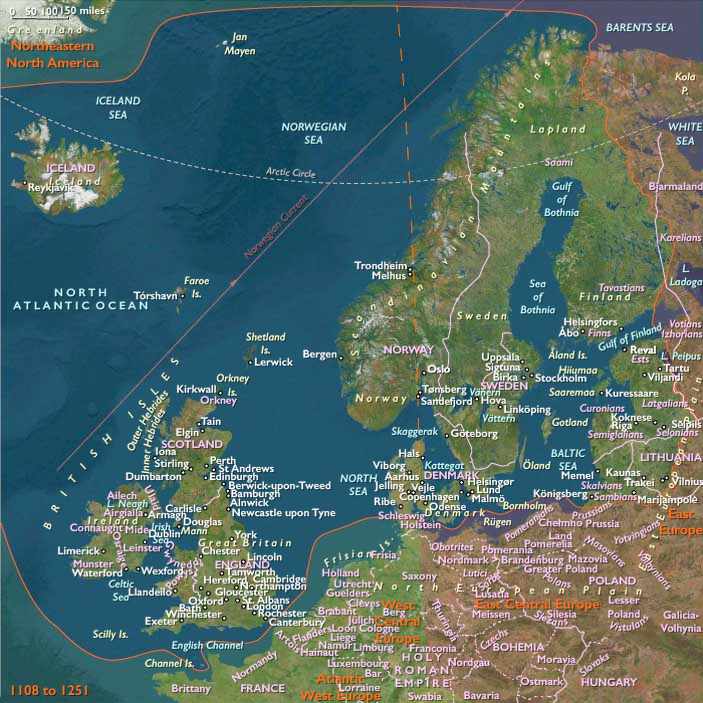
Rhys ap Gruffydd or ap Gruffudd (often anglicised to "Griffith") (1132 – 28 April 1197) is the ruler of the kingdom of Deheubarth in south Wales from 1155 to 1197.
Today, he is commonly known as The Lord Rhys, in Welsh Yr Arglwydd Rhys, although this title may have not been used in his lifetime.
He usually uses the title "Proprietary Prince of Deheubarth" or "Prince of South Wales", but two documents have been discovered in which he uses the title "Prince of Wales" or "Prince of the Welsh".
Rhys is one of the most successful and powerful Welsh princes, and, after the death of Owain Gwynedd of Gwynedd in 1170, the dominant power in Wales.
Rhys's grandfather, Rhys ap Tewdwr, was king of Deheubarth, and was killed at Brecon in 1093 by Bernard de Neufmarché.
Following his death, most of Deheubarth was taken over by the Normans.
Rhys's father, Gruffydd ap Rhys, eventually is able to become ruler of a small portion, and more territory was won back by Rhys's older brothers after Gruffydd's death.
Rhys becomes ruler of Deheubarth in 1155.
He is forced to submit to King Henry II of England in 1158.
Henry invades Deheubarth in 1163, strips Rhys of all his lands and takes him prisoner.
A few weeks late, he is released and given back a small part of his holdings.
Rhys makes an alliance with Owain Gwynedd and, after the failure of another invasion of Wales by Henry in 1165, is able to win back most of his lands.
In 1171, Rhys makes peace with King Henry and is confirmed in possession of his recent conquests as well as being named Justiciar of South Wales.
He maintains good relations with King Henry until the latter's death in 1189.
Following Henry's death, Rhys revolts against Richard I and attacks the Norman lordships surrounding his territory, capturing a number of castles.
In his later years, Rhys has trouble keeping control of his sons, particularly Maelgwn and Gruffydd, who maintain a feud with each other.
Rhys launches his last campaign against the Normans in 1196 and captures a number of castles.
The following year he dies unexpectedly and is buried in St. David's Cathedral.