Rædwald
king of East Anglia
Years: 570 - 624
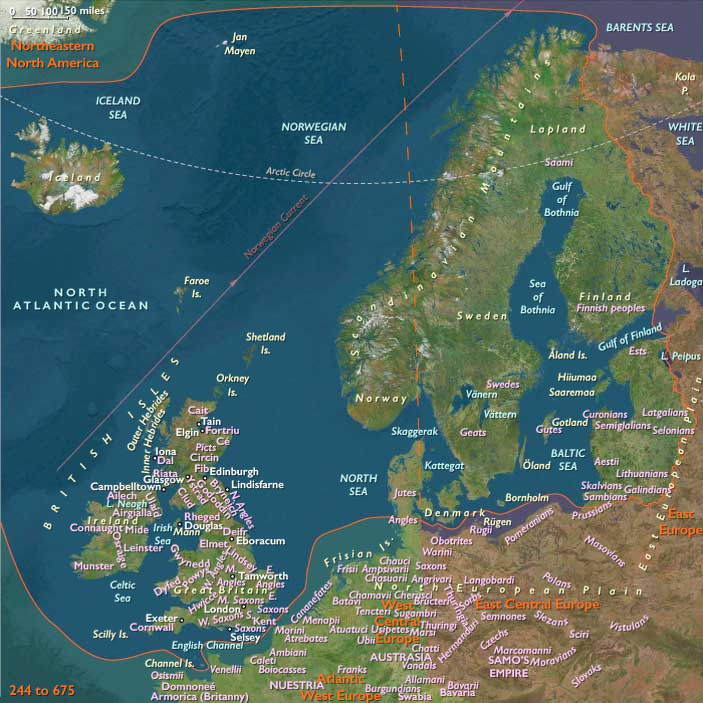
Rædwald (Old English: Rædwald, 'power in counsel'), also rendered as Raedwald or Redwald, is a 7th-century king of East Anglia, a long-lived Anglo-Saxon kingdom which today includes the English counties of Norfolk and Suffolk.
He is the son of Tytila of East Anglia and a member of the Wuffingas dynasty (named after his grandfather, Wuffa), who were the first kings of the East Angles.
Details about Rædwald's reign are scarce, primarily because the Viking invasions of the 9th century destroyed the monasteries in East Anglia where many documents would have been kept.
Rædwald reigns from about 599 until his death in around 624, initially under the overlordship of Æthelberht of Kent.
In 616, as a result of fighting the Battle of the River Idle and defeating Æthelfrith of Northumbria, he is able to install Edwin, who is acquiescent to his authority, as the new king of Northumbria.
During the battle, both Æthelfrith and Rædwald's son Rægenhere are killed.
From around 616, Rædwald is the most powerful of the English kings south of the River Humber.
According to Bede he was the fourth ruler to hold imperium over other southern Anglo-Saxon kingdoms: he was referred to in the Anglo-Saxon Chronicle, written centuries after his death, as a bretwalda (an Old English term meaning 'Britain-ruler' or 'wide-ruler').
He was the first king of the East Angles to become a Christian, converting at Æthelberht's court some time before 605, while eat the same time maintaining a pagan temple.
In receiving the faith he helps to ensure the survival of Christianity in East Anglia during the apostasy of the Anglo-Saxon kingdoms of Essex and Kent.
He is generally considered by historians to be the most favored candidate for the occupant of the Sutton Hoo ship-burial, although other theories have been advanced.