Maritime East Africa (1852–1863 CE): British Influence, Economic Expansion, and Madagascar's Political Shifts
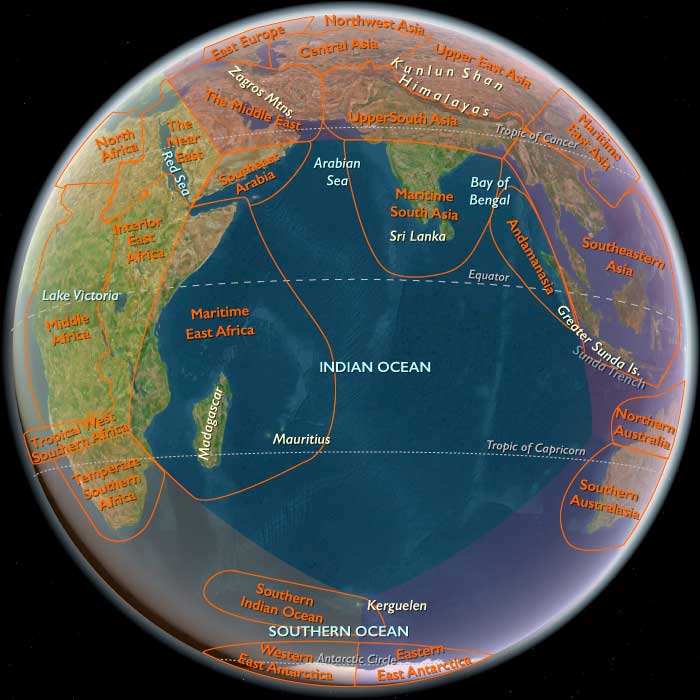
From 1852 to 1863 CE, Maritime East Africa—including the Somali coast, Mauritius, and Madagascar—experiences expanding British influence, significant economic developments tied to global markets, and notable political shifts within Madagascar’s Merina kingdom.
Somali Coast: Local Rule and British Relations
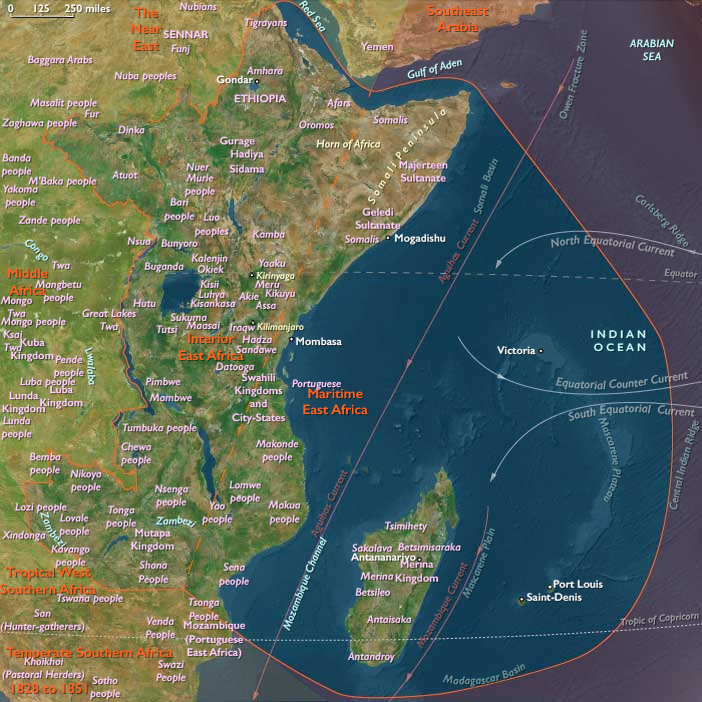
In 1854–1855, British naval lieutenant Richard Burton explores the northern Somali coast, observing significant local political autonomy despite formal foreign influences. At Saylac, Burton encounters Somali governor Haaji Sharmarke Ali Saleh of the Habar Yoonis clan, who exerts practical authority over the city and its surroundings. However, Saylac itself has significantly declined from its former prominence, now characterized by crumbling infrastructure, ineffective water storage, and recurrent incursions by local tribal groups.
Farther east along the Majeerteen (Bari) coast, two influential Somali kingdoms emerge prominently: the Majeerteen Sultanate under Boqor Osman Mohamoud, and the Sultanate of Hobyo (Obbia) under Sultan Yusuf Ali Kenadid. Sultan Osman Mohamoud’s leadership sees considerable economic growth from trading in livestock, ostrich feathers, and gum arabic, enhanced by British subsidies intended to protect British shipwreck survivors along the Somali coastline. Although nominally acknowledging British influence, these Somali kingdoms maintain considerable autonomy well into the nineteenth century.
Mauritius: Sugar Dominance under British Rule
In Mauritius, sugar production becomes the island’s dominant economic sector, significantly shaping its colonial economy under British administration. Initially incentivized by Britain’s decision in 1825 to equalize sugar duties across colonies, Mauritius dramatically expands its sugar output. From 1825 to 1826, production nearly doubles, and by 1854, the island surpasses one hundred thousand tons annually. Between 1855 and 1859, Mauritius achieves its peak significance as Britain’s primary sugar-producing colony, contributing 9.4 percent of the global sugar supply.
Despite rising overall production through subsequent decades, Mauritius’s global sugar dominance gradually diminishes due to declining world sugar prices and intensified competition from other sugar-producing nations. Nevertheless, the concentration on sugar transforms the island’s economy, diminishing food-crop cultivation and reinforcing large, plantation-based landholdings.
Madagascar: Political and Diplomatic Fluctuations under Merina Rule
Madagascar’s political environment undergoes significant swings during this era. Under King Radama II (r. 1861–1863), Madagascar adopts a notably pro-European stance, particularly toward France. Radama II signs a treaty of perpetual friendship with France, signifying openness to Western influence and modernization. However, his policies quickly provoke opposition from conservative nobles alarmed by the increasing French presence.
In 1863, Radama II is assassinated by nobles opposed to his pro-French diplomacy, abruptly ending his short reign. His widow, Queen Rasoherina (r. 1863–1868), succeeds him, swiftly reversing his policies. She annuls the French treaty and dissolves agreements made by Radama II, including revoking the charter of the influential French entrepreneur Jean Laborde, whose ventures had significantly shaped Madagascar’s industrial and agricultural landscape.
Malawi and Mozambique:
The mid-nineteenth century witnesses increased Portuguese administrative presence in central and northern Mozambique, though practical control remains patchy beyond coastal enclaves. Mozambique’s Zambezi Valley becomes a crucial artery for trade, linking inland southern Malawi settlements, including expanding missionary bases, to coastal markets. Blantyre grows steadily, influenced by increasing missionary activity and early plantation economies introduced by European settlers, setting foundations for its future status as Malawi’s commercial and administrative hub.
Legacy of the Era
The period from 1852 to 1863 CE in Maritime East Africa is marked by expanding British influence along the Somali coast, economic prosperity driven by sugar cultivation in Mauritius, and dramatic political and diplomatic shifts within Madagascar’s Merina kingdom. These developments profoundly shape regional dynamics, setting a foundation for intensified European colonial interactions and economic transformations in subsequent decades.