Ramiro II of León
King of León and King of Galicia
Years: 900 - 951
Ramiro II (c. 900–1 January 951), son of Ordoño II, is a King of León from 931 until his death.
Initially titular king only of a lesser part of the kingdom, he gains the crown of León (and with it, Galicia) after supplanting his brother Alfonso IV and cousin Alfonso Fróilaz in 931.
The scant Anales castellanos primeros are a primary source for his reign.

Related Events
Filter results
Showing 10 events out of 17 total
Dynastic Struggle for the Throne of León (925 CE)
Following the death of King Fruela II in 925 CE, a succession crisis erupts between the sons of Ordoño II and their cousin, Alfonso Fróilaz, son of Fruela.
- Alfonso Fróilaz, already King of Galicia, claims Asturias and León, asserting his right as the direct heir of Fruela II.
- However, Sancho Ordóñez, Alfonso IV, and Ramiro II, the sons of Ordoño II, dispute his claim, rebelling against their cousin and asserting their own rightful succession as the legitimate heirs of their father.
This internal struggle marks a pivotal moment in the political fragmentation of the Kingdom of León, with rival factions vying for control over the Asturian-Leonese throne.
The Ordóñez Brothers Overthrow Alfonso Fróilaz and Divide the Kingdom (925 CE)
With the support of King Jimeno Garcés of Pamplona, the Ordóñez brothers—Sancho Ordóñez, Alfonso IV, and Ramiro II—successfully defeat and depose their cousin Alfonso Fróilaz. They force him to retreat to the eastern marches of Asturias, stripping him of his claim to León and Galicia.
Following their victory, the brothers divide the kingdom among themselves:
- Alfonso Ordóñez is crowned King of León as Alfonso IV...
- Sancho Ordóñez, the eldest, is acclaimed King of Galicia.
This partition of the Asturian-Leonese realm reflects the ongoing dynastic struggles and regional fragmentation that characterize the early medieval kingdoms of northern Iberia.
Atlantic Southwest Europe (928–939 CE): Strengthening of León, Battle of Simancas, and Solidification of Regional Identities
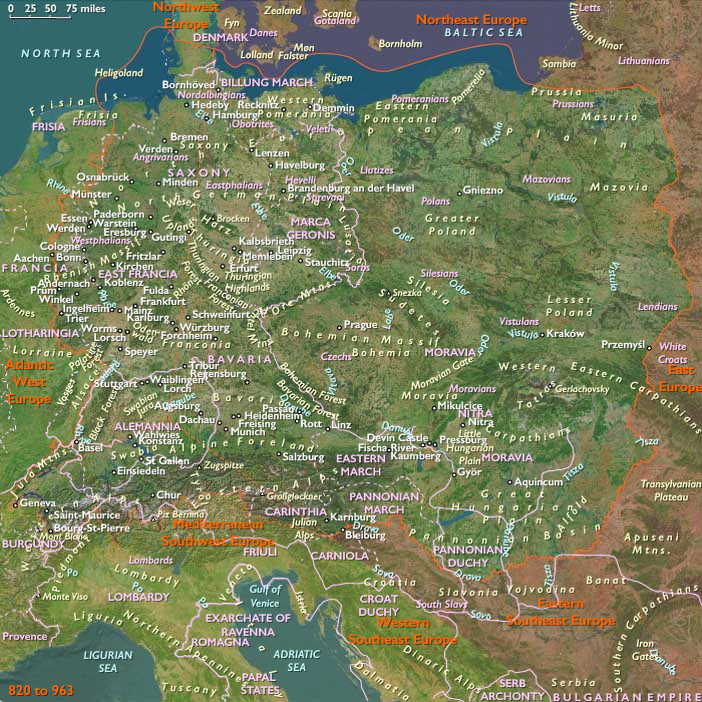
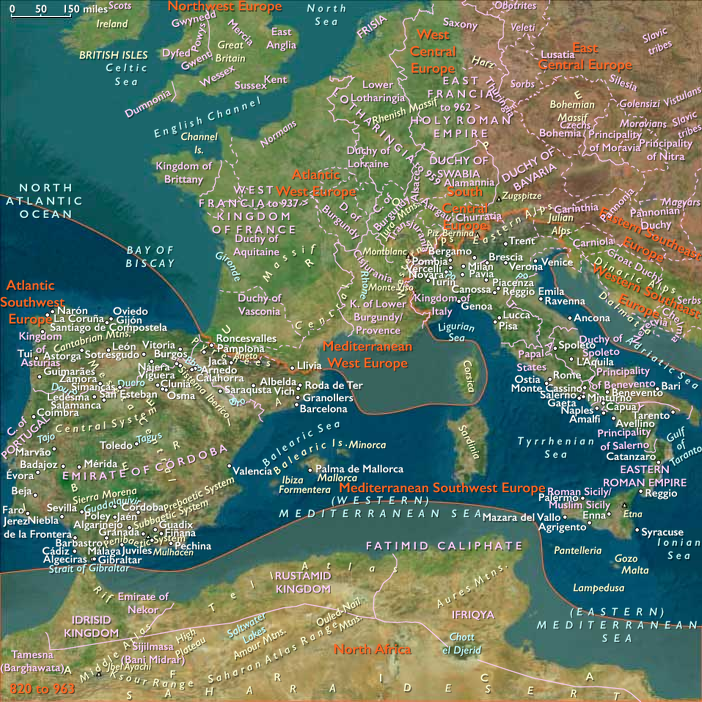
Between 928 and 939 CE, Atlantic Southwest Europe—including Galicia, northern and central Portugal, Asturias, Cantabria, and northern Spain south of the Franco-Spanish border (43.05548° N, 1.22924° W)—entered a decisive period characterized by military victories, political strength, and renewed regional identities. Under King Ramiro II of León (931–951 CE), the region achieved significant territorial security, notably through the landmark Battle of Simancas (939 CE) against Islamic al-Andalus. Meanwhile, the Basques under the Kingdom of Pamplona remained politically autonomous, further solidifying their distinct identity. Economic stability, ecclesiastical prominence, and the thriving pilgrimage tradition to Santiago de Compostela continued shaping the medieval trajectory of the region.
Political and Military Developments
Ramiro II’s Rise and Military Strengthening
Following internal uncertainties after Alfonso IV’s abdication in 931 CE, Ramiro II ascended the Leónese throne, swiftly restoring internal stability and strengthening centralized royal authority. His effective leadership reinforced frontier defenses along the Duero River, reasserting León’s position as the primary Iberian Christian stronghold.
Victory at the Battle of Simancas (939 CE)
In 939 CE, Ramiro II decisively defeated the forces of Caliph Abd al-Rahman III of Córdoba at the Battle of Simancas, near the Duero frontier. This significant victory halted Islamic military advances, greatly enhanced regional security, and enabled further Christian resettlement southward, deeply reinforcing León’s prestige and territorial integrity.
Continued Basque Autonomy under García Sánchez I
Simultaneously, the Basque kingdom under García Sánchez I of Pamplona (925–970 CE) maintained stable autonomy, skillfully balancing relations between León, al-Andalus, and neighboring Frankish territories. Their political independence and cohesive identity decisively shaped Iberian regional dynamics throughout this era.
Economic Developments
Sustained Regional Prosperity
Ramiro II’s stable reign supported sustained economic prosperity. Villa-based agriculture (grain, vineyards, olives), livestock husbandry, artisanal industries, and mining—particularly gold and silver extraction in Galicia and Asturias—remained robust, consistently enriching regional economic stability and wealth.
Reliable Maritime and Regional Trade
Coastal settlements, particularly Bracara Augusta (Braga) and smaller ports across Galicia and northern Portugal, maintained steady maritime trade networks. These resilient economic exchanges effectively connected the region with broader Atlantic and Mediterranean markets, supporting continued regional prosperity.
Cultural and Religious Developments
Continued Prominence of Santiago de Compostela
The pilgrimage tradition to Santiago de Compostela maintained its prominent cultural and religious position, steadily growing in popularity. The ongoing influx of pilgrims fostered economic prosperity, cultural exchange, and deepened religious devotion, solidifying Santiago’s pilgrimage as a defining element of regional identity.
Robust Ecclesiastical Leadership and Influence
Bishoprics—particularly Braga, Lugo, Asturica Augusta, and Santiago de Compostela—remained pivotal in regional governance, education, social welfare, and community cohesion. Ecclesiastical institutions provided stable moral and civic leadership, further embedding orthodox Christianity into regional cultural life.
Monastic Cultural Preservation and Scholarly Activity
Monastic communities continued flourishing, serving as vital centers for manuscript preservation, literacy, scholarship, agricultural innovation, and social welfare. Their continued vibrancy significantly enriched the region’s cultural heritage, educational continuity, and social stability.
Enduring Cultural Syncretism
The longstanding integration of orthodox Christianity with indigenous Celtic and Iberian traditions persisted robustly, particularly in rural Galicia, Asturias, and northern Portugal, reinforcing regional unity, resilience, and cultural distinctiveness.
Civic Identity and Governance
Consolidated Royal Authority and Regional Stability
Under Ramiro II, governance structures effectively balanced strong centralized royal authority and ecclesiastical influence with meaningful regional autonomy. Civic identities were strongly anchored to Leónese royal power, ecclesiastical institutions, and pilgrimage traditions, ensuring cohesive governance and robust regional identity.
Stable Basque Political and Cultural Autonomy
The Basques, under García Sánchez I, maintained their distinct territorial independence, political autonomy, and civic identity through the Kingdom of Pamplona, decisively shaping broader regional dynamics.
Notable Tribal Groups and Settlements
-
Astures and Cantabri: Continued providing essential political stability, military strength, and regional identity, decisively influencing Leónese governance structures and defensive strategies.
-
Galicians and Lusitanians: Maintained resilient local governance, economic prosperity, and cultural autonomy, pragmatically cooperating with Leónese central authority.
-
Basques: Clearly established politically and culturally, maintaining distinct territorial independence and governance under Pamplona, actively influencing Iberian regional developments.
Long-Term Significance and Legacy
Between 928 and 939 CE, Atlantic Southwest Europe:
-
Achieved a significant military victory at the Battle of Simancas, decisively shaping the region’s medieval geopolitical trajectory by firmly halting Islamic advances.
-
Reinforced political stability, territorial integrity, economic prosperity, and cultural resilience, deeply influencing the region’s historical continuity and medieval identity.
-
Maintained and consolidated Basque political autonomy, significantly shaping broader Iberian regional dynamics and political identities.
This pivotal era significantly strengthened regional political cohesion, cultural vitality, and economic stability, profoundly influencing Atlantic Southwest Europe’s enduring medieval historical trajectory.
The Partition of León and the Rise of Ramiro II (929 CE)
After deposing Alfonso Fróilaz, the three sons of Ordoño II, with the support of the Kingdom of Pamplona, divide the realm among themselves:
- Sancho Ordóñez rules in Galicia,
- Alfonso IV governs León, and
- Ramiro II controls the newly conquered lands to the south, with Ibn Hayyan identifying his court at Coimbra.
Ramiro II Seizes Power
When Sancho Ordóñez dies in 929, his kingdom is absorbed by Alfonso IV, reuniting the territories. However, soon after, a power struggle erupts.
In a swift turn of events in León and Zamora, Ramiro II forces Alfonso IV to abdicate. To secure his rule, Ramiro has both Alfonso IV and Fruela II’s three sons blinded, rendering them incapable of claiming the throne.
This brutal consolidation of power establishes Ramiro II as the undisputed ruler of the Kingdom of León, marking the beginning of a reign that will define Christian resistance against Al-Andalus.
The succession crisis that had struck León after Ordoño II's death in 924 had caused hostilities to cease until Ramiro II obtains the throne in 932; a first attempt by him to assist the besieged rebels in Toledo is repelled in 932, despite the Christian king having captured Madrid and scoring a victory at Osma.
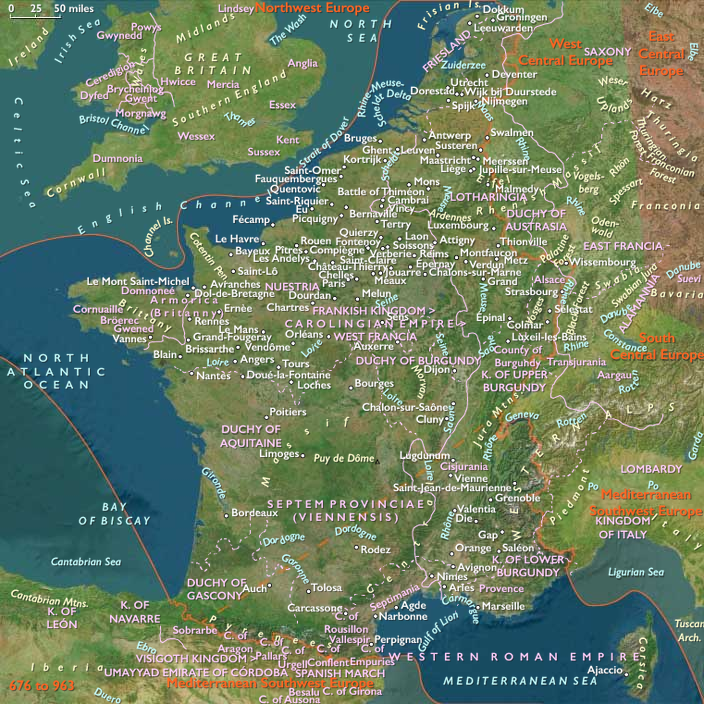
…forces the Navarrese queen Toda, his aunt, to submit to him as a vassal and withdraw from direct rule as regent for her son García Sánchez I.
The intervention of Abd-ar-Rahman III in the Basque kingdom begins a period of frequent punitive campaigns from Córdoba and submission to tributary status by Pamplona.
Abd ar-Rahman III Forces Ramiro II to Retreat (934 CE)
In 934 CE, Caliph Abd ar-Rahman III launches a successful military campaign to reassert Umayyad supremacyover Pamplona and Álava, strengthening Muslim control in the Ebro Valley.
Following these victories, he turns his forces against Ramiro II of León, forcing the Leónese king to retreat to Burgos. This setback temporarily halts Christian expansion and reaffirms Cordoban dominance over the contested frontier regions of northern Iberia.
Abd ar-Rahman conquers some thirty castles in León in 937.
He next turns to Muhammad ibn Hashim at-Tugib, governor of Zaragoza, who had allied with Ramiro but is pardoned after the capture of his city.
Ramiro II’s Military Expansion and Frontier Consolidation
Despite setbacks against Caliph Abd ar-Rahman III, King Ramiro II of León proves to be an outstanding military commander, successfully expanding Leonese control southward.
- He pushes the frontier to include Salamanca and ...