Ragnachar
Frankish petty king
Years: 460 - 509
Ragnachar or Ragnarius (died 509) is a Frankish petty king (regulus) who rules from Cambrai.
According to Gregory of Tours, Ragnachar "was so unrestrained in his wantonness that he scarcely had mercy for his own near relatives", an attribute he shares with his contemporary, fellow king and relative, Clovis.






Related Events
Filter results
Showing 7 events out of 7 total
The Execution of Syagrius and the Expansion of the Frankish Realm (486–487 CE)
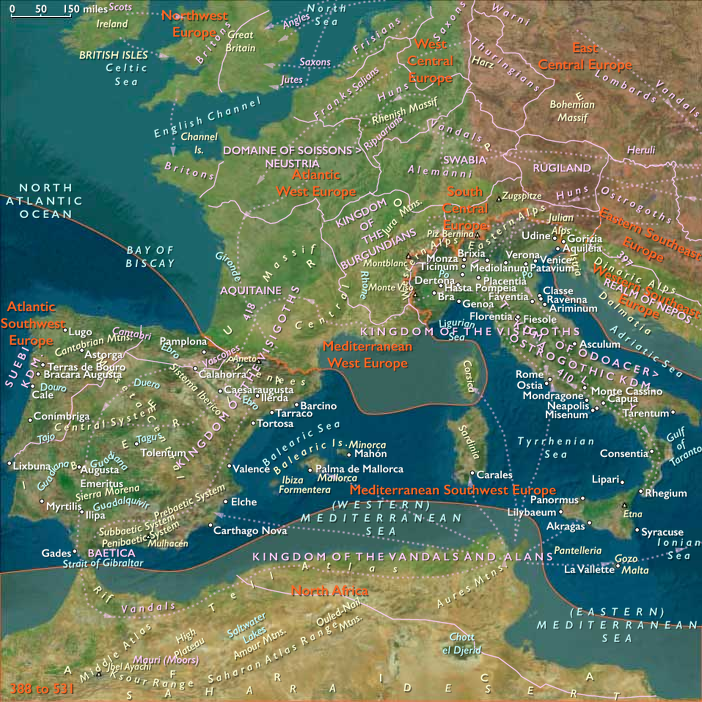
After his defeat at the Battle of Soissons (486 CE), Syagrius flees southward, seeking refuge with the Visigothsunder King Alaric II. However, his former Roman allies prove unreliable when faced with the military power of Clovis I.
The Fate of Syagrius
- Clovis, now the undisputed ruler of northern Gaul, demands that the Visigoths hand over Syagrius.
- Alaric II, unwilling to provoke a war with the rising Frankish power, complies with Clovis' demand.
- Syagrius is delivered to Clovis, who, according to Gregory of Tours, has him stabbed to death in secret, eliminating the last Roman claimant to power in Gaul.
The Expansion of the Frankish Kingdom
With Syagrius dead and his domain absorbed, Clovis nearly doubles the size of the Frankish realm, incorporating the former Roman province of Belgica Secunda.
- Soissons becomes the Frankish capital, replacing Tournai as Clovis' primary residence.
- The Frankish frontier expands southward, reaching the Loire River, bringing Clovis into direct territorial contact with the Visigoths.
- The Frankish realm, originally centered in Toxandria (modern Belgium and the southern Netherlands), now dominates northern Gaul.
The Growing Tension Between Franks and Visigoths
By 487 CE, the new Frankish-Visigothic border along the Loire River sets the stage for future conflict:
- Clovis, now ambitious for further expansion, views the Visigoths as his next major rival in Gaul.
- The Visigoths, already expanding into Provence and Hispania, face the growing threat of Frankish encroachment from the north.
This marks a turning point in the struggle for Gaul, as Clovis positions the Franks as the dominant power in the former Western Roman territories, setting the stage for his eventual conquest of the Visigothic kingdom in 507 CE.
Clovis and the Appointment of Ragnachar as Deputy Ruler
Following his victory over Syagrius and the expansion of the Frankish kingdom, Clovis I begins consolidating power by securing the loyalty of influential Frankish chieftains. One of the most significant figures he appoints as deputy ruler is Ragnachar, a Frankish petty king (regulus).
Ragnachar’s Role in the Frankish Realm
- Ragnachar, ruler of Cambrai, is a powerful Frankish leader who had previously controlled a small but strategic kingdom in northern Gaul.
- Clovis, recognizing his military and political importance, appoints him as his deputy, entrusting him with governance over Frankish-occupied territories.
- This move strengthens Clovis’ control over northern Gaul, ensuring loyalty from the remaining independent Frankish reguli while expanding Frankish influence southward toward the Loire.
The Tenuous Relationship Between Clovis and Ragnachar
Although initially an ally, Ragnachar's position remains precarious:
- He retains considerable autonomy, ruling as a subordinate but semi-independent leader.
- Over time, Clovis' consolidation of Frankish rule leads to rivalries with other Frankish leaders, including Ragnachar.
- Eventually, Ragnachar falls out of favor with Clovis, and their relationship will end in betrayal and execution—but for now, he plays a crucial role in the administration of the expanding Frankish kingdom.
This appointment reflects Clovis' strategy of absorbing Frankish warlords into his rule, gradually transforming the fragmented Frankish territories into a unified kingdom, which he will later dominate outright.
Clovis I: Christianization, Consolidation, and Recognition by the Eastern Empire (507–511 CE)
By the end of his reign, Clovis I completes the unification of the Franks, establishes a Christian Frankish state, and earns imperial recognition from the Eastern Roman Empire, securing his place as the most powerful ruler in Western Europe.
1. Making Chalcedonian Christianity the Official Religion
- Following his baptism in 496 CE, Clovis formally establishes Catholic (Chalcedonian) Christianity as the official faith of his kingdom.
- This solidifies his alliance with the Gallo-Roman bishops, giving him strong political backing in former Roman territories.
- His conversion sets the Franks apart from other Germanic kingdoms, such as the Visigoths, Burgundians, and Ostrogoths, which still followed Arian Christianity.
2. Paris Becomes the Frankish Capital
- Clovis moves his royal residence from Soissons to Paris (Lutetia), recognizing its strategic central location on the Seine River.
- This decision marks the beginning of Paris’ rise as the political and cultural center of France.
3. Founding the Abbey of Saints Peter and Paul
- Clovis commissions the construction of an abbey on the south bank of the Seine, dedicated to Saints Peter and Paul.
- The abbey later becomes known as the Abbey of Saint Genevieve, named after the patron saint of Paris, who had led the city's resistance against Attila the Hun.
- This abbey serves as the burial site for Clovis and his wife, Queen Clotilde.
4. Recognition by the Eastern Roman Empire
- After his victory at Vouillé (507 CE), the Eastern Roman Emperor Anastasius I acknowledges Clovis’ growing power.
- Gregory of Tours records that Anastasius grants Clovis the title of consul, though Clovis’ name does not appear in official Roman consular lists.
- This suggests that Clovis was granted a suffect consulship, an honorary title marking him as a protector of the Roman people in Gaul.
- This imperial recognition further legitimizes Clovis’ rule, allowing him to present himself as the heir to Roman authority in the West.
5. Eliminating the Other Frankish “Reguli” (Sub-Kings)
To centralize power and prevent internal threats, Clovis ruthlessly eliminates rival Frankish leaders, consolidating his rule over all Frankish tribes. Gregory of Tours records several assassinations:
- Sigobert the Lame (a Ripuarian Frankish king) is murdered, and his son Chlodoric the Parricide is later killed by Clovis’ agents.
- Chararic, another Salian Frankish king who had previously refused to aid Clovis in battle, is executed.
- Ragnachar of Cambrai, his brother Ricchar, and their sibling Rignomer of Le Mans are eliminated, removing the last major rivals to Clovis’ dominance.
6. Clovis’ Final Triumph: The Sole King of the Franks
By the time of his death in 511 CE, Clovis has:
- Unified all Frankish tribes under a single rule, creating a centralized Frankish kingdom.
- Established Paris as the political capital of his expanding realm.
- Positioned himself as the protector of Catholic Christianity in Western Europe.
- Earned recognition from the Eastern Roman Empire, reinforcing his legitimacy.
- Secured the long-term stability of his dynasty, setting the stage for the Merovingian kingship.
The Legacy of Clovis I
Clovis’ reign transforms the Franks from a loose collection of tribes into the dominant power in post-Roman Gaul. His policies lay the foundation for the Frankish kingdom, which will evolve into medieval France and the Holy Roman Empire. His conversion to Catholic Christianity, his strategic alliances with the clergy, and his ruthless political consolidation ensure that his descendants will rule for centuries, shaping the course of Western European history.
Clovis' Elimination of Chararic and the Final Consolidation of Frankish Rule
By the last years of his reign, Clovis I turns his attention to internal power struggles within the Frankish realm, eliminating rival Frankish leaders who had once ruled independently. One of these rivals is Chararic, a Frankish petty king who had failed to support Clovis at a critical moment in 486 CE.
Chararic's Betrayal and Clovis' Revenge
- During Clovis' war against Syagrius in 486, he had requested Chararic’s assistance.
- Chararic, however, held back from the battle, waiting to see who would emerge victorious before pledging his loyalty.
- Though Clovis was victorious, he did not immediately punish Chararic, allowing him to retain power—possibly as part of a longer strategy to secure alliances before turning against rivals.
The Capture and Tonsuring of Chararic and His Son
- Sometime after Clovis' conversion to Christianity (c. 507 CE), he finally moves against Chararic, trapping and capturing both him and his son.
- Rather than executing them outright, Clovis tonsures them, a symbolic and humiliating punishment in Frankish and Christian tradition.
- Chararic is ordained as a priest, stripping him of his royal status.
- His son is made a deacon, preventing him from inheriting the throne.
The Fatal Mistake of Chararic and His Son
- According to Gregory of Tours, while imprisoned, Chararic laments their fate, feeling dishonored by the tonsure.
- His son, in response, suggests that they let their hair grow back, implying they could reclaim their former power once freed.
- This conversation is reported to Clovis, who takes it as a sign of potential rebellion.
The Execution and Final Annexation of Chararic’s Kingdom
- Upon learning of Chararic's ambitions, Clovis orders the execution of both father and son.
- With their deaths, Clovis annexes Chararic’s kingdom and treasure, further strengthening his control over the Frankish realm.
Interpretations of Clovis' Timing
- Historian Ian Wood questions why Clovis waited over twenty years to eliminate Chararic.
- He suggests that Clovis should have eradicated Frankish opposition much earlier in his reign, but that the timing of the tonsure suggests a post-507 CE event, after Clovis’ conversion to Christianity.
- If Gregory’s account is accurate, the final years of Clovis’ reign (507–511 CE) were largely focused on internal power struggles, consolidating all Frankish factions under his sole rule.
Final Consolidation of Frankish Power
With the elimination of Chararic and other Frankish reguli, Clovis:
- Extinguishes any remaining internal opposition, making him the undisputed ruler of all the Franks.
- Further centralizes Merovingian rule, setting the precedent for strong royal authority over tribal leaders.
- Secures treasures and territories, enriching his kingdom and expanding Frankish influence in Gaul.
By 511 CE, Clovis has eradicated his rivals, expanded his kingdom, and cemented his rule, leaving behind a unified Frankish realm that will dominate Western Europe for centuries to come.
The Fall of Ragnachar and the Final Unification of the Franks (509 CE)
By 509 CE, Clovis I has established himself as the most powerful ruler in Gaul, having defeated the Romans, Alemanni, and Visigoths. However, internal Frankish opposition remains, particularly from Ragnachar, a Frankish reguli (petty king) who had once been Clovis' ally but later became a rival due to religious and political differences.
Ragnachar’s Early Alliance with Clovis (486 CE)
- In 486 CE, Ragnachar joins Clovis in his attack on Syagrius, the last Roman ruler in Gaul, aiding in the conquest of Soissons.
- However, tensions arise after Clovis’ conversion to Christianity in 496 CE.
Ragnachar’s Pagan Resistance and the Frankish Schism
- Following Clovis’ baptism into Catholic Christianity, a division forms within the Frankish army.
- Around half of the Frankish warriors refuse to convert and instead cleave to Ragnachar, who remains a traditional pagan.
- Hincmar of Reims, in his Life of Saint Remigius, states that many Franks followed Ragnachar across the Somme, separating from Clovis.
Ragnachar’s Unpopularity Among His Own Warriors
- Ragnachar earns a negative reputation due to his corrupt leadership and favoritism toward his counselor, Farro.
- Gregory of Tours writes that Ragnachar divides all gifts and food between himself and Farro, dismissing complaints from his men with the phrase, “Enough for me and my Farro.”
- His Franks grow resentful, and when his spies return from observing Clovis' army, they mockingly say it is “sufficient strength for you and your Farro.”
Clovis Exploits Discontent and Deceives Ragnachar’s Leudes
- Clovis seizes on the growing resentment within Ragnachar’s ranks.
- He bribes Ragnachar’s leudes (military followers) with false gifts—armlets and belts gilded with bronze to appear as gold, tricking them into betrayal.
- Deprived of support, Ragnachar loses the loyalty of his warriors and is left vulnerable.
The Battle and Capture of Ragnachar (509 CE)
- Clovis declares war and confronts Ragnachar in battle.
- Defeated and fleeing, Ragnachar and his brother Ricchar are captured by their own men and delivered to Clovis, hands bound behind their backs.
Clovis Executes Ragnachar and Ricchar
- Gregory of Tours recounts that when Ragnachar is brought before Clovis, the king taunts him:
- "Why have you humiliated our family by permitting yourself to be bound? It would have been better for you to die."
- Clovis then executes Ragnachar with an ax.
- He turns to Ricchar and says:
- "If you had aided your brother, he would not have been bound."
- Ricchar is then killed in the same manner.
The Final Unification of the Franks
With Ragnachar’s death and his kingdom absorbed, Clovis achieves:
- The final elimination of the last Frankish rival rulers.
- The unification of all Frankish territories under a single king.
- A fully centralized Merovingian kingdom, ending the era of multiple competing reguli.
By the time of his death in 511 CE, Clovis has successfully:
- Created the first fully unified Frankish kingdom,
- Established Catholic Christianity as the state religion,
- Replaced all former rival warlords, ensuring the Merovingian dynasty's uncontested rule.
With all enemies vanquished, the Frankish kingdom, under Clovis, stands as the dominant power in Western Europe, laying the foundation for medieval France and the Holy Roman Empire.
The Final Elimination of Ragnachar’s Line and the Complete Unification of the Frankish Kingdom (509 CE)
Following the execution of Ragnachar and his brother Ricchar, Clovis ensures the total eradication of their lineage and claim to power.
The Killing of Rignomer at Le Mans
- Ragnachar’s other brother, Rignomer, survives the initial purge but remains a potential rival.
- On Clovis’ orders, Rignomer is later assassinated in Le Mans, eliminating the last member of Ragnachar’s bloodline.
- With his death, all of Ragnachar’s family wealth and his former kingdom pass to Clovis, further enriching the Merovingian royal treasury.
The Theological Framing of Clovis’ Victory
- Hincmar of Reims, writing in the ninth century, gives a Christianized account of Ragnachar’s downfall.
- He attributes Clovis' success to the "grace of Christ," reinforcing the idea that Clovis' rule is divinely sanctioned.
- According to Hincmar’s version, Ragnachar, "submitting to the shame of baseness," is betrayed by his own men and bound to be handed over to Clovis.
- Hincmar links Clovis’ victory with the mass conversion of the Franks, stating that "all the people of the Franks, by the Blessed Remigius, were converted to the faith and received baptism."
The Final Consolidation of Frankish Power
With Ragnachar, Ricchar, and Rignomer dead, Clovis has:
- Eliminated all remaining rival Frankish rulers, bringing the kingdom under sole Merovingian rule.
- Absorbed Ragnachar’s kingdom and treasure, further strengthening the centralized Frankish state.
- Solidified his image as a Christian king, with religious narratives framing his victories as part of divine providence.
By 511 CE, Clovis rules a unified Frankish kingdom, marking the true foundation of Frankish dominance in Western Europe. His strategic eliminations, political consolidation, and religious alliances set the stage for the Merovingian dynasty's long-lasting reign.
Sigobert, called the Lame, presumably wounded at the knee at the Battle of Tolbiac against the Alamanni, is king of the Ripuarian Franks, centered at Cologne.
His son, Chlodoric of Strasburg, called the Parricide, murders his own father in order to take his kingdom, having acted at the instigation of a rival king, Clovis I of the Salian Franks.
Clovis then accuses Chlodoric of the murder and has him killed in his turn for the crime.
In this way, Clovis becomes king of Sigobert's and Chlodoric's people.
Gregory of Tours suggests that Chlodoric was murdered in the same campaign that also killed the Frankish King Chararic.
Before, Clovis had killed King Ragnachar and his brothers.
After all these murders, Gregory tells us that Clovis lamented that he had no family left anymore, implying that among his own casualties were close relatives.
Clovis in 509 with his conquest of Cologne becomes the first king of all Franks.