Pulakesi II
ruler of the Chalukya dynasty
Years: 590 - 642
Pulikeshi II, Immadi Pulikeshi (610–642 CE) is the most famous ruler of the Chalukya dynasty.
In his reign the Chalukyas of Badami see their kingdom extend over most of the Deccan.
Related Events
Filter results
Showing 10 events out of 10 total
Mangalesha agrees in 597 to serve as Chalukyan regent upon the death of his brother Kirtivarman until Kirtivarman’s son Pulakesi II attains a majority, but Mangalesha soon usurps the throne.
The Chalukyas begin pressuring to control territories on India’s northwest coast, invading the territories of Khandesh and Gujarat.
Pulakesi also launches a naval assault against Puri, the capital of the Mauryas of Konkana, captures the city, and incorporates Konkana into his rapidly expanding empire.
The rightful Chalukya ruler ascends the throne as Pulakesi II in 610 following a long and bloody fratricidal war against his usurping uncle, Mangalesha.
Assuming control of Chalukya domains much enlarged during the reign of his treacherous uncle, Pulakesi focuses on consolidating his kingdom.
Intent on controlling India’s northwest coast, he gains parts of Gujarat and Malawa with the voluntary submission to his overlordship of the Latas, the Malvas, and the Gujaras.
Pulakesin exterminates the Kadambas in western Deccan, retaining the Alupas and Gangas as vassals.
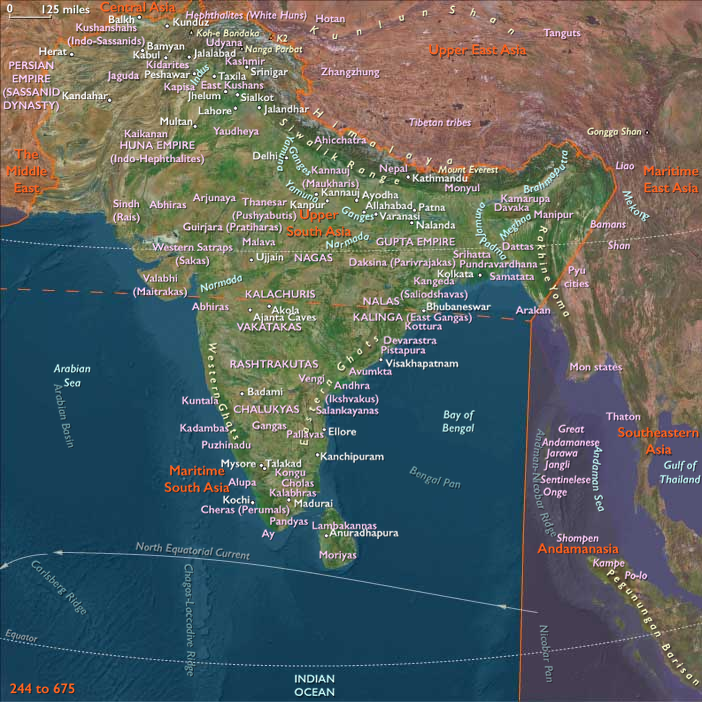
Pulakesi turns south with his army following his defeat of Kalinga and Koshala, crosses the Krishna River, and marches on the Pallava capital of Kanchipuram.
Mahendravarman mounts a successful defense of his capital, but is forced to cede substantial northern territory to the Chalukya king.
King Harsha of Thaneswar, frustrated in his attempts to gain control of the areas west of the Indus River, attempts a war of conquest in the south central Deccan Plateau, recognizing that who controls the Deccan could dominate the trade of coastal southern India.
The Chalukya dynasty, under Pulakesi II, fiercely resists, defeating Harsha on the banks of the Narmada (Narbada) River in 620 after the latter loses a major part of his elephant force and retreats.
A truce establishes the Chalukya kingdom’s northern boundary at the Narmada, establishing this river as the geographical division between North and South India.
Now in control of the entire Deccan Plateau, his holdings in the east stretch as far south as the Kistna River, encompassing lands formerly ruled by the Andhra dynasty.
Pulakesi had seized the Visnukindin east coast kingdom of Vengi (Pedavegi and Denduluru, near Eluru) around 615 and installed as viceroy his brother Kubja Vishnuvardhana, who declares his independent rule in 624, establishing an eastern Chalukya dynasty on the Bay of Bengal.
The Chalukyas control territories on both coasts of India by 627, dominate the east Asian trade, and act as an effective barrier to expansion by the ambitious kingdoms of South India.
The Pallava rulers of Kanchi trace their roots to Parthians who, according to some accounts, had quit the Ganges area to rule Dravidian-speaking regions as southern India’s first emperors, displacing an early Chola dynasty from a narrow strip of the east coast and establishing their capital at Kanchipuram.
The Pallava dynasty under Mahendravarma rules an extensive kingdom bounded by the Kaveri and Krishna rivers.
Chalukya king Pulakesi II, after conquering Koshala and Kalinga, turns south with his army, crosses, the Krishna River, and marches on the Pallava capital at Kanchipuram.
Although Mahendravarman successfully repels the attack, he is forced to cede extensive northern territories to the Chalukyas.
Narasimhavarman succeeds Pallava king Mahendravarman at the latter’s death in 630.

Pulakesi’s brother Vishnuvardhana rules over a kingdom extending from Nellore to Visakhapatnam.
He assumes the title of Vishamasiddhi (conqueror of difficulties).
Vishnuvardhana participated in the wars between his brother and the Pallava Narasimhavarma I and probably lost his life in battle in 641.
On the death of Pulakesi II, the Vengi Viceroyalty develops into an independent kingdom under Vishnuvardhana’s son Jayasimha.
Narasimhavarman, still seething at the Chalukyas’ seizure in 624 of the Visnukindin east coast kingdom of Vengi, which the Pallavas had themselves coveted, raids the Deccan area from 641 to 647, capturing large areas of Chalukya territory, conquering the temple-fort of Vatapi (Badami) in 642 and killing Pulakesi.
There is a period of confusion following the crushing defeat of the Chalukyas and the burning of Badami.
The five sons of Pulakesi fight among themselves and try to divide the kingdom into independent kingdoms.
Pulakesi's third son Vikramaditya I becomes the Chalukya king around 642 and eventually restores order after defeating his brothers.