Ptolemy V Epiphanes
king of Egypt
Years: 209BCE - 181BCE
Ptolemy V Epiphanes (reigned 204–181 BCE), son of Ptolemy IV Philopator and Arsinoe III of Egypt, is the fifth ruler of the Ptolemaic dynasty.
He becomes ruler at the age of five, and under a series of regents the kingdom is paralyzed.


Related Events
Filter results
Showing 10 events out of 43 total
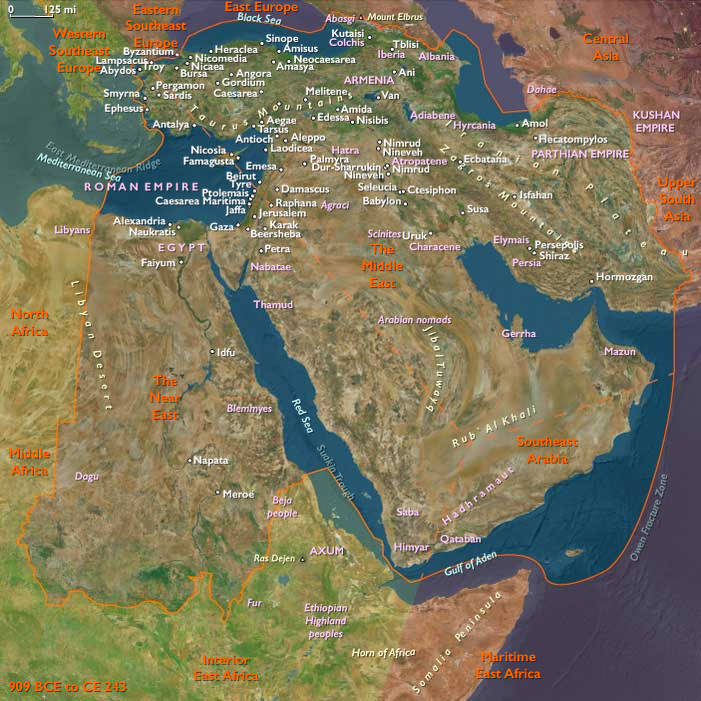
Near East (333–190 BCE): Hellenistic Conquests and Cultural Transformations
Alexander's Empire and its Immediate Aftermath (333–322 BCE)
The year 333 BCE inaugurates the Hellenistic Age when Alexander III of Macedon defeats the Persian Empire, transforming the geopolitical landscape of the Near East. Alexander’s swift military successes culminate in notable victories at the battles of Granicus (334 BCE), Issus (333 BCE), and Gaugamela (331 BCE). After the prolonged and pivotal siege of Tyre in 332 BCE, Alexander's domain stretches from Greece to the borders of India. He strategically integrates conquered territories through city foundations, notably Alexandria in Egypt, and religious accommodations, earning acceptance among local populations. His unexpected death in 323 BCE at Babylon triggers a complex power struggle among his generals—Perdiccas, Ptolemy Soter, Seleucus, and Antigonus Monophthalmus—eventually leading to the division of Alexander’s vast empire into separate dynasties.
Emergence of the Hellenistic Monarchies (321–298 BCE)
Alexander's territories fragment into significant Macedonian dynasties by 298 BCE. In Egypt, the Ptolemies establish a prosperous rule, significantly influencing the region by founding the renowned Library of Alexandria and the monumental Pharos Lighthouse. In Syria and Mesopotamia, the Seleucid dynasty emerges, though it remains in recurrent conflict with the Ptolemies, particularly over strategically vital areas such as Coele-Syria (modern-day Lebanon and southern Syria). Notably, after a forty-year conflict, a decisive Seleucid victory concludes initial hostilities over Phoenician territories.
Cultural Integration and Scholarly Achievement (297–274 BCE)
The Near East experiences widespread Hellenization, adopting Greek artistic, scientific, and architectural standards. Intellectual advancement peaks with scholars like Euclid, whose foundational texts on geometry and optics profoundly influence science. Cities such as Ashkelon and Ashdod are widely recognized by their Hellenized names, Ascalon and Azotus, exemplifying the era’s cultural synthesis. Egypt’s Ptolemaic Museum and Library at Alexandria become major scholarly hubs, further embedding Greek culture and intellectualism into the region.
Dynastic Rivalries and Egyptian Decline (273–226 BCE)
The Near East remains marked by fierce dynastic rivalries, particularly the Damascene War (280 BCE) and the subsequent First Syrian War (274 BCE). The internal stability of Ptolemaic Egypt significantly weakens due to court intrigues, rebellions, and economic strains. Antiochus III exploits this turmoil, resulting in Egypt's near-total loss of its Asian territories following the Battle of Panium (200 BCE). Such territorial shifts profoundly alter regional power structures.
Revolts and the Rise of Regional Powers (225–190 BCE)
Seleucid domains experience instability due to revolts by powerful satraps, notably Achaeus and Attalus of Pergamon, who successfully assert independence in Asia Minor. Attalus I consolidates Pergamon's power through victories over the Galatians, celebrated in the renowned sculpture The Dying Gaul. The century ends with the devastating Roman–Syrian War (192–188 BCE), significantly curtailing Seleucid authority, limiting it to a fragmented domain centered in Mesopotamia and inland Syria.
Legacy of the Age
The Near East during the Hellenistic Age undergoes profound political and cultural transformations marked by the spread of Greek culture, administrative reforms, and vibrant urban planning. Influential cities like Alexandria and Pergamon symbolize these shifts, becoming enduring centers of culture and learning. Despite flourishing intellectually and artistically, persistent dynastic conflicts and internal instabilities ultimately create vulnerabilities that pave the way for Roman ascendancy, marking this period as a crucial transition shaping the historical evolution of the Near East.
The Parthians had begun to try to conquer as much of the eastern Seleucid empire as possible after 238 BCE, joined in this endeavor by the now independent province of Bactria.
The Seleucid king Antiochus II Theos was at the time too busy fighting a war against Ptolemaic Egypt and so the Seleucids had lost most of their territory east of Persia and Media.
Antiochus III, an ambitious Seleucid king who has a vision of reuniting Alexander the Great's empire under the Seleucid dynasty, launches a campaign in 209 BCE to regain control of the eastern provinces, and after defeating the Parthians in battle, he successfully regains control over the region.
The Parthians are forced to accept vassal status and now only control the land conforming to the former Seleucid province of Parthia.
However, Parthia's vassalage is only nominal at best and only because the Seleucid army is on their doorstep.
For his retaking of the eastern provinces and establishing the Seleucid borders as far east as they had been under Seleucus I Nicator, Antiochus is awarded the title ‘great’ by his nobles.
Antiochus establishes a magnificent system of vassal states but has had to recognize the independence of two kingdoms, that of the Parthians and that of the Greco-Bactrian ruler Euthydemus, which had been no more than satrapies.
Luckily for the Parthians, the Seleucid Empire has many enemies, and it will not be long before Antiochus leads his forces west to fight Ptolemaic Egypt and the rising Roman Republic.
Near East (213–202 BCE): Egyptian Instability and Hellenistic Opportunism
In the early years of this era, native Egyptians, empowered by their decisive role in the victory at the Battle of Raphia (217 BCE), become increasingly aware of their potential strength. Emboldened, they initiate a rebellion against their Hellenistic overlords. Polybius, the contemporary historian, describes this uprising as guerrilla warfare, marking a significant escalation in Egyptian resistance and highlighting the tenuous grip of the Ptolemaic dynasty over Egypt.
Meanwhile, court intrigue intensifies around the death of Ptolemy IV Philopator in 205 BCE and the accession of his young successor, Ptolemy V Epiphanes (205–180 BCE). According to Polybius, a clique led by the influential minister Sosibius consolidates power by announcing the young king’s accession and the sudden deaths of his parents, simultaneously banishing all prominent rivals from Egypt.
Recognizing Egypt's internal vulnerability, the rulers of Macedon and the Seleucid Empire, centered in Syria, secretly agree to exploit the situation, conspiring to partition Egypt’s valuable territories in Asia Minor and the Aegean region. This opportunistic alliance foreshadows further instability, as Egypt’s neighbors seek advantage from its weakened condition.
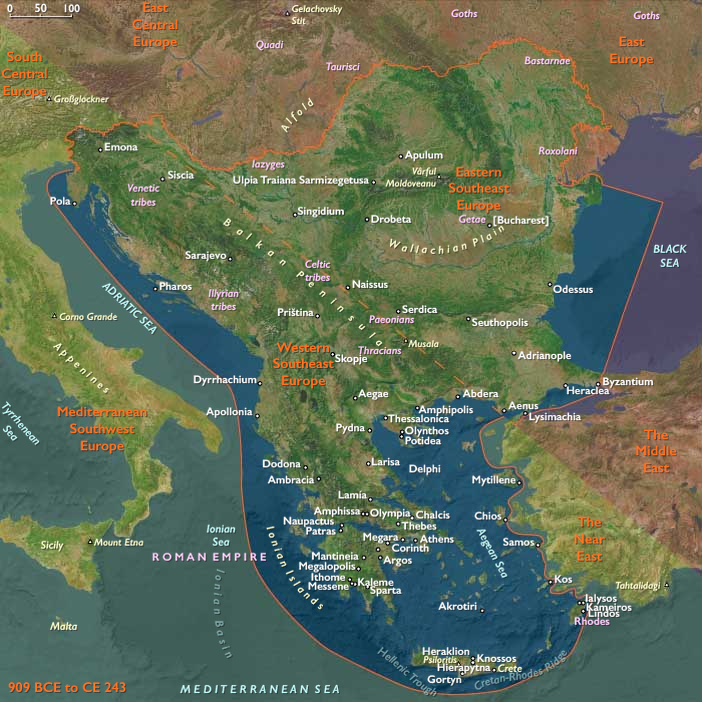
A sideshow of the Punic war is the indecisive First Macedonian War in the Eastern Mediterranean and the Ionian Sea, during which conflict Philip V of Macedon again defeats the Aetolian League and Rome after the two ally against him in 211.
The war ends with two different peace treaties; one with the Aetolian League in 206 and one with Rome in 205 called the "Peace of Phoenice," which allows Philip to keep the land he had taken in Illyria.
This war is essentially a renewal of the Social War and ends in the same way, with the Aetolian League losing a second war to Philip V and Macedonia.
Philip, seeing his chance to defeat Rhodes, forms an alliance with Aetolian and Spartan pirates who begin raiding Rhodian ships.
Philip also forms an alliance with several important Cretan cities, such as Hierapynta and Olous.
With the Rhodian fleet and economy suffering from the depredations of the pirates, Philip believes his chance to crush Rhodes is at hand.
To help achieve his goal, he forms an alliance with the King of the Seleucid Empire, Antiochus the Great, against Ptolemy V of Egypt (the Seleucid Empire and Egypt are the other two Diadochi states).
Philip begins attacking the lands of Ptolemy and Rhodes's allies in Thrace and around the Sea of Marmara.
Rhodes and her allies Pergamon, Cyzicus, and Byzantium combine their fleets in 202 BCE and defeat Philip at the Battle of Chios.
Rome's first major military expedition into the Greek world meets with brilliant success, disrupting Hellenistic hegemony in the eastern Mediterranean.
Philip V loses all his territory outside Macedonia, and the victorious commander Flamininus establishes a Roman protectorate over the "liberated" Greek city-states.
Flamininus develops the policy of turning the cities, leagues, and kingdoms of the Hellenistic world into clients of Rome and of himself, a policy that will become the basis of Roman hegemony of the Mediterranean.
The fortunes of Greece and Rome for about the next five hundred years will henceforth be intertwined.
The Romans, in the ongoing war with Carthage, now deploy the Fabian strategy against Hannibal's skill on the battlefield.
Roman forces are more capable in siegecraft than the Carthaginians and recapture all of the major cities that have joined the enemy, as well as defeating a Carthaginian attempt to reinforce Hannibal at the battle of the Metaurus.
In Iberia, which serves as the main source of manpower for the Carthaginian army, a second Roman expedition under Publius Cornelius Scipio Africanus Major, takes Carthago Nova by assault and ends Carthaginian rule over Iberia in the battle of Ilipa.
The final showdown is the Battle of Zama in Africa between Scipio Africanus and Hannibal, resulting in the latter's defeat and the imposition of harsh peace conditions on Carthage, which ceases to be a major power and becomes a Roman client-state.
The battles of the Second Punic War are ranked among the most costly traditional battles of human history; in addition, there are a few successful ambushes of armies that also end in their annihilation.
The Greeks now form the new upper classes in Egypt, replacing the old native aristocracy.
In general, the Ptolemies have undertaken changes that have far exceeded any other measures that earlier foreign rulers had imposed, using the religion and traditions to increase their own power and wealth.
Although the Ptolemies have established a prosperous kingdom, enhanced with fine buildings, the native population enjoys few benefits, and there are frequent uprisings.
These expressions of nationalism reach a peak in the reign of Ptolemy IV Philopator, when the native Egyptians, sensing their power, rise in an anti-Macedonian rebellion, described by Polybius as guerrilla warfare.
The revolt has spread by 205 to Upper Egypt, where others have gained control over one district and rule as a prospective line of native "pharaohs."
As the feeble reign of Ptolemy IV has progressed, he has fallen increasingly under the influence of his favorites, and he dies around November 205 at thirty-nine.
His clique of Alexandrian Greek courtiers, led by Sosibius, keeps Ptolemy's death a secret.
The late Ptolemy’s advisors murder Queen Arsinoe about a year after his death, leaving the young successor, five-year old Ptolemy V at their mercy.
Sosibius becomes his guardian.
Events surrounding the death of Philopator and the succession of the youthful Epiphanes (205-180 BCE) are obscured by court intrigue.
According to the second-century BCE Greek historian Polybius, all prominent officials are banished from Egypt while Sosibius' clique announces the young king's accession and the death of his parents.
The Hellenistic rulers of Macedon and of the Syrian-based Seleucid kingdom, seeing an opportunity in Egypt's weakness, conspire to partition the kingdom's Asiatic and Aegean possessions.
Agathocles, another member of the court clique in Alexandria, becomes the guardian of Ptolemy V when Sosibius retires in about 202.
Agathocles soon provokes Tlepolemus, the governor of Pelusium (Egypt's eastern frontier city), who marches on Alexandria, where his supporters rouse a mob, compelling Agathocles to resign in favor of another courtier.
The boy king, enthroned in the stadium while the mob clamors for the murderers of his parents, nods in confusion at the prompting of a courtier, and the mob searches out and butchers Agathocles and his family.
Tlepolemus, however, soon proves incompetent and is removed.
Antiochus now marches against Egypt.
The Roman Republic being embroiled in the Second Punic War with Carthage, ...
…Antiochus, secretly allied to Philip V, initiates the Fifth Syrian-Egyptian War by invading Palestine in 202 to reconquer what he had lost at Raphia.
During the confusion in Egypt, Antiochus makes serious inroads into Coele Syria.
Ptolemy's forces mount a counteroffensive, capturing Jerusalem.
The Rhodian admiral Theophiliscus, on the way back to Rhodes, dies of the wounds he had received at Chios, having appointed Cleonaeus as his successor.
As the Rhodian fleet is sailing in the strait between Lade and Miletus on the shore of Asia Minor, Philip's fleet attacks them.
Defeating the Rhodians, Philip forces their fleet to retreat back to Rhodes.
The Milesians are impressed, and send Philip and the Heracleides garlands of victory when they enter Milesian territory.