Northwest Europe (1876–1887): The Imperial Zenith, Gladstone and Disraeli, and Reform at Home
Imperial Peak: Victoria’s Diamond Jubilee and Global Expansion
Between 1876 and 1887, Britain reached the apex of its imperial grandeur, symbolically marked by Queen Victoria’s Diamond Jubilee in 1887. Celebrating sixty years on the throne, the Jubilee underscored Britain's unparalleled global dominance. The British Empire expanded dramatically in Asia, Africa, and the Pacific, prominently exemplified in Africa by the ambition to have the Union Jack flying uninterrupted "from Cairo to Cape Town." This era of imperial expansion, known as the "Scramble for Africa," consolidated British control over extensive territories, secured through a dominant Royal Navy—then the world’s preeminent maritime force—and supported by a small, professional army, uniquely sustained without conscription, unlike other European powers.
Queen Victoria herself played a limited role politically, yet became the enduring symbolic embodiment of British national pride, imperial grandeur, and societal propriety. Her restrained demeanor, common sense, and directness mirrored national virtues that made Britain globally preeminent. As a female sovereign, her evolving public image—from innocent young woman, devoted wife, and mother, to grieving widow and grandmotherly matriarch—conveyed powerful moral symbolism, deeply influencing Victorian ideals of domesticity and endurance. Victoria’s emblematic legacy extended beyond Britain, defining a moral image of Empire and domestic propriety that profoundly shaped national identity.
Disraeli and Gladstone: Giants of Victorian Politics
British politics during this era were dominated by two towering figures: Conservative Benjamin Disraeli and Liberal William Ewart Gladstone. Their rivalry defined what historians later termed Britain’s "golden age of parliamentary government."
Benjamin Disraeli (1804–1881), prime minister in 1868 and from 1874 to 1880, emerged as an iconic Conservative statesman. Disraeli reshaped Conservatism into a broadly appealing force through his concept of "one-nation" Tory democracy. Known for his international assertiveness and charismatic leadership, he enjoyed significant support from Queen Victoria, contrasting sharply with Gladstone’s contentious relationship with the monarch. Disraeli’s foreign policy was robust and patriotic, exemplified by his assertive diplomacy at the Congress of Berlin (1878) during the Russo-Turkish War, successfully limiting Russian expansion into Ottoman territories, thus securing British strategic interests. His personal charm and political insight made him a lasting hero to Conservatives, though historians have subsequently critiqued his imperialist ambitions and rhetorical excess.
William Ewart Gladstone (1809–1898), Disraeli’s great Liberal counterpart, served as prime minister four times (1868–1874, 1880–1885, 1886, 1892–1894). Gladstone, the moral conscience of British liberalism, shaped politics through exceptional oratory, evangelical religiosity, and fierce commitment to progressive reforms. His famous Midlothian Campaign (1879–1880) pioneered modern political campaigning, rallying public opinion against Ottoman atrocities in Bulgaria. Gladstone’s foreign policy idealism envisioned a Europe built on international law, cooperation, and mutual trust, directly challenging Bismarck’s system of militarized alliances and calculated tensions—a vision ultimately defeated by German Realpolitik.
Gladstone’s reforms had profound domestic impacts. His first ministry (1868–1874) successfully introduced landmark measures including the Irish Church Act (1869), disestablishing the Protestant Church of Ireland, ending centuries-old sectarian burdens upon Irish Catholics. Additionally, Gladstone championed:
-
The Education Act of 1870: introducing compulsory elementary education nationwide, significantly raising literacy and educational standards.
-
The Judicature Act of 1873: unifying Britain’s chaotic court system into a single, streamlined judiciary.
-
The Secret Ballot Act of 1872: safeguarding electoral integrity by preventing vote-buying and intimidation.
-
The Trade Union Act of 1871: legally securing unions, diminishing employer intimidation, and providing legal protections for trade-union funding.
-
Civil service reforms: replacing aristocratic patronage with merit-based examinations, emphasizing talent over birthright.
Gladstone’s vision of government-driven social fairness and expanded liberty resonated profoundly with Britain’s lower middle classes and working people, earning him the affectionate title, "Grand Old Man."
Yet Gladstone’s passionate advocacy for Irish Home Rule in 1886 deeply divided his party, splitting it irreversibly. Joseph Chamberlain formed the breakaway Liberal Unionist faction, aligning with Conservatives against Home Rule, leaving the Liberal Party politically fragmented for decades.
Ireland and Home Rule Conflict
Ireland’s quest for autonomy intensified in the 1880s, led by nationalist politician Charles Stewart Parnell. His Irish Parliamentary Party grew into a major parliamentary presence, pressing for self-government under the British Crown. Gladstone’s introduction of the first Home Rule Bill in 1886 split the Liberals and prompted fierce resistance from Unionists, particularly in Protestant-majority Ulster, who feared Catholic-nationalist domination. Although the bill failed, its divisive legacy permanently reshaped British and Irish politics, paving the way for later nationalist struggles.
Army Reforms and Military Modernization
While Britain’s Royal Navy dominated globally, the army suffered from outdated structures, unfair practices, and ineffective organization. Gladstone’s war secretary, Edward Cardwell, launched significant military reforms during this period:
-
Reducing enlistment terms from twenty-one years to six active years plus six reserve years.
-
Organizing regiments by territorial districts for streamlined mobilization.
-
Equipping regiments with advanced rifles.
-
Eliminating the purchase of officers’ commissions, emphasizing meritocracy.
-
Abolishing flogging in peacetime, reflecting changing attitudes toward military discipline.
Although incomplete, due to lingering aristocratic privileges like those enjoyed by the Duke of Cambridge, these reforms substantially modernized and professionalized Britain's army.
Gender Roles, Fashion, and Cultural Shifts
Socially, the late Victorian period witnessed subtle yet significant shifts, especially regarding gender norms. By the 1870s, women associated with the artistic Aesthetic Movement adopted uncorseted dress styles, gently challenging conventional restrictions. While mainstream fashion remained corseted, the growing aesthetic movement anticipated broader shifts toward comfort and personal freedom in women's fashion.
Conversely, men's attire became increasingly standardized, reflecting middle-class aspirations toward gentlemanly respectability and social conformity.
Technological and Industrial Advances
Britain’s technological and industrial dominance continued robustly. Railways expanded steadily, facilitating commerce and communication, while telegraph networks integrated global markets. British industries leveraged standardized manufacturing techniques, precision engineering, and mass production to sustain global leadership, despite economic challenges from the "Long Depression" (1873–1896).
Education, Leisure, and Cultural Life
Educational reforms steadily raised literacy and numeracy standards nationwide, contributing to Britain’s economic resilience and social stability. Middle-class leisure grew extensively, with organized tourism popularized by entrepreneurs like Thomas Cook, now commonplace, opening domestic and international travel to broad social groups.
Victorian literature thrived, represented by authors such as Thomas Hardy, Henry James, and Robert Louis Stevenson, addressing social and moral themes. However, fine arts continued to receive less attention compared to Britain’s celebrated industrial and technological achievements.
Diplomacy, International Relations, and European Affairs
Britain maintained diplomatic neutrality amid European tensions, notably during the Russo-Turkish War (1877–1878)and the subsequent Congress of Berlin (1878). Prime Minister Disraeli successfully limited Russian territorial gains, preserving Britain's strategic interests in the Eastern Mediterranean and access to India.
Relations with the United States significantly improved following the resolution of wartime disputes (Alabama Claims, Treaty of Washington, 1871). Nevertheless, Britain remained wary of continental ambitions, particularly Germany’s growing power under Chancellor Otto von Bismarck, whose complex alliance system undermined Gladstone’s idealistic vision of European harmony.
Scandinavia and Icelandic Nationalism
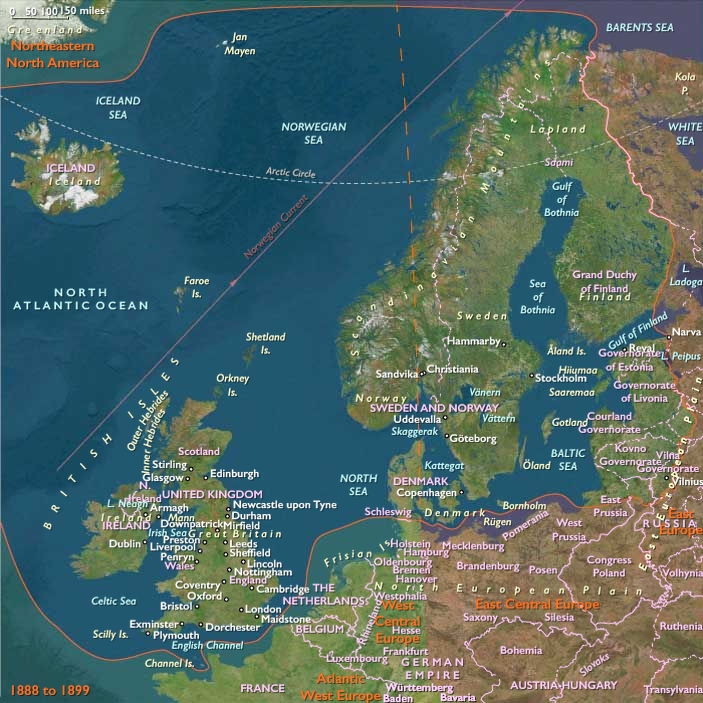
In Northern Europe, Iceland’s nationalist movement gained steady momentum under leader Jón Sigurðsson, inspired by romantic nationalism and earlier trade liberalization. Norway maintained its distinct national identity within its union with Sweden, while Denmark recovered cautiously from territorial losses of the 1864 Schleswig War, reinforcing stable domestic development.
From 1876 to 1887, Northwest Europe, notably Victorian Britain, reached its imperial and economic apex, symbolized by Queen Victoria’s Diamond Jubilee. Britain’s global expansion, parliamentary dynamism led by Disraeli and Gladstone, substantial domestic reforms, and evolving social norms defined this era. Despite increasing challenges—Irish nationalism, economic pressures, diplomatic complexities—Britain's confident imperial identity and parliamentary vibrancy profoundly shaped this influential historical period.