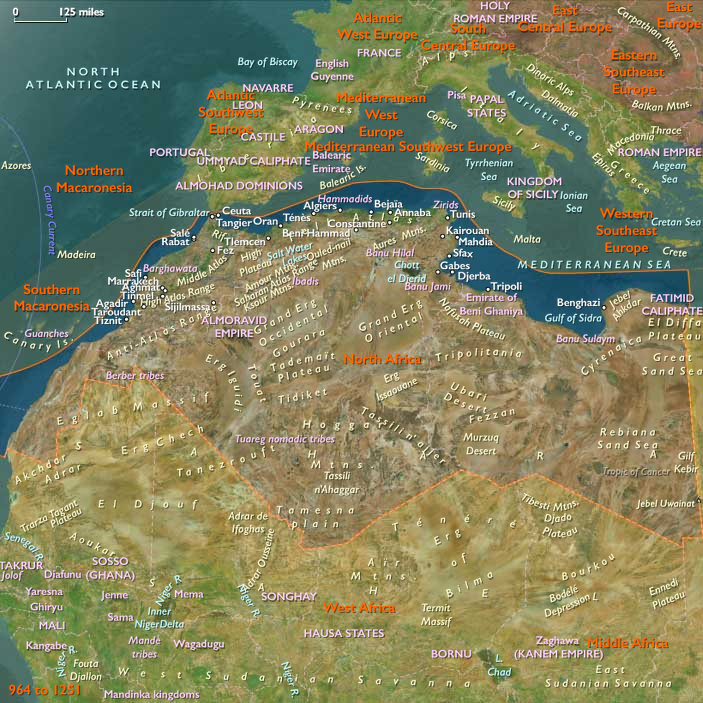
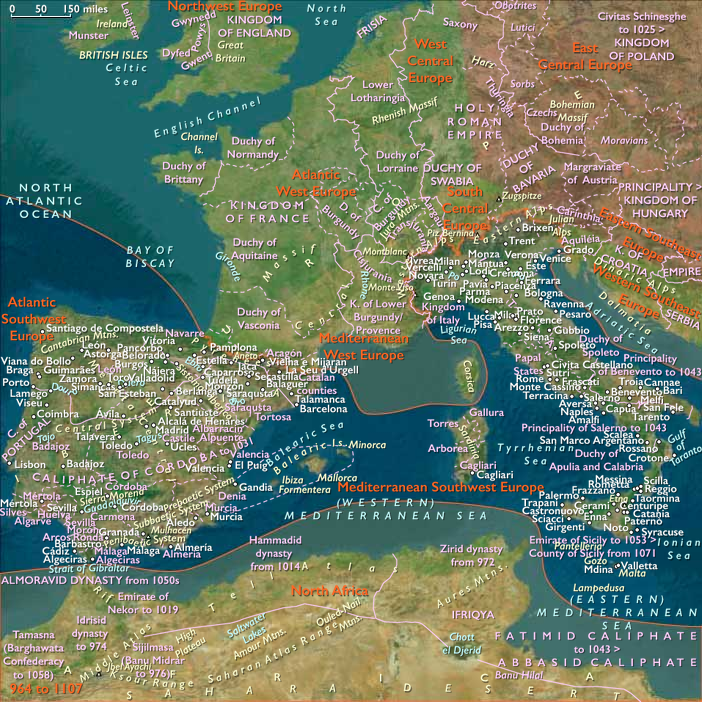
The future Pope Victor II was born Daufer in 1026 or 1027 to a branch of the Lombard dukes of Benevento as a son of Prince Landulf V of Benevento.
After his father died in battle with the Normans in 1047, he had fled from an arranged marriage and, though brought back by force, eventually fled again, this time to to Cava de' Tirreni, where he had obtained permission to enter the monastery of S. Sophia at Benevento, changing his name from Dauferius to Desiderius.
Finding life at S. Sophia insufficiently strict , he had gone first to the island monastery of Tremite San Nicolo in the Adriatic and in 1053 to some hermits at Majella in the Abruzzi.
About this time he was brought to the notice of St. Leo IX, and it is probable that the pope employed him at Benevento to negotiate peace with the Normans after the fatal battle of Civitate.
Desiderius had later attached himself to the court of Pope Victor II at Florence.
There he met two monks of the renowned Benedictine monastery of Monte Cassino, with whom he had returned in 1055.
Joining the community, he was shortly afterwards appointed superior of the dependent house at Capua.
In 1057, Pope Stephen IX, who had retained the abbacy of Monte Cassino, came to visit and at Christmas, believing himself to be dying, ordered the monks to elect a new abbot.
Their choice had fallen on Desiderius.
The pope recovered, and, desiring to retain the abbacy during his lifetime, appointed the abbot-designate his legate for Constantinople.
It was at Bari, when about to sail for the East, that the news of the pope's death reached Desiderius.
Having obtained a safe-conduct from the Norman Count of Apulia, he had returned to his monastery and had been duly installed by Cardinal Humbert on Easter Day 1058.
A year later, Pope Nicholas II raised him to the cardinalate as Cardinal-Priest.
Desiderius has rebuilt the church and conventual buildings, perfected the products of the scriptorium and reestablished monastic discipline, so that there are two hundred monks in the monastery in his day.
On October 1, 1071, the new Basilica of Monte Cassino had been consecrated by Pope Alexander II.
Desiderius' reputation has brought gifts and exemptions to the abbey.
The money is spent on church ornaments, including a great golden altar front from Constantinople adorned with gems and enamels.
Peter the Deacon gives a list of some seventy books Desiderius had copied at Monte Cassino, including works of Saint Augustine, Saint Ambrose, Saint Bede, Saint Basil, Saint Jerome, Saint Gregory of Nazianzus and Cassian, the histories of Josephus, Paul Warnfrid, Jordanes and Saint Gregory of Tours, the Institutes and Novels of Justinian, the works of Terence, Virgil and Seneca, Cicero's De natura deorum, and Ovid's Fasti.
Desiderius had been appointed papal vicar for Campania, Apulia, Calabria and the Principality of Beneventum with special powers for the reform of monasteries.
Within two years of the consecration of the Cassinese Basilica, Alexander II had been succeeded by Hildebrand as Pope Gregory VII.
Desiderius has been able to exert the help of the Normans of southern Italy repeatedly in favor of the Holy See.
Already in 1059, he had persuaded Robert Guiscard and Richard of Capua to become vassals of St. Peter for their newly conquered territories: now Gregory VII immediately after his election sent for him to give an account of the state of Norman Italy and entrusts him with the negotiation of an interview with Robert Guiscard on August 2, 1073, at Benevento.