Pope Sixtus IV
head of the Catholic Church
Years: 1414 - 1484
Pope Sixtus IV (July 21, 1414 – August 12, 1484), born Francesco della Rovere, is Pope from 1471 to 1484.
His main accomplishments as Pope include: Building the Sistine Chapel, where the team of artists he brings together introduces the Early Renaissance to Rome with the first masterpiece of the city's new artistic age, establishing the Vatican archives and the Spanish Inquisition and annulling the decrees of the Council of Constance.
He is famed for his nepotism and is personally involved in the infamous Pazzi Conspiracy.
Related Events
Filter results
Showing 10 events out of 79 total
Francesco della Rovere, a native of Celle, near Savona, has risen from impoverished origins to become, at fifty, minister-general of the Franciscans in 1464.
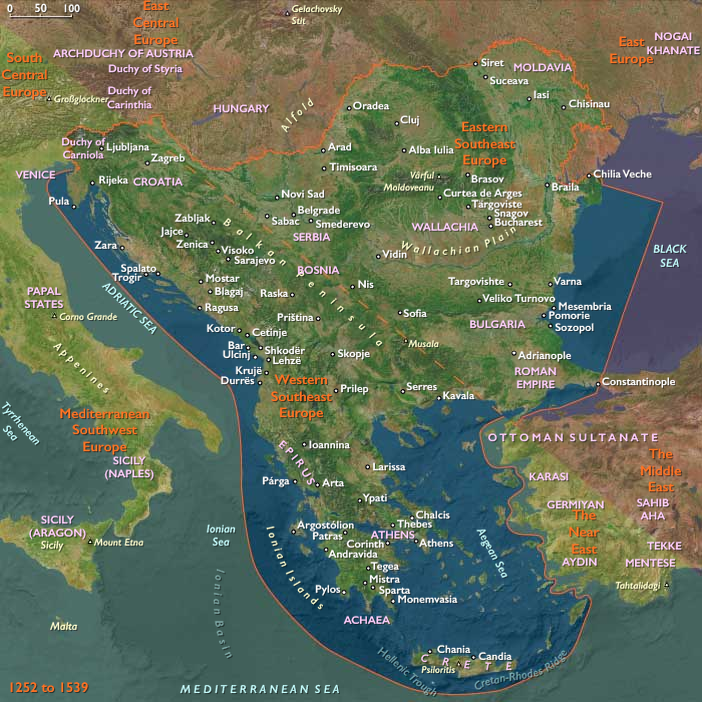
Moldavia and its prince, Stephen the Great (1457-1504), are the principalities' last hope of repelling the Ottoman threat.
Stephen draws on Moldavia's peasantry to raise a fifty-five thousand-man army and repels the invading forces of Hungary's King Matyas Corvinus in a daring night attack.
Stephen's army invades Walachia in 1471 and defeats the Turks when they retaliate in 1473 and 1474.
After these victories, Stephen implores Pope Sixtus IV to forge a Christian alliance against the Turks.
The pope replies with a letter naming Stephen an "Athlete of Christ", but he does not heed Stephen's calls for Christian unity.
Francesco della Rovere, born in Celle Ligure, a town near Savona, to Leonardo della Rovere and Luchina Monleoni, a Ligurian family of modest means.
Della Rovere had joined the Franciscan Order as a young man, an unlikely choice for a political career, and his intellectual qualities had been revealed while he was studying philosophy and theology at the University of Pavia.
He had gone on to lecture at Padua and many other Italian universities.
Della Rovere had been elected Minister General of the Franciscan order at the age of fifty in 1464, and 1467 had been appointed Cardinal by Pope Paul II, with the titular church being the Basilica of San Pietro in Vincoli.
Cardinal della Rovere is renowned for his unworldliness and has even written learned treatises entitled On the Blood of Christ and On the Power of God.
His pious reputation is one of the deciding factors that prompted the College of Cardinals to elect him pope upon the unexpected death of Paul II at the age of fifty-four.
Upon being elected pope, della Rovere adopts the name Sixtus—a name that has not been used since the fifth century.
One of his first acts is to declare a renewed crusade against the Ottoman Turks in Smyrna.
After the conquest of Smyrna, the fleet disbands, however.
Some fruitless attempts are made towards unification with the Greek Church.
Sixtus, for the remainder of his pontificate, will turn to temporal issues and dynastic considerations, taking advantage of his position to engage in nepotism on a grand scale.
There had been in Genoa Colleges, or Studiums, that already in the thirteenth century had conferred degrees in law, theology, medicine and arts.
The College of Theology, the nucleus of the future University of Genoa, is in 1471 established officially with a Papal Bull of Sixtus IV.
After the battle, Stephen sends four of the captured Turkish commanders, together with thirty-six of their standards and abundant booty, to King Casimir, and implores him to provide troops and money to support the Moldavians in the struggle against the Ottomans.
He also sends letters and a few prisoners and Turkish standards to the Pope and Hungarian King Matthias Corvinus, asking for support.
The Pope's reply to Stephen denies him help, but awards him with the "Athleta Christi", while King Casimir pleads poverty and does nothing; his own men then accuse him of sloth, and advise him to change his shameful behavior or hand over his rule to someone else.
The Struggle for Ciudad Real in the Castilian Succession War (1475–1476)
During the War of the Castilian Succession (1475–1479), Ciudad Real, a strategic city in La Mancha, changed hands multiple times between the rival factions of Joanna la Beltraneja (supported by Portugal) and Isabella of Castile. The battle for the city reflected the broader struggle between Portugal and Castile over control of central Spain.
Rodrigo Téllez-Girón Captures Ciudad Real for Joanna
- Rodrigo Téllez-Girón, Master of the Order of Calatrava, was a staunch supporter of Joanna la Beltranejaand her Portuguese backers.
- As the leader of a powerful military-religious order, he launched an offensive into La Mancha, a critical frontier region.
- He successfully captured Ciudad Real, securing an important stronghold for Joanna’s faction.
Rodrigo Manrique Recaptures Ciudad Real for Isabella
- Rodrigo Manrique, treasurer of the Order of Calatrava and Master of the Order of Santiago, was a loyalist of Isabella and Ferdinand.
- Recognizing the strategic importance of Ciudad Real, he led an Isabelline counteroffensive to reclaim the city.
- His forces recaptured Ciudad Real, reinforcing Isabella’s control over central Castile and weakening Portuguese influence in the region.
The Importance of the Battle for Ciudad Real
- La Mancha was a crucial battleground between the rival claimants, as it provided a strategic link between northern and southern Castile.
- The city’s final capture by Isabella’s forces helped consolidate her hold over Castile, while Afonso V of Portugal’s support for Joanna weakened.
- This shift in momentum ultimately led to Isabella’s triumph, culminating in the Treaty of Alcáçovas (1479), which ended the war and confirmed her as Queen of Castile.
The fall and recapture of Ciudad Real was a key moment in the Castilian Succession War, demonstrating the power struggle between the Iberian military orders and the rival monarchs vying for the Castilian throne.
Isabelline Counteroffensive: The Fall of Trujillo and the Securing of Strategic Castilian Lands (Late 1475–1476)
As the War of the Castilian Succession (1475–1479) progressed, Isabella I of Castile and her supporters launched a major counteroffensive, seizing key territories that had previously backed Joanna la Beltraneja and her Portuguese allies.
The Capture of Trujillo and the Securing of Military Orders’ Lands
- In late 1475–early 1476, Isabelline forces launched a successful campaign against Portuguese and pro-Joanna positions.
- Trujillo, a vital city in Extremadura, was captured by Isabella’s supporters, cutting off Portuguese access to central Castile.
- Isabella’s forces also gained control of key military order territories, which had previously supported Joanna:
- A significant portion of the Order of Calatrava's lands—weakening a major ally of Joanna.
- The lands of the Order of Alcántara, further eroding Portuguese influence in Castile.
- Additionally, Isabella’s supporters secured the Marquisate of Villena, a large and strategically important domain in eastern Castile, further tilting the war in her favor.
Impact on the War
- Weakened Joanna’s Support Base – With the loss of Trujillo and military order lands, Joanna and Afonso V were left with fewer Castilian allies.
- Strengthened Isabella’s Position – Gaining control over the orders of Calatrava and Alcántara reinforced Isabella’s claim to the throne, as these orders had substantial military and political power.
- Strategic Blow to Portugal – Afonso V’s forces were now increasingly isolated, with dwindling options for maneuvering in Castile.
A Turning Point Leading to the Battle of Toro (1476)
- The fall of Trujillo and other territories weakened the Portuguese position in Castile, setting the stage for the decisive Battle of Toro (March 1, 1476).
- Though the battle itself was militarily indecisive, Isabella’s political advantage grew, leading to the eventual collapse of the Portuguese campaign and the signing of the Treaty of Alcáçovas (1479).
The Isabelline counteroffensive, particularly the capture of Trujillo and control over military orders’ lands, was a turning point in the war, accelerating Joanna’s decline and Isabella’s final victory.
The Castilian Succession Crisis: Afonso V’s Invasion and Marriage to Joanna la Beltraneja (1475)
Following the death of King Henry IV of Castile and León in 1474, a succession crisis erupted between two rival claimants:
- Joanna la Beltraneja – Henry IV’s alleged daughter, supported by Portugal and a faction of Castilian nobles.
- Princess Isabella of Castile – Henry IV’s half-sister, supported by her husband, Ferdinand of Aragon, and a rival faction of Castilian nobility.
The conflict led to the War of the Castilian Succession (1475–1479), a decisive struggle between Portugal and Castile, with France and Aragon also involved.
Afonso V’s Invasion of Castile and His Marriage to Joanna (1475)
- On May 10, 1475, King Afonso V of Portugal led an army into Castilian territory, launching an offensive to claim the Castilian throne.
- He advanced to Plasencia, where Joanna la Beltraneja awaited him.
- On May 25, 1475, Joanna and Afonso were proclaimed sovereigns of Castile, asserting their right to rule as king and queen.
- To strengthen his claim, Afonso married Joanna, despite being her uncle, making a Papal dispensation necessary.
- The required papal approval was granted several months later, reinforcing their legitimacy in the eyes of their supporters.
Consequences and the Prolonged Succession War
- Isabella and Ferdinand rejected the union, leading to full-scale war between Portugal and Castile-Aragon.
- The war lasted until 1479, with naval and land battles fought over the Castilian crown and Atlantic trade routes.
- Afonso’s lack of military aggressiveness and the stalemate at the Battle of Toro (1476) weakened Joanna’s claim.
- The war ended with the Treaty of Alcáçovas (1479), which:
- Recognized Isabella and Ferdinand as rulers of Castile.
- Confirmed Portugal’s dominance in the Atlantic, except for the Canary Islands.
- Forced Joanna to renounce her claim and retreat to a convent in Portugal.
The failed campaign marked Portugal’s last attempt to unite with Castile, while Isabella and Ferdinand’s victory paved the way for the unification of Spain and their global expansion.
The Portuguese Advance in the Castilian Succession War (1475)
After Afonso V of Portugal and Joanna la Beltraneja were proclaimed sovereigns of Castile in Plasencia on May 25, 1475, the Portuguese army marched towards Arévalo, intending to continue toward Burgos, a strategic city in the conflict.
Strategic Importance of Burgos
- Afonso V hoped to unite with troops sent by his ally, Louis XI of France, reinforcing his army against Isabella and Ferdinand.
- However, Burgos was divided:
- The castle of Burgos was held by the Estúñiga family, who supported Joanna la Beltraneja.
- The city itself was controlled by the Fernández de Velasco family, loyal to Isabella of Castile.
Portuguese Strategy and Challenges
- Afonso’s next move depended on securing support from Castilian noble factions, particularly in Burgos, which was a vital stronghold.
- Despite the loyalty of the Estúñigas, the Portuguese advance faced resistance from Isabella’s supporters.
Outcome: Afonso’s Difficulties in Securing Castilian Support
- The war did not unfold as Afonso V had expected. His military movements were slow, and Castilian nobles who had initially supported Joanna became increasingly hesitant.
- This hesitation, combined with Isabella’s consolidation of power in key cities, made it difficult for Afonso to sustain his campaign.
The struggle for Burgos and northern Castile was part of the broader War of the Castilian Succession (1475–1479), which ultimately resulted in Isabella and Ferdinand’s triumph, while Afonso failed to secure Castile for Joanna.
Afonso V’s Strategic Shift: Consolidating Control in Toro (1475)
After marching from Plasencia to Arévalo in May 1475, Afonso V of Portugal encountered less Castilian support than he had anticipated in his campaign for the Castilian throne. Realizing that his position in Castile was weaker than expected, he abandoned his plan to march toward Burgos and instead focused on securing areas closer to Portugal.
Strategic Decision: The Shift to Toro
- Instead of advancing further into Castile, Afonso V redirected his efforts toward consolidating control over Toro, a key city near the Portuguese border.
- Toro received Afonso favorably, offering him a strong base of operations.
- However, while the city welcomed him, the castle garrison remained loyal to Isabella, highlighting the deep divisions within Castile.
Why Toro Was a Strategic Choice
-
Proximity to Portugal
- Securing Toro allowed Afonso to maintain supply lines from Portugal and ensure he could retreat if necessary.
-
Symbolic and Political Importance
- Toro was a historically significant Castilian city and had a strong noble presence.
- By holding Toro, Afonso could demonstrate legitimacy and encourage more Castilian nobles to join his cause.
-
Tactical Positioning Against Isabella
- Controlling Toro allowed Afonso to prepare for battle, as Isabella and Ferdinand were mobilizing their forces.
Consequences of Afonso’s Decision
- Afonso’s failure to push further into Castile weakened his overall campaign.
- The decision to focus on Toro led to the Battle of Toro (1476), a crucial and inconclusive battle in which both sides claimed victory.
- Although Afonso held Toro after the battle, Isabella’s political position grew stronger, leading to her eventual recognition as Queen of Castile.
Conclusion: Afonso’s Missed Opportunity
- Afonso’s reliance on Portuguese forces and lack of widespread Castilian support made his campaign difficult.
- By failing to secure Burgos and northern Castile, he lost the chance to challenge Isabella more effectively.
- His retreat to Toro set the stage for the eventual collapse of his claim to the Castilian throne, culminating in the Treaty of Alcáçovas (1479), which confirmed Isabella’s rule and Portugal’s dominance in the Atlantic.