Pope Sergius III
head of the Catholic Church
Years: 860 - 911
Pope Sergius III (c. 860 − 14 April 911) is the head of the Catholic Church from 29 January 904 to his death in 911.
He is pope during a period of feudal violence and disorder in central Italy, when the Papacy is a pawn of warring aristocratic factions.
Sergius III had reputedly ordered the murder of his two immediate predecessors, Leo V and Christopher, and is the only pope to have allegedly fathered an illegitimate son who later becomes pope (John XI).
He is the first Pope to be depicted wearing the papal tiara.
Related Events
Filter results
Showing 9 events out of 9 total
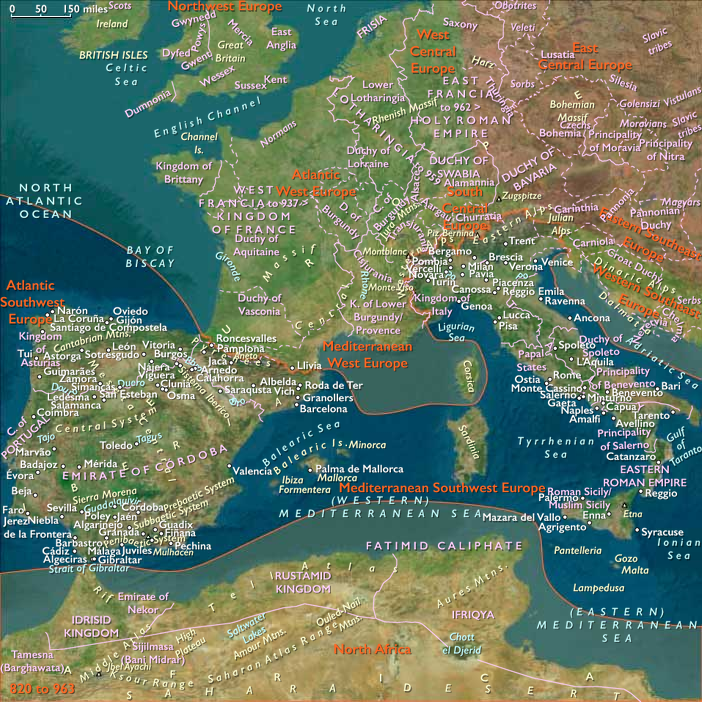
Mediterranean Southwest Europe (904–915 CE): Saeculum Obscurum and Papal Corruption
The era 904–915 CE in Mediterranean Southwest Europe is notably characterized by the beginning of the Saeculum obscurum ("Dark Age") in papal history, alongside continued political complexity and cultural dynamism in the region.
Saeculum Obscurum in the Papacy
The period beginning in 904 CE, marked by the installation of Pope Sergius III, initiates the infamous Saeculum obscurum, a sixty-year phase in which the papacy falls under significant influence from the powerful and corrupt aristocratic Roman family known as the Theophylacti and their relatives. This era, characterized by widespread corruption, nepotism, and political manipulation, profoundly undermines papal prestige and spiritual authority, with repercussions extending throughout Christendom.
Continued Political Fragmentation in Italy
Italy remains politically fragmented, with local aristocratic families gaining prominence amid weakened Carolingian imperial authority. The compromised papacy, deeply entangled with aristocratic factions, contributes further to this political decentralization, reducing Rome's ability to assert coherent leadership across the Italian territories.
Internal Turmoil and Regional Autonomy in Al-Andalus
In Al-Andalus, Emir Abdallah ibn Muhammad (r. 888–912 CE) continues struggling with internal conflicts, rebellions, and regional autonomy. Powerful local families and governors retain semi-independent status, intensifying the decentralization and weakening the central Umayyad authority in Córdoba, although cultural and intellectual activity remains vibrant.
Mozarab and Jewish Cultural Resilience
Mozarab and Jewish communities persist in their cultural vitality, maintaining significant roles in urban life, scholarship, and commerce. Lucena, in particular, remains a leading Jewish intellectual center, continuing its rich scholarly tradition and fostering intercultural exchange.
Economic Stability and Technological Advances
Economic activity remains robust, supported by sustained technological innovations like the Catalan forge, which significantly enhance iron production. These developments underpin continued agricultural productivity, military effectiveness, and urban prosperity across Mediterranean Southwest Europe.
Legacy of the Era
The era 904–915 CE marks a dark chapter in papal history, overshadowed by the influence of the Theophylacti family, but simultaneously exhibits continued cultural resilience and economic stability throughout the region. These dynamics reflect the complexity of Mediterranean Southwest Europe's transition toward the central medieval period.
Saeculum obscurum (Latin: the Dark Age) is a name given to a period in the history of the Papacy during the first half of the tenth century, beginning in 904 with the installation of Pope Sergius III; it will last for sixty years until the death of Pope John XII in 964.
During this period, the Popes are influenced strongly by a powerful and corrupt aristocratic family, the Theophylacti, and their relatives.
Sergius is the son of Benedictus, and traditionally was believed descended from a noble Roman family, although it has been speculated that he was in fact related to the family of Theophylact, Count of Tusculum.
He had been ordained as a subdeacon by Pope Marinus I, followed by his being raised to the deaconate by Pope Stephen V. During the pontificate of Pope Formosus (891–896), he had been a member of the party of nobles who supported the Emperor Lambert, who was the opponent of Formosus and the pope’s preferred imperial candidate, Arnulf of Carinthia.
Formosus had consecrated Sergius as bishop of Caere (Cerveteri) in 893, apparently in order to remove him from Rome.
Sergius had ceased to act as bishop of Caere with the death of Formosus in 896, as all of the ordinations conferred by Formosus were declared null and void although Formosus’ ordination of Sergius was later reconfirmed by Theodore II.
He had also actively participated in the farcical Cadaver synod that condemned the pontificate of Formosus.
With the death of Theodore in 898, Sergius, with a small following of Roman nobility led by his father Benedictus, had attempted to have himself elected pope, contrary to the wishes of the emperor Lambert, who was also duke of Spoleto.
Although Sergius was actually elected, a rival candidate, Pope John IX (898–900), was also elected With Lambert’s support, John had been successfully installed as pope, and one of his first acts had been to convene a synod which excommunicated Sergius and his followers.
Sergius was then forcibly exiled by Lambert, fleeing to his see at Caere, where he had placed himself under the protection of Adalbert II, Margrave of Tuscany.
By the time the Antipope Christopher (903–904) seized the chair of Saint Peter by force, circumstances had changed at Rome, with the rise of the magister militum Theophylact, Count of Tusculum, who had been stationed at Rome by the retreating emperor Louis the Blind in 902.
Putting himself at the head of a faction of the nobility, Theophylact had revolted against Christopher, and asked Sergius to return to Rome to become pope.
Sergius accepts, and with the armed backing of Adalbert II, he enters Rome, by which stage Christopher has already been cast into prison by Theophylact.
Sergius is then consecrated Pope on January 29, 904.
Sergius III, owing his rise to the power of his new patron Theophylact, quickly rewards him with the position of sacri palatii vestararius, the principal official at the top of papal patronage in control of the disbursements, and thus of patronage.
All real power now devolves onto Theophylact, and Sergius essentially becaomes his puppet.
Perhaps the first clear sign of this shift in power is the fate of Sergius’ two predecessors, Pope Leo V and the Antipope Christopher.
According to the pro-Formosan Eugenius Vulgarius, Sergius ordered both men to be strangled in prison sometime in early 904.
That both men were murdered during Sergius’ pontificate appears probable, although other accounts state that Christopher at least was allowed to retire to a monastery.
Given where the real power lay, it seems more likely that either Theophylact gave the orders directly, or that he directed Sergius to give the orders.
Thus begins the era of the Saeculum obscurum (Latin: the Dark Age; a period was first identified and named by the Italian Cardinal and ecclesiastical historian Caesar Baronius in his Annales Ecclesiastici in the sixteenth century.
Baronius' primary source for his history of this period was Liutprand of Cremona.
The Theophylacti family, which originates from Theophylactus, will throughout the Saeculum obscurum hold positions of increased importance in the Roman nobility such as Judex, vestararius, gloriosissimus dux, consul and senator, and magister militum.
Theophylact's wife Theodora and daughter Marozia will come to hold a great influence over the papal selection and religious affairs in Rome through conspiracies, affairs, and marriages.
Marozia when she is fifteen becomes the concubine of Pope Sergius III; she will later take other lovers and husbands.
Nicholas Mystikos may have become involved in the revolt of Andronikos Doukas.
He is deposed as patriarch on February 1, 907 and replaced by Euthymios.
Exiled to his own monastery, Nicholas regards his deposition as unjustified and involves Pope Sergius III in the dispute.
The new patriarch attempts a compromise by defrocking the offending priest but recognizing the marriage of Emperor Leo and Zoe.
In 907, Oleg obtains a treaty regulating the position of Russian merchants in Constantinople (which will be formally ratified in 911).
Many of the Rus' remain, becoming members of the emperor's Varangian (as the Greeks call the Swedish and Danish Vikings) guard.
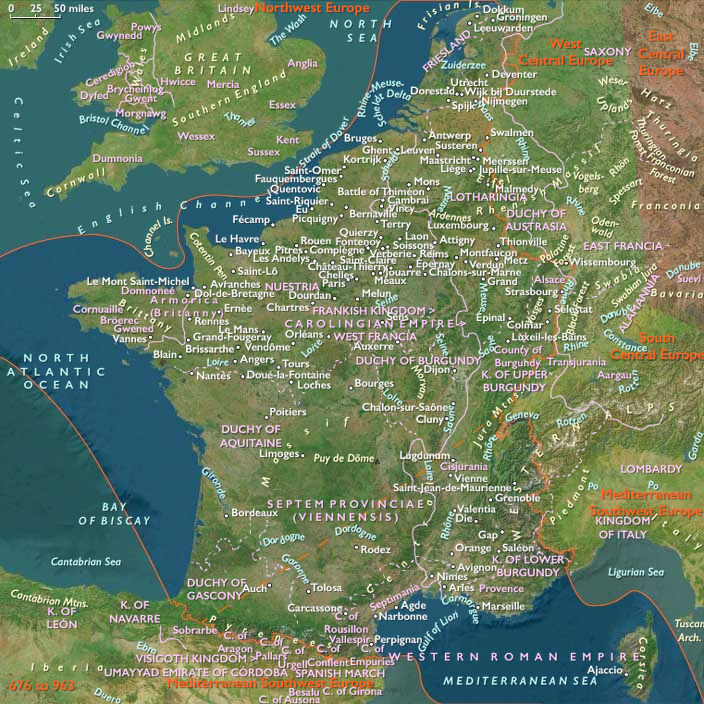
William I of Aquitaine and the Founding of Cluny Abbey (910): A Turning Point in Medieval Monasticism
William I of Aquitaine, also known as William the Pious, emerges as a powerful noble in post-Carolingian France, ruling over a vast domain that stretches from Austrasia to Toulouse, including Auvergne, the Limousin, Poitou, the Autunois, and the Mâconnais. His legacy, however, is most enduringly tied to his founding of Cluny Abbey in 910, which sparks a monastic revival across Europe.
William’s Rise to Power
- Son of Bernard II of Auvergne and Ermengard, William inherits Auvergne and the Limousin.
- In 893, he conquers Poitou and Aquitaine on behalf of Ebalus Manser, but keeps Aquitaine for himself and is proclaimed duke.
- His marriage to Engelberga, daughter of Boso of Provence and Ermengard of Italy, strengthens his political alliances with the Bosonid dynasty.
The Founding of Cluny Abbey (910)
In 910, William I of Aquitaine donates land in the forests of Burgundy to establish Cluny Abbey, laying the foundation for one of the most influential monastic movements in medieval Europe.
- Unlike most noble patrons, William relinquishes all control over the monastery.
- He places the abbey under direct papal authority, answering only to Pope Sergius III, thus freeing it from secular influence and noble interference.
- This is a radical departure from the common practice, where noble founders retained control over monasteries and installed their relatives as abbots.
The Cluniac Reforms and Berno’s Leadership
- William nominates Berno of Baume as the first abbot of Cluny, entrusting him with high standards of monastic observance.
- Cluny follows strict Benedictine Rule, emphasizing:
- Liturgical prayer and elaborate divine office recitations.
- Moral and spiritual discipline among monks.
- A centralized system, where Cluny exerts direct control over its daughter houses, ensuring uniformity in monastic life.
The Expansion of the Cluniac Movement
- By the 12th century, the Congregation of Cluny will include over a thousand monasteries across Europe.
- The Cluniac Order becomes a spiritual and cultural force, influencing papal politics, monastic discipline, and medieval art and architecture.
- Cluny’s independence from feudal lords serves as a model for later monastic movements, reinforcing the Church’s authority over secular rulers.
Legacy of William I of Aquitaine
- His political achievements in Aquitaine cement his rule as a strong feudal lord.
- His founding of Cluny transforms medieval monasticism, leading to:
- Greater monastic autonomy from secular interference.
- Revival of discipline and learning within the Benedictine tradition.
- A major step toward Church reform movements, culminating in the Gregorian Reforms of the 11th century.
While William I is a powerful feudal ruler, it is his visionary support of monastic reform that shapes the future of Western Christianity. His decision to free Cluny from secular entanglements ensures that the Cluniac movement will become one of the defining religious forces of medieval Europe.
Mediterranean Southwest Europe (916–927 CE): Continued Papal Decline, Andalusian Fragmentation, and Cultural Persistence
The era 916–927 CE in Mediterranean Southwest Europe is characterized by continuing papal instability under the influence of powerful Roman aristocrats, increasing fragmentation within Al-Andalus, and enduring cultural resilience among diverse religious communities.
Papal Turmoil and the Saeculum Obscurum
This period continues the Saeculum obscurum, a turbulent era initiated in 904 CE with Pope Sergius III, during which the papacy remains dominated by the powerful and corrupt Theophylacti family. Papal authority suffers significantly from scandals, factional struggles, and political manipulation, severely undermining Rome’s spiritual and political influence across Europe.
Andalusian Fragmentation and Regional Autonomy
In Al-Andalus, Emir Abd al-Rahman III (r. 912–961 CE) inherits a territory fragmented by regional rebellions and decentralized power structures. Despite ongoing internal strife, Abd al-Rahman III gradually asserts his authority, laying the foundations for future centralization and recovery. Powerful local families and independent governors continue to challenge central authority, though signs of renewed political consolidation begin to emerge.
Mozarab and Jewish Communities' Resilience
Mozarab communities retain their cultural identity, playing essential roles as intermediaries between Islamic and Christian cultures, preserving religious traditions, scholarship, and local administration. Lucena continues as a thriving center for Andalusian Jewry, maintaining vibrant intellectual and cultural activity that enriches Iberian society.
Continued Economic Prosperity and Technological Advancement
Technological advancements, notably the sustained use of the Catalan forge, continue driving economic stability and prosperity throughout the region. Enhanced iron production facilitates agricultural productivity, urban growth, and strengthened military capabilities, maintaining Mediterranean Southwest Europe's economic vitality despite broader political instability.
Legacy of the Era
The era 916–927 CE underscores continuing papal corruption and political instability, the slow yet determined recovery efforts within Al-Andalus, and enduring cultural resilience within Mozarab and Jewish communities. These developments significantly influence the evolving medieval landscape of Mediterranean Southwest Europe, laying foundations for future consolidation and cultural flourishing.
Mediterranean Southwest Europe (928–939 CE): Caliphal Centralization in Al-Andalus and Continuing Papal Turmoil
The era 928–939 CE in Mediterranean Southwest Europe witnesses significant political consolidation under Abd al-Rahman III in Al-Andalus, while Italy experiences ongoing papal instability amid the prolonged Saeculum Obscurum.
Abd al-Rahman III and the Establishment of the Caliphate of Córdoba
In Al-Andalus, Emir Abd al-Rahman III (r. 912–961 CE) decisively asserts his authority, formally declaring himself Caliph in 929 CE. This bold political move proclaims Córdoba independent from the Abbasid Caliphate in Baghdad, initiating the powerful Caliphate of Córdoba. Abd al-Rahman III significantly stabilizes and centralizes power, strengthening the administrative structure and fostering renewed cultural and economic prosperity throughout Iberia.
Papal Instability and Continued Saeculum Obscurum
Meanwhile, the papacy continues to languish under the shadow of the Saeculum Obscurum, dominated by the powerful and corrupt Roman aristocratic families, notably the Theophylacti. Papal authority remains deeply compromised, characterized by internal corruption, scandal, and political manipulation, significantly diminishing Rome's spiritual and moral influence in Europe.
Cultural Vitality and Jewish Scholarship
Despite political challenges, intellectual and cultural vitality endure. Lucena continues to flourish as a critical center of Andalusian Jewry, sustaining rich scholarly traditions and intercultural exchanges. Mozarab communities maintain their influential cultural position, bridging Latin-Christian and Islamic intellectual traditions within the context of Córdoba’s flourishing caliphate.
Fragmented Italy and Carolingian Decline
Italy remains politically fragmented, with local rulers increasingly asserting independence as centralized Carolingian authority continues to decline. Although regional power structures stabilize to some extent, Italy enters a prolonged period marked by localized governance and limited imperial cohesion, supported culturally by a resilient ecclesiastical structure.
Economic Stability and Technological Continuation
Technological innovations, particularly the Catalan forge, continue to underpin regional economic stability and growth. Improved iron production sustains agricultural productivity, military preparedness, and urban expansion, contributing significantly to the ongoing economic resilience of Mediterranean Southwest Europe.
Legacy of the Era
The era 928–939 CE marks a pivotal turning point with the establishment of the Caliphate of Córdoba, contrasting sharply with the ongoing political turmoil and weakened papal authority in Italy. These developments highlight the divergent political trajectories within Mediterranean Southwest Europe, significantly shaping the region’s subsequent medieval history.