Pontius Pilatus
5th Prefect of the Roman province of Judaea
Years: 6BCE - 36
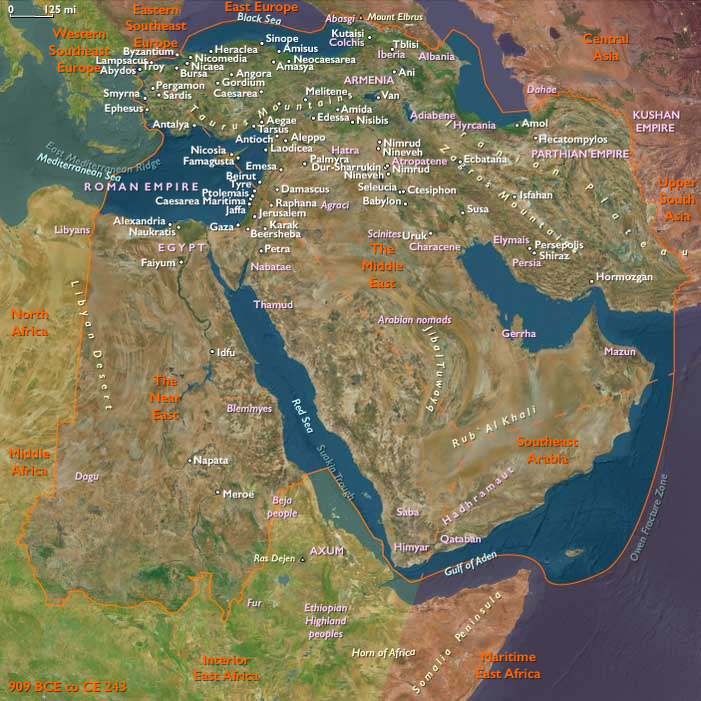
Pontius Pilatus, known in the English-speaking world as Pontius Pilate, is the fifth Prefect of the Roman province of Judaea, from CE 26–36.
He is best known from his appearance in the New Testament as the judge at Jesus' trial and the man who authorized the crucifixion of Jesus.
As prefect, he serves under Emperor Tiberius.
The sources for Pilate's life are the four canonical gospels, Philo of Alexandria, Josephus, a brief mention by Tacitus, and an inscription known as the Pilate Stone, which appears to confirms his historicity and establishes his title as prefect.
Based on these sources, it appears that Pilate was an equestrian of the Pontii family, and succeeded Valerius Gratus as prefect of Judaea in CE 26.
Once in his post he offended the religious sensibilities of his subjects, leading to harsh criticism from Philo and Josephus.
According to Josephus, he was ordered back to Rome after harshly suppressing a Samaritan uprising, arriving just after the death of Tiberius (according to Flavius Josephus' Jewish Antiquities 18.89) which occurred on 16 March in the year 37.
He was replaced by Marcellus.
In all four gospel accounts, Pilate appears in association with the responsibility for the death of Jesus.
In the Gospel of Matthew, Pilate washes his hands to show that he was not responsible for the execution of Jesus and reluctantly sends him to his death.
The Gospel of Mark, depicting Jesus as innocent of plotting against the Roman Empire, portrays Pilate as reluctant to execute Jesus.
In the Gospel of Luke, Pilate not only agrees that Jesus did not conspire against Rome, but Herod Antipas, the Tetrarch of Galilee, also finds nothing treasonable in Jesus' actions.
Scholars have long debated how to interpret Pilate's portrayal in the sources.
Some Biblical scholars have argued that the Gospel accounts are not historically accurate, with some believing Pilate was a mythical character.
The discovery of the Pilate Stone at Caesarea Maritima in 1961 is still under debate by present scholars.
There are several possible origins for the cognomen Pilatus.
A commonly accepted one is that it means "skilled with the javelin".
The pilum (= javelin) was five feet of wooden shaft and two feet of tapered iron.
Pontius Pilate's family name signifies he was from the tribe Pontii, an ancient Samnite name.