Pontiac (Ottawa leader)
Odawa war chief
Years: 1720 - 1769
Pontiac or Obwandiyag (c. 1720 – April 20, 1769) is an Odawa war chief who becomes noted for his role in Pontiac's War (1763–1766), an American Indian struggle against British military occupation of the Great Lakes region and named for him.
It follows the British victory in the French and Indian War, the North American front of the Seven Years' War.
Pontiac's importance in the war that bears his name has been debated.
Nineteenth-century accounts portray him as the mastermind and leader of the revolt, but some subsequent scholars will argue that his role had been exaggerated.
Historians today generally view him as an important local leader who influenced a wider movement that he did not command.
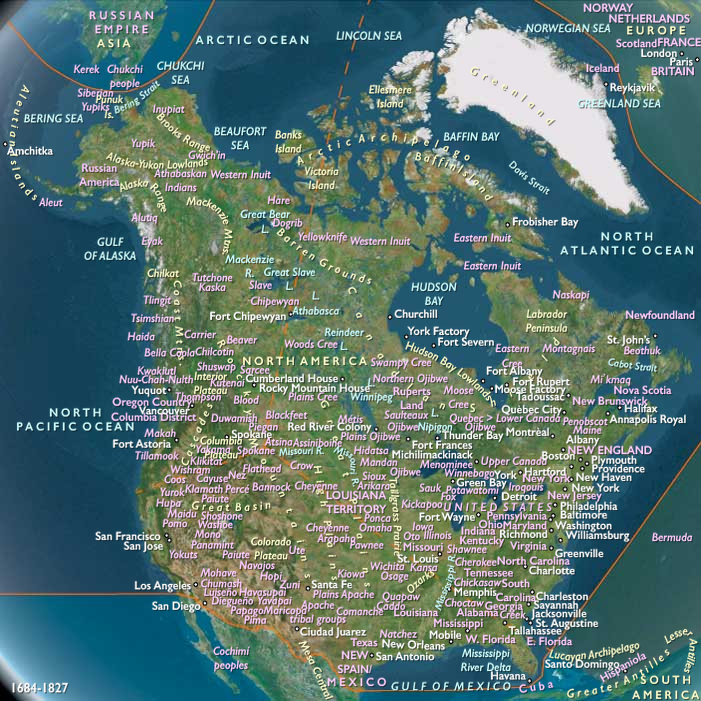
The war begins in May 1763 when Pontiac and three hundred followers attempt o take Fort Detroit by surprise.
His plan is foiled, so Pontiac lays siege to the fort, where he is eventually joined by more than nine hundred warriors from a half-dozen tribes.
Meanwhile, messengers spread the word of Pontiac's actions, and the war expands far beyond Detroit.
In July 1763, Pontiac defeats a British detachment at the Battle of Bloody Run, but he is unable to capture the fort.
In October, he lifts the siege and withdraws to the Illinois Country.
Pontiac's influence declines around Detroit because of the unsuccessful siege, but he gains stature as he continues to encourage resistance to the British.
Seeking to end the war, British officials make him the focus of their diplomatic efforts.
In July 1766, he makes peace with British Superintendent of Indian Affairs Sir William Johnson.
The attention that the British pay to Pontiac results in resentment among other tribal leaders, as the war effort is decentralized and Pontiac claims greater authority than he possesses.
He is increasingly ostracized, then assassinated by a Peoria warrior in 1769.

Related Events
Filter results
Showing 10 events out of 44 total
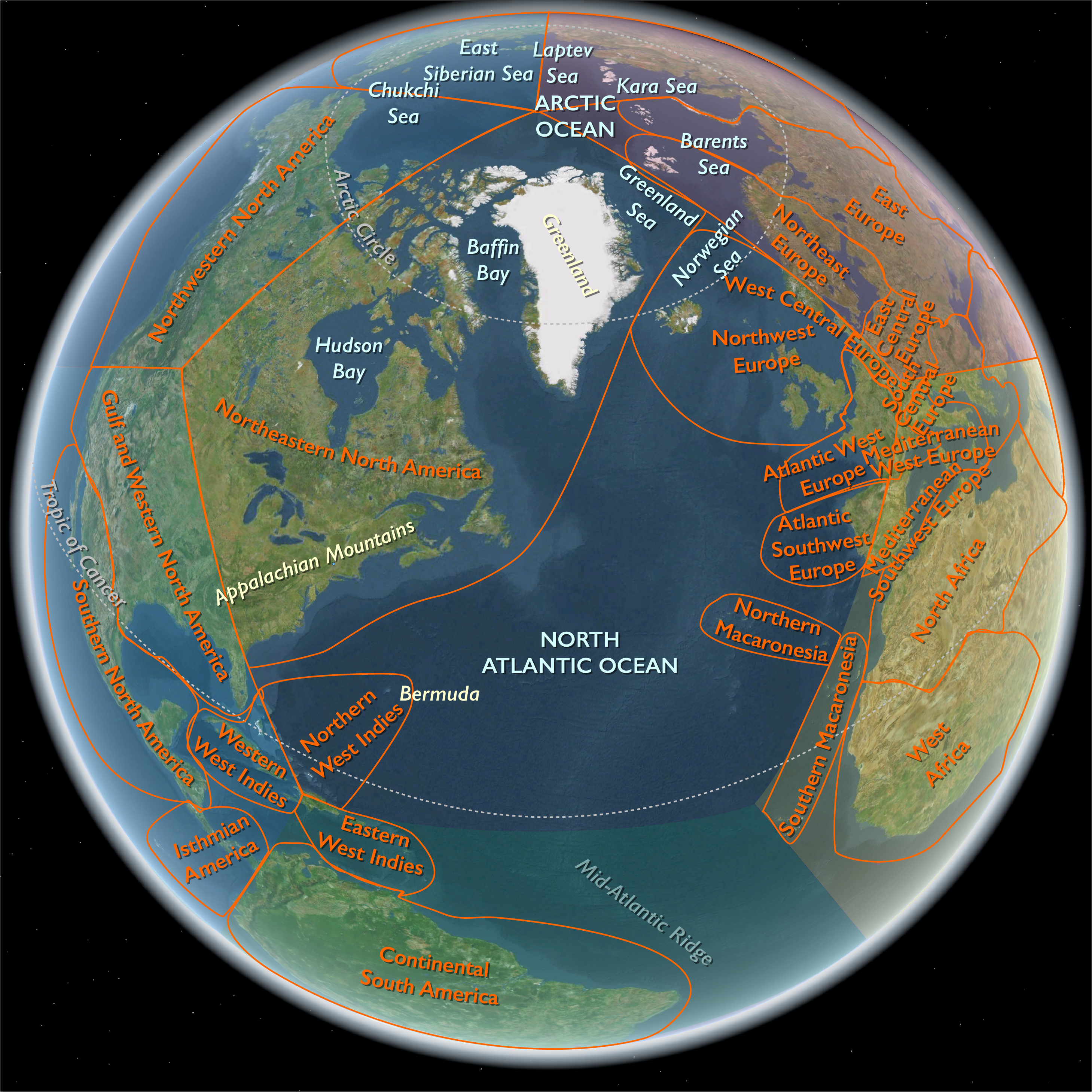
Northeastern North America
(1756 to 1767 CE): French and Indian War, Colonial Expansion, and Frontier Struggles
The period from 1756 to 1767 marked a critical turning point for Northeastern North America, dominated by the French and Indian War—the North American theater of the global Seven Years' War. The conflict, intertwined with complex Native alliances, British imperial policies, vigorous frontier settlement, and economic shifts, fundamentally redefined territorial control, colonial expansion, indigenous relationships, and economic activities across the region.
The French and Indian War (1754–1763)
European Rivalries and Native Alliances
The French and Indian War stemmed from imperial competition between Britain and France, manifesting as widespread colonial conflicts across North America. France, constrained by a small colonial population, compensated by securing alliances with numerous native peoples, recruiting indigenous warriors to offset their numerical disadvantage.
The Seven Nations of Canada, indigenous peoples of the Laurentian Valley—including the Algonquin, Abenaki, and Huron (Wyandot)—allied closely with the French. Motivated largely by historical grievances against the dominant Iroquois Confederacy (comprising the Seneca, Mohawk, Oneida, Onondaga, Cayuga, and Tuscarora), who supported the British, these alliances deepened regional animosities and prolonged frontier conflicts.
Though aligned with Britain, the Iroquois themselves played a relatively limited military role in this war, acting primarily as a defensive bulwark against French and Algonquin incursions.
British Military Successes and Geopolitical Changes
Initially suffering setbacks, British fortunes reversed dramatically by the late 1750s under the decisive leadership of William Pitt the Elder. In 1758, British forces recaptured the crucial fortress of Louisbourg, regaining dominance in the North Atlantic. In 1759, the pivotal Battle of Quebec (Plains of Abraham) resulted in the capture of Quebec City, effectively sealing French defeat in North America.
In 1760, British forces occupied Montreal, ending major French resistance. The global Seven Years' War concluded officially with the Treaty of Paris (1763):
-
France ceded nearly all its North American territories east of the Mississippi River, including Canada, to Britain.
-
France transferred lands west of the Mississippi, along with New Orleans, to Spain.
-
Spain ceded Florida to Britain in exchange.
Thus, the geopolitical landscape shifted dramatically, with Britain emerging as the unrivaled North American colonial power.
Indigenous Resistance and the Royal Proclamation of 1763
Pontiac’s War (1763–1766)
Immediately following the war, indigenous peoples fiercely resisted British domination. Pontiac’s War, named for the Ottawa Chief Pontiac, unified numerous tribes of the Great Lakes and Ohio Valley in concerted attacks against British forts and settlements, seeking to halt aggressive colonial expansion.
Although ultimately suppressed, Pontiac’s campaign demonstrated significant indigenous resistance and profoundly influenced British colonial policy.
Royal Proclamation of 1763 and Frontier Policy
Responding directly to Pontiac’s rebellion, Britain issued the Royal Proclamation of 1763, prohibiting further colonial settlement west of the Appalachian Mountains. This proclamation curtailed western colonial expansion, angering settlers and speculators like George Washington, a Virginian surveyor and militia officer heavily invested in lands in western Pennsylvania and what is now West Virginia.
Frontier Expansion and Settlement Patterns
Persistent Western Migration
Despite British attempts to halt settlement, American colonists aggressively continued westward expansion into territories beyond the Appalachian Mountains, especially into regions such as western Pennsylvania, present-day West Virginia, the Ohio Country, Kentucky, and Tennessee.
Notably, the iconic frontiersman Daniel Boone led settlers through the Cumberland Gap into Kentucky and Tennessee, symbolizing America's westward migration despite British restrictions.
Settlements in the Ohio Valley and Pennsylvania Frontier
Prominent colonial figures such as George Washington actively promoted frontier settlements. Washington, having acquired significant landholdings through surveying and military service, encouraged settlement into western regions of present-day Pennsylvania and West Virginia, fueling land speculation and territorial disputes.
Spanish Florida and Isleño Settlers
Between 1757 and 1759, Spain introduced settlers from the Canary Islands (the Isleños) into Florida, sending about 154 colonists. However, after Florida's transfer to Britain in 1763, most Isleño settlers emigrated to Cuba, further reshaping the demographic landscape of the region.
Economic Transformations and Deerskin Trade
Height of the Deerskin Trade
By the mid-eighteenth century, the deerskin trade became a cornerstone of regional economies, particularly in the Southeast. Between 1739 and 1761, approximately 500,000 to 1,250,000 deer were killed, with Charleston alone exporting 5,239,350 pounds of deer skins during this era.
These deerskins became essential raw materials in the production of fashionable buckskin pantaloons, gloves, and leather bookbindings, making deerskin trade a lucrative colonial enterprise but severely impacting regional wildlife and indigenous subsistence hunting.
Cultural and Social Developments
The Legacy of the Great Awakening
The evangelical fervor of the Great Awakening continued influencing colonial attitudes toward individual liberty, religious diversity, and resistance to authoritarian control. This movement fostered increased political awareness and resistance to British authority.
Urban Growth and Cultural Institutions
Urban centers like Charleston, New York, Boston, and Philadelphia thrived economically and culturally. Charleston, in particular, became culturally sophisticated, with institutions such as the Charleston Library Society (founded 1748) and America’s first permanent theater (1736) contributing significantly to its elite social milieu.
Plains Indigenous Adaptations and Conflicts
Intensified Horse Culture and Tribal Warfare
From about 1740 onward, the introduction of horses profoundly transformed northern Plains societies. Tribes such as the Crow, Hidatsa, and Shoshone became expert horse breeders and traders, significantly expanding their economic and military capabilities.
Intertribal competition intensified, as horse-poor groups—including the Blackfoot Confederacy, Assiniboine, Gros Ventre, and Pawnee—increasingly raided tribes with larger horse herds. Meanwhile, southern tribes such as the Lakota (Sioux), Cheyenne, and Arapaho pressed northward, escalating regional conflicts.
Eastern Indigenous Decline and Consolidation
Demographic Collapse and Reorganization
By 1750, the indigenous populations of the eastern seaboard dramatically declined to fewer than 20,000. Many tribes consolidated or moved: the Tuscarora formally joined the Iroquois Confederacy as its sixth nation after fleeing North Carolina; the Mahicans, diminished significantly, became known as the Stockbridge Indians following their resettlement at Stockbridge, Massachusetts.
Legacy of the Era (1756–1767 CE)
The years 1756–1767 reshaped Northeastern North America irrevocably. British victory in the Seven Years’ War established unrivaled colonial dominance, severely curtailed French influence, and ignited indigenous resistance exemplified by Pontiac’s War. Despite the Royal Proclamation of 1763, colonial westward expansion continued, creating tensions with Britain that foreshadowed the revolutionary era. Economic activities such as the lucrative deerskin trade expanded, profoundly impacting regional economies and environments. Indigenous societies rapidly adapted or were forcibly displaced, shaping future conflicts. Urban centers thrived culturally and economically, laying foundations for distinct American identities. Collectively, these developments positioned the colonies for increasing confrontation with Britain, set the stage for future frontier conflicts, and forged lasting social and cultural transformations.
In his vision, Neolin had been called to visit the Master of Life.
He had prepared as if for a hunt.
His journey led him along a path which eventually forked into three roads.
Neolin had sheltered at the fork as night fell, where he noticed "the three roads became all the brighter the darker it grew, a thing that surprised him to a point of fear".
At sunrise, Neolin set out upon the most expansive of the three roads, where he "suddenly saw a great fire coming out of the earth".
He returned to the crossroads and picked a second road, which again led to a great fire.
Returning again to the fork, Neolin picked the third road, which led him to "what appeared to be a mountain of marvelous whiteness, and he stopped, overcome with astonishment".
While at the mountain he encountered a beautiful woman who explained to him that in order for him to see the Master of Life he must strip naked and cleanse himself in the nearby river.
After doing that, the woman told him that "he must use only his left hand and his left foot in the ascent".
Neolin arrived at the top of the mountain naked and tired, and saw a village.
A voice told him that he could go into the village because he was cleansed before the ascent.
At the gate he was greeted by a man dressed in all white who led him to the Master of Life.
The Master of Life took Neolin's hand, gave him a "hat all bordered with gold," and said, "I am He who hath created the heavens and the earth, the trees, lakes, rivers, all men, and all thou seest and hath seen upon the earth. Because I love you, ye must do what I say and love, and not do what I hate".
In conversation with the Master of Life, Neolin was told that the master was displeased with his people for "addiction to the white man's alcohol, and deplored Indian polygamy, sexual promiscuity, witchcraft, and strife".
The greatest offense is the fact that the Indians are tolerating the Europeans in their lands.
The Master promises to restore the lands with game and prosperity if the Indians will resist "further European incursions".
The Master of Life tells him that the path to Heaven is to reject the ways of the Europeans and to return to the traditional ways of their ancestors; particularly monogamous sexuality, to live by the bow and arrow, to dress themselves in animal skins, and to stop drinking alcohol.
There is great resemblance between the religion that Neolin introduces to the Lenni Lenape and Christianity, perhaps because of the exposure to Christianity through missionaries.
Hundreds of native people in the area later known as Ohio become disciples of Neolin.
Neolin teaches that natives have been corrupted by European ways and need to purify themselves by returning to their traditions and preparing for a holy war.
"Drive them out," he declares of the settlers.
A group of chiefs gain influence by adopting Neolin's ideas, and organize a confederacy of tribes.
The principal figure among them is the Ottawa chief Pontiac, renowned as an orator and political leader.
In 1762, Neolin is shown a prayer by the Master of Life, to be said every morning and evening.
Neolin's greatest work is the "Great Book of Writing", a chart in which he maps the path a soul must take to get to heaven.
This description of the 'path to happiness' is portrayed by Neolin on a diagram, inscribed on a deer hide.
The diagram "drew a path from earth to heaven ascending to happiness".
Each path is blocked by 'strokes' which represented the vices brought by the Europeans.
The only way to happiness is to avoid these vices.
By doing this, individuals will have to lead down the narrow path in order to lead themselves to happiness.
By order of Neolin "to help the Indian remember these teachings, Neolin advised the hearers to obtain a copy of the bible, which he offered to reproduce at the fixed rate of one buckskin or two doeskins each". (Hunter, Charles E. (1971). "The Delaware Nativist Revival of the Mid-Eighteenth Century". Ethnohistory. Duke University Press. Retrieved 19 Mar 2018.)
The largest of these wars is the worldwide Seven Years' War, in which France has lost New France in North America to Great Britain.
Peace with the Shawnee and Lenape who had been combatants had come in 1758 with the Treaty of Easton, where the British had promised not to settle further beyond the ridge of the Alleghenies—a demarcation later to be confirmed by the Royal Proclamation of 1763, though it is little respected.
Most fighting in the North American theater of the war, generally referred to as the French and Indian War in the United States, had come to an end after British General Jeffrey Amherst captured Montreal, the last important French settlement, in 1760.
British troops proceed to occupy the various forts in the Ohio Country and Great Lakes region previously garrisoned by the French.
Even before the war officially ends with the Treaty of Paris (1763), the British Crown has begun to implement changes in order to administer its vastly expanded North American territory.
While the French have long cultivated alliances among certain of the natives, the British post-war approach is essentially to treat the natives as a conquered people.
Before long, natives who had been allies of the defeated French find themselves increasingly dissatisfied with the British occupation and the new policies imposed by the victors.
Amherst believes that with France out of the picture, the natives will have no other choice than to accept British rule.
He also believes that they are incapable of offering any serious resistance to the British Army; therefore, of the eight thousand troops under his command in North America, only about five hundred are stationed in the region where the war erupts.
Amherst and officers such as Major Henry Gladwin, commander at Fort Detroit, make little effort to conceal their contempt for the natives.
Natives involved in the uprising frequently complain that the British treat them no better than slaves or dogs.
Additional native resentment results from Amherst's decision in February 1761 to cut back on the gifts given to the natives.
Gift giving had been an integral part of the relationship between the French and the tribes of the pays d'en haut.
Following a native custom that carries important symbolic meaning, the French had given presents (such as guns, knives, tobacco, and clothing) to village chiefs, who in turn redistributed these gifts to their people.
By this process, the village chiefs gained stature among their people, and were thus able to maintain the alliance with the French.
Amherst, however, considers this process to be a form of bribery that is no longer necessary, especially since he is under pressure to cut expenses after the war with France.
Many natives regard this change in policy as an insult and an indication that the British look upon them as conquered people rather than as allies.
Amherst also begins to restrict the amount of ammunition and gunpowder that traders can sell to natives.
While the French had always made these supplies available, Amherst does not trust the natives, particularly after the "Cherokee Rebellion" of 1761, in which Cherokee warriors took up arms against their former British allies.
As the Cherokee war effort had collapsed because of a shortage of gunpowder, so Amherst hopes that future uprisings can be prevented by restricting gunpowder.
This creates resentment and hardship because gunpowder and ammunition are wanted by native men because it helps them to provide game for their families and skins for the fur trade.
Many natives begin to believe that the British are disarming them as a prelude to making war upon them.
Sir William Johnson, the Superintendent of the Indian Department, tries to warn Amherst of the dangers of cutting back on gifts and gunpowder, to no avail.
While the French colonists—most of whom are farmers who seasonally engage in fur trade—have always been relatively few, there seem to be no end of settlers in the British colonies, who want to clear the land of trees and occupy it.
Shawnees and Delawares in the Ohio Country have been displaced by British colonists in the east, and this motivates their involvement in the war.
On the other hand, natives in the Great Lakes region and the Illinois Country have not been greatly affected by white settlement, although they are aware of the experiences of tribes in the east.
Historian Gregory Dowd will argue that most natives involved in Pontiac's Rebellion were not immediately threatened with displacement by white settlers, and that historians will therefore overemphasize British colonial expansion as a cause of the war.
Dowd believes that the presence, attitude, and policies of the British Army, which the natives find threatening and insulting, are more important factors.
Also contributing to the outbreak of war is a religious awakening that swept through Native settlements in the early 1760s.
The movement is fed by discontent with the British as well as food shortages and epidemic disease.
The most influential individual in this phenomenon is Neolin, known as the "Delaware Prophet", who calls upon natives to shun the trade goods, alcohol, and weapons of the whites.
Merging elements from Christianity into traditional religious beliefs, Neolin tells listeners that the Master of Life is displeased with the natives for taking up the bad habits of the white men, and that the British pose a threat to their very existence.
"If you suffer the English among you," said Neolin, "you are dead men. Sickness, smallpox, and their poison [alcohol] will destroy you entirely."
It is a powerful message for a people whose world is being changed by forces that seem beyond their control.
Natives of the pays d'en haut are from many different tribes.
At this time and place, a "tribe" is a linguistic or ethnic group rather than a political unit.
No chief speaks for an entire tribe, and no tribe acts in unison.
For example, Ottawas do not go to war as a tribe: some Ottawa leaders choose to do so, while other Ottawa leaders denounce the war and stay clear of the conflict.
The tribes of the pays d'en haut consists of three basic groups.
The first group is composed of tribes of the Great Lakes region: Ojibwe, Odawa, and Potawatomi, who speak Algonquian languages; and the Huron, who speak an Iroquoian language.
They have long been allied with French habitants, with whom they live, trade, and intermarry.
Great Lakes natives are alarmed to learn that they are under British sovereignty after the French loss of North America.
When a British garrison takes possession of Fort Detroit from the French in 1760, local natives caution them that "this country was given by God to the Indians."
Like the Great Lakes tribes, these people have a long history of close trading and other relations with the French.
Throughout the war, the British will be unable to project military power into the Illinois Country, which is on the remote western edge of the conflict.
The Illinois tribes will be the last to come to terms with the British.
These people had migrated to the Ohio valley earlier in the century from the mid-Atlantic and other eastern areas in order to escape British, French, and Iroquois domination in the New York and Pennsylvania area.
Unlike the Great Lakes and Illinois Country tribes, Ohio Native Americans have no great attachment to the French regime.
They had fought as French allies in the previous war in an effort to drive away the British.
They had made a separate peace with the British with the understanding that the British Army would withdraw from the Ohio Country, but after the departure of the French, the British strengthen their forts in the region rather than abandoning them, so the Ohioans go to war in 1763 in another attempt to drive out the British.
However, the westernmost Iroquois nation, the Seneca tribe, has become disaffected with the alliance.
As early as 1761, the Seneca had begun to send out war messages to the Great Lakes and Ohio Country tribes, urging them to unite in an attempt to drive out the British.
When the war finally comes in 1763, many Seneca are quick to take action.
Neolin rejects the uprising, and calls for the tribes to lay down their arms, but Pontiac's War goes ahead, and proves to be one of the first in a series of Native American anti-colonial resistance movements marked by an inspirational combination of religious and political leadership.
The conflict is named after its most famous participant, the Ottawa leader Pontiac; variations include "Pontiac's War", "Pontiac's Rebellion", and "Pontiac's Uprising".
An early name for the war is the "Kiyasuta and Pontiac War", "Kiyasuta" being an alternate spelling for Guyasuta, an influential Seneca/Mingo leader.
The war will become widely known as "Pontiac's Conspiracy" after the publication in 1851 of Francis Parkman's The Conspiracy of Pontiac.
Parkman's influential book, the definitive account of the war for nearly a century, is still in print.
In the twentieth century, some historians will argue that Parkman exaggerates the extent of Pontiac's influence in the conflict and that it is misleading to name the war after Pontiac
For example, in 1988 Francis Jennings will write: "In Francis Parkman's murky mind the backwoods plots emanated from one savage genius, the Ottawa chief Pontiac, and thus they became 'The Conspiracy of Pontiac,' but Pontiac was only a local Ottawa war chief in a 'resistance' involving many tribes."
Alternate titles for the war have been proposed, but historians generally continue to refer to the war by the familiar names, with "Pontiac's War" probably the most commonly used. "Pontiac's Conspiracy" is now infrequently used by scholars.