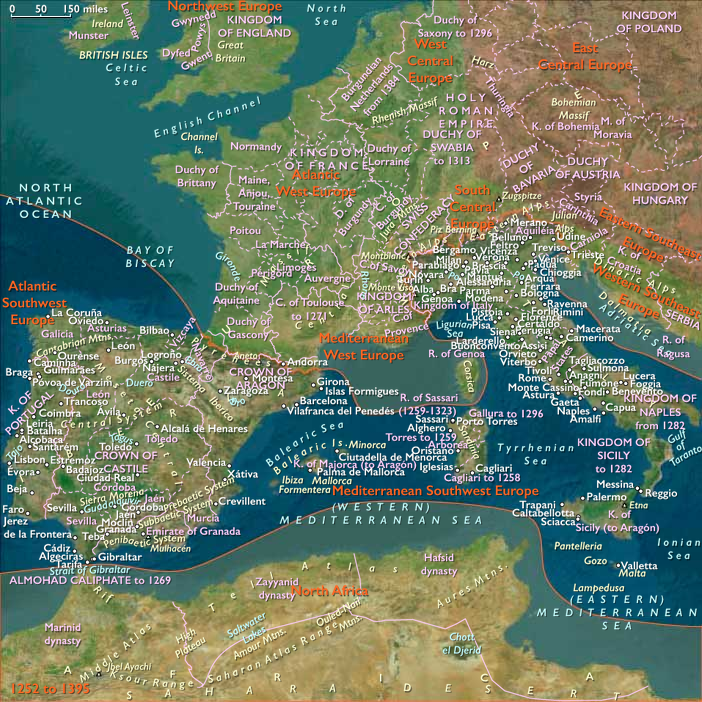
Mediterranean Southwest Europe (1324–1335 CE): Pietro Lorenzetti and the Evolution of Gothic Painting
The era 1324–1335 CE in Mediterranean Southwest Europe witnesses significant developments in Gothic painting, prominently through the work of the Sienese artist Pietro Lorenzetti, whose innovations continue the artistic revolution initiated by Giotto.
Pietro Lorenzetti’s Artistic Innovation
Pietro Lorenzetti, a prominent Sienese painter, significantly advances Gothic art during this period. Initially influenced by the tenderness and graceful linearity characteristic of his predecessor Duccio di Buoninsegna, Lorenzetti soon develops his distinct dramatic intensity and robust style. His eloquent frescoes in the Lower Church of San Francesco at Assisi vividly illustrate this evolution.
Frescoes at Assisi: Emotional Intensity and Realism
Lorenzetti's fresco cycle at Assisi, focusing on Christ’s Passion—including the Crucifixion, Deposition from the Cross, and Entombment—demonstrates his pioneering depiction of emotionally interactive figures. Unlike earlier static representations, Lorenzetti’s massed compositions feature intense, realistic human interactions and emotional expressiveness. His figures are convincingly placed within coherent spaces, creating powerful narratives that significantly enhance Gothic painting.
His influential “Descent from the Cross” notably showcases a moving poignancy, exemplified by the sharply angled contours of Christ’s emaciated body and the palpable anguish expressed by Mary and the mourners. This approach directly reflects Lorenzetti’s familiarity with Giotto’s influential frescoes in the Bardi and Peruzzi Chapels of Santa Croce in Florence, as well as Giotto’s seminal work in Padua’s Arena Chapel.
Continuation of Gothic Architectural Achievements
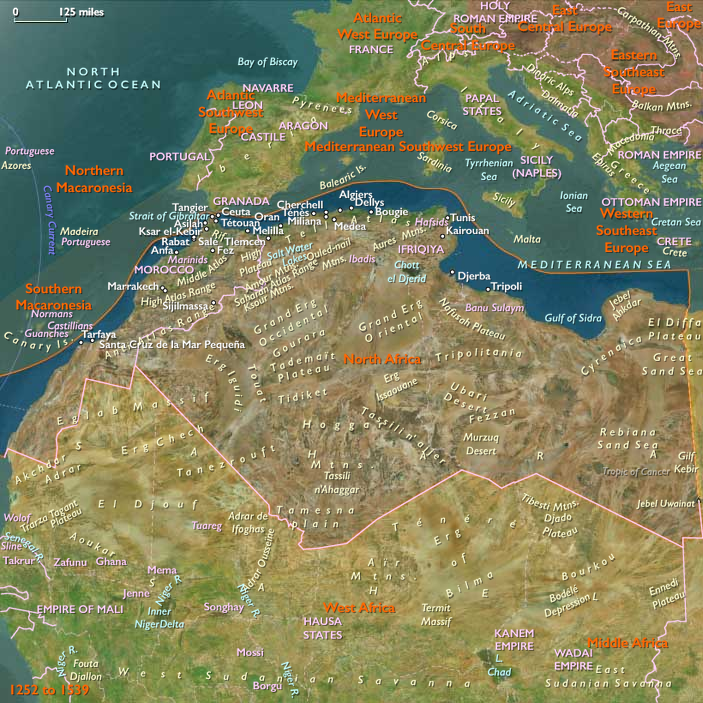
Throughout Mediterranean Southwest Europe, Gothic architecture continues to flourish, particularly evident in the ongoing construction and embellishment of cathedrals, palaces, and civic structures in major cities like Florence, Siena, and Barcelona. These projects exemplify the region’s cultural ambition, religious devotion, and civic pride.
Economic and Maritime Developments
The powerful maritime republics, particularly Venice and Genoa, persist in their rivalry, dominating Mediterranean trade routes and maintaining their economic strength and cultural influence. Their economic prosperity supports continued artistic patronage and urban expansion.
Legacy of the Era
The era 1324–1335 CE significantly influences Mediterranean Southwest Europe through Pietro Lorenzetti’s groundbreaking artistic contributions, which expand upon Giotto’s innovations, further transforming Gothic painting into a sophisticated vehicle for emotional and narrative expression. These cultural achievements profoundly impact European art, setting critical precedents for subsequent Renaissance developments.