Philip VI of France
King of France
Years: 1293 - 1350
Philip VI (1293 – 22 August 1350), known as the Fortunate (French: le Fortuné) and of Valois, is the King of France from 1328 to his death.
He is also Count of Anjou, Maine, and Valois from 1325 to 1328.
A member of the Capetian dynasty, he is the son of Charles of Valois (who was the brother of King Charles IV's father Philip IV) and the first King of France from the House of Valois.
Philip's reign is dominated by the consequences of a succession dispute.
When King Charles IV the Fair dies without a male heir in 1328, the nearest male relative is his nephew Edward III of England, who has inherited his claim through his mother Isabella of France, the sister of the dead king.
It is held in France, however, that Edward is ineligible to inherit the French throne through the female line according to the ancient Salic Law.
At first, Edward seems to accept Philip's accession as the nearest male relative of Charles IV descended through the male line, however he presses his claim to the throne of France after a series of disagreements with Philip.
The result is the beginning of the Hundred Years' War in 1337.
After initial successes at sea, Philip's navy is annihilated at the Battle of Sluys in 1340, ensuring that the war will occur on the continent.
The English take another decisive advantage at the Battle of Crécy (1346), while the Black Death strikes France, further destabilizing the country.
In 1349, Philip VI buys the Dauphiné from its ruined ruler Humbert II and entrusts the government of this province to his grandson Charles.
Philip VI dies in 1350 and is succeeded by his son John II the Good.

Related Events
Filter results
Showing 10 events out of 54 total
Atlantic West Europe (1108 – 1251 CE): The Angevin Empire, Champagne–Flanders Circuits, and Aquitaine under the English Crown
Geographic and Environmental Context
Atlantic West Europe spans northern France and the Low Countries.
-
Anchors: Paris–Seine–Reims, Upper Loire (Orléans–Blois–Tours), Anjou/Angers–Maine–Le Mans, Poitou/Poitiers–La Rochelle–Saintes, Bordeaux–Gironde–Bayonne, Flanders/Bruges–Ghent–Ypres, Low Countries delta.
Climate and Environmental Shifts
-
High-medieval peak supported population and urbanization; river improvements eased up-country grain and wine traffic.
Societies and Political Developments
-
Eleanor of Aquitaine married Louis VII (1137), annulled (1152), then married Henry II Plantagenet (1152)—creating the Angevin Empire (from Anjou/Normandy to Aquitaine).
-
Capetian–Angevin rivalry dominated: Philip II conquered Normandy (1204), but Aquitaine/Guyenne largely remained under English suzerainty; La Rochelle and Bordeaux became Angevin pillars.
-
Flanders and Champagne fairs integrated Mediterranean–northern circuits; communes of Bruges, Ghent, Ypres asserted charters.
-
Brittany navigated between Plantagenets and Capetians.
Economy and Trade
-
Bordeaux claret exports to England boomed; La Rochelle shipped salt and wine; Nantes handled salt fish and grain.
-
Flanders/Champagne fairs: Italian capital met northern cloth; Bruges emerged as a banking mart.
-
Upper Loire and Anjou–Touraine supplied wine/grain to Paris and ports.
Belief and Symbolism
-
Gothic beginnings in Chartres, Paris; pilgrimage roads of Poitou–Bordeaux remained crowded.
Long-Term Significance
By 1251, Aquitaine was England’s continental anchor; Flanders the cloth workshop; Paris–Loire the Capetian core—poised for 13th–14th-century contests.
The Succession Crisis of 1316–1317 and the Origins of the Salic Law Interpretation
Upon the death of Louis X of France in 1316, his only son, John I, posthumously born on November 15, 1316, became king. However, John lived only a few days, dying on November 19, 1316. His eldest uncle, Philip of Poitiers, had been acting as regent but now saw an opportunity to claim the throne for himself.
Philip V’s Claim and the Exclusion of Joan
- John I’s death created uncertainty, as Louis X had also left behind a daughter, Joan (born in 1312), who by traditional inheritance laws should have succeeded him.
- However, Philip of Poitiers, Louis X’s twenty-three-year-old younger brother, disregarded Joan’s claim, arguing that a woman could not inherit the throne.
- To legitimize his claim, Philip convened an assembly of prominent citizens in 1317, which declared that a woman could not succeed as ruler of France.
- He was crowned Philip V in January 1317, solidifying his rule.
The Establishment of the Male-Only Succession Rule
- Although no formal "Salic Law" (excluding female succession) was yet established, Philip V’s succession set a powerful precedent that later French kings and legal scholars would invoke.
- This principle would be fully codified in the 15th century, but its origins trace back to this 1316–1317 succession crisis.
- The exclusion of Joan of Navarre from the French throne had long-term consequences, particularly in the Hundred Years' War (1337–1453), when England’s Edward III used his maternal descent from Philip IV to justify his claim to the French crown.
Navarre’s Separation from France
- While Philip V successfully secured the French throne, Joan’s exclusion from France's succession did not go unchallenged elsewhere.
- In Navarre, where inheritance laws did allow female succession, Joan’s claim was later recognized, and she became Queen Joan II of Navarre in 1328, effectively separating Navarre from France after nearly thirty years of union.
Legacy
- The events of 1316–1317 shaped the future of French succession law, ensuring that only male heirs could inherit the throne, a rule that remained in force until the end of the monarchy.
- Philip V’s strategic maneuvering prevented the Capetian line from passing through a female heir, securing his family's continuity in power.
- The exclusion of female heirs later became a key point of contention in European dynastic disputes, influencing both internal French politics and international conflicts.
Philip V’s assumption of the throne in 1317 not only determined the immediate succession crisis but also set the foundation for centuries of male-only inheritance in France, ultimately influencing the course of European history.
The Accession of Charles IV ("the Fair") (1322)
On January 3, 1322, Philip V of France died, and he was succeeded by his younger brother, Charles IV, who, like his father Philip IV, was also known as "the Fair" (le Bel).
The Last Direct Capetian King
- Charles IV was the third and last son of Philip IV to rule France, following the short reigns of his elder brothers:
- Louis X (r. 1314–1316)
- Philip V (r. 1316–1322)
- His reign marked the final chapter of the direct Capetian dynasty, as he died without a male heir in 1328, leading to the succession crisis that resulted in the rise of the Valois dynasty.
Continuity of Capetian Rule
- Charles IV maintained his family's centralized royal authority and continued Philip IV’s policies of taxation, administration, and ecclesiastical control.
- Like his brother Philip V, he sought to assert Capetian dominance over the nobility and feudal territories.
The Implications of His Accession
- With no surviving sons from any of Philip IV’s three sons, Charles IV’s death in 1328 would trigger a major succession dispute, ultimately leading to:
- The establishment of the House of Valois, as Philip VI took the throne.
- Edward III of England’s claim to the French crown, setting the stage for the Hundred Years’ War (1337–1453).
Legacy
The accession of Charles IV in 1322 was a continuation of Capetian rule, but his failure to produce a male heir marked the end of the direct Capetian line, paving the way for the dynastic struggles that would reshape France and Europe.
The Succession Crisis of 1328 and the Rise of the House of Valois
The Salic Law, which governed the French succession, strictly prohibited the crown from passing to a woman or through the female line. This principle became decisive in 1328, when King Charles IV the Fair died without a male heir, ending the direct Capetian line.
With no direct male descendant, the question of succession arose. The closest male claimant by blood was Edward III of England, the son of Isabella of France, Charles IV’s sister. However, the French nobility, adhering to Salic tradition, rejected Edward’s claim on the basis that kingship could not be transmitted through a woman. Instead, the crown passed to Philip of Valois, Charles IV’s cousin, who ascended the throne as Philip VI.
The Peak of Medieval French Monarchy
Philip VI’s reign (1328–1350) marked the height of medieval French power, as he inherited a kingdom that had been strengthened by his Capetian predecessors. France was the largest, wealthiest, and most populous kingdom in Western Europe, with a strong centralized monarchy and a formidable military. However, Philip’s rule was soon challenged by Edward III, who, resentful of his exclusion, revived his claim to the French throne in 1337, thus initiating the Hundred Years’ War.
While Philip initially secured French dominance at sea and maintained control over Flanders and Gascony, the early stages of the war would ultimately test and weaken the monarchy. His reign, though significant in consolidating Valois rule, marked the beginning of a prolonged struggle between England and France, which would shape the political and military landscape of Europe for the next century.
Atlantic West Europe (1324–1335): War, Crisis, and Social Transformation
Between 1324 and 1335, Atlantic West Europe—including the Low Countries, Brittany, Normandy, Burgundy, Aquitaine, central France, Alsace, and Franche-Comté—faced significant military confrontations, internal crises, economic challenges, and social transformations. This era marked intensified struggles over territorial sovereignty, devastating famines, and shifting political alliances that reshaped regional dynamics.
Political and Military Developments
-
France: Intensified Royal Control and Conflict
-
King Charles IV (the Fair, r. 1322–1328) continued centralizing royal power, but his death without a male heir in 1328 triggered the Capetian dynasty's end and initiated the Valois succession.
-
The accession of Philip VI (House of Valois, r. 1328–1350) intensified dynastic tensions with England, sparking the early conflicts that would lead to the Hundred Years’ War.
-
-
Aquitaine and Gascony: Anglo-French Tensions
-
Increasing disputes over English-held Aquitaine and Gascony escalated, contributing to the outbreak of war in 1337, driven by competing claims from Edward III of England and Philip VI of France.
-
-
Low Countries: Urban Autonomy and Resistance
-
Flemish cities, particularly Ghent and Bruges, continued to assert their economic and political independence, leading to sporadic conflicts with French royal and local noble authority.
-
-
Burgundy, Alsace, and Franche-Comté: Navigating Sovereignty
-
The Duchy of Burgundy, under Eudes IV (r. 1315–1350), maneuvered diplomatically between French royal interests and regional autonomy, consolidating power internally.
-
Alsace and Franche-Comté remained contested between imperial and French influence, strengthening local governance to maintain relative independence.
-
-
Brittany and Normandy: Struggles and Alliances
-
Brittany experienced internal power struggles among competing noble factions, impacting its relationship with France and England.
-
Normandy continued integration efforts into royal administration, balancing loyalty to the French crown with local autonomy.
-
Economic and Social Developments
-
Great Famine and Economic Decline
-
The Great Famine (1315–1322) severely impacted agriculture, resulting in widespread food shortages, rising mortality rates, and economic hardship persisting into this period.
-
Urban economies, particularly in Flemish cities, faced significant disruption, although recovery began slowly toward the end of the era.
-
-
Trade and Maritime Activities
-
Maritime trade remained vital despite disruptions, especially wine trade from Bordeaux and wool trade through Flemish ports like Bruges.
-
Trade networks experienced temporary instability due to ongoing conflicts and climatic challenges.
-
Cultural and Intellectual Developments
-
Continued Gothic Influence and Artistic Innovation
-
Gothic architecture flourished despite regional hardships, evident in continued construction and embellishments of cathedrals, including those at Amiens and Strasbourg.
-
-
University of Paris and Scholarly Output
-
The University of Paris maintained its intellectual prominence, advancing theological and philosophical scholarship despite broader societal instability.
-
Religious Developments
-
Growing Influence of Mendicant Orders
-
The Franciscans and Dominicans expanded their influence in urban areas, addressing social and spiritual needs exacerbated by famine and hardship.
-
-
Jewish Communities and Social Tensions
-
Jewish populations in the region faced heightened persecution, blamed for economic hardships and facing expulsions and violence in several locales.
-
Legacy and Significance
The era 1324–1335 significantly reshaped Atlantic West Europe, setting the stage for prolonged conflict in the Hundred Years’ War, revealing vulnerabilities in social and economic structures, and prompting shifts in governance and alliances. The challenges of famine and economic distress, combined with increasing political tensions, catalyzed profound transformations that would shape the region's trajectory in subsequent decades.
The Flemish Peasant Revolt (1323–1328): A Prolonged Uprising Against Feudal Authority
The Flemish Peasant Revolt, which erupted in late 1323, began as a series of scattered rural riots but quickly escalated into a full-scale rebellion that dominated public affairs in Flanders for nearly five years. Rooted in economic hardship, feudal oppression, and heavy taxation, the revolt reflected widespread discontent among the rural population and urban guilds, who opposed the pro-French policies of the Count of Flanders, Louis I of Nevers.
Causes of the Revolt
Several factors fueled the uprising:
- Heavy taxation imposed to fund the Count’s obligations to Philip VI of France, exacerbating economic hardship.
- Onerous feudal dues that burdened peasants and landowners alike.
- Trade disruptions caused by Anglo-French tensions, which harmed Flanders’ wool-based economy.
- Resentment against French influence, as many Flemings saw the Count as a French puppet rather than an autonomous ruler.
The Course of the Rebellion
By 1325, the movement had spread across Flanders, drawing support from disaffected burghers, landowners, and rural insurgents. Rebel forces, led by figures such as Niklaas Zannekin, seized key towns, including Bruges, Ypres, and Courtrai, and established a popular government, effectively expelling the Count from much of his domain.
Despite their initial successes, the rebels lacked a unified strategy and soon faced the military intervention of France. In 1328, Philip VI of France, responding to Count Louis’ plea for assistance, launched a royal expedition into Flanders. The rebellion was crushed at the Battle of Cassel (August 23, 1328), where the peasant forces, despite their numbers, were decisively defeated by French knights.
Aftermath and Consequences
The defeat at Cassel led to the execution of rebel leaders, including Zannekin, and the restoration of Count Louis’ authority. However, the revolt left lasting tensions between the Flemish population and the French-aligned nobility, foreshadowing further conflicts in the Hundred Years’ War.
While ultimately unsuccessful, the Flemish Peasant Revolt underscored the growing fragility of feudal structures, as popular uprisings and economic resistance increasingly challenged traditional aristocratic rule in 14th-century Europe.
The Death of Charles IV and the Rise of Philip VI: The End of the Direct Capetians (1328)
On February 1, 1328, King Charles IV of France, the last of the direct Capetian kings, died without a male heir at the age of thirty-four. His death triggered a succession crisis, as there was no clear precedent for whether the throne could pass through a female line.
The Succession Crisis: Edward III’s Claim Rejected
- The strongest claim came from Edward III of England, whose mother, Isabella of France, was the daughter of Philip IV and sister of Charles IV.
- However, the French magnates rejected Edward’s claim, arguing that the throne could not pass through a woman.
- This decision was based on an evolving interpretation of succession laws, later referred to as the Salic Law, which excluded female succession and inheritance through the female line.
The Rise of Philip VI: The First Valois King
- Instead of Edward III, the throne passed to Philip VI, the late king’s thirty-five-year-old cousin.
- Philip had already inherited the counties of Valois, Anjou, and Maine from his father, Charles of Valois, in 1325.
- As the nephew of Philip IV, Philip VI was the closest male heir in the Capetian line, making him the first king of France from the House of Valois.
Consequences of the Succession
- While the French magnates considered the matter settled, Edward III of England did not forget the rejection of his claim.
- In 1337, Edward revived his claim to the French throne, launching the Hundred Years’ War (1337–1453), one of the longest and most consequential conflicts in European history.
- Philip VI’s accession marked the beginning of the Valois dynasty, which would rule France for over two centuries, through periods of war, territorial expansion, and internal strife.
The succession crisis of 1328 was a turning point in French history, as the rejection of Edward III’s claim laid the groundwork for Anglo-French hostilities that would shape Europe for the next century.
The Outbreak of the Hundred Years' War (1337)
In 1337, as Europe stood on the eve of the first wave of the Black Death, tensions between England and Franceerupted into what would become the Hundred Years' War (1337–1453). The immediate cause was Edward III of England’s claim to the French throne, which he asserted following the disputed succession of Philip VI under Salic Law. However, the conflict was also fueled by deeper territorial, economic, and feudal tensions, particularly over Gascony, a valuable English-controlled region in southwestern France.
The Changing Boundaries of War
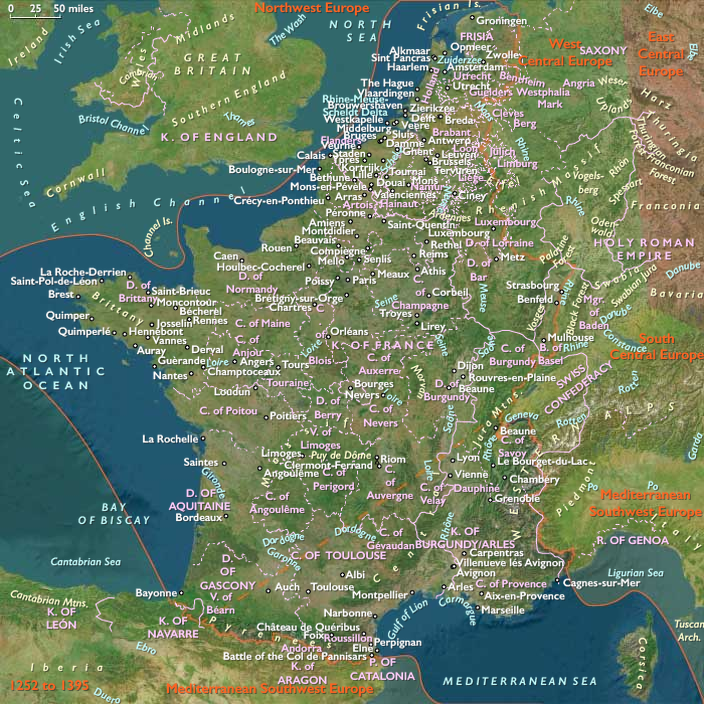
Throughout the conflict, territorial control shifted dramatically, with English and French fortunes rising and falling over successive campaigns. Despite intermittent truces and diplomatic efforts, the English maintained extensive landholdings in France for much of the war, at times controlling nearly half the kingdom, including Normandy, Aquitaine, and even Paris.
Key phases of the war included:
- Edwardian Phase (1337–1360) – English victories at Crécy (1346) and Poitiers (1356), leading to the Treaty of Brétigny (1360), which ceded large French territories to England.
- Caroline Phase (1369–1389) – A French resurgence under Charles V, reclaiming much of the lost territory.
- Lancastrian Phase (1415–1453) – Henry V’s stunning victory at Agincourt (1415) and the Treaty of Troyes (1420), which temporarily recognized English rule over France.
The Turning Point: Joan of Arc and the French Counteroffensive
By the 1420s, English rule in France seemed secure, but the emergence of Joan of Arc in 1429 proved decisive. With her divine conviction and military leadership, she inspired French forces to lift the siege of Orléans and secure a decisive victory at Patay. Alongside commanders like La Hire (Étienne de Vignolles), she spearheaded the reconquest of key regions, culminating in the coronation of Charles VII at Reims.
Following Joan’s martyrdom in 1431, French forces continued their counteroffensive, reclaiming English-held territory piece by piece. By 1453, with the fall of Bordeaux, England had lost nearly all its continental possessions, except Calais, which would remain in English hands until 1558.
The Long-Term Impact
The Hundred Years' War reshaped both nations:
- France emerged as a more centralized kingdom, with a strengthened monarchy and professionalized army.
- England, though losing its continental empire, began to develop a stronger national identity, turning its focus toward domestic consolidation and later imperial ambitions.
The war, marked by charismatic leaders, fluctuating fortunes, and enduring national rivalries, remains one of the most defining conflicts of medieval Europe.
The Hundred Years’ War: A Dynastic Struggle for the French Crown
The Hundred Years’ War (1337–1453) was a prolonged conflict between two royal houses—the House of Valois and the House of Plantagenet—over the French throne, which became vacant following the extinction of the senior Capetian line in 1328. The dispute arose from competing claims:
- The Valois claim, backed by the French nobility, upheld Philip VI of France as the rightful successor under Salic Law, which barred succession through the female line.
- The Plantagenet claim, asserted by Edward III of England, was based on his descent from Isabella of France, daughter of Philip IV, though Salic Law rendered this claim invalid in French legal tradition.
The Rival Houses and Their Claims
The House of Valois, a cadet branch of the Capetians, ruled France from 1328 onward, while the Plantagenets, rulers of England since the 12th century, also styled themselves Kings of France, contesting Valois rule.
The Plantagenets—also known as the House of Anjou—had deep roots in French territories, particularly Anjou, Normandy, and Aquitaine. Since the time of the Angevin Empire, English kings had maintained extensive landholdings in France, which were steadily eroded by Capetian expansion. However, even in the 14th century, the Plantagenets still controlled Gascony (Aquitaine), a critical source of wealth and military support.
French Soldiers on Both Sides
While the war is often framed as a struggle between England and France, French soldiers fought on both sides, as the kingdom itself was deeply divided:
- The Duchy of Burgundy frequently supported the Plantagenet cause, particularly after the assassination of John the Fearless in 1419, aligning with England in the Anglo-Burgundian alliance.
- Aquitaine, traditionally loyal to the Plantagenets, remained a stronghold of English power for much of the war, with local nobility and towns supporting English rule.
The Hundred Years’ War was not merely a dynastic dispute, but a conflict that shaped the political, military, and national identities of both France and England, leading to the eventual rise of strong centralized monarchies in both realms.
The Breton War of Succession (1341–1364): A Proxy War in the Hundred Years’ War
The Breton War of Succession (1341–1364) was a prolonged dynastic conflict between the House of Blois and the House of Montfort over control of the Duchy of Brittany. Though a regional dispute, it became deeply entangled in the Hundred Years’ War, as both England and France backed rival claimants, turning Brittany into a crucial battleground in their broader struggle for dominance.
The Origins of the Conflict
The war began following the death of Duke John III of Brittany in 1341, who left no direct heir. Two factions emerged to claim the duchy:
- Charles of Blois, supported by his uncle, King Philip VI of France.
- John of Montfort, who sought assistance from Edward III of England, aligning his claim with England’s broader ambitions in France.
As a result, Brittany became a proxy war, with both sides investing significant military resources to secure control over the duchy.
Key Phases of the War
- Early Fighting (1341–1347): The conflict saw a mix of sieges, skirmishes, and naval engagements, with Charles of Blois gaining early support but John of Montfort securing English backing.
- The Siege of Hennebont (1342): Montfort’s widow, Jeanne de Flanders, famously defended Hennebont against French forces, rallying support until English reinforcements arrived.
- The Battle of La Roche-Derrien (1347): A major victory for the English-backed Montfort faction, leading to Charles of Blois’ capture.
- Renewed War (1356–1364): After Charles was released in 1356, the war reignited, culminating in the decisive Battle of Auray (1364), where he was killed and John IV of Montfort emerged victorious.
The Treaty of Guérande (1365)
The war officially ended with the Treaty of Guérande (1365), in which John IV of Montfort was recognized as Duke of Brittany, though he still owed fealty to the French Crown. While England’s ally had triumphed, the war further weakened Brittany, leaving it vulnerable to French influence in the decades to come.
Significance in the Hundred Years' War
The Breton War of Succession was more than a localized dynastic struggle—it was a critical theater in the early stages of the Hundred Years' War, forcing France and England to divert resources while shaping the balance of power in northwestern France. The war also demonstrated the importance of Breton ports and alliances, which would remain strategically significant for the duration of the Hundred Years’ War.