Philip the Bold
Duke of Burgundy
Years: 1342 - 1404
Philip the Bold ( January 17, 1342 – April 27, 1404, Halle) is Duke of Burgundy (as Philip II) and jure uxoris Count of Flanders (as Philip II), Artois and Burgundy (as Philip IV).
The fourth and youngest son of King John II of France and his wife, Bonne of Luxembourg, Philip is the founder of the Burgundian branch of the House of Valois.
His vast collection of territories make him the undisputed premier peer, and make his successors formidable rivals of the King of France.

Related Events
Filter results
Showing 10 events out of 23 total
Atlantic West Europe (1108 – 1251 CE): The Angevin Empire, Champagne–Flanders Circuits, and Aquitaine under the English Crown
Geographic and Environmental Context
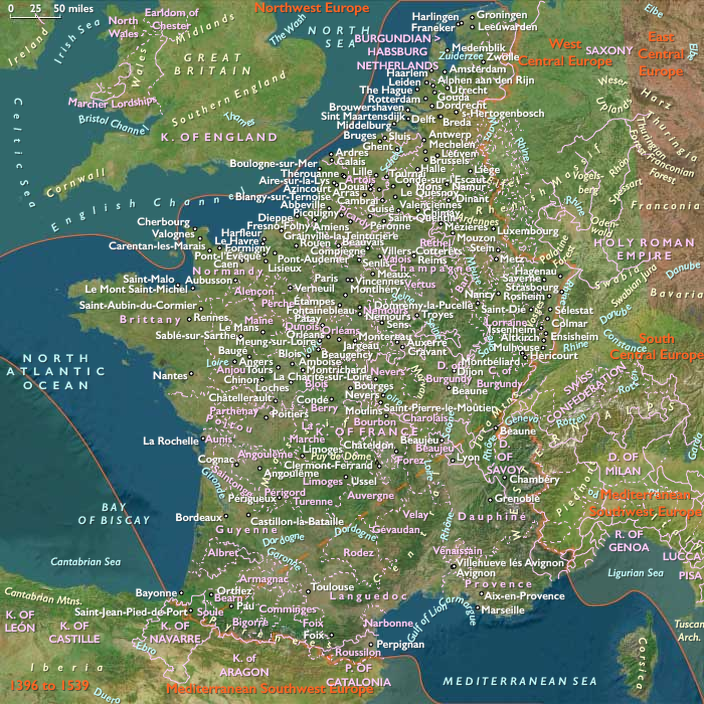
Atlantic West Europe spans northern France and the Low Countries.
-
Anchors: Paris–Seine–Reims, Upper Loire (Orléans–Blois–Tours), Anjou/Angers–Maine–Le Mans, Poitou/Poitiers–La Rochelle–Saintes, Bordeaux–Gironde–Bayonne, Flanders/Bruges–Ghent–Ypres, Low Countries delta.
Climate and Environmental Shifts
-
High-medieval peak supported population and urbanization; river improvements eased up-country grain and wine traffic.
Societies and Political Developments
-
Eleanor of Aquitaine married Louis VII (1137), annulled (1152), then married Henry II Plantagenet (1152)—creating the Angevin Empire (from Anjou/Normandy to Aquitaine).
-
Capetian–Angevin rivalry dominated: Philip II conquered Normandy (1204), but Aquitaine/Guyenne largely remained under English suzerainty; La Rochelle and Bordeaux became Angevin pillars.
-
Flanders and Champagne fairs integrated Mediterranean–northern circuits; communes of Bruges, Ghent, Ypres asserted charters.
-
Brittany navigated between Plantagenets and Capetians.
Economy and Trade
-
Bordeaux claret exports to England boomed; La Rochelle shipped salt and wine; Nantes handled salt fish and grain.
-
Flanders/Champagne fairs: Italian capital met northern cloth; Bruges emerged as a banking mart.
-
Upper Loire and Anjou–Touraine supplied wine/grain to Paris and ports.
Belief and Symbolism
-
Gothic beginnings in Chartres, Paris; pilgrimage roads of Poitou–Bordeaux remained crowded.
Long-Term Significance
By 1251, Aquitaine was England’s continental anchor; Flanders the cloth workshop; Paris–Loire the Capetian core—poised for 13th–14th-century contests.
The Black Prince’s Chevauchée and the Lead-Up to the Battle of Poitiers (August–September 1356)
By 1356, after years of war, Edward III of England sought a diplomatic resolution, proposing that France permanently cede Aquitaine in exchange for peace. However, French King John II ("the Good") rejected the proposal, prompting Edward’s eldest son, Edward, Prince of Wales (later known as the Black Prince), to launch a massive chevauchée (scorched-earth raid) deep into central France.
The Chevauchée of August 1356: Raiding Across Central France
- On August 8, 1356, the Black Prince’s army began its devastating march northward from English-held Aquitaine, carrying out a chevauchée designed to weaken France’s economy, demoralize the population, and provoke the French army into battle.
- His fast-moving English and Gascon force, composed of mounted knights, men-at-arms, and archers, met little resistance and proceeded to burn numerous towns and villages to the ground, pillaging the countryside for supplies.
- The English lived off the land, creating havoc in French territories and stripping central France of valuable resources.
The Loire River and the Delay at Tours
- By early September 1356, the Black Prince’s army reached the Loire River at Tours, a key crossing point in central France.
- He attempted to capture the castle and sack the town, but was unable to breach its defenses due to a heavy rainstorm, which prevented his troops from setting fires.
- This delay at Tours proved costly, as it allowed John II of France to close in with a large army, finally putting the English force in jeopardy.
John II’s Response: The Pursuit Begins
- King John II had been assembling a powerful army to intercept the English raiders and prevent their retreat back to Aquitaine.
- The delay at Tours gave him the time he needed to maneuver into position, forcing the Black Prince’s army into a dangerous situation.
- Now, instead of freely raiding French lands, Edward’s force had to plan a strategic retreat southward, knowing that a major confrontation was inevitable.
The Path to the Battle of Poitiers
- The Black Prince’s chevauchée had succeeded in devastating central France, but his army was now being pursued by a superior French force.
- This set the stage for the decisive Battle of Poitiers (September 19, 1356), one of the most significant English victories of the Hundred Years’ War, where John II would be captured, throwing France into crisis.
Edward’s brutal chevauchée of 1356, though initially an overwhelming success, ultimately led to the climactic confrontation at Poitiers, shaping the course of the Hundred Years’ War for years to come.
Atlantic West Europe (1360–1371): Fragile Peace, Regional Power Shifts, and Social Unrest
Between 1360 and 1371, Atlantic West Europe—encompassing the Low Countries, Brittany, Normandy, Burgundy, Aquitaine, central France, Alsace, and Franche-Comté—experienced a temporary lull in the Hundred Years' War, significant regional power shifts, economic strain, and widespread social tensions. The Treaty of Brétigny (1360)briefly halted hostilities between France and England, creating space for internal reconstruction, but underlying instabilities persisted, fueling regional ambitions and social discontent.
Political and Military Developments
-
France: Treaty of Brétigny and Internal Struggles
- The Treaty of Brétigny (1360) marked a pause in the Hundred Years' War, temporarily ceding extensive French territories—including Aquitaine—to English control and significantly reducing French royal prestige and resources.
- King Charles V (the Wise, r. 1364–1380) assumed the throne after Jean II's death (1364), beginning systematic efforts to recover lost territories and centralize royal authority through military reforms, strategic diplomacy, and administrative strengthening.
-
Aquitaine and Gascony: Heightened English Control
- The Black Prince (Edward of Woodstock) ruled Aquitaine from Bordeaux, maintaining considerable autonomy and enforcing strict administration, resulting in significant regional prosperity but also provoking growing resentment and discontent among local nobility and towns.
-
Low Countries: Urban Autonomy and Noble Rivalries
- The Low Countries witnessed significant urban unrest, particularly in Flanders and Brabant, where powerful cities like Ghent, Bruges, and Brussels sought greater economic and political independence from local nobles.
- Growing tensions between urban elites and rural aristocracy periodically erupted into conflicts, shaping regional governance and alliances.
-
Burgundy, Alsace, and Franche-Comté: Emerging Power
- Philip the Bold, younger son of Jean II, received the Duchy of Burgundy in 1363, marking the beginning of the powerful Valois-Burgundy dynasty. Philip quickly consolidated power, establishing Burgundy as an influential, semi-independent political entity.
- Alsace and Franche-Comté maintained relative independence, serving as contested territories balancing French, imperial, and Burgundian ambitions.
-
Brittany and Normandy: Succession and Local Governance
- Brittany remained entrenched in the Breton War of Succession (ending in 1364), concluding with the victory of the Montfort faction under John IV (Jean de Montfort). Brittany maintained an autonomous stance between France and England.
- Normandy experienced recovery and tighter integration into royal administration under Charles V, rebuilding economically from previous devastations.
Economic and Social Developments
-
Economic Strain and Resilience
- The aftermath of the Black Death continued to strain labor markets, leading to recurring rural and urban unrest, particularly in France, Aquitaine, and the Low Countries.
- Flemish cities such as Ghent and Bruges slowly rebounded, maintaining their positions as major centers of the wool and textile trades, despite intermittent social unrest.
-
Urban-Rural Tensions
- Increasing taxes and feudal demands caused rural populations to rebel periodically against noble authority, most notably reflected in localized uprisings and communal revolts across northern France, Normandy, and Brittany.
- In urban areas, conflicts intensified between merchant guilds and urban laborers, reflecting deepening socio-economic disparities.
Cultural and Intellectual Developments
-
Literary Flourishing and Court Culture
- Charles V's court promoted intellectual and artistic renewal, notably through translations of classical texts into French, signaling growing royal patronage of vernacular literature and scholarly culture.
- Works by prominent writers, such as Jean Froissart, chronicled contemporary events and court life, marking an advancement in vernacular historiography.
-
Gothic Artistic Patronage
- Gothic architecture and artistic patronage continued to thrive, particularly evident in the completion and decoration of cathedrals, such as those in Strasbourg and Rouen, highlighting cultural recovery from previous devastations.
Religious Developments
- Clerical Challenges and Popular Piety
- The aftermath of plague-era clerical shortages and perceived corruption spurred popular religious movements, confraternities, and increasing lay devotion, emphasizing spiritual renewal outside traditional ecclesiastical structures.
- Mendicant orders, particularly Dominicans and Franciscans, continued their influential roles within urban centers, fostering a more personalized religious experience.
Legacy and Significance
Between 1360 and 1371, Atlantic West Europe experienced a fragile and temporary peace that permitted internal recovery and significant regional restructuring. The Treaty of Brétigny reshaped Anglo-French territorial dynamics, planting seeds of renewed future conflict. The emergence of Burgundy as a major power, ongoing struggles for urban autonomy, and widespread social unrest defined the era, marking a critical transitional period leading to the resumption of hostilities and profound socio-political transformations in the coming decades.
The End of the Old Burgundian Line and the Rise of Philip the Bold (1361–1363)
The duchy of Burgundy, ruled by a cadet branch of the Capetian dynasty since 1031, became vacant in 1361 when Philip of Rouvres, the last duke of the older Burgundian line, died without an heir. This led to Burgundy returning to the French Crown, but rather than permanently incorporating it into the royal domain, King John II of France granted the duchy as an appanage to his youngest son, Philip the Bold, in 1363.
Philip the Bold: From Prince to Duke of Burgundy
- Philip the Bold (Philippe le Hardi) was born in Pontoise in 1342, the fourth and youngest son of King John II of France and Bonne of Luxembourg.
- He earned his cognomen "the Bold" for his courage at the Battle of Poitiers (1356), where, at just fourteen years old, he fought beside his father and was captured alongside him by the English.
Previous Title: Duke of Touraine (1360–1363)
- In 1360, John II had granted Philip the Duchy of Touraine, an important territory in central France.
- However, in 1363, as a reward for his loyalty and bravery at Poitiers, Philip returned Touraine to the Crownin exchange for a greater prize—the Duchy of Burgundy.
The New Duke of Burgundy (1363–1404)
- With the death of Philip of Rouvres (1361), King John II took direct control of Burgundy before granting it to Philip the Bold in 1363.
- This marked the foundation of the Valois-Burgundy dynasty, which would become one of the most powerful ruling houses in medieval Europe.
- Philip ruled Burgundy as an independent power base, using it to expand his influence across France, the Low Countries, and beyond.
Impact and Legacy
- Philip the Bold’s rule over Burgundy (1363–1404) transformed the duchy into a major European power, leading to the rise of the Burgundian state, which would play a crucial role in French and European politics for over a century.
- His marriage to Margaret III of Flanders (1369) brought rich Flemish territories under Burgundian control, making the Duchy of Burgundy a rival to the French monarchy.
- The Valois Dukes of Burgundy would eventually challenge the French Crown, culminating in the Burgundian Wars of the 15th century.
The transfer of Burgundy to Philip the Bold in 1363 laid the foundation for a powerful and semi-independent Burgundian state, turning the duchy into a dominant political force that would shape the future of France and the Low Countries.
he Battle of Cocherel (May 6, 1364): Du Guesclin’s Victory Secures Burgundy for France
The Battle of Cocherel (May 6, 1364) was a pivotal battle in the Hundred Years' War, where Bertrand du Guesclin, leading the forces of the newly crowned Charles V of France, decisively defeated Charles II of Navarre’s army. This victory secured Burgundy for the French Crown, strengthened King Charles V's authority, and forced Navarre into a new peace agreement.
Background: The Struggle for Burgundy and Navarre’s Ambitions
- After the Battle of Poitiers (1356), France had been destabilized, and Charles II of Navarre sought to expand his influence, hoping to claim the Duchy of Burgundy.
- However, Dauphin Charles (the future Charles V) intended to grant Burgundy to his brother, Philip (later Philip the Bold).
- To neutralize the Navarrese threat, Charles V, shortly before his coronation in 1364, sent Bertrand du Guesclin to confront Navarre’s forces.
The Forces at Cocherel
French Army (Commanded by Bertrand du Guesclin)
- Supported by Jean, Count of Auxerre (the highest-ranking noble present).
- Reinforced by knights from Burgundy (e.g., Jean de Vienne), Picardy, Paris, Gascony, and Brittany.
Navarrese Army (Commanded by Jean de Grailly, Captal de Buch)
- Composed of 800–900 knights and 4,000–5,000 soldiers from:
- Normandy
- Gascony
- England (including 300 English archers)
- Many troops were routiers (mercenary free companies) that had previously operated in Brittany and western France.
Battle Tactics and Du Guesclin’s Strategy
- The Navarrese army took up a defensive position on a hill, using the standard English defensive formation:
- Archers were placed in wedges along the front, designed to decimate an advancing enemy before they reached the main force.
- Rather than engaging directly, du Guesclin used a feigned retreat, luring the Navarrese forces down from their defensive position.
- As the Navarrese pursued, du Guesclin’s reserve forces launched a devastating flank attack, crushing the enemy ranks.
- Jean de Grailly, Captal de Buch, was captured, further demoralizing the Navarrese forces.
Aftermath and Consequences
- Navarre’s forces were decisively defeated, forcing Charles II of Navarre into a new peace treaty with France.
- The victory secured Burgundy for Philip the Bold, ensuring it remained under the control of the French royal family.
- Du Guesclin’s success cemented his reputation as one of France’s greatest military leaders, setting the stage for his future role as Constable of France.
- The Battle of Cocherel marked an early success for Charles V, demonstrating the effectiveness of strategic military leadership over traditional chivalric tactics.
The French victory at Cocherel (1364) was a turning point in securing Valois authority, preventing Navarre from expanding its influence, and reaffirming Burgundy’s loyalty to the French Crown.
Atlantic West Europe (1372–1383): Renewed Conflict, Rising Burgundy, and Social Upheaval
Between 1372 and 1383, Atlantic West Europe—including the Low Countries, Brittany, Normandy, Burgundy, Aquitaine, central France, Alsace, and Franche-Comté—experienced renewed warfare, the rise of powerful regional states, social unrest, and evolving economic dynamics. The resumption of the Hundred Years’ War, the further consolidation of Burgundy under Philip the Bold, and intensifying urban and rural tensions significantly shaped this turbulent era.
Political and Military Developments
-
France and England: The War Resumes
- Hostilities in the Hundred Years' War resumed fully in 1372, reversing the temporary peace established by the Treaty of Brétigny. French naval victories, notably the Battle of La Rochelle (1372), marked a turning point, weakening English control in Aquitaine.
- Under Charles V (r. 1364–1380) and his talented constable, Bertrand du Guesclin, France gradually recaptured large territories previously ceded to England.
-
Aquitaine and Gascony: English Retreat and Regional Turmoil
- Aquitaine suffered increasing turmoil as the English lost significant ground. Revolts among regional nobility and towns undermined English rule, weakening the position of the Black Prince (Edward of Woodstock), who died in 1376, further destabilizing English governance.
-
Burgundy, Alsace, and Franche-Comté: Burgundian Consolidation
- Philip the Bold, Duke of Burgundy (r. 1363–1404), significantly expanded his territories and influence. Through marriage alliances and strategic diplomacy, Philip integrated the County of Burgundy (Franche-Comté) and reinforced his control over key regions, positioning Burgundy as a major European power.
- Alsace remained an influential buffer zone, managing local autonomy despite pressure from French, Imperial, and Burgundian interests.
-
Low Countries: Urban Revolts and Economic Rivalries
- Flanders faced severe social upheaval, notably the Revolt of Ghent (1379–1385), where urban populations rebelled against the Count of Flanders, Louis de Male, over oppressive taxation and governance issues. The conflict profoundly destabilized the region's economic and political landscape.
-
Brittany and Normandy: Continued Autonomy and Stability
- Brittany maintained relative autonomy under Duke John IV (Jean de Montfort, r. 1364–1399), carefully balancing neutrality with alliances to both France and England.
- Normandy continued its economic and administrative recovery under closer integration into French royal structures, despite occasional local tensions.
Economic and Social Developments
-
Economic Struggles and Social Unrest
- Heavy taxation due to renewed warfare led to widespread unrest across rural and urban areas, notably triggering peasant rebellions like the Harelle revolt in Rouen (1382), reflecting escalating social tensions.
- Trade disruptions severely impacted Flemish cities, exacerbating social grievances among urban populations, and fueling revolts against noble authority.
-
Urban-Rural Divide
- Increasing economic disparities between urban elites and rural populations intensified, manifesting in widespread discontent and periodic revolts across France, Burgundy, and the Low Countries.
Cultural and Intellectual Developments
-
Royal Patronage and Cultural Renewal
- Under Charles V, Paris emerged as a vibrant cultural and intellectual hub, attracting scholars, poets, and artists. This era saw an expansion of vernacular literature and historiography, exemplified by the chronicler Jean Froissart, whose writings documented the era’s significant events and courtly culture.
-
Artistic Flourishing
- The patronage of Burgundy’s Philip the Bold significantly advanced Gothic artistic developments, particularly evident in the Charterhouse of Champmol in Dijon, marking Burgundy’s emergence as a key European cultural center.
Religious Developments
- Popular Piety and Ecclesiastical Criticism
- Disillusionment with the Church’s wealth and corruption intensified, fueling growing movements advocating religious reform and personal spirituality, notably through the continued spread of mendicant orders (Dominicans, Franciscans) and lay confraternities.
- Clerical reform movements arose, questioning papal authority, particularly in response to the onset of the Western Schism (1378), dividing European loyalties between rival popes in Avignon and Rome.
Legacy and Significance
Between 1372 and 1383, Atlantic West Europe witnessed renewed warfare and significant shifts in regional power dynamics. France’s strategic gains against England, the rise of Burgundy under Philip the Bold, urban revolts in the Low Countries, and widespread social unrest defined the period. These developments deepened political divisions, reshaped regional alliances, and set the stage for future conflicts, laying critical groundwork for subsequent transformations in European political and cultural history.
The Legacy of Charles V: A Model of Kingship and Its Decline
The reign of King Charles V of France (r. 1364–1380) left a lasting impression on posterity, as his conception of governance became an ideal that later courtiers wished his successors would emulate. His rule combined pragmatism, intellectual refinement, and political acumen, stabilizing the kingdom after the disasters of the Hundred Years’ War and the internal turmoil of the Jacquerie (1358) and the Étienne Marcel Revolt (1357–1358).
Charles V in Political Thought and Biography
Much of what we know about Charles V’s personal and political life comes from Christine de Pizan’s biography, commissioned in 1404 by Philip the Bold, Duke of Burgundy. Pizan’s work not only preserves intimate details of the king’s rule, but also serves as a moral guide for his successors. Drawing on the political philosophy of Nicole Oresme, who translated Aristotle’s moral works into French, and Giles of Rome, the biography presents Charles as a model ruler, embodying the wisdom and piety that his heirs were expected to follow.
A similar didactic portrayal appears in Philippe de Mézières’ allegorical Songe du Vieil Pèlerin (The Old Pilgrim’s Dream), written for Charles’ son, the future Charles VI. Mézières urges the dauphin to emulate his father’s piety and reformist zeal, though history would prove that Charles VI did not live up to this ideal.
The Royal Library and the Intellectual Kingship of Charles V
Among Charles V’s greatest achievements was his vast royal library, housed in his expanded Louvre, which symbolized both the magnificence of the monarchy and his belief in governance for the common good. Containing over 1,200 volumes, the library was described in detail by the 19th-century historian Léopold Delisle.
- Charles prioritized works in French so that his counselors and officials could access them, reinforcing royal authority through knowledge.
- The most significant translations commissioned for the library were those of Nicole Oresme, who produced the first full French translations of Aristotle’s Politics, Ethics, and Economics.
- The Politics and Economics served as manuals for government, while the Ethics advised the king on how to be a virtuous ruler.
- Other notable works included:
- Songe du Vergier, an anonymous legal treatise inspired by the debates between Philip IV’s jurists and Pope Boniface VIII.
- The translations of Raoul de Presles, which included St. Augustine’s City of God.
- The 1377 edition of the Grandes Chroniques de France, edited to emphasize the vassalage of Edward III, reinforcing the Valois claim to French sovereignty over English-occupied lands.
Charles' kingship placed great emphasis on both royal ceremony and political theory, seeking to embody the ideals of St. Louis (Louis IX), Charlemagne, and Clovis, as depicted in his Coronation Book of 1364, now housed in the British Library.
The Builder King: Architecture and Urban Fortifications
Charles was also a builder king, commissioning or rebuilding several significant fortifications and palaces in the late 14th-century style, including:
- The Bastille, initially constructed as a fortress to defend Paris.
- The Château du Louvre, expanded as both a residence and a stronghold.
- The Château de Vincennes, a royal residence and military stronghold.
- The Château de Saint-Germain-en-Laye, a model later widely imitated by the nobility.
These constructions reflected Charles' strategic foresight, reinforcing France’s urban defenses while also displaying royal prestige.
The Fragility of Charles V’s Achievements
While his reign marked a recovery from the devastation of Brétigny (1360), Charles’ successes ultimately proved ephemeral.
- His brothers, who dominated the regency council after his death, quarreled among themselves, weakening central authority.
- His son, Charles VI, neglected governance in favor of courtly entertainments, and after his descent into madness in 1392, his uncles resumed control, leading to factional rivalries.
- By 1419, the kingdom was divided between Armagnac and Burgundian factions, while Henry V of England was conquering northern France, culminating in the Treaty of Troyes (1420), which nearly extinguished Valois rule.
Thus, the hard-won victories of Charles V were squandered by his successors, plunging France into renewed crisis.
The Final Years and Death of Charles V ("the Wise") (1380)
By 1380, King Charles V of France ("Charles the Wise") had consolidated French control over Normandy, successfully neutralized the threat posed by Charles II of Navarre, and continued unsuccessful peace negotiations with England. Though he was an effective ruler known for his military and economic reforms, his heavy taxation policies had led to widespread discontent, especially among the working classes and nobility.
Charles V’s Reforms and Challenges
-
Military Successes
- Charles V secured French gains in Normandy, reducing English influence.
- He neutralized Charles II of Navarre, whose ambitions had previously destabilized the region.
-
Economic and Currency Reforms
- He stabilized France’s currency, correcting earlier devaluations.
- However, his heavy war taxation, particularly the hearth tax, caused significant unrest among the lower classes and nobility.
-
Patron of Arts and Learning
- He was a major patron of artists and intellectuals, commissioning illuminated manuscripts, translations of Aristotle, and architectural works.
-
The Great Schism of the Papacy
- His policies contributed to the Papal Schism (1378), dividing the Catholic Church between rival popes in Avignon and Rome, further complicating French and European politics.
Abolition of the Hearth Tax and Death (September 16, 1380)
- On his deathbed, recognizing rising noble and public discontent, Charles V canceled the hearth tax, the main financial pillar of his government.
- This sudden reversal left France financially weakened, exacerbating noble rivalries and fiscal instability.
- He died at the age of 42 on September 16, 1380.
Succession and the Regency of Philip of Burgundy
- His son, Charles VI, was only 11 years old at the time of his accession.
- Philip the Bold, Duke of Burgundy, Charles V’s youngest brother, became regent, marking the beginning of Burgundian dominance at the French court.
Impact and Legacy
- Charles V’s reign restored France’s military fortunes, but his tax policies alienated key segments of society.
- His patronage of the arts and intellectual life laid the foundation for the cultural achievements of the early 15th century.
- His death and the regency of Philip the Bold set the stage for intense factional struggles at the French court, influencing the political instability of Charles VI’s reign.
Charles V’s reign was one of military and economic recovery, but his final decisions—especially the abolition of the hearth tax—created financial instability, shaping the political conflicts of the next generation.
This revision enhances clarity, strengthens readability, and fully contextualizes the final years and legacy of Charles V. Let me know if you’d like any refinements!
The Battle of Roosebeke (November 27, 1382): French Victory Over the Flemish Revolt
In 1382, King Charles VI of France intervened in Flanders to support his ally, Louis de Male, Count of Flanders, against a rebellion led by the city of Ghent. The Flemish rebels, led by Philip van Artevelde, sought to overthrow feudal rule, challenging both the Count of Flanders and French authority. The French response culminated in the Battle of Roosebeke (November 27, 1382), where Olivier de Clisson, as Constable of France, led the French royal army to a decisive and brutal victory.
The Flemish Revolt and French Intervention
- The Flemish cities, particularly Ghent, had long resisted feudal control, favoring municipal independence and trade autonomy.
- Philip van Artevelde, son of the famous Flemish leader Jacob van Artevelde, led the bourgeois militia against Louis de Male.
- Fearing the spread of urban revolts across France, Charles VI decided to intervene militarily.
The Battle of Roosebeke (November 27, 1382)
- Olivier de Clisson commanded the French royal army, which consisted of seasoned knights and men-at-arms.
- The Flemish forces, made up of militia fighters, artisans, and merchants, lacked professional military experience.
- Clisson used tactical superiority to crush the Flemish:
- He outmaneuvered the undisciplined militias, trapping them with cavalry charges and flanking attacks.
- The French forces encircled the Flemish, leading to a brutal massacre of 25,000 men.
- Philip van Artevelde was killed, and the rebellion collapsed as the French army sacked and looted the battlefield.
Aftermath and Consequences
- The crushing of the Ghent revolt reinforced feudal control in Flanders, ensuring Louis de Male’s continued rule.
- Olivier de Clisson’s victory solidified his position as one of France’s most capable military commanders.
- The massacre of 25,000 Flemish rebels sent a clear message against urban uprisings, though resistance in Flanders would continue in later years.
The Battle of Roosebeke (1382) was a defining moment in the conflict between feudal lords and urban autonomy, demonstrating the military dominance of France and the brutality of medieval warfare under the command of Olivier de Clisson.
Political Struggles in France: The Rise of Olivier de Clisson as Leader of the Anti-Burgundian Party (1382)
By 1382, the French court was dominated by factional struggles, as the boy-king Charles VI was still too young to govern independently. His uncles, notably Philip the Bold of Burgundy, sought to control royal policy, while opposition forces, led by Louis, Duke of Anjou, attempted to counterbalance Burgundian influence. When Louis died in 1382, Olivier de Clisson, the Constable of France, emerged as the new leader of the anti-Burgundian faction, supported by northwestern nobility and military commanders.
Power Struggles at the French Court
- Philip the Bold of Burgundy attempted to assert dominance over France’s policies, securing his influence over the young Charles VI.
- Louis, Duke of Anjou, led an anti-Burgundian party, made up of:
- Royal officials who opposed Burgundian control.
- Military commanders who favored a more independent, centralized monarchy.
- Nobles from northwestern France, traditionally wary of Burgundian power.
Olivier de Clisson’s Rise as Anti-Burgundian Leader (1382)
- Upon Louis of Anjou’s death in 1382, leadership of the anti-Burgundian party fell to Olivier de Clisson, Constable of France.
- Clisson, a seasoned military leader, had strong backing from:
- French royal commanders, who had fought alongside him in Brittany and against the English.
- Nobles from Brittany, Normandy, and Anjou, regions historically skeptical of Burgundian dominance.
- His leadership shifted the opposition from a purely political struggle to one with strong military implications.
Impact and Legacy
- The power struggle between Burgundy and its opponents would continue for decades, eventually escalating into the Armagnac-Burgundian Civil War (1407–1435).
- Clisson’s leadership in the anti-Burgundian faction placed him at odds with Philip the Bold, leading to further conflicts at the French court.
- His control over the military gave the anti-Burgundian party a significant advantage, influencing future French campaigns against English and Burgundian interests.
The rise of Olivier de Clisson as leader of the anti-Burgundian party in 1382 marked a new phase in the internal power struggles of France, as the country drifted toward further factional conflicts that would shape its history well into the 15th century.