Pharnaces II
king of Pontus
Years: 97BCE - 47BCE
Pharnaces II of Pontus, also known as Pharnaces II (about 97 BCE-47 BCE) is a prince, then King of Pontus and the Bosporan until his death.
He is a monarch of Persian and Greek Macedonian ancestry.
Pharnaces II is the youngest son and child born to King Mithridates VI of Pontus from his first wife, his sister Queen Laodice.
He was born and raised in the Kingdom of Pontus and is the namesake of his late paternal great grandfather Pharnaces I of Pontus.



Related Events
Filter results
Showing 10 events out of 10 total
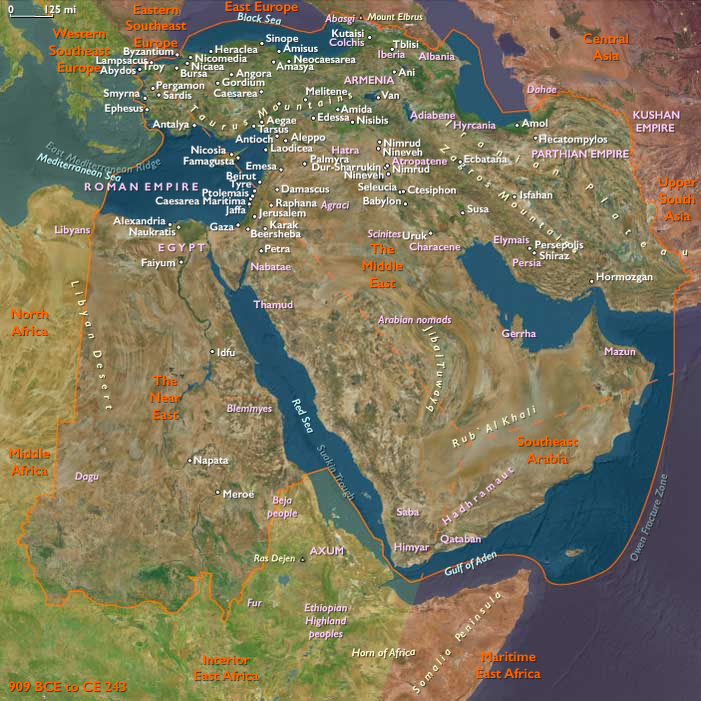
King Mithridates VI of Pontus, after his defeat by Roman General Pompey in 63 BCE, flees with a small army from Colchis (modern Georgia) over the Caucasus Mountains to the Crimea.
Establishing himself at Panticapaeum (Kerch), he makes plans to raise yet another army to invade Italy by way of the Danube.
His eldest living son, Machares, viceroy of Cimmerian Bosporus, is unwilling to aid his father.
Mithridates VI had Machares killed, and Mithridates VI takes the throne of the Bosporan Kingdom.
Mithridates now orders the conscriptions and preparations for war.
His youngest son, Pharnaces II, leads a rebellion against his father, joined by Roman exiles in the core of Mithridates VI's Pontic army.
Mithridates withdraws to the citadel, where, after failing in an attempt to poison himself, Mithridates orders a Gallic mercenary to kill him.
His body is sent to Pompey, who buries his enemy in the rock-cut tombs of his ancestors in Amasia, the old capital of the Kingdom of Pontus.
Pharnaces II makes his submission to Pompey, who confirms him as ruler of the new province he creates, the Bosporus Cimmerius (Crimean region).
…Pompey extends the Roman chain of protectorates to include Colchis, on the Black Sea, and the states south of the Caucasus.
The organization of the East remains Pompey's greatest achievement.
His sound appreciation of the geographical and political factors involved has enabled him to impose an overall settlement that is to form the basis of the defensive frontier system and is to last, with few important changes, for more than five hundred years.
The Great Roman Civil War (49–45 BCE), also known as Caesar's Civil War, one of the last politico-military conflicts in the Roman Republic before the establishment of the Roman Empire, begins as a series of political and military confrontations between Julius Caesar, his political supporters (broadly known as Populares), and his legions, against the Optimates (or Boni), the politically conservative and socially traditionalist faction of the Roman Senate, who are supported by Pompey and his legions.
Caesar is appointed dictator in Rome, with Mark Antony as his Master of the Horse; Caesar presides over his own election to a second consulate (with Publius Servilius Vatia as his colleague), then, after eleven days, resigns this dictatorate.
He pursues Pompey to Alexandria, where Pompey is murdered by a former Roman officer serving in the court of King Ptolemy XIII.
Caesar then becomes involved with the Alexandrine civil war between Ptolemy and his sister, wife, and co-regent queen, the Pharaoh Cleopatra VII.
Caesar sides with Cleopatra, perhaps as a result of Ptolemy's role in Pompey's murder; he is reported to have wept at the sight of Pompey's head, which is offered to him by Ptolemy's chamberlain Pothinus as a gift.
In any event, Caesar withstands the Siege of Alexandria, later defeating the Ptolemaic forces in 47 BCE in the Battle of the Nile and installing Cleopatra as ruler.
Caesar and Cleopatra never marry, as Roman Law only recognizes marriages between two Roman citizens, but he continues his relationship with Cleopatra throughout his last marriage, which lasts fourteen years—in Roman eyes, this does not constitute adultery—and may have fathered a son called Caesarion.
Cleopatra visits Rome on more than one occasion, residing in Caesar's villa just outside Rome across the Tiber.
Caesar had again been appointed Dictator late in 48 BCE, with a term of one year.
After spending the first months of 47 BCE in Egypt, Caesar crosses to Asia, where he annihilates King Pharnaces II of Pontus in the Battle of Zela; his victory is so swift and complete that he mocks Pompey's previous victories over such poor enemies.
He thence proceeds to Africa to deal with the remnants of Pompey's senatorial supporters.
He quickly gains a significant victory at Thapsus in 46 BCE over the forces of Metellus Scipio (who dies in the battle) and Cato the Younger (who commits suicide).
After this victory, Caesar is appointed Dictator for ten years.
Mediterranean Southwest Europe (57–46 BCE): Caesar's Civil War and the Collapse of the Republic
The era 57–46 BCE marks one of the most critical periods in the history of the Roman Republic, dominated by the turmoil and transformation brought about by Caesar's Civil War. This conflict, fundamentally political and military, pits Julius Caesar and his supporters—the Populares—against the conservative faction of the Senate—the Optimates—led militarily by Pompey the Great.
Outbreak of Civil War and Caesar’s Dictatorship
The conflict erupts in 49 BCE, after prolonged political tensions between Caesar and the Senate culminate in Caesar’s dramatic crossing of the Rubicon River, symbolically declaring war against Rome itself. Pompey and most senators flee Rome, regrouping in Greece and other parts of the Republic.
In Rome, Caesar rapidly consolidates power, assuming the role of dictator and appointing Mark Antony as his Master of the Horse. After presiding briefly over his election to a second consulate alongside Publius Servilius Vatia, Caesar resigns the dictatorship after eleven days, though retaining supreme authority through military dominance.
Pompey's Defeat and Death in Egypt
Caesar pursues Pompey to Egypt, arriving in Alexandria shortly after Pompey’s assassination at the hands of the court of Ptolemy XIII. Caesar aligns himself with Cleopatra VII, Ptolemy’s sister and rival, becoming embroiled in the Alexandrine civil war. After surviving a challenging siege, Caesar decisively defeats Ptolemy’s forces at the Battle of the Nile in 47 BCE, establishing Cleopatra firmly as ruler of Egypt.
Despite never marrying due to Roman legal constraints—Roman law only recognizes marriages between Roman citizens—Caesar maintains a significant relationship with Cleopatra, who later visits Rome, residing in Caesar’s villa across the Tiber. Caesar and Cleopatra’s union is historically notable, and Caesar is believed to have fathered a son, Caesarion, with her.
Caesar’s Campaigns and Dictatorship
Caesar’s authority continues to solidify. After his victory in Egypt, he swiftly moves to Asia Minor, defeating King Pharnaces II of Pontus at the Battle of Zela with remarkable speed, famously summarized by his phrase, "Veni, vidi, vici" ("I came, I saw, I conquered").
Returning westward, Caesar decisively confronts and defeats the last remnants of Pompey’s senatorial allies at the Battle of Thapsus in Africa in 46 BCE, where key opponents such as Metellus Scipio and Cato the Younger perish—Scipio in battle and Cato by suicide.
Following Thapsus, Caesar is appointed dictator for ten years, securing unprecedented control over the Roman Republic, effectively signaling the Republic's transition into a period of singular authority.
Expansion and Colonization
Meanwhile, Roman colonization efforts continue. Como, situated in the Lombardy region of northern Italy near Lake Como and historically inhabited by the Celtic Orobii tribe, becomes a Roman colony during this period, indicative of Rome’s continuing expansion and consolidation of its northern territories.
Legacy of the Era
The period 57–46 BCE profoundly reshapes the Roman Republic. Caesar’s victories not only eradicate the immediate political and military opposition but also lay the foundation for a fundamental transformation of Roman governance. Caesar’s ascendance and extended dictatorship directly precipitate the demise of the Republic, paving the way for imperial rule and permanently altering Rome’s historical trajectory.
Mediterranean Southwest Europe (57–46 BCE): Caesar's Civil War and the Collapse of the Republic
The era 57–46 BCE marks one of the most critical periods in the history of the Roman Republic, dominated by the turmoil and transformation brought about by Caesar's Civil War. This conflict, fundamentally political and military, pits Julius Caesar and his supporters—the Populares—against the conservative faction of the Senate—the Optimates—led militarily by Pompey the Great.
Outbreak of Civil War and Caesar’s Dictatorship
The conflict erupts in 49 BCE, after prolonged political tensions between Caesar and the Senate culminate in Caesar’s dramatic crossing of the Rubicon River, symbolically declaring war against Rome itself. Pompey and most senators flee Rome, regrouping in Greece and other parts of the Republic.
In Rome, Caesar rapidly consolidates power, assuming the role of dictator and appointing Mark Antony as his Master of the Horse. After presiding briefly over his election to a second consulate alongside Publius Servilius Vatia, Caesar resigns the dictatorship after eleven days, though retaining supreme authority through military dominance.
Pompey's Defeat and Death in Egypt
Caesar pursues Pompey to Egypt, arriving in Alexandria shortly after Pompey’s assassination at the hands of the court of Ptolemy XIII. Caesar aligns himself with Cleopatra VII, Ptolemy’s sister and rival, becoming embroiled in the Alexandrine civil war. After surviving a challenging siege, Caesar decisively defeats Ptolemy’s forces at the Battle of the Nile in 47 BCE, establishing Cleopatra firmly as ruler of Egypt.
Despite never marrying due to Roman legal constraints—Roman law only recognizes marriages between Roman citizens—Caesar maintains a significant relationship with Cleopatra, who later visits Rome, residing in Caesar’s villa across the Tiber. Caesar and Cleopatra’s union is historically notable, and Caesar is believed to have fathered a son, Caesarion, with her.
Caesar’s Campaigns and Dictatorship
Caesar’s authority continues to solidify. After his victory in Egypt, he swiftly moves to Asia Minor, defeating King Pharnaces II of Pontus at the Battle of Zela with remarkable speed, famously summarized by his phrase, "Veni, vidi, vici" ("I came, I saw, I conquered").
Returning westward, Caesar decisively confronts and defeats the last remnants of Pompey’s senatorial allies at the Battle of Thapsus in Africa in 46 BCE, where key opponents such as Metellus Scipio and Cato the Younger perish—Scipio in battle and Cato by suicide.
Following Thapsus, Caesar is appointed dictator for ten years, securing unprecedented control over the Roman Republic, effectively signaling the Republic's transition into a period of singular authority.
Expansion and Colonization
Meanwhile, Roman colonization efforts continue. Como, situated in the Lombardy region of northern Italy near Lake Como and historically inhabited by the Celtic Orobii tribe, becomes a Roman colony during this period, indicative of Rome’s continuing expansion and consolidation of its northern territories.
Legacy of the Era
The period 57–46 BCE profoundly reshapes the Roman Republic. Caesar’s victories not only eradicate the immediate political and military opposition but also lay the foundation for a fundamental transformation of Roman governance. Caesar’s ascendance and extended dictatorship directly precipitate the demise of the Republic, paving the way for imperial rule and permanently altering Rome’s historical trajectory.
Contemporary historians are silent on the early reign of Pharnaces II, but eventually, on viewing the increasing power struggles between the Romans, and with an eye to recreating the kingdom of his father, he had attacked and subjugated the free Greek city of Phanagoria, violating one of his agreements with Pompey.
Pharnaces, following his defeat in the Battle of Zela, manages to assemble a small force of Scythian and Sarmatian troops, with which he is able to gain control of a few cities.
His former governor and son-in-law Asander attacks his forces and kills him.
(The historian Appian states that he died in battle; Cassius Dio says he was captured and then killed.)
Caesar makes Mithridates of Pergamon king of the Bosporan Kingdom, by commanding him to declare war on his niece Dynamis and her husband Asander (who are now the ruling monarchs) to keep the kingship for himself.
Dynamis and Asander are defeated by Mithridates and his army, and Mithridates becomes the Bosporan king.
Pompey’s client Pharnaces II, son of Mithridates VI Eupator (Mithradates the Great), while the Romans are distracted by the civil war between the Roman triumvirs and Pompey, has decided to seize the opportunity to re-create his father’s kingdom of Pontus and expand his Bithynian domain in Asia Minor through conquest.
With the forces under his disposal and against little opposition, he has made himself the ruler of Colchis and Lesser Armenia.
Deiotarus, the ruler of Galatia, appeals to Gnaeus Domitius Calvinus, Caesar’s lieutenant in Asia, for support, and soon the Roman forces seek battle with Pharnaces II.
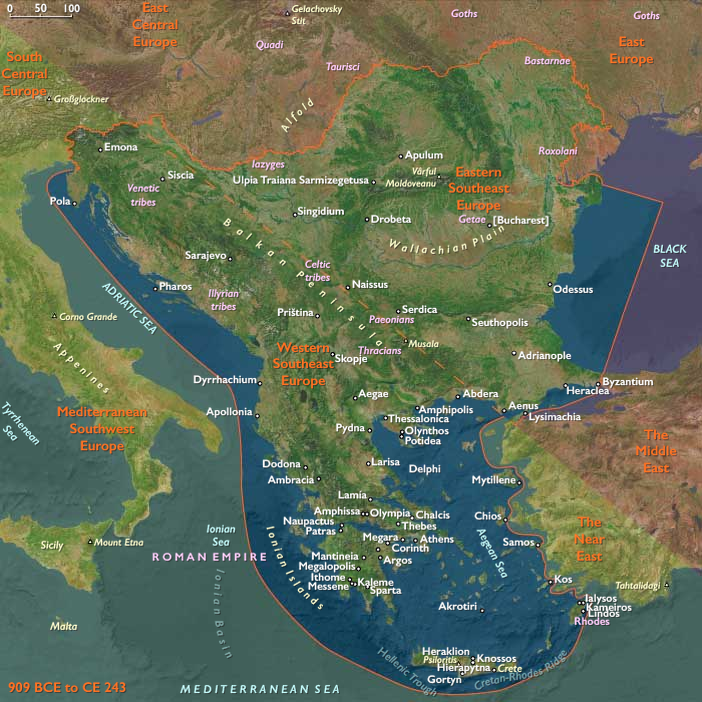
They meet at Nicomedia in Anatolia, and Pharnaces II defeats the Roman army and overruns Pontus.
Cassius had in 48 BCE sailed his ships to Sicily, where he had attacked and burned a large part of Caesar's navy.
He then proceeded to harass ships off the Italian coast.
News of Pompey's defeat at the Battle of Pharsalus had caused Cassius to head for Hellespont, with hopes of allying with the king of Pontus, Pharnaces II.
Caesar, having established Cleopatra as ruler of Egypt, meanwhile marches his army north through Syria into Asia Minor.
Cassius is overtaken by Caesar en route, and is forced to surrender unconditionally.
Caesar makes Cassius a legate, employing him in the war against the very same Pharnaces whom Cassius had hoped to join after Pompey's defeat at Pharsalus. (However, Cassius will refuse to join in the fight against Cato and Scipio in Africa, choosing instead to retire to Rome.)
Caesar’s superior troops, meeting Pharnace II and his army at the Battle of Zela in Pontus in May, 47, easily defeat those of Pharnaces.
Caesar promptly sends a message back to Rome: “Vini, vidi, vici” (“I came, I saw, I conquered”).
Pharnaces, escaping the rout with just a small detachment of cavalry, flees quickly back to the Bosporan kingdom.
Caesar demolishes the mountain strongholds of the Pontic territory and divides the region among minor kings.