Petronilla of Aquitaine
2nd daughter of William X of Aquitaine and Aenor of Châtellerault
Years: 1125 - 1193
Petronilla of Aquitaine (c. 1125 – 1193) is the second daughter of William X of Aquitaine and Aenor of Châtellerault.
She is the elder sister of William Aigret and the younger sister of Eleanor of Aquitaine, who is Queen consort of France, later England.
She is variously called Alix (or Aelith in Occitan) and Petronilla; she typically goes by Alix after her marriage, while Petronilla seems to have been her childhood name (she is referred to as such in her father's will).
Related Events
Filter results
Showing 4 events out of 4 total
The Ralph of Vermandois Marital Scandal and the War with Champagne (1142–1143 CE)
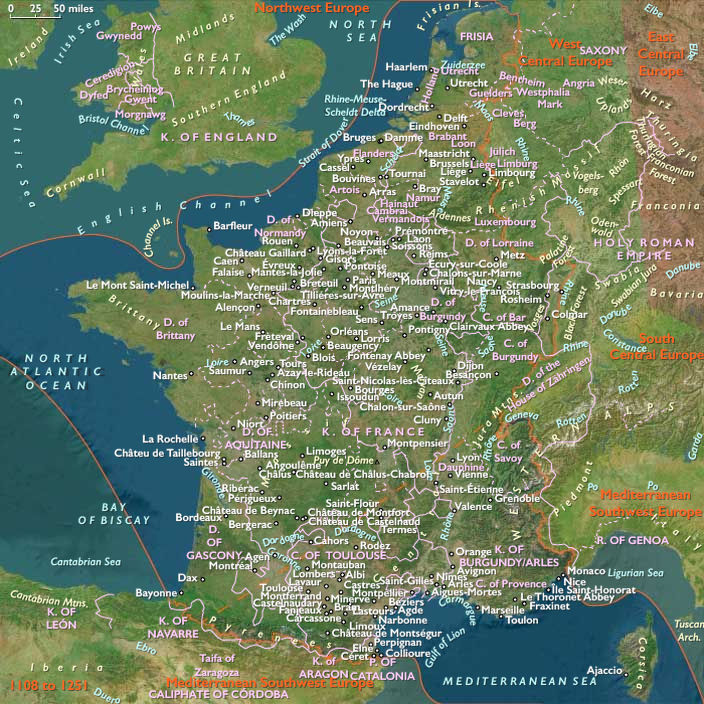
In 1142, under pressure from Queen Eleanor of Aquitaine, King Louis VII of France allowed his powerful cousin Ralph I of Vermandois to repudiate his first wife, Eleanor of Blois, in favor of Petronilla of Aquitaine, Eleanor of Aquitaine’s younger sister. This politically motivated annulment triggered a diplomatic and military crisis in France, culminating in a war with Theobald II of Champagne and an excommunication from the papacy.
The Political and Familial Tensions Behind the Annulment
- Ralph of Vermandois was a high-ranking noble and seneschal of France, making his marriage alliances crucial to Capetian politics.
- His first wife, Eleanor of Blois, was the daughter of Stephen, Count of Blois, and Adela of Normandy, making her the sister of King Stephen of England.
- Eleanor of Aquitaine and her sister Petronilla sought greater power at court, and Eleanor persuaded Louis VII to arrange for Ralph to marry Petronilla.
- This required annulling Ralph’s first marriage, which was facilitated by three bishops, but their ruling was quickly overruled by Pope Innocent II.
The War with Theobald II of Champagne
- Theobald II of Champagne, Eleanor of Blois’ brother, vehemently opposed the repudiation of his sister and sought papal support to challenge it.
- Innocent II excommunicated Ralph and Petronilla, declaring their marriage illegitimate, further escalating tensions.
- In retaliation, Louis VII launched a military campaign against Theobald, attacking Champagne and its allies.
- The war led to the infamous burning of Vitry, where over 1,000 people seeking refuge in a church were burned alive, a deeply regrettable act for Louis that would later push him toward a penitential Crusade.
Resolution: Papal Intervention and the Legitimization of Ralph’s Marriage (1143 CE)
- The war and excommunication persisted until the death of Pope Innocent II in 1143.
- His successor, Pope Celestine II, took a more conciliatory approach, lifting the excommunication and sanctifying Ralph and Petronilla’s marriage.
- The conflict weakened Louis VII’s relations with the Church and the Champagne nobility, setting the stage for future tensions within the Capetian realm.
Impact of the Scandal
- Eleanor of Aquitaine’s influence over Louis VII became even more pronounced, increasing her role in shaping Capetian policies.
- The war with Champagne demonstrated Louis VII’s willingness to challenge noble autonomy, but it also alienated many powerful vassals.
- The burning of Vitry weighed heavily on Louis VII’s conscience, contributing to his later decision to lead the ill-fated Second Crusade (1147–1149).
The Ralph of Vermandois marriage scandal was more than a personal affair—it was a political crisis that entangled the French monarchy in war, excommunication, and lasting noble unrest.
The War with Champagne and the Burning of Vitry-le-François (1142–1144 CE)
The conflict between King Louis VII of France and Theobald II of Champagne was further complicated by the ongoing dispute over the Archbishopric of Bourges. Theobald had aligned himself with Pope Innocent II, deepening the rift between the Capetian monarchy and the papacy.
The war escalated dramatically, culminating in the royal army’s occupation of Champagne and one of the most notorious atrocities of Louis VII’s reign—the burning of Vitry-le-François, in which over a thousand civilians perished in the flames.
The Siege and Burning of Vitry-le-François (1143 CE)
- The royal army invaded Champagne, with Louis VII personally leading the assault.
- At Vitry-le-François, the town was besieged and set ablaze.
- More than 1,000 people, who had sought refuge in the church, were burned alive in one of the most shocking acts of the war.
- The horror of the massacre left Louis VII deeply shaken, leading to a spiritual and political crisis.
Louis VII’s Retreat and Reconciliation with the Papacy (1144 CE)
- Overcome with guilt for the massacre at Vitry, and humiliated by the Church’s condemnation, Louis VII admitted defeat in the war against Champagne.
- He withdrew his armies and returned Champagne’s lands to Theobald II, effectively ending the hostilities.
- To restore relations with the Papacy, Louis finally accepted Pierre de la Châtre as Archbishop of Bourges, bringing an end to their longstanding investiture dispute.
- As a further act of penance, Louis shunned Raoul of Vermandois and Petronilla of Aquitaine, whose marriage had originally sparked the war.
Consequences and Lasting Impact
- The burning of Vitry profoundly affected Louis VII, strengthening his desire for atonement, which later influenced his decision to lead the ill-fated Second Crusade (1147–1149).
- His defeat in Champagne and reconciliation with the Papacy marked a humbling moment for the young king, reinforcing the limits of Capetian power over rebellious nobles.
- The alienation of Eleanor of Aquitaine, due to his repudiation of Petronilla, further strained their already troubled marriage, ultimately setting the stage for their later divorce (1152).
Though Louis VII retained the French throne, the war with Champagne had exposed his military recklessness, his fraught relationship with the Papacy, and the growing influence of Eleanor in Capetian politics—all factors that would shape the rest of his reign.
The Early Reign of Louis VII: Conflict, War, and the Burning of Vitry (1137–1144 CE)
Upon his accession to the French throne in 1137, Louis VII inherited a strong and stable kingdom, though his reign was quickly marked by conflict with the Papacy, territorial disputes, and internal unrest. His marriage to Eleanor of Aquitaine, one of the wealthiest and most powerful heiresses in Europe, expanded the Capetian domains, but it also brought political complications that would shape his reign.
Marriage to Eleanor of Aquitaine and Early Challenges
- On July 22, 1137, shortly before becoming king, Louis VII married Eleanor of Aquitaine, the heiress of William X of Aquitaine.
- This marriage vastly increased Capetian territorial holdings, theoretically placing the Duchy of Aquitaine under the French crown.
- However, Eleanor’s strong-willed personality and courtly culture clashed with Louis’ pious, reserved nature, leading to early tensions in their union.
In his early years as king, Louis faced local uprisings in:
- Orléans and Poitiers, where burgesses sought to organize communes, challenging royal authority.
- These revolts were quickly suppressed, reinforcing Louis’ determination to protect his royal prerogatives.
Conflict with Pope Innocent II Over Bourges (1141–1144)
- In 1141, the archbishopric of Bourges became vacant, and Louis VII supported his chancellor, Cadurc, as the new archbishop.
- Pope Innocent II rejected this appointment, instead naming Pierre de la Châtre as the rightful archbishop.
- Enraged, Louis VII swore upon relics that Pierre would never enter Bourges as long as he lived.
- In response, Innocent II placed an interdict on the king’s lands, undermining Louis’ authority and deepening the conflict.
War with Theobald II of Champagne (1142–1144)
While still at odds with the papacy, Louis became embroiled in a major war with Champagne over a marriage scandal involving his queen’s family:
- Ralph I of Vermandois, the seneschal of France, sought to divorce his wife, Eleanor of Blois (the niece of Theobald II of Champagne).
- He wished to marry Petronilla of Aquitaine, the sister of Queen Eleanor.
- The Pope opposed the divorce, but Louis VII sanctioned the marriage, further alienating him from the papacy and Theobald of Champagne.
- Champagne sided with the Pope, deepening the conflict.
The War and the Burning of Vitry (1144)
- Louis invaded Champagne and led a two-year war (1142–1144) against Theobald.
- His forces captured key territories, culminating in the royal occupation of Champagne.
- However, in 1144, at the siege of Vitry-le-François, the royal army burned the town.
- Over 1,000 people, who had sought refuge in the church, perished in the flames.
Guilt and Reconciliation with the Church (1144)
- The burning of Vitry left Louis VII overcome with guilt.
- Facing papal condemnation and pressure, Louis admitted defeat:
- He withdrew his armies from Champagne and returned its lands to Theobald.
- He accepted Pierre de la Châtre as archbishop, ending his dispute with the papacy.
- He shunned Ralph of Vermandois and Petronilla, severing ties with their controversial marriage.
Louis’ humiliation by the Church and his desire for penance led him to seek spiritual redemption, a sentiment that greatly influenced his later decision to lead the Second Crusade (1147–1149).
Consequences of the Champagne War
- Strengthened the Papacy’s Influence – The Pope’s victory in the dispute weakened Capetian authority in Church appointments.
- Increased Eleanor’s Frustration – Eleanor resented Louis’ submissive attitude, further straining their marriage.
- Paved the Way for the Second Crusade – Louis’ guilt over Vitry contributed to his decision to embark on a Crusade, a move that would shape the rest of his reign.
The war with Champagne exposed Louis VII’s weaknesses as a ruler, leading to greater Church influence over royal affairs, tensions in his marriage to Eleanor, and a growing sense of Capetian fragility in the face of noble resistance.

Thierry, Count of Flanders: His Final Years and the Expansion of Flemish Power (1156–1168 CE)
Thierry, Count of Flanders (r. 1128–1168), spent his final years expanding Flemish influence both militarily and diplomatically while continuing his commitment to the Crusades. His rule was marked by territorial expansion, economic growth, and the strengthening of Flemish governance, laying the foundation for Flanders’ later prominence in northern Europe.
Marriage Alliances and Territorial Gains
- In 1156, Thierry arranged the marriage of his eldest son, Philip of Alsace, to Elizabeth (Isabelle) of Vermandois, the daughter and heiress of Raoul I of Vermandois.
- This strategic union strengthened Flemish ties to central France and set the stage for future territorial gains in Vermandois.
- That same year, Thierry and his wife, Sibylla of Anjou, left for the Holy Land, leaving Philip to govern Flanders in their absence.
Crusading Efforts and Conflicts in the Levant (1156–1159, 1164–1166)
Thierry participated in two major Crusader campaigns:
-
The Siege of Shaizar (1157–1158)
- Thierry joined King Baldwin III of Jerusalem in the siege of Shaizar, an important fortress in Syria.
- A dispute over possession of the stronghold arose between Thierry and Raynald of Châtillon, which ultimately led to the siege failing, and the fortress remained in Muslim hands.
-
The Campaigns of Amalric I (1164–1166)
- Thierry returned to the Holy Land in 1164, accompanying King Amalric I of Jerusalem (his wife's half-brother) on expeditions to Antioch and Tripoli.
- These campaigns were part of Amalric’s broader effort to expand Christian control in the Levant, though Thierry played a secondary role.
- Upon returning to Flanders in 1166, he adopted a date palm as his seal, symbolizing his devotion to the Crusader cause.
Philip of Alsace’s Leadership and Flemish Expansion (1156–1168)
- While Thierry was absent, Philip ruled Flanders as co-count, proving himself an effective leader and military strategist.
- He defeated Floris III, Count of Holland, ending piracy along the Flemish coast.
- Floris was captured in Bruges and remained imprisoned until 1167, when he was forced to recognize Flemish suzerainty over Zeeland as part of his ransom.
- In 1159, Philip married Elizabeth of Vermandois, securing the Vermandois inheritance.
- When Elizabeth’s brother died in 1167, Vermandois passed to Philip, pushing Flemish influence further south than ever before, disrupting the balance of power in northern France.
- Additionally, Philip recovered Waasland and Quatre-Métiers, further expanding Flemish authority.
Thierry’s Final Years and Legacy
- Thierry returned to Flanders in 1166, continuing his moderate and peaceful rule.
- His reign saw the beginning of a highly developed administration, setting the stage for Flanders’ economic and political growth in later centuries.
- Commercial expansion and agricultural development flourished, making Flanders a leading economic hubin medieval Europe.
- He died on January 17, 1168, and was buried in the Abbey of Watten, between Saint-Omer and Gravelines.
- His son, Philip of Alsace, succeeded him as sole ruler, inheriting a strong and expanding Flemish state.
Through marriage diplomacy, military campaigns, and economic reforms, Thierry secured Flanders’ position as a dominant power in northern Europe, with Philip poised to take it to even greater heights