Peter I of Aragon and Navarre
King of Aragon and Navarre
Years: 1068 - 1104
Peter I (1068/9 – 27x29 September 1104) is the King of Aragon and Navarre for a decade from 1094 until his death.
He is the son and successor of Sancho V Ramírez by his first wife, Isabella of Urgell.
He is named in honor of Saint Peter, because of his father's special devotion to the Holy See, to which he had made his kingdom a vassal.
Peter continues his father's close alliance with the Church and pursues the Reconquista with even greater success, allying with Rodrigo Díaz de Vivar, known as El Cid, the ruler of Valencia, against the Almoravids.
According to the medieval Annales Compostellani, Peter is in bellis expertus et audax in principio ("expert in war and daring in initiative").
Related Events
Filter results
Showing 10 events out of 24 total
Atlantic Southwest Europe (1084–1095 CE): Alfonso VI’s Ambitions, Portuguese Resurgence, and Regional Realignments
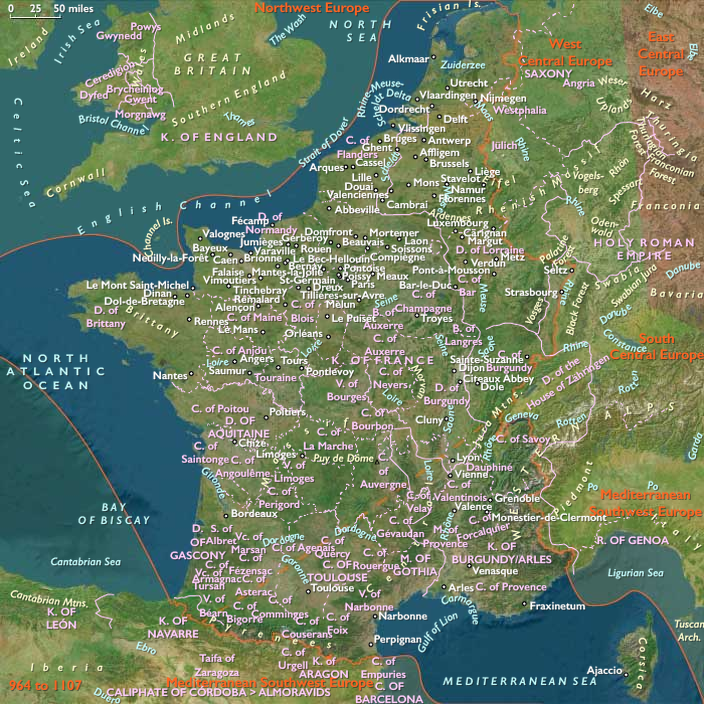
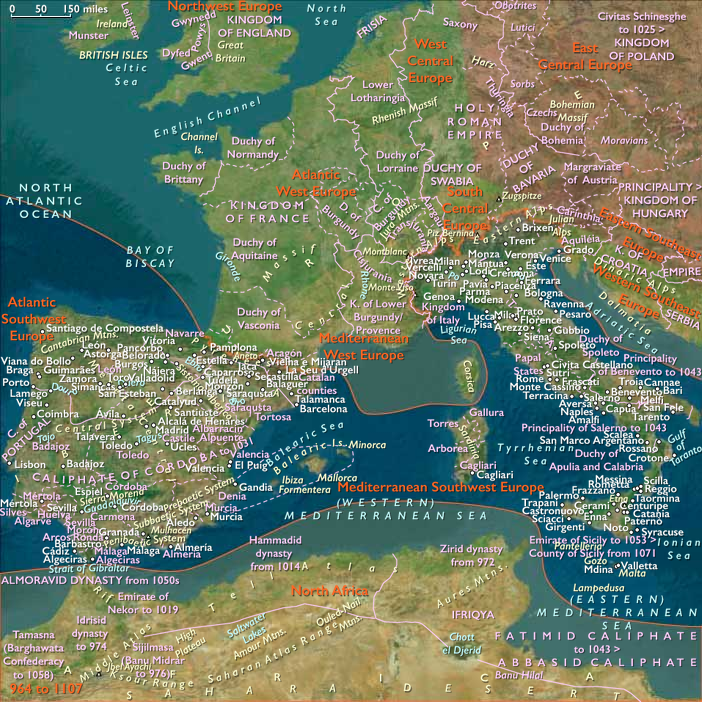
Between 1084 and 1095 CE, Atlantic Southwest Europe—including Galicia, northern and central Portugal, Asturias, Cantabria, and northern Spain south of the Franco-Spanish border (43.05548° N, 1.22924° W)—entered a pivotal era marked by ambitious territorial expansion, intensified cultural developments, and evolving political dynamics. Under King Alfonso VI of León-Castile (1072–1109 CE), the region experienced decisive southward expansion, notably marked by the historic conquest of Toledo in 1085 CE, fundamentally reshaping Iberian geopolitics. In the County of Portugal, regional autonomy was revitalized and significantly strengthened under Count Raymond of Burgundy (1093–1107 CE), who had married Alfonso’s daughter, Urraca of León. Simultaneously, the Navarre-Aragón union under Sancho Ramírez (1076–1094 CE) and his successor, Peter I (1094–1104 CE), navigated diplomatic complexity, maintaining regional stability despite external pressures.
Political and Military Developments
Alfonso VI’s Expansion and the Conquest of Toledo (1085 CE)
Under Alfonso VI, León-Castile decisively expanded southward, culminating in the landmark capture of Toledo in 1085, a pivotal turning point symbolizing Christian resurgence and significantly altering regional power balances. This conquest positioned Alfonso VI as Iberia’s foremost Christian ruler, increasing his kingdom’s geopolitical prominence and redefining frontier boundaries.
Arrival and Governance of Raymond of Burgundy in Portugal (1093 CE)
In 1093, Raymond of Burgundy, a Burgundian nobleman, assumed governance of the County of Portugal after marrying Alfonso VI’s daughter, Urraca of León. Raymond’s arrival revitalized Portuguese autonomy, territorial stability, and administrative efficiency, significantly strengthening regional identity, governance cohesion, and laying essential foundations for Portugal’s eventual sovereignty.
Navarre-Aragón’s Diplomatic Stability
Navarre, integrated into Aragón under Sancho Ramírez and subsequently Peter I, navigated diplomatic complexities amid Castilian expansion. Though diminished as an independent power, Navarre maintained territorial integrity and regional autonomy through cautious diplomacy, strategic alliances, and careful neutrality amid broader political shifts.
Economic Developments
Robust Economic Growth
Economic prosperity significantly accelerated, driven by productive agriculture (grain, vineyards, olives), livestock farming, artisanal manufacturing, and vibrant mining activities (notably precious metals from Galicia and Asturias). The conquest of Toledo and subsequent frontier stabilization notably enhanced economic security, stimulating regional commerce and territorial repopulation efforts.
Expanded Maritime and Pilgrimage Commerce
Coastal cities, notably Bracara Augusta (Braga) and smaller northern Portuguese ports, intensified maritime commerce, effectively linking the region to Atlantic and Mediterranean markets. Pilgrimage routes to Santiago de Compostela further amplified economic activity, ensuring sustained regional economic prosperity.
Cultural and Religious Developments
Flourishing of Santiago de Compostela
Pilgrimage to Santiago de Compostela continued to thrive, significantly strengthening Galicia’s cultural, religious, and economic prominence. Pilgrim influx fostered cultural exchanges, increased ecclesiastical wealth, and further solidified Santiago’s international spiritual reputation, decisively shaping regional identity.
Ecclesiastical Authority and Community Stability
Influential bishoprics—especially Braga, Lugo, Asturica Augusta, and Santiago de Compostela—maintained strong local governance, moral leadership, and educational prominence, significantly reinforcing regional cohesion, stability, and cultural continuity amid political expansion.
Monastic Cultural Vitality
Monastic communities actively supported scholarly traditions, manuscript production, education, agricultural innovations, and intellectual pursuits, significantly maintaining regional cultural vibrancy, historical heritage, and intellectual resilience during territorial expansion.
Enduring Cultural Syncretism
Integration of orthodox Christianity with local Celtic and Iberian traditions remained robust, particularly in rural Galicia, Asturias, and northern Portugal, reinforcing distinct regional identities and sustaining cultural resilience.
Civic Identity and Governance
Strengthened León-Castile Royal Authority
Under Alfonso VI, the kingdom’s expansion and territorial consolidation significantly enhanced royal authority balanced by localized aristocratic governance. Frontier repopulation and territorial acquisitions, particularly Toledo, decisively shaped civic identities, governance cohesion, and regional stability.
Revitalized Portuguese Autonomy
Raymond of Burgundy’s governance decisively strengthened Portuguese autonomy, territorial cohesion, and administrative stability. His capable leadership notably fostered regional civic identity, local governance efficiency, and territorial security, laying critical foundations for Portugal’s subsequent national emergence.
Stable Navarre-Aragón Governance
Under Sancho Ramírez and Peter I, Navarre-Aragón maintained stable governance structures, regional identity, and territorial integrity, navigating diplomatic complexities through cautious political strategy and effective local autonomy.
Notable Tribal Groups and Settlements
-
Astures and Cantabri: Provided critical frontier security, governance stability, and regional cohesion, significantly supporting Alfonso VI’s territorial expansions and internal stability.
-
Galicians and Lusitanians: Actively contributed to economic prosperity, cultural vitality, and localized governance, reinforcing Santiago’s international prominence and Portuguese territorial integrity.
-
Basques (Navarre): Sustained resilient regional identity, stable political governance, and cautious diplomacy under Aragónese integration, preserving regional cohesion amid broader Iberian political shifts.
Long-Term Significance and Legacy
Between 1084 and 1095 CE, Atlantic Southwest Europe:
-
Witnessed decisive southward territorial expansion under Alfonso VI, particularly marked by the transformative conquest of Toledo, fundamentally reshaping Iberian geopolitical dynamics.
-
Experienced significant strengthening of Portuguese regional autonomy and administrative stability under Raymond of Burgundy, decisively laying foundations for Portugal’s national emergence.
-
Maintained stable Navarre-Aragón governance amid diplomatic complexities, preserving regional cohesion and autonomy.
-
Sustained robust economic growth, pilgrimage traditions, cultural flourishing, ecclesiastical authority, and vibrant local governance, decisively shaping the medieval trajectory and historical legacy of the region.
This transformative era decisively shaped regional identities, territorial cohesion, economic prosperity, and cultural vitality, profoundly influencing Atlantic Southwest Europe's historical trajectory and enduring medieval legacy.
The Reign and Marriages of William VIII, Duke of Aquitaine (r. 1058–1086)
William VIII, Duke of Aquitaine (r. 1058–1086), was a key figure in 11th-century France, known for his marriages, diplomatic alliances with Iberian kingdoms, and struggles to secure the legitimacy of his heirs. His reign focused on maintaining and expanding Aquitaine’s influence, particularly through marital diplomacy with the kingdoms of Spain.
Marital History and Legitimacy Struggles
- William VIII married three times and had at least five children, but securing legitimate heirs was a challenge.
- His second marriage to Matoeda ended in divorce in May 1068, likely due to infertility.
- His third wife, Hildegarde of Burgundy (daughter of Robert I, Duke of Burgundy), was his cousin.
- The marriage produced a son, but due to canonical restrictions on consanguinity, William VIII had to travel to Rome in the early 1070s to persuade the pope to recognize his children from this union as legitimate.
Political Alliances Through Marriage with Iberian Kingdoms
- William VIII prioritized diplomacy with Iberian rulers, forming alliances through the marriages of his daughters:
- Agnes (d. 1078), daughter by his second wife Matoeda, was married to Alfonso VI of Castile, strengthening ties with the leading Christian power in Spain.
- Agnes (d. 1097), daughter by his third wife Hildegarde, was married to Peter I of Aragon, reinforcing Aquitaine’s influence in the Pyrenees region.
Death and Succession (1086)
- William VIII died on September 25, 1086, at Chizé, a stronghold in western Aquitaine.
- His son by Hildegarde of Burgundy, William IX, succeeded him as Duke of Aquitaine.
Legacy
- William VIII’s reign strengthened Aquitaine’s political influence through marriage diplomacy and alliances with Iberian rulers.
- His efforts to secure the legitimacy of his heirs ensured that his lineage continued through William IX, who would become one of the most famous dukes of Aquitaine.
- The duchy remained a powerful and independent force in medieval France, setting the stage for future conflicts and alliances with both Capetian France and the Plantagenets.
William VIII’s diplomatic marriages and struggles for legitimacy shaped the course of Aquitanian and Iberian politics, demonstrating the importance of dynastic alliances in medieval Europe.
Atlantic Southwest Europe (1096–1107 CE): Consolidation of Portuguese Autonomy, Alfonso VI’s Late Reign, and Regional Stabilization
Between 1096 and 1107 CE, Atlantic Southwest Europe—including Galicia, northern and central Portugal, Asturias, Cantabria, and northern Spain south of the Franco-Spanish border (43.05548° N, 1.22924° W)—experienced significant political stabilization, territorial consolidation, and sustained economic prosperity. In the Kingdom of León-Castile, the latter reign of Alfonso VI (1072–1109 CE) focused on reinforcing administrative structures and securing territorial gains, especially in the critical frontier areas. In Portugal, Raymond of Burgundy (1093–1107 CE) decisively strengthened regional autonomy, significantly revitalizing local governance and laying enduring foundations for future sovereignty. Concurrently, the Navarre-Aragón union, governed by Peter I (1094–1104 CE) and later by Alfonso I "the Battler" (1104–1134 CE), maintained regional stability amid broader Iberian complexities, preserving internal cohesion and identity.
Political and Military Developments
Alfonso VI’s Territorial Consolidation and Late Reign Stability
In his later years, Alfonso VI concentrated on consolidating extensive territorial acquisitions, notably maintaining the strategic city of Toledo. He reinforced administrative efficiency, frontier security, and territorial repopulation along the Duero and Tagus rivers. Although his ambitious southern advances slowed, Alfonso’s rule continued providing essential political stability, profoundly shaping regional governance and territorial integrity.
Strengthening of Portuguese Autonomy under Raymond of Burgundy
Count Raymond of Burgundy significantly consolidated Portuguese autonomy during his tenure, effectively fortifying frontier defenses, administrative structures, and local governance. His capable administration notably stabilized Portuguese regional identity, territory, and civic governance, laying essential groundwork for future Portuguese independence. Raymond’s death in 1107 marked a transitional moment but left a robust foundation for the county’s future.
Navarre-Aragón Stability under Peter I and Alfonso I
Navarre-Aragón maintained stability under Peter I’s leadership, carefully navigating diplomatic complexities amid Castilian expansion and interactions with Islamic taifa kingdoms. Upon Peter’s death in 1104, his brother, Alfonso I ("the Battler"), succeeded him, ushering in a more assertive era. However, the region’s internal stability and governance cohesion remained intact, significantly influencing northern Iberian politics.
Economic Developments
Sustained Economic Prosperity
Regional economies continued flourishing, supported by stable agriculture (grain, vineyards, olives), livestock husbandry, artisanal crafts, and mining activities, especially precious metals from Galicia and Asturias. Stable political conditions reinforced economic growth, frontier repopulation, and territorial integration efforts.
Continued Expansion of Maritime and Pilgrimage Commerce
Coastal settlements, particularly Bracara Augusta (Braga) and smaller northern Portuguese ports, expanded vibrant maritime trade networks, significantly enhancing regional connections with Atlantic and Mediterranean markets. The pilgrimage routes to Santiago de Compostela further supported robust commercial activities, strengthening economic resilience and regional prosperity.
Cultural and Religious Developments
Santiago de Compostela’s Continued Prominence
Pilgrimage activity to Santiago de Compostela remained robust, consolidating its role as a leading European spiritual and cultural center. The city’s ecclesiastical authority, economic prosperity, and cultural exchanges were strengthened significantly by ongoing pilgrimage influx, profoundly shaping regional identity and cultural prominence.
Ecclesiastical Authority and Community Stability
Influential bishoprics—including Braga, Lugo, Asturica Augusta, and Santiago de Compostela—provided strong local governance, moral authority, and educational leadership. Their ongoing influence significantly reinforced community stability, regional cohesion, and cultural continuity.
Monastic Intellectual Vitality
Monastic communities actively maintained scholarly traditions, manuscript preservation, agricultural innovation, and intellectual pursuits. Their sustained cultural and educational roles significantly preserved regional historical heritage and cultural resilience.
Enduring Cultural Syncretism
Integration of orthodox Christianity with indigenous Celtic and Iberian traditions remained strong, particularly in rural Galicia, Asturias, and northern Portugal. This cultural fusion significantly reinforced regional identity, cultural distinctiveness, and social resilience during political stabilization.
Civic Identity and Governance
Solidified León-Castile Governance Structures
Under Alfonso VI’s later rule, governance structures became increasingly stable, supported by effective local aristocratic and ecclesiastical cooperation. Territorial consolidation and repopulation notably strengthened regional civic identities, reinforcing political cohesion and territorial integrity.
Portuguese Regional Identity and Stability
Raymond of Burgundy’s effective administration decisively consolidated Portuguese autonomy, territorial cohesion, and administrative structures, significantly shaping civic identity and governance stability. His capable governance laid critical groundwork for Portugal’s future national sovereignty and regional cohesion.
Stable Governance in Navarre-Aragón
The Navarre-Aragón union maintained territorial integrity, stable local governance, and resilient civic identity under Peter I and subsequently Alfonso I "the Battler." This political stability preserved regional autonomy and diplomatic maneuverability amid broader Iberian political dynamics.
Notable Tribal Groups and Settlements
-
Astures and Cantabri: Continued providing critical frontier security, governance stability, and regional cohesion, significantly supporting León-Castile’s territorial consolidation and political stability.
-
Galicians and Lusitanians: Played pivotal roles in maintaining economic prosperity, cultural vitality, and localized governance stability, notably reinforcing Santiago’s prominence and Portuguese territorial autonomy.
-
Basques (Navarre): Maintained resilient regional identity and internal cohesion amid Navarre-Aragón political integration, significantly shaping regional governance structures and cultural continuity.
Long-Term Significance and Legacy
Between 1096 and 1107 CE, Atlantic Southwest Europe:
-
Experienced significant political consolidation and territorial stabilization under Alfonso VI’s late reign, decisively reshaping Iberian political structures and territorial cohesion.
-
Achieved decisive strengthening of Portuguese regional autonomy and governance under Raymond of Burgundy, laying essential foundations for future Portuguese national sovereignty.
-
Preserved stable governance and regional autonomy within Navarre-Aragón, navigating diplomatic complexities and preserving internal cohesion.
-
Continued economic prosperity, pilgrimage traditions, ecclesiastical authority, and cultural resilience, significantly shaping the medieval trajectory and enduring legacy of the region.
This decisive era consolidated regional political stability, strengthened civic identities, and reinforced economic resilience, profoundly influencing Atlantic Southwest Europe’s historical trajectory and lasting medieval legacy.
The city of Osca, present Huesca, had come to be called Washqah after the Arab conquest in the late eighth century, falling within the Tagr al-A'la, the Upper March of the Emirate of Córdoba.
It was ruled by a local governor appointed from Córdoba, but was repeatedly subject to political turmoil, rebellion and assassination as the Banu Qasi, Banu Amrus and Banu al-Tawil clans, as well as the Arista dynasty of Pamplona, struggled for control, autonomy or independence from the Emirate, later Caliphate.
In the mid-tenth century, Wasqah had been given to the Banu Tujibi, who governed the Upper March from Zaragoza, and it became part of their Taifa of Zaragoza when in 1018 they successfully freed themselves from the disintegrating Caliphate.
Sancho Ramirez had built the nearby Montearagón castle in 1094 with the intention of laying siege to Wasqah but had been killed by a stray arrow as he was reconnoitering the city's walls.
Peter had succeeded to the whole of his father's kingdom only on the latter's death while besieging Huesca in 1094.
Peter had raised the siege, only to return to it within the year.
After 1094, his objectives had shifted westwards, towards the valley of the Gallega.
In 1095, Peter had renewed his father's oaths to Urban II, and Urban renewed his promise of protection, under which Sancho, his sons, and his kingdom had been placed in July 1089.
On March 16, 1095 the pope had even issued a bull, Cum universis sancte, granting the king and queen of Aragon immunity from excommunication without the permission of the pope.
This same year, while he is besieging Huesca, Peter defeats the relief forces of the Taifa of Zaragoza at the Battle of Alcoraz.
Peter later rewards a certain Sancho Crispo for his contribution of three hundred knights and infantry at Alcoraz.
He goes on to take Huesca on November 27 of this same year.
Peter travels south in 1097 to inspect his fortress at Castellón, though the Historia Roderici claims that he came to help Rodrigo Díaz de Vivar, called El Cid.
He meets Rodrigo in Valencia and with a large force already assembled they decide to reinforce the southern frontier fort of Benicadell, rebuilt by Rodrigo in 1091.
As they are passing by Játiva they are met by an Almoravid force under the command of Mohammed, the nephew of Almoravid leader Yusuf ibn Tashfin, and the commander whom Rodrigo had defeated at the Battle of Cuarte in 1095.
They decide to hastily restock Benicadell and retreat to Valencia via the coast, but are met at the Battle of Bairén by Muhammad's forces encamped on the high ground that reached almost to the sea.
A small Almoravid fleet had been assembled from the southern ports, including Almería, and the Christians are trapped between arrow fire from the ships and the cavalry perched atop the hill.
Rodrigo rouses the troops with a speech and the next day at midday the Christians charge.
The Battle of Játiva ends in a rout, with many Almoravids killed or forced into the river or the sea, where many drown.
Peter and Rodrigo return to Valencia in triumph and thanking God for the victory, as the Historia records.
The Cid had been married in July 1074 to kinswoman Jimena de Gormaz (spelled Ximena in Old Castilian), the daughter of the Count of Oviedo and a kinswoman of Alfonso VI.
This was probably on Alfonso's suggestion; a move that he probably hoped would improve relations between him and El Cid.
Together El Cid and Ximena have had three children.
Their daughters, Cristina and María, have both married high nobility; Cristina, to Ramiro, lord of Monzón and bastard descendant of kings of Navarre; María, first to Infante of Aragon and second to Ramón Berenguer III, count of Barcelona.
El Cid's son, Diego Rodríguez, is killed while fighting against the invading Almoravids at the Battle of Consuegra in 1097.
Peter's first marriage, to Agnes of Aquitaine (betrothed 1081), had been arranged by his father and performed in the capital of Jaca in January 1086.
His second marriage, to a certain Bertha, probably from Lombardy, is officiated in Huesca on August 1097.
This represents the transfer of the capital of Aragon from Jaca to the larger city of Huesca.
Rodrigo Díaz de Vivar, known as El Cid, had conquered the province of Valencia on June 17, 1094, then joined forces with Peter I of Aragon later that year in Burriana to cement an alliance with the end goal of doing battle with the Almoravids.
Under this agreement, El Cid departed in December of 1096 with the aid of Aragonese troops to bring weapons, ammunition and general supplies to the castle of Sierra de Benicadell.
The castle itself had been retaken by El Cid in October of 1091 to control access to Valencia from the south via the interior route.
Muhammad ibn Tasufin, commander of the Islamic forces, marched to intercept the combined Christian forces at Xàtiva.
Throughout January of 1097, from that position, he threatens and harasses the forces of El Cid and Peter I of Aragon, who manages nevertheless to reach the castle at Sierra de Benicadell and resupply it.
While El Cid and the king are marching north, they camp at Bairén, a place situated a few kilometers north of Gandía.
The Almoravids manage to take the nearby high ground at Mondúver (at eight hundred and foirty-one meters above sea level), from where they were able to harass the Christian camp.
In addition, General Muhammad has managed to bring a fleet of ships, both Almoravid and Andalusian, onto the nearby seashore from which archers and crossbowmen are able to catch the Christian forces in a crossfire.
The situation appears desperate, but El Cid harangues his troops one morning, ordering them to conduct a frontal charge and assault on the Almoravid forces, breaking their center.
By midday, the attack is in full swing.
The Almoravids, taken aback by the courage and desperate nature of the attack, break and flee the field in disarray.
The chaotic nature of the Muslim retreat leads many Almoravid soldiers to drown in the river that crosses their path of retreat or in the sea as they try to reach the safety of the Almoravid armada.
The Christian army is able to come away from the battle with a great deal of victory spoils after looting the Almoravid camp.
After the battle, they are able to continue, in safety, to the city of Valencia.
Peter, in preparation for the fall of Barbastro, had in 1099 sent Pons, then Bishop of Roda, to Rome to ask Pope Urban to transfer the see of Roda to Barbastro.
The pope had complied and endowed the transferred diocese with all the re-conquered lands of the Diocese of Lleida.
Peter's motive in this action was probably to curtail any expansion of the Diocese of Urgell in the direction of Lleida.
In any case, Barbastro falls in 1100.
Peter, according to what is probably a legend, had planned to join on the Crusade of 1101 and make a pilgrimage to Jerusalem at the urging of the monks of San Juan de la Peña, but Pope Paschal II had refused to allow it and ordered him to make war on Zaragoza instead.
Probably aided by knights from France and Catalonia, Peter certainly does make war on Zaragoza in 1101, in a campaign that lasts the whole year.
He may have been inspired by the First Crusaders, since contemporary accounts of the 1101 campaign call him a "cross-bearer" (crucifer).
The size of his forces so impresses a contemporary scribe in León that he remarks in the dating formula of a document of February 12 that "Peter, Aragonese king, with his infinite multitude of armed men, the city of Zaragoza, with Christ's banner, fought".
Peter has by June begun the siege of Zaragoza itself.
For the siege, he has a fortress built named Juslibol (a corruption of the Latin slogan Deus lo volt [”God wills it”] used by the First Crusaders) and rings the city with banners bearing the cross.
In August, he is conducting a razzia (raid) as far south as Alpenes and the river Ebro, but the campaign is eventually aborted due to insufficient cavalry.
By the end of the year he has expanded Aragon and Navarre in the west almost as far as the walls of Zaragoza and …