Pepin of Herstal
Frankish diplomat and military leader
Years: 635 - 714
Pepin (c. 635 – 16 December 714), commonly known as Pepin of Herstal, is a Frankish statesman and military leader who de facto rules Francia as the Mayor of the Palace from 680 until his death.
He takes the title, Duke and Prince of the Franks, upon his conquest of all the Frankish realms.
The son of the powerful Frankish statesman, Ansegisel, Pepin works to establish his family, the Pippinids, as the strongest in Francia.
He is able to realize his dreams by becoming Mayor of the Palace in Austrasia in 680.
Pepin subsequently embarks on several wars to expand his power.
He unites all the Frankish realms by the conquest of Neustria and Burgundy in 687.
In foreign conflicts, Pepin increases the power of the Franks by his subjugation of the Alemanni, the Frisians, and the Franconians.
He also begins the process of evangelization of Germany.
Pepin's statesmanship is notable for the further diminution of Merovingian royal authority, and for the acceptance of the undisputed right to rule for his family.
Therefore, Pepin is able to name as heir, his grandson, Theudoald; however, this is not accepted by his powerful bastard son, Charles Martel, leading to a civil war after his death in which the latter emerges victorious.

Related Events
Filter results
Showing 10 events out of 16 total
Atlantic West Europe (532–675): From Merovingian Ascendancy to Aristocratic Dominance and Monastic Influence
Between 532 and 675, Atlantic West Europe—spanning Neustria, Austrasia, Aquitaine, Burgundy, Brittany, and surrounding regions—experienced profound transformations. This era began with the height of Merovingian rule, characterized by territorial unification, and ended with the rise of powerful aristocratic factions, the growing influence of the Church, and the foundations of the future Carolingian dynasty.
Political and Military Developments
Merovingian Unification and Expansion (532–561)
-
Chlothar I (r. 511–561) reunified the Frankish kingdoms, extending Merovingian control over Neustria, Austrasia, Burgundy, and Aquitaine.
-
The conquest of Burgundy (532–534) was a critical step, integrating the Rhône-Saône region into Frankish domains and ensuring long-term Frankish influence there.
Fragmentation and Internal Rivalries (561–613)
-
Following Chlothar I’s death (561), Frankish unity fractured into multiple kingdoms (Neustria, Austrasia, Burgundy, Aquitaine), each ruled by Chlothar’s descendants.
-
Intense rivalry between Neustrian and Austrasian factions led to frequent warfare, weakening central authority but fostering strong regional identities.
-
Brunhilda of Austrasia (d. 613) emerged as a formidable political figure, leading to extensive power struggles with Neustria’s Queen Fredegund.
Reunification Under Chlothar II and Dagobert I (613–639)
-
Chlothar II (r. 613–629) reestablished Merovingian unity, stabilizing royal governance by issuing the Edict of Paris (614), enhancing aristocratic and episcopal power.
-
His son, Dagobert I (r. 629–639), strengthened Frankish control, notably in Aquitaine, Brittany, and along the Rhine, marking the height of Merovingian royal prestige.
Aristocratic Dominance and Royal Decline (639–675)
-
Dagobert’s successors faced rapid decline in royal authority, overshadowed by aristocratic factions led by mayors of the palace.
-
Ebroin, Neustrian mayor (658–673, 675–680), wielded enormous power, while in Austrasia, Pepin of Herstalrose (from 675), laying the groundwork for Carolingian ascendancy.
-
Brittany and Aquitaine drifted into semi-autonomy, ruled by regional dukes and princes, further weakening Merovingian control.
Economic and Social Developments
Agricultural Expansion and Landholding Patterns
-
Increased cultivation and land-clearance activities, particularly in the Loire and Seine valleys, boosted agricultural productivity.
-
Powerful aristocratic families dominated vast estates, forming the precursors of later feudal lordships.
Trade and Urban Networks
-
Trade continued along the Loire, Rhine, and Seine rivers, connecting inland markets with coastal trade hubs.
-
Brittany and Aquitaine fostered maritime trade connections with the British Isles and Iberia, enhancing regional economies.
Rise of Aristocratic Estates
-
The proliferation of large, self-sufficient villae (estates) reinforced the local power of aristocratic landowners.
-
These estates became significant economic and political centers, especially as royal authority waned.
Religious and Cultural Developments
Expansion of Christianity and Monasticism
-
Monastic movements, inspired initially by Columbanus and Irish missionaries, led to the founding of influential monasteries such as Luxeuil (c.590), Saint-Denis, Saint-Wandrille, and Corbie.
-
Monasteries played crucial roles as centers of education, manuscript production, and cultural preservation.
Church Influence and Synods
-
Church councils, such as Council of Orléans (511, 533) and Council of Paris (614), shaped ecclesiastical law and governance, significantly influencing secular affairs.
-
Bishops and abbots increasingly exerted political authority, reinforcing the Church's role as a stable institution amid political upheaval.
Art, Architecture, and Intellectual Life
-
Merovingian art flourished, blending Gallo-Roman and Germanic traditions, especially in metalwork and illuminated manuscripts.
-
Religious architecture, notably basilicas and monasteries, proliferated across the region, laying foundations for the later Carolingian cultural revival.
Long-term Consequences and Significance
By 675, Atlantic West Europe had transitioned significantly:
-
The Merovingian dynasty, having achieved territorial consolidation earlier in the age, had lost much of its political power to dominant aristocratic families.
-
The rise of influential mayors of the palace—particularly in Austrasia—set the stage for the Carolingian dynasty's emergence.
-
Monasticism profoundly reshaped religious, cultural, and intellectual landscapes, preserving classical heritage and facilitating cultural continuity through an era of political turbulence.
-
Economic and social foundations developed through agricultural expansion, trade networks, and powerful regional aristocracies laid essential groundwork for the subsequent Carolingian reforms and the later medieval transformation of Europe.
This transformative era from 532 to 675 thus marked the end of classical late antiquity in Atlantic West Europe, ushering in the structural and cultural developments that defined the early medieval landscape.
Atlantic West Europe (664–675): Aristocratic Dominance, Monastic Expansion, and the Rise of Austrasian Influence
Between 664 and 675, Atlantic West Europe—including Neustria, Austrasia, Burgundy, Aquitaine, and adjoining regions—continued to experience declining Merovingian royal authority, aristocratic ascendancy, increased monastic influence, and the beginnings of Austrasian dominance that would shape future political developments.
Political and Military Developments
Continued Decline of Royal Authority
-
Chlothar III (r. 657–673, Neustria and Burgundy) and Childeric II (r. 662–675, Austrasia; briefly unified all Frankish realms 673–675) held nominal royal power overshadowed by their mayors of the palace.
-
Central authority weakened further as aristocratic factions solidified power, leaving Merovingian kings largely symbolic rulers.
Rise and Fall of Ebroin in Neustria
-
Ebroin, the powerful Neustrian mayor of the palace (658–673, and again 675–680), imposed firm control, briefly stabilizing the region but sparking intense aristocratic resistance and rivalries.
-
Ebroin's authoritarian rule provoked revolts, culminating in his temporary imprisonment (673), demonstrating the volatility of aristocratic politics.
Austrasian Ascendancy Under Pepin of Herstal
-
Pepin of Herstal (Pepin II), gaining prominence in Austrasia, began consolidating power as mayor of the palace (from around 675), laying foundations for Carolingian ascendancy.
-
Pepin’s power represented a critical shift, positioning Austrasia as the dominant political force within the Frankish realms.
Increasing Regional Autonomy in Aquitaine and Brittany
-
Aquitaine’s dukes consolidated semi-independent authority, distancing themselves further from Merovingian control.
-
Brittany maintained its independence, navigating between Frankish and regional influences.
Economic and Social Developments
Aristocratic Estates and Feudal Beginnings
-
Aristocratic families strengthened their control over land, solidifying early feudal structures marked by powerful landholding elites.
-
Large estates increasingly became self-contained economic units, managed independently of royal oversight.
Trade and Regional Economies
-
Internal trade networks continued, though primarily localized due to weakened central governance.
-
Coastal trade flourished in Brittany and Aquitaine, linking these regions economically with British Isles and the Iberian Peninsula.
Religious and Cultural Developments
Expansion of Monasticism and Irish Influence
-
Monastic foundations grew extensively, notably Luxeuil Abbey and Corbie Abbey, becoming cultural and economic centers.
-
Irish missionaries, following Columbanus's tradition, continued founding monasteries across Neustria and Austrasia, fostering cultural exchange and ecclesiastical reform.
Intellectual and Artistic Continuity
-
Monastic scriptoria produced illuminated manuscripts, such as early copies of religious texts, preserving classical and early medieval scholarship.
-
Bishops and abbots increasingly assumed leadership roles, both spiritually and politically, reinforcing ecclesiastical influence over society.
Church Synods and Reform Movements
-
Continued ecclesiastical councils and synods, notably the Council of Autun (670), reaffirmed Church discipline and sought to impose uniform religious practices.
-
The Church emerged as a stabilizing force amid political instability and royal weakness.
Legacy and Significance
The period 664–675 further entrenched aristocratic power, witnessed the rise of Austrasian dominance under Pepin of Herstal, and saw the continued flourishing of monastic and ecclesiastical authority. These developments critically set the stage for the transition from the Merovingian to the Carolingian era, profoundly shaping Atlantic West Europe’s medieval trajectory.
Atlantic West Europe (676–819): From Merovingian Fragmentation to Carolingian Unity
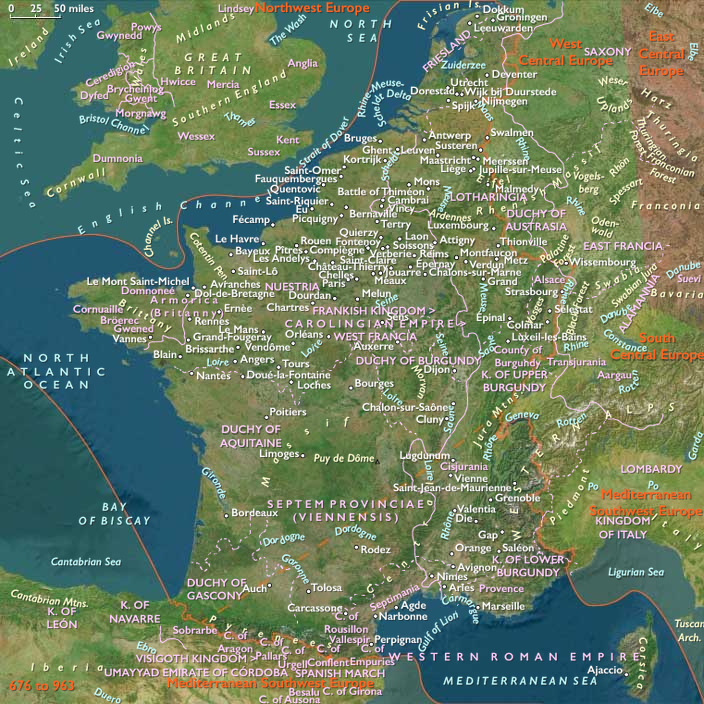
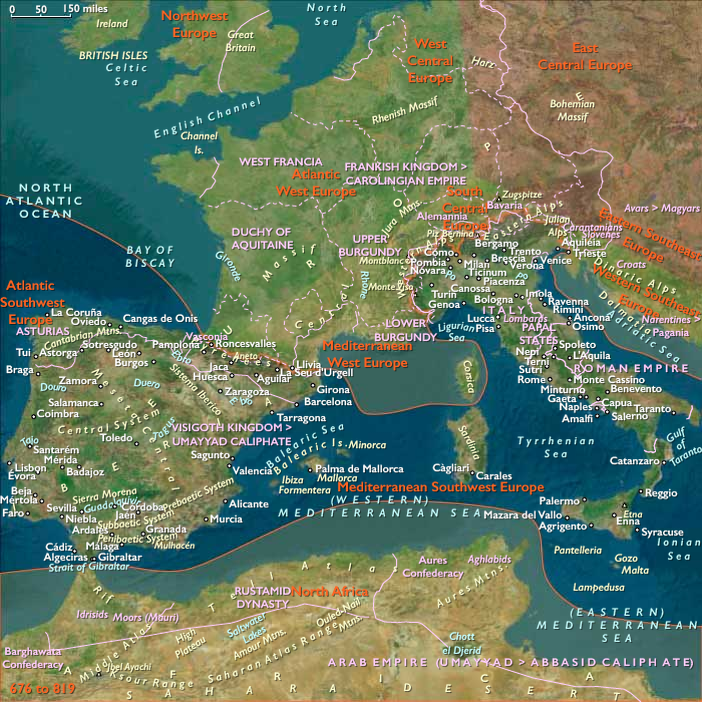
Between 676 and 819, Atlantic West Europe—including regions corresponding to modern-day France (Neustria, Austrasia, Aquitaine, Brittany, Burgundy) and the Low Countries—underwent profound political restructuring, evolving from fragmented Merovingian rule into the unified, culturally vibrant Carolingian Empire. This age witnessed the pivotal transition from declining royal authority to the consolidation of power under influential mayors of the palace, culminating in the ascendance of Charlemagne and the flowering of the Carolingian Renaissance.
Political and Military Developments
Merovingian Fragmentation and Austrasian Dominance (676–714)
- Following the assassination of Childeric II (675), the Frankish kingdoms—Neustria, Austrasia, and Burgundy—descended into rivalry and weakened royal power.
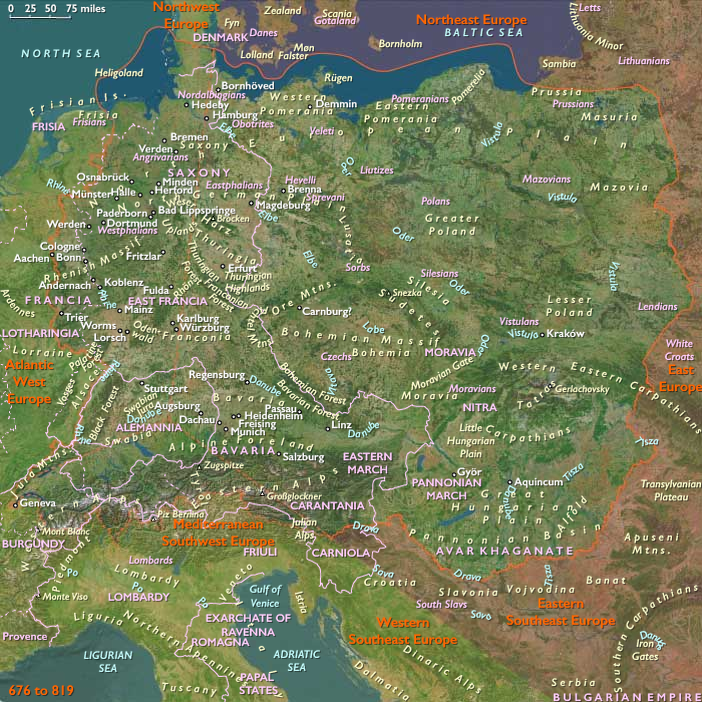
- Pepin of Herstal, Austrasian mayor of the palace, established dominance after the decisive Battle of Tertry (687), consolidating power over Neustria and Burgundy, thereby shifting control away from Merovingian kings to the mayors of the palace.
Carolingian Rise (715–751)
- Charles Martel (r. 718–741), son of Pepin of Herstal, fortified the Carolingian position by defeating Neustrian rivals and asserting authority over Aquitaine, Burgundy, and the Low Countries.
- His victory at Tours-Poitiers (732) halted the northward expansion of Umayyad forces, significantly shaping the future of Atlantic West Europe and earning him legendary status.
Carolingian Consolidation and Expansion (752–819)
- Pepin the Short (r. 751–768), Charles Martel's son, deposed the last Merovingian king (751), becoming king himself with papal sanction. His reign legitimized Carolingian rule, strengthened royal authority, and subdued Aquitaine.
- Charlemagne (r. 768–814) dramatically expanded Frankish territory through wars against Saxons, Lombards, Avars, and Muslim Spain, solidifying control over Aquitaine, Brittany, and parts of Burgundy.
- Charlemagne’s imperial coronation in 800 by Pope Leo III established the Carolingian Empire, a cultural and political unity unprecedented since Rome.
- Louis the Pious (r. 814–840) inherited a vast, culturally vibrant empire, though internal tensions foreshadowed future divisions.
Economic and Social Developments
Agricultural Revival and Feudal Foundations
- Improved stability under the Carolingians spurred agricultural expansion and economic recovery. Monastic estates spearheaded land clearance, technological innovations, and improved farming practices, laying groundwork for medieval manorialism.
- Proto-feudal relationships emerged as local aristocrats and monasteries provided peasants protection in exchange for labor, reinforcing hierarchical rural societies.
Urban Development and Commercial Renewal
- Trade gradually revived as towns such as Paris, Lyon, Nantes, Tours, and Utrecht benefited from increased political stability, becoming regional market centers.
- The Carolingian monetary reforms, especially the introduction of the silver denier, standardized and facilitated trade throughout Atlantic West Europe.
Religious and Cultural Developments
Expansion of Christianity and Ecclesiastical Reforms
- Carolingian rulers promoted Christianity vigorously, supporting missionary work in Saxony and among neighboring peoples.
- St. Boniface (d. 754), supported by Charles Martel and Pepin the Short, reorganized the Frankish church, strengthened papal ties, and founded key bishoprics throughout Atlantic West Europe.
Carolingian Renaissance
- Charlemagne’s court at Aachen became the heart of an intellectual revival, attracting scholars like Alcuin of York, Paul the Deacon, and Einhard.
- The establishment of cathedral and monastic schools, along with manuscript production centers in monasteries such as Corbie, Tours, and Fulda, significantly advanced literacy, education, and classical scholarship.
- Revival and standardization of Latin, script reforms (Caroline minuscule), and illuminated manuscripts marked cultural achievements.
Intellectual and Artistic Developments
Artistic and Architectural Innovations
- The period saw an evolution from Merovingian artistic traditions to Carolingian art, blending Classical Roman, Byzantine, and Germanic elements.
- Notable architectural projects included Charlemagne’s palace chapel at Aachen, Abbey of Saint-Denis, and monasteries throughout the empire.
Legacy and Significance
The era from 676 to 819 in Atlantic West Europe transformed a fragmented post-Roman landscape into a unified, culturally dynamic Carolingian Empire. The rise of the Carolingian dynasty established a powerful political order, revitalized economic life, and fostered a vibrant intellectual and artistic culture, laying the critical foundations for medieval European civilization.
The Rise of Pepin of Heristal and the Decline of Merovingian Power
Amidst a period of civil wars and internal strife, the fragmented Frankish kingdoms are ultimately united under Pepin of Heristal, the Arnulfing mayor of Austrasia and the true power behind the throne. Through military success and strategic alliances, Pepin consolidates his control, forcing the reigning Merovingian king to recognize him as sole mayor of the palace and grant him the title dux et princeps Francorum—“Duke and Prince of the Franks.”
This title, as noted in the Liber Historiae Francorum, marks what contemporaries saw as the beginning of Pepin’s effective reign, despite the continued existence of Merovingian figureheads. From this point onward, the surviving historical record depicts the Merovingian monarchs as increasingly ceremonial, with little to no real influence over governance.
Pepin’s dominance sets the stage for the Carolingian ascendancy, paving the way for his descendants—most notably Charlemagne—to fully eclipse Merovingian authority and reshape the political landscape of Western Europe.
Atlantic West Europe, 676–687: Shifting Power and Frankish Realignments
The period from 676 to 687 in Atlantic West Europe was marked by renewed internal divisions within the Frankish kingdoms, the continued fragmentation of Merovingian authority, and the rising prominence of Austrasian power—setting the stage for the Carolingian ascendancy.
Political and Military Developments
-
Fragmentation of Merovingian Power
- After the death of Childeric II (675), the Frankish kingdoms plunged into renewed chaos, exacerbating rivalries between Austrasia, Neustria, and Burgundy.
- Kings such as Dagobert II (Austrasia, r. 676–679) and Theuderic III (Neustria, intermittently 673–691) struggled to assert meaningful authority amid powerful court factions.
-
Rise of Austrasian Mayors
- Pepin of Herstal emerged as a pivotal figure in Austrasia, strengthening the region’s autonomy and building political networks.
- Tensions between Neustria and Austrasia culminated in the decisive Battle of Tertry (687), where Pepin secured Austrasian dominance over Neustria, dramatically altering the power dynamics of the Frankish kingdoms.
-
Weakening of Neustria and Burgundy
- Neustrian authority diminished significantly, with Mayor of the Palace Ebroin's death (680/681) creating a leadership vacuum that Pepin of Herstal exploited.
- Burgundy increasingly fell under Austrasian influence following the Austrasian victory at Tertry.
Economic and Social Developments
- Instability and Economic Disruption
- Prolonged civil strife hindered economic stability, leading to disruptions in trade, agriculture, and local governance.
- Rural communities increasingly depended on local lords and ecclesiastical estates for protection and support, further entrenching proto-feudal structures.
Religious and Cultural Developments
- Monastic Expansion Amid Instability
- Despite political turmoil, monastic communities such as Luxeuil, Corbie, and Saint-Denis thrived, becoming vital centers of stability, education, and manuscript production.
- The church continued to assert moral and political influence, offering a counterbalance to secular factionalism.
Intellectual and Artistic Developments
- Continuing Merovingian Manuscript Culture
- Monastic scriptoria preserved classical and Christian texts, maintaining cultural continuity despite political disruptions.
- Artistic expression continued in illuminated manuscripts, blending late-Roman artistic traditions with Merovingian motifs.
Long-Term Significance
The era 676–687 marked the critical transition from divided Merovingian rule toward Austrasian hegemony under Pepin of Herstal, paving the way for the Carolingian dynasty's rise. The decisive Battle of Tertry represented a fundamental turning point, reshaping political structures that would define Frankish governance for generations.
Pepin of Heristal and the Triumph at Tertry
From 680, Pepin of Heristal, the son of Pepin of Landen, serves as mayor of the palace of Austrasia, successfully maintaining the kingdom’s autonomy against Neustrian expansionist ambitions. Unlike many of his predecessors, Pepin secures his position through both diplomatic skill and military strength, ensuring peaceful governance in the east while preparing for inevitable conflict with the western Frankish factions.
A turning point comes in 687, when the mayor of the palace of Neustria, seeking to exploit the weakness of an infant Merovingian king in Austrasia, rallies the nobles of Neustria and Burgundy in an effort to reassert control. Pepin, however, proves the stronger force, decisively defeating his foes at the Battle of Tertry, near Péronne in modern France.
This victory secures Pepin’s dominance over the Frankish realms, effectively placing both Neustria and Burgundy under Austrasian control. While the Merovingian kings continue to reign in name, real power now firmly rests with the Arnulfing mayors of the palace, paving the way for the eventual rise of the Carolingian dynasty.
Pepin of Heristal: Architect of Frankish Unity
Following his victory at the Battle of Tertry (687), Pepin of Heristal consolidates his rule over the Frankish realms, uniting Austrasia, Neustria, and Burgundy under his sole mayorship. Though a Merovingian infant king nominally reigns over all the Franks, Pepin wields actual power, effectively governing as the de facto ruler of the entire Frankish kingdom.
By centralizing authority, Pepin ensures the continued dominance of the Arnulfing lineage, establishing a lasting political structure that strengthens the position of the mayors of the palace. His rule not only stabilizes the Frankish realm but also lays the groundwork for the eventual transition from Merovingian figureheads to the full ascendance of the Carolingians, shaping the political landscape of medieval Europe.
Atlantic West Europe, 688–699: Pepin of Herstal and the Consolidation of Frankish Power
Between 688 and 699, Atlantic West Europe saw the firm establishment of Pepin of Herstal’s authority as Mayor of the Palace across the Frankish realms. This era solidified Austrasian dominance, reinforced Carolingian foundations, and brought relative stability after decades of internal conflict.
Political and Military Developments
-
Consolidation of Pepin of Herstal’s Authority
- Following his decisive victory at the Battle of Tertry (687), Pepin of Herstal effectively ruled Austrasia, Neustria, and Burgundy, uniting the Frankish kingdoms under Austrasian hegemony.
- Pepin established his capital at Metz, reinforcing Austrasia’s central political role within the broader Frankish realm.
-
Weakening of Merovingian Kings
- Merovingian kings, notably Theuderic III (d. 691) and Clovis IV (r. 691–695), served largely symbolic roles as royal authority became increasingly concentrated in the office of Mayor of the Palace.
- By the late 690s, Pepin’s rule was uncontested, significantly reducing internal factionalism between Neustria and Austrasia.
Economic and Social Developments
-
Revival of Stability and Economic Activity
- Pepin's effective rule provided a more stable environment for agriculture and trade, allowing regional economies in Austrasia, Neustria, and Burgundy to slowly recover from prior disruptions.
- Improved governance and security fostered local market activities, laying the foundations for economic recovery that would continue into the early 8th century.
-
Emerging Proto-Feudalism
- Land grants and patronage networks began to solidify, establishing early feudal relationships where military allegiance to mayors and local lords gained prominence.
Religious and Cultural Developments
-
Church Alliances and Monastic Growth
- Pepin of Herstal maintained close relationships with powerful ecclesiastical institutions, relying on monasteries like Saint Arnulf in Metz and Saint-Denis near Paris to strengthen his legitimacy.
- Monasteries continued to thrive as cultural and educational hubs, notably Corbie, Luxeuil, and Saint Wandrille.
-
Missionary Activity
- Frankish monks continued their missionary outreach, preparing the ground for later missions, especially into Germanic territories beyond the Rhine.
Intellectual and Artistic Developments
- Continued Monastic Scholarship
- Scriptoria at Metz, Corbie, and Luxeuil preserved religious and classical texts, though artistic innovation was modest during this period.
- Manuscripts produced in this era combined Merovingian traditions with early influences that would later flourish under the Carolingians.
Long-Term Significance
The era 688–699 was critical in establishing Austrasian dominance under Pepin of Herstal, marking the practical decline of Merovingian kingship and the rise of Carolingian rule. By consolidating authority, Pepin brought stability and laid essential foundations for subsequent political developments and Carolingian ascendancy.
Dorestad: The Trading Hub of Northwestern Europe
Between the 7th and 9th centuries, Dorestad emerges as the largest emporium in northwestern Europe, thriving as a major North Sea trading center. Stretching three kilometers along the confluence of the Rhine and Lek rivers, southeast of Utrecht, it occupies a strategic position near the modern town of Wijk bij Duurstede in the Netherlands. Goods from the Middle Rhineland, including wine from vineyards south of Mainz, pass through its bustling markets, reinforcing its prominence in regional commerce.
A Contested Stronghold
Dorestad’s strategic and economic value makes it a frequent battleground. Between 600 and 719, the Frisians and the Franks repeatedly clash over control of the city. A Roman fortress, originally constructed during the Roman era, remains in use throughout the Early Middle Ages, providing a defensive stronghold for whichever power holds the settlement.
The Frisian rulers, whose exact titles vary by source, are often referred to as dukes in Frankish records, while other sources call them kings—reflecting the differing perspectives of Christianized Latin chroniclers and the Germanic pagan Frisians who likely viewed their leaders as monarchs.
The Fall of Frisian Control
In the late 7th century, Frisian ruler Radbod, who had sought to expel Christian influence from his realm and resist Frankish dominance, suffers a decisive defeat at the Battle of Dorestad (689) against Pepin of Herstal. As a result, Radbod is forced to cede West Frisia (Frisia Citerior)—the territory between the Scheldt and the Vlie—to the Franks, bringing a significant portion of the Frisian lands under Frankish rule.
Despite the changing political landscape, Dorestad remains a key economic hub, its mint further enhancing its influence across the region. However, its prosperity will eventually decline in the mid-9th century, as Viking raids and shifting trade routes weaken its prominence in European commerce.
The Battle of Tertry and the Ascendancy of Austrasia
In 681, Theuderic III, the Merovingian king of Neustria, and his mayor of the palace, Waratton, establish a fragile peace with Pepin of Heristal, the mayor of the palace of Austrasia. This temporary truce, however, unravels following Waratton’s death in 686, when his successor, Berthar, adopts an aggressive stance against Austrasia.
In 687, Berthar, alongside Theuderic III, leads the Burgundo-Neustrian army against Pepin of Heristal in a decisive confrontation at the Battle of Tertry, near Péronne. The result is a crushing Austrasian victory, cementing Pepin’s control over Neustria and Burgundy and effectively shifting the balance of power within the Frankish realm. With this triumph, Austrasia emerges as the dominant force in Francia, with its mayor now the true ruler of the kingdom.
Following Theuderic III’s death, his nine-year-old son, Clovis IV, inherits the throne of Austrasia in 691, though his rule is entirely nominal. Real authority rests with his uncle, Pepin of Heristal, who governs as the de facto ruler of the Frankish state, further solidifying the decline of Merovingian royal power and the rise of the Arnulfing dynasty.