Pedro II of Brazil
Emperor of Brazil
Years: 1825 - 1891
Dom Pedro II (English: Peter II; 2 December 1825 – 5 December 1891), nicknamed "the Magnanimous", is the second and last ruler of the Empire of Brazil, reigning for over 58 years.
Born in Rio de Janeiro, he is the seventh child of Emperor Dom Pedro I of Brazil and Empress Dona Maria Leopoldina and thus a member of the Brazilian branch of the House of Braganza.
His father's abrupt abdication and flight to Europe in 1831 leaves a five-year-old Pedro II as Emperor and leads to a grim and lonely childhood and adolescence.
Obliged to spend his time studying in preparation for rule, he knows only brief moments of happiness and encounters few friends of his age.
His experiences with court intrigues and political disputes during this period greatly affect his later character.
Pedro II grows into a man with a strong sense of duty and devotion toward his country and his people.
On the other hand, he increasingly resents his role as monarch.
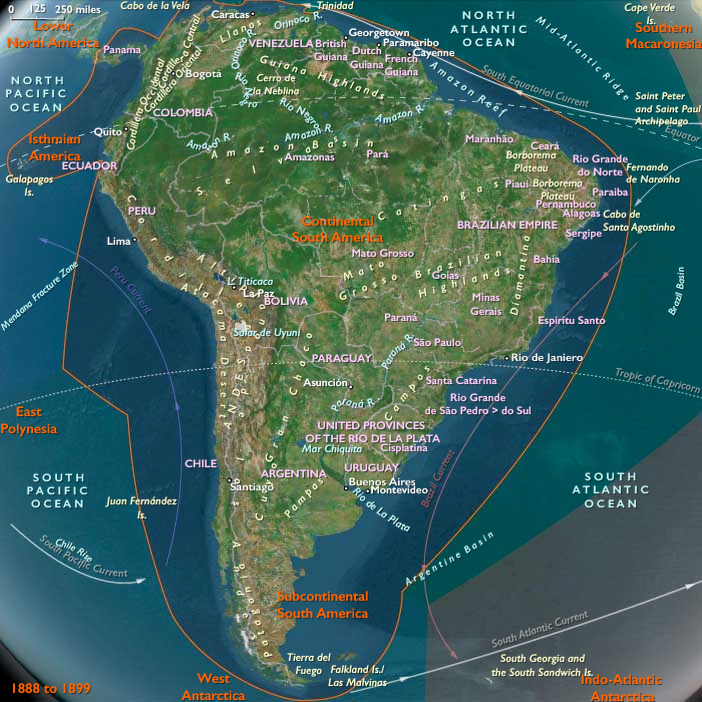
Inheriting an Empire on the verge of disintegration, Pedro II turns Portuguese-speaking Brazil into an emerging power in the international arena.
The nation grows to be distinguished from its Hispanic neighbors by its political stability, zealously guarded freedom of speech, respect for civil rights, vibrant economic growth and especially for its form of government: a functional, representative parliamentary monarchy.
Brazil is also victorious in three international conflicts (the Platine War, the Uruguayan War and the Paraguayan War) under his rule, as well as prevailing in several other international disputes and domestic tensions.
Pedro II steadfastly pushes through the abolition of slavery despite opposition from powerful political and economic interests.
A savant in his own right, the Emperor establishes a reputation as a vigorous sponsor of learning, culture and the sciences.
He wins the respect and admiration of scholars such as Charles Darwin, Victor Hugo and Friedrich Nietzsche, and is a friend to Richard Wagner, Louis Pasteur and Henry Wadsworth Longfellow, among others.
Although there is no desire for a change in the form of government among most Brazilians, the Emperor is overthrown in a sudden coup d'état that has almost no support outside a clique of military leaders who desires a form of republic headed by a dictator.
Pedro II has become weary of emperorship and despairs over the monarchy's future prospects, despite its overwhelming popular support.
He allows no prevention of his ouster and does not support any attempt to restore the monarchy.
He spends the last two years of his life in exile in Europe, living alone on very little money.
The reign of Pedro II thus comes to an unusual end—he is overthrown while highly regarded by the people and at the pinnacle of his popularity, and some of his accomplishments are soon brought to naught as Brazil slips into a long period of weak governments, dictatorships, and constitutional and economic crises.
The men who had exiled him soon begin to see in him a model for the Brazilian republic.
A few decades after his death, his reputation is restored and his remains are returned to Brazil as those of a national hero.
This reputation has lasted to the present day.
Historians have regarded the Emperor in an extremely positive light, and he is usually ranked as the greatest Brazilian.