Pedro de los Ríos y Gutiérrez de Aguayo
Spanish colonial administrator
Years: 1485 - 1547
Pedro de los Ríos y Gutiérrez de Aguayo (died 1547) is a Spanish colonial administrator who succeeded Pedrarias Dávila as governor of Castilla del Oro (1526–1529) and of Nicaragua (1526–1527).
Born in Córdoba, Spain, his parents are Diego Gutiérrez de los Ríos y González de Hoces and Elvira Gutiérrez de Aguayo y López de Montemayor.
Related Events
Filter results
Showing 10 events out of 17 total
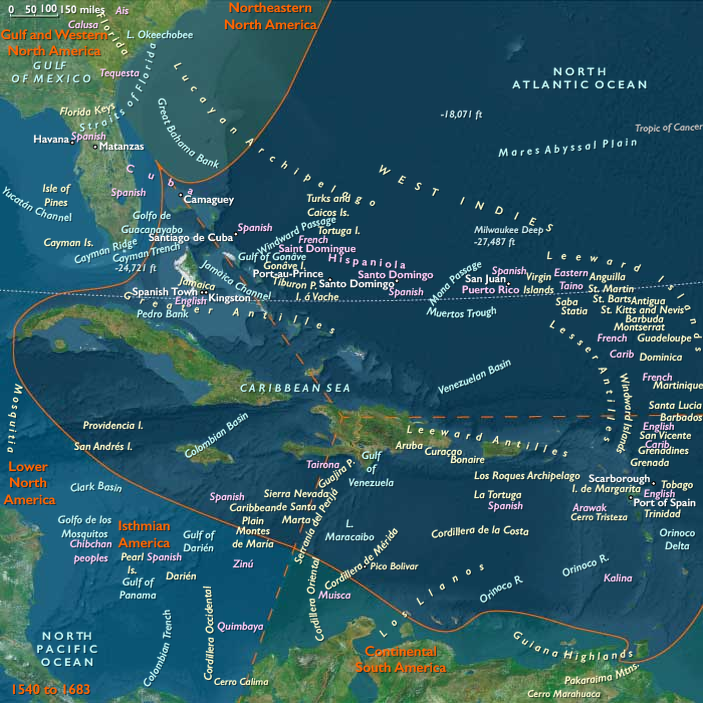
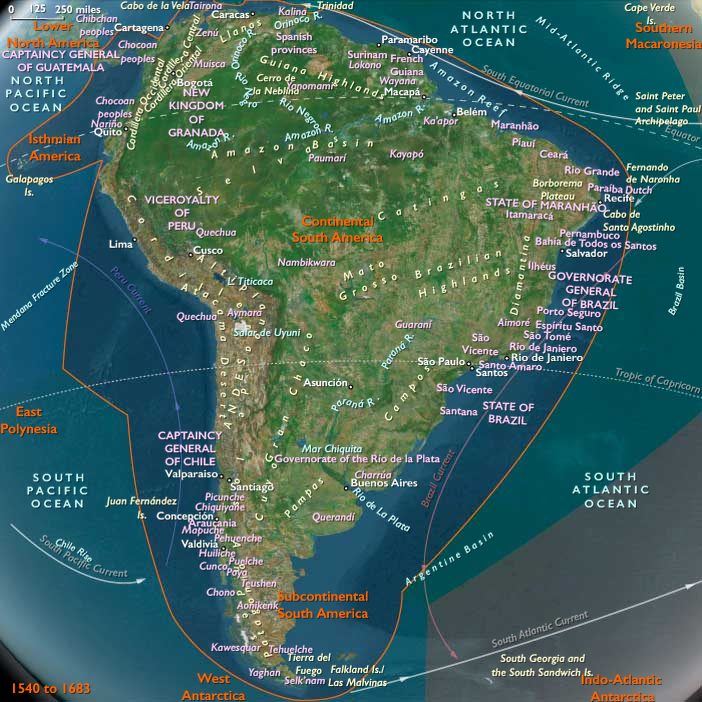
Pizarro had left Panama on March 10, 1526, after all preparations were ready, with two ships carrying one hundred and sixty men and several horses, reaching as far as the Colombian San Juan River.
The party separates Ssoon after arriving, with Pizarro staying to explore the new and often perilous territory off the swampy Colombian coasts, while the expedition's co-commander, Almagro, is sent back to Panama for reinforcements.
Pizarro's Piloto Mayor (main pilot), Bartolomé Ruiz, continues sailing south and, after crossing the equator, finds and captures a balsa (raft) under sail, with natives from Tumbes.
To everyone's surprise, these carry a load of textiles, ceramic objects, and some much-desired pieces of gold, silver, and emeralds, making Ruiz's findings the central focus of this second expedition, which only serves to pique the conquistadors' interests for more gold and land.
Some of the natives are also taken aboard Ruiz's ship to serve later as interpreters.
He then sets sail north for the San Juan River, arriving to find Pizarro and his men exhausted from the serious difficulties they had faced exploring the new territory.
Soon Almagro also sails into the port with his vessel laden with supplies, and a considerable reinforcement of at least eighty recruited men who had arrived at Panama from Spain with the same expeditionary spirit.
The findings and excellent news from Ruiz along with Almagro's new reinforcements cheers Pizarro and his tired followers.
They now decide to sail back to the territory already explored by Ruiz and, after a difficult voyage due to strong winds and currents, reach Atacames on the Ecuadorian coast.
Here, they find a very large native population recently brought under Inca rule.
Unfortunately for the conquistadores, the warlike spirit of the people they have just encountered seems so defiant and dangerous in numbers that the Spanish decide not to enter the land.
Pizarro, Almagro, and Luque, two years after the first very unsuccessful expedition to South America, start the arrangements for a second expedition with permission from Pedrarias Dávila.
The governor, who himself is preparing an expedition north to Nicaragua, is reluctant to permit another expedition, having lost confidence in the outcome of Pizarro's expeditions.
The three associates, however, eventually win his trust and he acquiesces.
Also by this time, a new governor is to arrive and succeed Pedrarias Dávila.
This is Pedro de los Ríos, who had manifested his initial approval of Pizarro's expeditions and will take charge of the post in July 1526 (he will join Pizarro several years later in Peru).
Luque acts as an agent for the financial backer, Judge Gaspar de Espinosa, of the joint expedition by Pizarro and Almagro to Peru in 1526.
Pizarro and Almagro decide, after much wrangling, that Pizarro will stay at a safer place, the Isla de Gallo, near the coast, while Almagro will return yet again to Panama with Luque for more reinforcements—this time with proof of the gold they had just found and the news of the discovery of an obvious wealthy land they had just explored.
The new governor of Panama, Pedro de los Ríos, has learned of the mishaps of Pizarro's expeditions and the deaths of various settlers who had gone with him.
Fearing an unsuccessful outcome, he outright rejects Almagro's application for continued resources.
In addition, he orders two ships commanded by Juan Tafur to be sent immediately with the intention of bringing Pizarro and everyone back to Panama.
The leader of the expedition has no intention of returning, and when Tafur arrives at the now famous Isla de Gallo, Pizarro draws a line in the sand, saying: "There lies Peru with its riches; Here, Panama and its poverty. Choose, each man, what best becomes a brave Castilian. For my part, I go to the south.”
Francisco Pizarro and Diego de Almagro, two of the three partners—the third is a priest, Hernando de Luque—in the proposed, and thus far unsuccessful, conquest of Peru—it had decided after much wrangling that Pizarro would stay at a safer place, the Isla de Gallo, near the coast, while Almagro would return yet again to Panama with Luque for more reinforcements—this time with proof of the gold they had just found and the news of the discovery of an obvious wealthy land they had just explored.
The new governor of Panama, Pedro de los Ríos, had learned of the mishaps of Pizarro's expeditions and the deaths of various settlers who had gone with him.
Fearing an unsuccessful outcome, he had outright rejected Almagro's application for continued resources.
In addition, he had ordered two ships commanded by Juan Tafur to be sent immediately with the intention of bringing Pizarro and everyone back to Panama.
The leader of the expedition had no intention of returning, and when Tafur arrived at the now famous Isla de Gallo, Pizarro had drawn a line in the sand, saying: "There lies Peru with its riches; Here, Panama and its poverty. Choose, each man, what best becomes a brave Castilian. For my part, I go to the south.”
Only thirteen men had decided to stay with Francisco Pizarro on the Isla de Gallo; they will later become known as "The Famous Thirteen" (Los trece de la fama), while the rest of the expedition members had stayed with Tafur aboard his ships.
Pizarro's Piloto Mayor (chief pilot), Bartolomé Ruiz, also left in one of the ships with the intention of joining Almagro and Luque in their efforts to gather more reinforcements and eventually return to aid Pizarro.
Soon after the ships left, Pizarro and his men had constructed a crude boat and journeyed twenty-five leagues north for La Isla Gorgona, where they will remain for seven months before the arrival of new provisions.
Back in Panama, Pedro de los Ríos (after much persuading by Luque) had finally acquiesced to the requests for another ship, but only to bring Pizarro back within six months and completely abandon the expedition.
Both Almagro and Luque had quickly grasped the opportunity and left Panama (this time without new recruits) for La Isla Gorgona to once again join Pizarro.
On meeting with Pizarro, the associates on the recommendations of Ruiz's Indian interpreters decide to continue sailing south.
The Pizarro expedition finally reaches the northwestern Peruvian Tumbes Region by April 1528.
Tumbes becomes the territory of the first fruits of success the Spanish had so long desired, as they are received with a warm welcome of hospitality and provisions from the Tumpis, the local inhabitants.
On subsequent days, two of Pizarro's men, Alonso de Molina and Pedro de Candia, reconnoiter the territory and both, on separate accounts, report back the incredible riches of the land, including the decorations of silver and gold around the chief's residence and the hospitable attentions with which everyone had received them.
The Spanish also see, for the first time, the Peruvian llama, which Pizarro calls the "little camels".
The natives also begin calling the Spanish the "Children of the Sun" due to their fair complexions and brilliant armor.
Pizarro, meanwhile, continues receiving the same accounts of a powerful monarch who rules over the land they are exploring.
These events only serve as evidence to persuade the expedition of the wealth and power displayed at Tumbes as an example of the riches the Peruvian territory has awaiting to conquer.
The conquistadors decide to return to Panama to prepare the final expedition of conquest with more recruits and provisions.
Before leaving, however, Pizarro and his followers sail south not so far along the coast to see if anything of interest can be found.
Historian William H. Prescott recounts that after passing through territories they named such as Cabo Blanco, port of Payta, Sechura, Punta de Aguja, Santa Cruz, and Trujillo (founded by Almagro years later), they finally reached for the first time the ninth degree of the southern latitude in South America.
On their return towards Panama, Pizarro briefly stops at Tumbes, where two of his men have decided to stay to learn the customs and language of the natives.
Pizarro is also given two boys to learn his language, one of whom will later be baptized as Felipillo and serve as an important interpreter, the equivalent of Cortés' La Malinche of Mexico, and another called Martinillo.
Their final stop is at La Isla Gorgona, where two of his ill men (one had died) had stayed before.
Francisco Pizarro and his followers, after at least eighteen months away in the equatorial coastlands, anchor off Panama to prepare for the final expedition to Peru.
Pedro de Candia was born on the island of Crete, which is at this time a Venetian colony known as the Kingdom of Candia, hence his nickname.
He left the island through one of his mother's relatives at the service of the Crown of Aragon, who took him to Italy.
During his period in Italy he was training to become a condottieri and trained in the arms; he fought against the Turks and in the Italian campaigns including the Battle of Pavia before transferring to the Iberian peninsula to serve the Spanish Catholic Queen and King.
Pedro was eventually married at Villalpando.
He had gone to America with Pedro de los Ríos, the new governor or Panama, in 1526, and had accompanied Diego de Almagro and Francisco Pizarro during their first explorations along the coasts of Peru, and when the landing at Tacamez, north of Guayaquil, was effected, he already had command of the artillery.
He was one of the thirteen men that remained in the islands of Gallo and Gorgona with Pizarro, and during the subsequent explorations of the Peruvian ports he undertook to go in person to the Indian towns and investigate their condition.
When Governor Ríos had refused to allow a third expedition to the south, the associates had resolved that Pizarro should leave for Spain and appeal to the sovereign in person.
Pizarro sails from Panama for Spain in the spring of 1528, accompanied by Pedro de Candia, some natives and llamas, plus samples of fabric, gold, and silver.
Francisco Pizzaro, refused permission by the governor of Panama for further exploration of the lands to the south, has traveled to Spain in 1528 to appeal directly to the king, reaching Seville from Panama in early summer.
King Charles I, who is at Toledo, has an interview with Pizarro and hears of his expeditions in South America, a territory the conquistador describes as very rich in gold and silver which he and his followers have bravely explored "to extend the empire of Castile."
The king, who is soon to leave for Italy, is impressed by the accounts of Pizarro and promises to give his support for the conquest of Peru.
Queen Isabel, though, in the absence of the king, signs the Capitulación de Toledo on July 6, 1529, a license document that authorizes Francisco Pizarro to proceed with the conquest of Peru.
Pizarro is officially named the Governor, Captain general, Adelantado, and Alguacil Mayor, of New Castile for the distance of two hundred leagues along the newly discovered coast, and invested with all the authority and prerogatives, his associates Diego de Almagro and Hernando de Luque being left in wholly secondary positions (a fact which will later incense Almagro and lead to eventual discords with Pizarro).
One of the conditions of the grant is that within six months, Pizarro should raise a sufficiently equipped force of two hundred and fifty men, of whom one hundred might be drawn from the colonies.
This gives Pizarro time to leave for …
…his native Trujillo and persuade his brother Hernando Pizarro and other close friends to join him on his third expedition.
Along with him also comes Francisco de Orellana, who will later discover and explore the entire length of the Amazon River.
Two more of his brothers from his father, Juan Pizarro and Gonzalo Pizarro, and a brother from his mother, Francisco Martin de Alcantara, will later decide to also join him, as well as his cousin Pedro Pizarro, who will serve as his page.