Otto of Nordheim
Duke of Bavaria
Years: 1020 - 1083
Otto of Nordheim (German: Otto von Northeim) (c. 1020 – 11 January 1083) is Duke of Bavaria from 1061 until 1070.
He is one of the leaders of the Saxon revolt against Emperor Henry IV.



Related Events
Filter results
Showing 10 events out of 25 total
Agnes of Poitou has served since her husband's death in 1056, as regent during on behalf of young son, Henry IV.
Despite being related to kings of Italy and Burgundy, Agnes is not known as a quality leader.
During her rule, she has given away three duchies, Bavaria, Swabia, and Carinthia, to relatives.
Agnes opposes church reform, and takes the side of Italian dissidents who do as well.
Pope Stephen IX, unable to take actual possession of Rome due to the Roman aristocracy's election of an antipope, Benedict X, had sent Hildebrand of Sovana and Anselm of Lucca (respectively, the future Popes Gregory VII and Alexander II) to Germany to obtain recognition from Agnes.
Stephen had died before being able to return to Rome, but Agnes' help had been instrumental in letting Hildebrand depose the Antipope in 1059 and with Agnes' support replace him by the Bishop of Florence, Nicholas II.
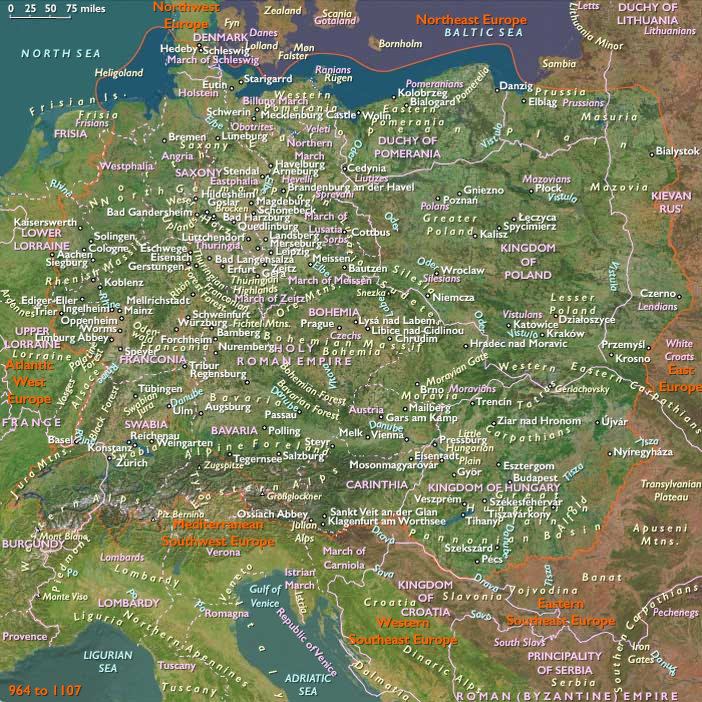
Henry IV and his mother in early April 1062, are staying in the palace of Kaiserswerth (today a quarter in Düsseldorf).
Here they both meet with Archbishop Anno II of Cologne.
After banqueting together, Anno invites the eleven-year-old boy to visit a magnificent ship that he has moored in the River Rhine nearby.
Anno then takes the king to Cologne and blackmails Empress Agnes to hand over the Imperial Regalia.
As a consequence of what is referred to as referred to as the Coup of Kaiserswerth, the power of the state falls into the hands of the rebels, who, in addition to Anno and Count Egbert of Brunswick, mentioned by Lampert, also include Otto of Northeim and the Archbishops Adalbert of Bremen and Siegfried I of Mainz.
Anno, born around 1010, belonging to the Swabian family of the von Steusslingen, and educated at Bamberg, had become confessor to the Emperor Henry III, who in 1956 had appointed him archbishop of Cologne.
He has taken a prominent part in the government of Germany during the minority of Henry IV and is the leader of the party that in 1062 seizes the person of Henry in the coup of Kaiserswerth, and deprives his mother, the empress Agnes, of power.
Henry is brought to Cologne, and despite jumping overboard from a board to escape, he is recaptured again.
Agnes resigns, as ransom, from the throne, and Anno takes her place as regent.
After the dethroning, she moves to Rome, where she will act as a mediator and peacemaker between Henry IV and his enemies.
Anno’s first move is to back Pope Alexander II against the antipope Honorius II, whom Agnes had initially recognized but subsequently left without support.
Anno's rule proves unpopular.
For a short time, Anno exercises the chief authority in the kingdom, but he is soon obliged to share this with Adalbert, Archbishop of Bremen, and Siegfried I, Archbishop of Mainz, retaining for himself the supervision of Henry's education and the title of magister.
Henry had in the late 1060s demonstrated his determination to reduce any opposition and to enlarge the national boundaries.
He has led expeditions against the Lutici and the margrave of a district east of Saxony.
Much more serious is Henry's struggle with Otto of Nordheim, duke of Bavaria.
Otto belongs to the rich and influential Saxon family of the counts of Northeim, and having distinguished himself in war and peace alike, in 1061 had received the Stem Duchy of Bavaria from the Dowager Empress Agnes of Poitou, widow of Emperor Henry III and mother of the child Emperor Henry IV.
In 1062, he had assisted Archbishop Anno II of Cologne to seize Henry IV at Kaiserswerth in order to deprive his mother of power.
Otto had led a successful expedition into Hungary in 1063 and had taken a prominent part in the Empire's government during the King's minority.
In 1064, he had gone to Italy to settle a papal schism and had been largely instrumental in securing the banishment from court of Archbishop Adalbert of Bremen-Hamburg.
He had crossed the Alps in the royal interests on two other occasions and in 1069 had shared in two expeditions to the east of Germany.
Otto is in 1070 accused by a certain Egeno von Konradsburg of being privy to a plot to murder the king, and it is decided he should submit to trial by combat with his accuser at Goslar.
The duke smells treason and asks for a safe-conduct to and from the place of meeting.
When this is refused, he declines to appear and is consequently placed under the imperial ban and deprived of Bavaria, while his Saxon estates are plundered.
Duke Otto becomes an enemy of King Henry IV and forfeits his duchy, but his son-in-law Welf remains loyal to the king.
In compliance with Henry's commands, he repudiates and divorces his duchess, Ethelinde, and soon thereafter is rewarded for his fidelity by being appointed Duke of Bavaria in Otto's stead.
This event takes place at Goslar in 1070, when the States of Bavaria submit quietly to the newly made duke, who is the representative of one of the most ancient families in the province.
His repudiation of the duchess, which could be considered an act of injustice, does not seem to have been held against him.
Magnus, the eldest son and successor of Ordulf and Wulfhild of Norway, is the last member of the House of Billung.
In 1070, he had joined Otto in rebellion against Henry IV.
Otto obtains no support in Bavaria, but raises an army among the Saxons and carries on a campaign of plunder against Henry until 1071, when he submits.
Magnus is captured and imprisoned in the castle of Harzburg, the imposing imperial fortress which so inflames the Saxon freemen.
King Henry IV, forcibly prosecuting his policy of recovering imperial estates lost in north central Germany during his minority, exacerbates the normal tension between king and vassals.
Like his father, Emperor Henry III, Henry desires to set Goslar as the fixed capital of the German Kingdom.
Undercurrents of discord between the Salian royal family and the Saxons had already existed under Henry's father.
This may have been primarily due to his Rhenish Franconian origin as well as his numerous stays in the Imperial Palace of Goslar, which were associated with a disproportionately high economic burden on the surrounding population.
With the accession of Henry IV in 1065 this conflict has intensified, as Henry makes demands on numerous Imperial domains (Reichsgüter) in the center of the Saxon heartland around the Harz mountains—especially the silver mines of Rammelsberg.
To secure these estates, he has initiated a castle building program, erecting numerous fortresses along the range, the most prominent being the Harzburg.
This is perceived as a threat by the Saxons.
In addition, these castles are staffed with ministeriales of Swabian origin, who frequently plunder the Saxon population to make up for their lack of income.
Attempts to restore the rights over the Harz forests are not received well by the Saxon freedmen, and efforts to extend the crownlands in general as well as the increased demands laid upon the fisc are opposed.
The Saxon count Otto of Nordheim, Duke of Bavaria since 1061, had been accused in 1070 by the ministerialis Egeno I of Konradsburg of planning an assault on the king's life.
Otto had been deposed and banned, but had nevertheless gained support from the son of the Billung duke Ordulf of Saxony, the young Magnus.
King Henry IV had both captured and arrested.
While Otto has been pardoned, Magnus remains in custody at the Harzburg and is not released even after his father's death in 1072, as he shows no intention to renounce the Saxon ducal dignity.
This heightens tensions between the Imperial court and the Saxons; Magnus' subsequent release in exchange for seventy Swabians captured in Lüneburg does little to encourage a thaw in relations.
In anger, the king has rejected several Saxon petitions for redress.
According to the chronicler Lambert of Hersfeld, the Saxon princes had come to the Imperial Palace of Goslar on June 29, 1073 in order to point to these abuses and demand improvements.
Henry IV refuses to enter discussions and several bishops and princes organize a resistance.
Several castles are besieged, and Henry, along with the imperial insignia, flees from the large, advancing Saxon army to …
…the nearby castle of Harzburg, erected during the castle building program in Saxony from 1065 to 1068 and strategically sited by Henry himself.
Henry's architect is later the Bishop of Osnabrück, Benno II.
The castle provides protection for the nearby Imperial Palace of Goslar.
Its walls extend right up to the steep face of the conical mountain top.
The castle is impregnable to contemporary forces.
Despite its defensive strength, the castle is also especially palatial.
For example, it contains, among other things, an unusually large, three-roomed great hall and collegiate church, to which Henry has had many relics transferred.
He even has had a sort of family vault built, in which he laid the bones of his brother, Conrad and his son, Henry, both of whom died young.
Henry is besieged at Harzburg by the Saxon rebels, again led by Count Otto of Nordheim together with Bishop Burchard II of Halberstadt.
The besieging force allegedly numbers sixty thousand while his garrison only has three hundred men.
The king, however, is finally able to escape on the night of August 10, 1073, allegedly through the castle's well shaft and a secret passage.
Henry flees across the Harz, reaching the Landgraviate of Thuringia at Eschwege first, then moves on to …
…Franconian Hersfeld further into southern Germany, but he finds barely any support among the princes of the Empire, who are not willing to go to battle with him against the Saxons.