Otto III
Holy Roman Emperor, King of Germany, and King of Italy
Years: 980 - 1002
Otto III (June, 980 - January 23, 1002) is Holy Roman Emperor from 996 until his early death in 1002.
A member of the Ottonian dynasty, Otto III is the only son of the Emperor Otto II and his wife Theophanu.
Otto III is crowned as King of Germany in 983 at the age of three, shortly after his father's death in southern Italy while campaigning against the Byzantine Empire and the Emirate of Sicily.
Though the nominal ruler of Germany, Otto III's minor status ensures his various regents held power over the Empire.
His cousin Henry II, Duke of Bavaria, initially claims regency over the young king and attempts to seize the throne for himself in 984.
When his rebellion fails to gain the support of Germany's aristocracy, Henry II is forced to abandon his claims to the throne and to allow Otto III's mother Theophanu, who will serve as regent until 991.
Still only a child, Otto III's grandmother, the Dowager Empress Adelaide of Italy, serves as regent until Otto III reaches adulthood in 994.
In 996, Otto III marches to Italy to claim the titles King of Italy and Holy Roman Emperor which had been left unclaimed since Otto II's death in 983.
Otto III also seeks to reestablish Imperial control over the city of Rome, which had revolted under the leadership of Crescentius II, and through it the papacy.
Crowned as Emperor, Otto III puts down the Roman rebellion and installs his cousin as Pope Gregory V, the first Pope of German descent.
After pardoning him and leaving the city, Crescentius II again rebels against the Emperor, deposing Gregory V and installing John XVI as Pope.
Otto III returns to the city in 998, reinstalls Gregory V, and executes both Crescentius II and John XVI.
When Gregory V dies in 999, Otto III installs Sylvester II as the new Pope.
Otto III's actions throughout his life further strengthen imperial control over the Catholic Church.
For the beginning of his reign, Otto III faces opposition from the Slavic peoples along Germany's eastern border.
Following the death of his father in 983, the Slavs rebel against imperial control, forcing the Empire to abandon its territories east of the Elbe river.
Otto III will fight to regain the Empire's lost territories throughout his reign with only limited success.
While in the east, Otto III strengthens the Empire's relations with Poland, Bohemia, and Hungary.
Through his affairs in Eastern Europe in 1000, Otto III is able to extend the influence of Christianity by supporting mission work in Poland and through the crowning of Stephen I as the first Christian king of Hungary.
Returning to Rome in 1001, Otto III faces a rebellion from the Roman aristocracy that forces him to flee the city.
While marching to reclaim the city in 1002, however, Otto III suffers a sudden fever and dies in a castle near Civita Castellana at the age of 21.
With no clear heir to succeed him, his early death throws the Empire into political crisis.
Related Events
Filter results
Showing 10 events out of 67 total
North Europe (964 – 1107 CE): Baltic Silver Age, Norman Conquest, and the Making of a Christian North
Geographic and Environmental Context
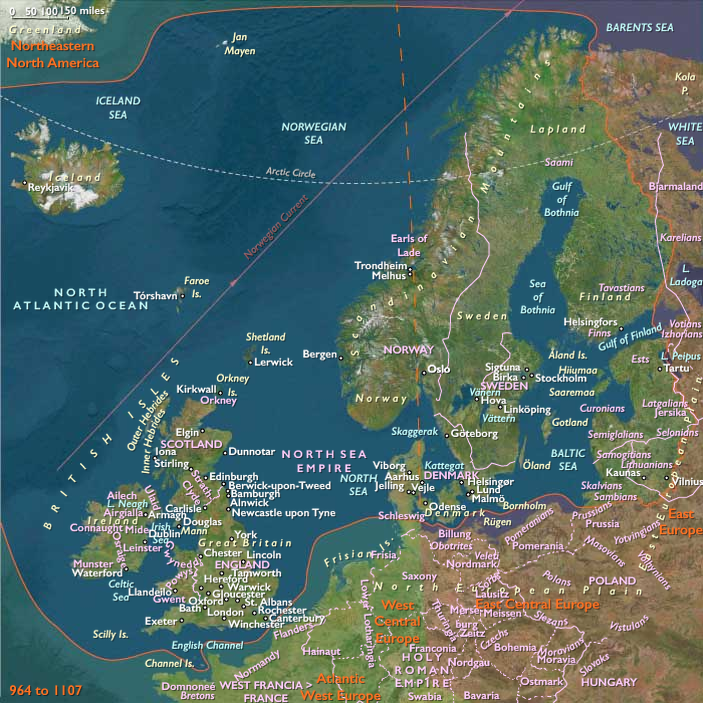
North Europe spanned the Baltic and North Sea worlds:
-
Northeast Europe: Sweden, Finland, Lithuania, Latvia, Estonia, eastern Denmark (Zealand–Skåne), and eastern Norway (Oslofjord), with Copenhagen and Oslo as rising nodes.
-
Northwest Europe: Iceland, Ireland, the United Kingdom (England–Scotland–Wales), Faroe, Shetland, Orkney, Channel Islands, and the western coastal zones of Norway and Denmark (west of 10°E).
The Øresund–Skåne choke point linked Baltic lanes to the North Sea, while Gotland, Sigtuna, Lund, Oslo, London, York, Dublin, Bergen, and Trondheim formed a necklace of maritime towns. Archipelagos (Orkney–Shetland–Faroe–Iceland) bridged Norway to the open Atlantic; the Bothnian and Finnish gulfs carried forest and fur frontiers into the Baltic exchange.
Climate and Environmental Shifts
The Medieval Warm Period (c. 950–1250) lengthened growing seasons, lifted cereal yields in southern Scandinavia and the eastern Baltic, and widened navigation windows by reducing seasonal ice in the Gulf of Bothnia and Gulf of Finland.
Stable marine ecologies sustained herring and cod from the North Sea to Iceland, while expansive forests underwrote fur, wax, honey, and tar exports. Periodic steppe drought signals nudged mobility on eastern Baltic frontiers but did not disrupt the main maritime arteries.
Societies and Political Developments
Danish and Norwegian Consolidation (Eastern portions + Atlantic coasts)
Harald Bluetooth (r. c. 958–986) unified Denmark, embraced Christianity (c. 965), and set royal markers at Jelling; royal tolls at the Øresund monetized Baltic–North Sea traffic. In Norway, Oslofjord chieftains turned toward kingship; Olaf II (St. Olaf, d. 1030) strengthened royal authority as coastal earls from Bergen–Trondheim managed Atlantic ties.
Sweden and the Eastern Baltic
With Birka’s decline (c. 975), Sigtuna rose as a royal mint-town; Svear and Götar assemblies coexisted with growing kingship. Christian influence deepened after c. 1000, though Uppsala’s cults persisted into the 11th century. Estonian, Livonian, Curonian, Semigallian, Latgalian, and Lithuanian hillfort polities taxed rivers and raided coasts; Finnicgroups in Åland–southwest Finland–Tavastia balanced autonomy with trade/tribute ties to Swedes and Novgorodians.
Insular and British Realms; Norman Reordering
England moved from late Anglo-Saxon consolidation through Cnut’s North Sea empire (1016–1035) to the Norman Conquest (1066) under William, introducing castles, feudal estates, and the Domesday survey (1086).
Ireland saw powerful dála kingships and Norse towns (Dublin–Waterford–Cork) negotiating autonomy; Brian Boru’s rise and death (1014) framed the high-king dynamic.
Scotland (Malcolm II–III) consolidated Lowland cores while Norse jarls held sway in Orkney–Hebrides.
Iceland Christianized c. 1000; the Althing preserved self-rule even as Norwegian overlordship gathered later in the century.
Christian Missions and Structures
Imperial support from Otto II–III backed Hamburg–Bremen missions to Scandinavia and the Baltic. By c. 1100, Denmark and Norway were Christian monarchies; Sweden maintained mixed forms; Baltic tribes and Finlandlargely resisted conversion until the 12th–13th centuries.
Economy and Trade
Exports: furs, wax, honey, amber, falcons, slaves (eastern Baltic); timber, tar, iron, fish (Norway–Iceland–North Sea); grain and livestock from southern Scandinavia.
Imports: silver (first Islamic dirhams via Rus’, later German/Anglo-Saxon coin), wine, silk, weapons, glass.
Monetization shift: the dirham inflow collapsed after c. 970; hack-silver hoards thin by c. 1050 as Lund and Sigtuna mint local coin and German money circulates.
Nodes and corridors:
-
Gotland as entrepôt with vast silver hoards; Sigtuna–Lund–Oslo as craft/market towns.
-
Øresund tolls knit Zealand–Skåne to the Rhine–Channel world.
-
Dvina/Daugava/Nemunas rivers opened the Baltic to Novgorod, Kiev, and the Polish interior.
-
London emerged as a major European port; Rouen–Seine, La Rochelle–Bordeaux, and Dublin–York handled Atlantic flows.
-
Flanders’ cloth towns (across your regional line) were prime outlets for English wool and Scandinavian raw goods.
Subsistence and Technology
Mixed farming expanded (rye, barley, oats + cattle/swine), while swidden persisted in Finland/eastern Baltic.
Fishing & sealing supported surplus in gulfs and archipelagos; offshore cod fisheries linked Norway–Iceland–Orkney.
Ironworking from bog ores supplied tools/axes; high-grade blades arrived from the Rhineland.
Shipbuilding excelled in clinker-built longships and broad-beamed knarrs; wool sails extended range.
Fortification & ecclesiastical build: timber–earth hillforts dotted the Baltic; stone churches and royal halls rose in Denmark/Sweden; motte-and-bailey castles spread in Norman England and the Isles.
Movement and Interaction Corridors
-
Baltic blueways: Gotlanders and Swedes ran east to Rus’ and south via Øresund to German–Flemish markets.
-
Øresund–Skåne bottleneck: Danish kings taxed passage between seas.
-
Eastern rivers: Dvina/Daugava to Novgorod; Nemunas toward Prussia/Poland.
-
Oslofjord–Skåne choke point linked Norway’s east to Danish and Swedish marts.
-
North Sea–Atlantic: Orkney–Shetland–Faroe–Iceland as stepping stones; London–York–Winchester, Dublin–Waterford–Cork, Bergen–Trondheim as hubs; Channel routes connected England to Normandy and Flanders.
Belief and Symbolism
Norse paganism persisted longest in Sweden (Uppsala) and among Baltic tribes; thunder gods (Perkūnas/Ukko) and sacred groves anchored ritual.
Christianity consolidated in Denmark and Norway by c. 1000; Sweden’s rulers converted mid-century; mission probes reached Finland and Livonia.
On the Atlantic rim, monastic expansion in England–Ireland–Scotland and Norman Romanesque reshaped sacred landscapes.
Burials show hybridization—stone churches and Christian graves in Denmark/Sweden alongside boat burials and cremations in the Baltic lands.
Adaptation and Resilience
-
Trade pivot: after dirhams waned, Baltic merchants shifted to German coin and barter bundles (furs–amber–wax), keeping circuits liquid.
-
Urban frameworks: royal towns (Sigtuna, Lund) concentrated minting, craft, and law; London, Dublin, York, Bergen scaled up port governance.
-
Dual economies: farming–fishing–raiding portfolios and seasonal mobility buffered shock.
-
Legal assemblies (things) stabilized transitions to kingship and Christianity; in the Isles, Althing and regional things sustained consensual rule.
Long-Term Significance
By 1107 CE, North Europe had crossed the threshold to a Christian, monetizing, and maritime-integrated world:
-
Denmark and Norway stood as consolidated Christian monarchies controlling the Øresund and North Atlantic gateways.
-
Sweden advanced toward full Christian kingship while Uppsala’s cult lingered; Finland and the Baltic tribes preserved autonomy and pagan traditions, foreshadowing 12th–13th-century crusades.
-
The Norman Conquest knit the Channel into a single political–military field; Iceland and the Isles formalized Christian law within assembly polities.
-
Gotland, London, and Dublin flourished as entrepôts, even as silver streams shifted from Islamic dirhams to western coin.
The age fixed the Baltic–North Sea system as a commercial hinge of northern Eurasia and set the institutional patterns—kingship, councils, coin, church, and ships—that would drive the 12th-century northern expansion.
Northeast Europe (964 – 1107 CE): Baltic Silver Age, Danish Kingship, and Christian Missions
Geographic and Environmental Context
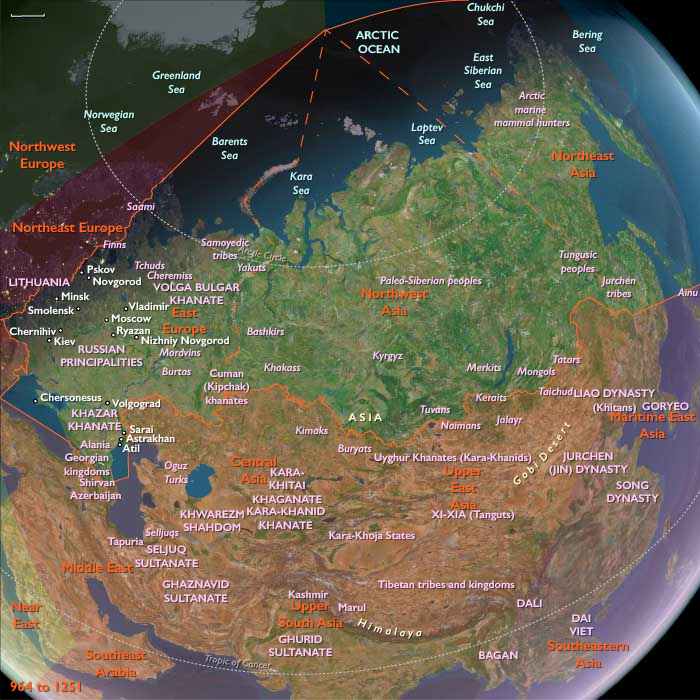
Northeast Europe includes Sweden, Finland, Lithuania, Latvia, Estonia, eastern Denmark, and eastern Norway (including Copenhagen and Oslo).
-
The Baltic Sea remained the central exchange basin, fringed with archipelagos and gulfs (Bothnia, Finland).
-
Southern Baltic lowlands (Lithuania, Latvia) combined farming with hillfort polities, while Finnish and Estonian coasts supported semi-nomadic mixed economies.
-
Zealand–Skåne and Oslofjord corridors formed maritime bottlenecks linking the Baltic to the North Sea.
Climate and Environmental Shifts
-
The Medieval Warm Period (c. 950–1250 CE) lengthened growing seasons and boosted cereal harvests in southern Scandinavia and the eastern Baltic.
-
Warmer summers extended navigation windows, reducing ice-blockage on the Gulf of Bothnia and Gulf of Finland.
-
Stable forest-steppe ecologies sustained furs and fisheries critical for export.
Societies and Political Developments
-
Denmark & Norway (eastern portions):
-
Harald Bluetooth (r. c. 958–986) unified Denmark and converted to Christianity (c. 965), erecting the Jelling stones.
-
Eastern Danish ports (Roskilde, Lund) and the Øresund strait became royal toll points.
-
In Norway, Oslofjord chieftains engaged in Baltic trade; consolidation under kings like Olaf II (St. Olaf, d. 1030) strengthened royal authority, though local autonomy remained strong.
-
-
Sweden:
-
Birka declined (c. 975); Sigtuna emerged as a royal foundation, minting coins and patronizing churches.
-
Svear and Götar assemblies coexisted with rising royal power; Christian influence grew after c. 1000, though pagan cults at Uppsala persisted.
-
-
Finland & Åland:
-
Finnic polities (southwest Finland, Tavastia) remained autonomous, engaged in trade and tribute relations with Swedes and Novgorodians.
-
-
Baltic tribes (Estonians, Livonians, Curonians, Semigallians, Lithuanians, Latgalians):
-
Fortified hillforts anchored clans; Curonian fleets raided coasts, while Livonian and Estonian chiefs taxed river access.
-
Contacts with Scandinavia and Rus’ intensified; dynastic alliances and tribute relations fluctuated.
-
-
Christian Missions:
-
Otto II and Otto III (Holy Roman Emperors) backed Hamburg–Bremen archbishops’ missions to Scandinavia and the Baltic.
-
By the early 11th century, Denmark and Norway were largely Christian; Sweden lagged until mid-century; the Baltic tribes resisted conversion until the 12th–13th centuries.
-
Economy and Trade
-
Exports: furs, wax, honey, amber, falcons, slaves.
-
Imports: silver (initially Islamic dirhams via Rus’, later German coinage), silks, wine, weapons.
-
Monetization:
-
Samanid dirham inflows collapsed after c. 970; Baltic hack-silver hoards diminish by c. 1050.
-
German and Anglo-Saxon coinage filled the gap; Sigtuna’s mint (est. late 10th c.) and Lund’s mint (early 11th c.) localized currency.
-
-
Markets & nodes: Gotland flourished as a hub, with vast silver hoards; Sigtuna, Lund, and Oslo became urban craft centers.
-
Agriculture: rye, barley, oats expanded; livestock husbandry grew more intensive in Denmark and southern Sweden.
Subsistence and Technology
-
Mixed farming (cereals + livestock) supported surplus in southern zones; slash-and-burn swidden in Finland and the eastern Baltic.
-
Fishing & sealing remained vital in gulfs and archipelagos.
-
Ironworking: bog iron smelted into tools, axes, and weapons; high-quality blades imported from the Rhineland.
-
Shipbuilding: clinker-built longships and broad cargo knarrs; wool sails improved range and speed.
-
Fortifications: timber and earth hillforts in Baltic lands; stone churches and royal halls in Denmark and Sweden.
Movement and Interaction Corridors
-
Baltic Sea routes: Gotlandic and Swedish traders linked to Rus’ river systems and to Denmark–Germany via Øresund.
-
Øresund straits: Danish kings taxed passage between Baltic and North Sea.
-
Eastern Baltic rivers: Dvina and Daugava opened trade to Novgorod; Nemunas linked Lithuania to Prussia and Poland.
-
Oslofjord–Skåne nexus: tied Norway’s eastern chieftains to Danish and Swedish markets.
Belief and Symbolism
-
Norse paganism: persisted in Sweden (Uppsala temple) and among Baltic tribes.
-
Christianity: Denmark and Norway converted by c. 1000; Sweden’s rulers converted mid-11th c.; missions probed into Finland and Livonia.
-
Baltic paganisms: gods of thunder (Perkūnas, Ukko), sacred groves, water cults remained central.
-
Burial practices showed hybridization—Christian graves in Denmark/Sweden alongside pagan cremations and boat burials in Baltic lands.
Adaptation and Resilience
-
Trade flexibility: After dirham decline, Baltic merchants pivoted to German coin and barter in furs, amber, and slaves.
-
Urban foundations: royal towns (Sigtuna, Lund) concentrated crafts, law, and minting, providing stable frameworks.
-
Dual economies: farming, fishing, and raiding provided redundancy; seasonal mobility mitigated risk.
-
Legal assemblies (things): balanced royal authority with local consensus, stabilizing transition to Christianity.
Long-Term Significance
By 1107 CE, Northeast Europe was transforming:
-
Denmark and Norway had consolidated as Christian monarchies.
-
Sweden maintained mixed pagan–Christian kingship, with Uppsala cults enduring.
-
Baltic tribes and Finland preserved autonomy and pagan traditions, resisting Christianization.
-
Gotland and coastal markets flourished as Baltic entrepôts, even as silver inflows shifted from Islamic dirhams to western coin.
This age set the stage for the 12th-century crusades into Finland and Livonia, the integration of Sweden into the European Christian sphere, and the continued prominence of the Baltic as a commercial and cultural hinge of northern Eurasia.
Central Europe (964 – 1107 CE): Christian Kings, Alpine Gateways, and the Imperial Heartland
Geographic and Environmental Context
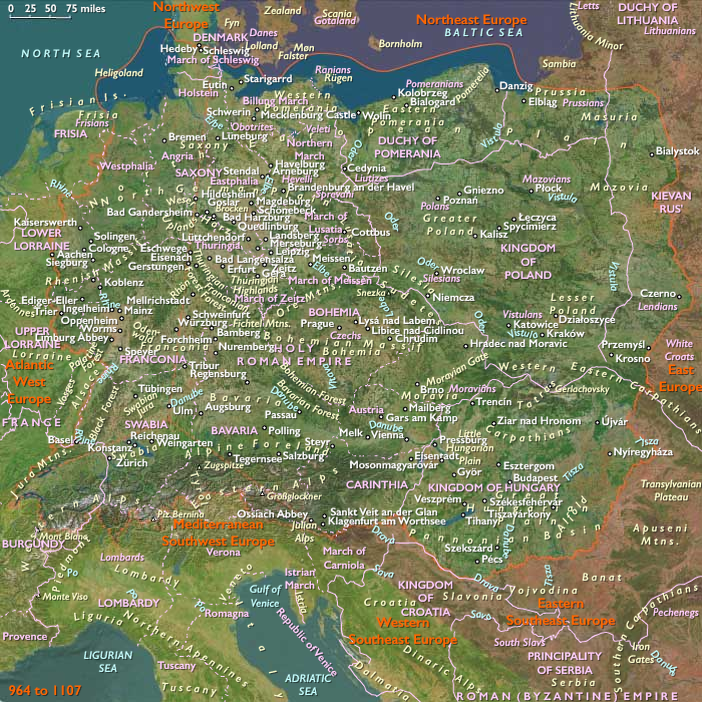
Central Europe stretched from the Baltic and Elbe plains through the Carpathian and Alpine basins to the Rhine and Moselle corridors.
It comprised Poland, Czechia, Slovakia, Hungary, Austria, Germany, Switzerland, and Liechtenstein, forming a vast zone where northern forests, central uplands, and southern passes met.
The Carpathian Basin linked the steppe world with Christendom, while the Alpine and Rhine valleys served as Europe’s main north–south arteries between the North Sea and Italy.
Danube, Elbe, Oder, Rhine, and Moselle rivers provided transport routes that shaped settlement, pilgrimage, and trade.
Climate and Environmental Shifts
During the Medieval Warm Period (c. 950–1250 CE), milder temperatures and reliable rainfall supported longer growing seasons, especially on the loess soils of Saxony, Bohemia, and Poland.
Forest clearance and three-field rotation expanded cultivation, while navigable rivers lengthened trading seasons.
In the south, Alpine pastures and vineyards flourished, and snow-line retreat eased passage over the Brenner, St. Bernard, and Julier Passes, binding the northern and Mediterranean economies more tightly than before.
Societies and Political Developments
East Central Europe: Christian Monarchies and Frontiers
After the defeat of the Magyars at Lechfeld (955), the Ottonian Empire consolidated control across Germany and radiated eastward influence.
-
Otto I (r. 936–973) crowned Holy Roman Emperor (962), anchored his rule in Saxony and Bavaria, and launched missionary bishoprics such as Magdeburg.
-
Successors Otto II, Otto III, Henry II, and Henry IV balanced ducal and ecclesiastical powers, strengthening imperial institutions.
In the Carpathian Basin, the Árpád dynasty converted nomadic Magyar power into a Christian monarchy.
Géza (r. 972–997) initiated baptism and diplomacy with the empire; Stephen I (r. 997–1038) received a royal crown (1000/1001), founding the Kingdom of Hungary and embedding Latin law, counties, and bishoprics.
Poland’s Piasts followed similar paths:
Mieszko I (baptized 966) bound Poland to Latin Christendom; Bolesław I Chrobry (r. 992–1025) crowned king, hosted the Congress of Gniezno (1000) with Otto III, and created an archbishopric.
After dynastic turbulence, Casimir I the Restorer (r. 1034–1058) revived the realm.
Bohemia’s Přemyslids alternated between autonomy and imperial vassalage; Prague’s bishopric (973) anchored Christianization.
Slovakia and the Vienna basin formed shifting borderlands between Magyar and German rule, the latter organized as the Ostmark (Austria).
South Central Europe: Alpine Gateways and Imperial Leverage
Across the Alps, Carinthia, Tyrol, and Switzerland became vital corridors of imperial power.
Ottonian and Salian emperors relied on bishoprics and abbeys—Chur, Sion, Brixen, Trento, Geneva, and Sion—to police roads and collect tolls.
Carinthia guarded the Drava–Inn passes as a marcher duchy, while local lords in the Inn Valley (forerunners of the Counts of Tyrol) gained prominence.
Zürich and Geneva grew as markets; Bern began under the Zähringers.
Monastic reform (Cluny) invigorated Einsiedeln, St. Gall, Disentis, and Pfäfers, which offered pilgrim hospitality and maintained bridges and shelters.
Castles multiplied, marking the rise of a feudal–ecclesiastical order that kept the high routes open for merchants and armies.
West Central Europe: Imperial Core and Rhineland Cities
West of 10° E, the Rhine–Moselle basin became the empire’s political and economic center.
Ottonian and Salian rulers—Conrad II, Henry III, Henry IV—built palaces and cathedrals at Speyer, Mainz, Worms, and Trier.
The Investiture Controversy (1070s–1080s) between Henry IV and Pope Gregory VII turned the Rhineland into a crucible of imperial–papal politics; bishops of Cologne, Mainz, and Trier emerged as territorial princes.
The urban clergy and lay guilds of Cologne and Mainz financed cathedral construction and trade, while Basel tied Burgundy and Swabia into the imperial web.
Economy and Trade
Agriculture expanded across all three zones.
-
In the north and east, adoption of the heavy plow, horse collar, and three-field rotation boosted yields.
-
Alpine and Rhine regions thrived on dairy, wine, and timber; Valais and Rheintal produced export cheese and wine.
-
Mining centers in the Harz, Kraków, and Moravia supplied silver for imperial and regional mints.
-
Transit trade through Alpine passes brought spices, silk, and papyrus north, while salt, metals, and livestock flowed south.
-
Rhine shipping connected Cologne and Mainz to Flanders and England; Danube routes joined Vienna, Buda, and Byzantium.
Coinage proliferated—denarii from Cologne, Regensburg, and Zürich circulated beside early Hungarian and Polish issues—while fairs at cathedral towns regularized exchange.
Subsistence and Technology
Technological diffusion underpinned prosperity:
-
The carruca heavy plow transformed loess cultivation.
-
Water-mills spread along Rhineland and Alpine streams; proto-windmills appeared.
-
Stone fortifications replaced timber gords; Romanesque churches rose from Poland to Burgundy.
-
Alpine engineers improved stone causeways, culverts, and bridge towers to secure mountain travel.
Movement and Interaction Corridors
-
Elbe–Oder marches advanced imperial settlement and Christian missions among the Polabian Slavs.
-
Morava–Danube corridor linked imperial centers with Pannonian diplomacy.
-
Carpathian passes tied Hungary to Poland and the Balkans.
-
Brenner, Reschen, Julier, Splügen, and Great St. Bernard carried imperial and Venetian trade.
-
Rhine–Moselle axis funneled goods from Alpine Italy to the North Sea ports.
These arteries made Central Europe both a crossroads of empires and a unified economic organism.
Belief and Symbolism
Christianization unified the region culturally.
-
Baptisms of Mieszko I (966) and Stephen I (1000) symbolized entry into Latin Christendom.
-
Archbishoprics at Gniezno, Prague, and Esztergom institutionalized the faith; monastic reform spread Cluniac ideals.
-
Cathedrals at Speyer, Mainz, and Worms, and pilgrimage shrines at Aachen and Trier, expressed the sacred authority of emperors and bishops.
-
Pagan enclaves—Lutici, Obodrites, and Baltic tribes—persisted beyond the Elbe, preserving frontier contrast.
-
In the Alps, devotion to St. Bernard and local hermit saints protected travelers through perilous cols.
Adaptation and Resilience
-
Dynastic alliances among Ottonians, Salians, Piasts, Přemyslids, and Árpáds stabilized borders through marriage and shared Christianity.
-
Agrarian and mining growth buffered against famine and financed armies and churches.
-
Feudal and monastic networks secured alpine and river corridors, ensuring passage despite wars or avalanches.
-
Urban resilience grew through guilds, tolls, and self-governance; cathedrals anchored civic identity.
-
Cultural adaptation—Latin literacy, Romanesque art, canon law—embedded local societies within a continental Christian order.
Long-Term Significance
By 1107 CE, Central Europe had completed its transformation from a frontier of pagans and raiders to the Christian and commercial heartland of the continent.
-
The Holy Roman Empire radiated authority from the Rhine–Danube core, linking imperial kingship, episcopal wealth, and monastic reform.
-
Poland, Bohemia, and Hungary stood as enduring monarchies, mediating between Latin Christendom and the Slavic East.
-
The Alpine corridors became Europe’s indispensable north–south hinge, and the Rhine axis its busiest artery.
-
Across valleys and passes, cathedrals, monasteries, and castles symbolized a civilization knit together by faith, commerce, and imperial law.
Central Europe thus entered the twelfth century as the pivotal bridge between Western Europe and the Eurasian frontiers—a realm of kings and abbots, merchants and pilgrims, whose rivers and mountains defined the very structure of medieval Europe itself.
East Central Europe (964 – 1107 CE): Christian Monarchies, Ottonian Frontiers, and Magyar Transformation
Geographic and Environmental Context
East Central Europe includes Poland, Czechia (Bohemia and Moravia), Slovakia, Hungary (the Carpathian Basin), northeastern Austria, and the greater part of Germany (including Berlin, Munich, and Hamburg).
-
Northern plains (Poland, Brandenburg, Saxony) opened into Baltic trade routes.
-
Bohemian Massif and Morava corridor tied Prague and Olomouc to Bavaria and the Danube.
-
The Carpathian Basin (Hungary) formed a steppe–agrarian arena linking to Byzantium and the Balkans.
-
The Danube–Vienna basin integrated northeastern Austria with German and Hungarian frontiers.
-
German lands east of the Rhine consolidated under Ottonian rule, anchoring expansion eastward.
Climate and Environmental Shifts
-
The Medieval Warm Period (c. 950–1250 CE) lengthened growing seasons and improved cereal yields, encouraging settlement expansion in loess uplands and forest clearings.
-
Extended navigability of rivers (Elbe, Oder, Danube) enhanced trade.
-
Steppe droughts occasionally spurred Magyar raids and nomadic unrest in the Carpathian frontier.
Societies and Political Developments
-
Germany (Ottonians → Salians):
-
Otto I (r. 936–973) crowned Holy Roman Emperor (962), after defeating the Magyars at the Battle of Lechfeld (955), ending their raids.
-
Saxony, Bavaria, and Franconia became stabilized duchies; bishoprics like Magdeburg expanded missionary work eastward.
-
Successors Otto II, Otto III, Henry II, and Henry IV built imperial authority, balancing duchies and papacy.
-
-
Hungary (Magyars → Christian Kingdom):
-
After Lechfeld, the Árpád dynasty turned toward state-building.
-
Grand Prince Géza (r. 972–997) initiated Christianization, forging alliances with the empire.
-
His son Stephen I (r. 997–1038) converted formally, crowned with the Holy Crown (1000/1001), founding the Christian Kingdom of Hungary.
-
The Árpád realm expanded bishoprics, counties, and fortresses, integrating the Carpathian Basin into Latin Christendom.
-
-
Bohemia and Moravia:
-
The Přemyslid dukes alternated between autonomy and imperial suzerainty.
-
Boleslaus II (r. 972–999) expanded Prague’s influence; in 973, a bishopric was established there.
-
After conflicts with Poland, Bohemia secured its position as an imperial duchy.
-
-
Poland (Piast dynasty):
-
Mieszko I (r. 960–992) consolidated Polans, baptized in 966, linking Poland to the Latin Church and Otto I’s empire.
-
His son Bolesław I Chrobry (r. 992–1025) crowned king in 1025, expanded into Lusatia, Bohemia, and Kiev; hosted the Congress of Gniezno (1000) with Otto III, elevating Gniezno’s archbishopric.
-
After his death, succession disputes weakened Piast power until restoration under Casimir I (r. 1034–1058).
-
-
Slovakia and Northeastern Austria:
-
Incorporated into shifting frontiers: early Magyar domain, later divided between Hungary, Bohemia, and Ottonian influence.
-
The Vienna basin became a frontier march, the Ostmark, evolving into medieval Austria.
-
Economy and Trade
-
Agriculture: rye, wheat, oats, barley expanded; three-field rotation spread in Germany and Bohemia.
-
Livestock: cattle and swine herding enriched manorial economies.
-
Salt & silver mining: Kraków and Moravian mines fueled regional wealth; Harz silver powered Ottonian coinage.
-
Trade routes:
-
Baltic corridor: amber, furs, and slaves exchanged at markets (Wolin, Gdańsk, Hamburg).
-
Elbe–Oder corridor: linked Saxony to Poland.
-
Danube corridor: Vienna–Pressburg–Buda connected Bavaria to Hungary and Byzantium.
-
-
Monetization: denarii minted in Regensburg, Cologne, and Magdeburg circulated widely; Polish and Hungarian mints developed by the 11th century.
Subsistence and Technology
-
Heavy plow (carruca): spread widely, supporting deeper tillage of heavy loess soils.
-
Horse collar & shoes: improved field traction and cavalry logistics.
-
Fortifications: stone castles began to appear beside older timber–earth gords.
-
Ecclesiastical architecture: stone Romanesque churches replaced wooden chapels in Poland, Bohemia, and Hungary.
-
River craft: larger planked vessels supplemented dugouts; alpine passes carried mule trains.
Movement and Interaction Corridors
-
Elbe–Oder frontier: Ottonian marches pressed against Polabian Slavs.
-
Morava–Danube route: corridor for Christian missions and Magyar–imperial diplomacy.
-
Carpathian passes: strategic channels for Magyar and Piast campaigns.
-
Baltic routes: connected Poland and Denmark to Norse and Rus’ markets.
Belief and Symbolism
-
Christianization:
-
Ottonian emperors promoted bishoprics and monasteries across Saxony, Thuringia, and Bohemia.
-
Poland (966), Hungary (1000), and Bohemia became Christian monarchies, with archbishoprics at Gniezno, Esztergom, and Prague.
-
-
Paganism: Baltic and Polabian Slavs (Lutici, Obodrites) and residual Magyar clans retained traditional cults into the 11th c.
-
Symbolism: Romanesque churches, reliquaries, and royal seals displayed integration into Christian Europe.
Adaptation and Resilience
-
Dynastic alliances: Piast, Přemyslid, and Árpád rulers used marriage with Ottonian and Salian houses to secure legitimacy.
-
Military adaptation: Magyars transformed from raiders to defenders, adopting armored cavalry and fortresses.
-
Economic resilience: silver mining and agricultural intensification stabilized revenues.
-
Cultural adaptation: adoption of Latin literacy, diocesan structures, and royal coronation rituals embedded local dynasties in European Christendom.
Long-Term Significance
By 1107 CE, East Central Europe was integrated into Latin Christendom as a region of Christian monarchies and imperial frontiers:
-
Germany emerged as the Holy Roman Empire’s core, projecting power eastward.
-
Hungary stood as a stable Christian kingdom under the Árpád dynasty.
-
Poland and Bohemia had secured monarchic legitimacy within the Christian order.
-
Pagan Polabian Slavs and Baltic tribes remained outside, setting the stage for future crusades.
This period transformed East Central Europe from a pagan–steppe frontier into a Christian heartland, aligned with Western Europe yet retaining its role as a frontier between empires, faiths, and cultures.
European civilization has become stable and prosperous under the aegis of the Christian church, through whose network of abbeys a new artistic order is established and spread.
The Ottonian Renaissance is a limited renaissance that accompanies the reigns of the first three emperors of the Saxon Dynasty, all named Otto: Otto I (936–973), Otto II (973–983), and Otto III (983–1002), and which in large part depends upon their patronage.
The Ottonian Renaissance begins after Otto's marriage to Adelaide unites the kingdoms of Italy and Germany in 952, thus bringing the West closer to Constantinople and furthering the cause of Christian (political) unity in 963 with his imperial coronation.
The period is sometimes extended to cover the reign of Henry II as well, and, rarely, the Salian dynasts.
The term is generally confined to Imperial court culture conducted in Latin in Germany.
The Ottonian Renaissance is recognized especially in the arts and architecture, invigorated by renewed contact with Constantinople, in some revived cathedral schools, such as that of Bruno of Cologne, in the production of illuminated manuscripts from a handful of elite scriptoria, such as Quedlinburg, founded in 936 by Otto, and in political ideology.
The Imperial court becomes the center of religious and spiritual life, led by the example of women of the royal family: Matilda of Ringelheim, the literate mother of Otto I, or his sister Gerberga of Saxony, or his consort Adelaide, or Empress Theophano.
West Central Europe (964 – 1107 CE): Salian Kingship, Cathedral Cities, and the Rhineland–North Sea Axis
Geographic and Environmental Context
West Central Europe includes modern Germany west of 10°E and the far northwest of Switzerland (Basel and the eastern Jura).
-
Anchors: the Rhine–Moselle cities (Cologne, Mainz, Trier, Worms, Speyer, Bonn), the Main corridor (Frankfurt, Würzburg), and the Basel–eastern Jura passes toward Burgundy.
Climate and Environmental Shifts
-
The Medieval Warm Period expanded viticulture in the Moselle, Middle Rhine, and Burgundy-linked corridors.
-
Increased agricultural productivity supported demographic growth and the spread of villages into forest clearings.
-
Flooding remained a challenge in the Rhine’s lowlands, but embankment and drainage projects began in earnest by the 11th century.
Societies and Political Developments
-
Ottonian–Salian kingship:
-
Otto II (973–983) and Otto III (983–1002) anchored imperial assemblies at Aachen and Mainz;
-
Henry II (1002–1024) fostered church reform and consolidated royal–episcopal cooperation;
-
Salian dynasty: Conrad II (1024–1039), Henry III (1039–1056), and Henry IV (1056–1106) built palaces and cathedrals at Speyer, Worms, and Mainz.
-
-
Investiture Controversy (1070s–1080s): Conflict between Henry IV and Pope Gregory VII over episcopal appointments culminated in Henry’s penance at Canossa (1077); Rhineland bishops and abbots played decisive roles in imperial–papal tensions.
-
Ecclesiastical states: archbishops of Cologne, Mainz, and Trier grew as territorial lords with lands, tolls, and vassals.
-
Burgundy & Alsace: Incorporated into the empire, with Basel as a frontier bishopric tied to both Burgundy and Swabia.
Economy and Trade
-
Agriculture: three-field system spread widely; heavy plows and horse traction improved yields; new villages and clearances expanded settlement into Eifel, Hunsrück, and Jura fringes.
-
Viticulture: Moselle and Rhine wines exported north via river fleets to Flanders, England, and Scandinavia.
-
Rhine trade: Cologne became a premier emporium, importing English wool, Flemish cloth, and Baltic amber, and exporting wine, salt, glassware, and metalwork.
-
Markets and coinage: Imperial and episcopal mints (Cologne, Mainz, Worms, Speyer, Basel) struck silver denarii; fairs tied to cathedrals and relics fostered periodic exchange.
Subsistence and Technology
-
Plowlands and vineyards expanded; drainage of river meadows increased hay production.
-
Water-mills and early windmills multiplied along tributaries; quarrying provided stone for monumental cathedrals.
-
Fortifications: stone keeps and city walls arose around episcopal cities; royal palaces (pfalzen) at Aachen, Ingelheim, and Goslar (just beyond) showcased imperial presence.
-
Shipcraft: larger river barges and sailing craft allowed bulk wine/grain exports; Rhine bridges consolidated toll regimes.
Movement and Interaction Corridors
-
Middle Rhine corridor: Mainz–Worms–Speyer–Cologne became the empire’s busiest trade spine.
-
Moselle–Saar–Meuse links: Trier’s trade integrated with Lotharingia and Flanders.
-
Upper Rhine–Basel–Jura routes: tied Burgundy and Italy into Rhineland commerce.
-
Pilgrimage roads: Aachen (Charlemagne’s relics) and Trier (Holy Robe) drew pilgrims, while Cologne’s shrines foreshadowed later importance.
Belief and Symbolism
-
Romanesque cathedral boom: monumental churches at Speyer (imperial burial place), Mainz, Worms, and Trier reflected Salian patronage.
-
Cluniac reform spread into the Rhineland, inspiring new monasteries and disciplined abbeys.
-
Saints’ cults and relic processions (Aachen’s Palatine Chapel, Trier’s relics, Cologne’s early shrines) enhanced urban prestige.
-
Investiture Controversy polarized sacred kingship and papal supremacy, with West Central Europe at the conflict’s center.
Adaptation and Resilience
-
Episcopal–imperial partnership enabled political stability despite dynastic crises.
-
Agricultural innovation buffered against climate variability and underpinned demographic growth.
-
Urban resilience: cathedral cities developed artisan guilds and merchant groups, securing self-defense and provisioning during conflicts.
-
Trade redundancy: Rhine routes, Moselle spurs, and Jura passes gave multiple options when wars disrupted any one corridor.
Long-Term Significance
By 1107 CE, West Central Europe stood as the imperial and ecclesiastical core of the Holy Roman Empire:
-
The Rhine axis (Mainz–Cologne–Trier–Speyer–Worms) dominated European trade.
-
Aachen retained symbolic prestige as Charlemagne’s capital and an imperial assembly site.
-
Monumental cathedrals and reformist monasteries transformed the cultural landscape.
-
Political struggles of the Investiture Controversy forged enduring tensions between emperor, pope, and prince-bishops.
This subregion’s fusion of riverine economy, cathedral building, and imperial-episcopal governance defined the high medieval Rhineland and its place at the heart of Latin Christendom.
Otto II moves his army westward after celebrating Easter in Taranto, defeating a Muslim army in early July.
Emir Abu al-Qasim, who has declared a Holy War (jihad) against the Empire, retreats when he notices the unexpected strength of Otto II's troops when the Emperor is not far from Rossano Calabro.
Informed of the Muslim retreat, Otto II leaves his wife Theophanu and young son Otto III (along with the Imperial treasury) in the city and marches his army to pursue the Muslim force.
Al-Qasim, unable to flee back to his stronghold in Sicily due an imperial naval blockade, faces the Imperial army in a pitched battle south of Crotone at Cape Colonna on July 14, 982.
After a violent clash, a corps of Otto II's heavy cavalry destroys the Muslim center and pushes towards al-Qasim's guards, with the Emir killed during the charge.
Despite the Emir's death, the Muslim troops do not flee the battlefield.
The Muslims regroup and manage to surround the Imperial soldiers, slaughtering many of them and inflicting a severe defeat upon the Emperor.
According to the historian Muslim Ibn al-Athir, Imperial casualties number around four thousand.
The Lombard Princes Landulf IV of Benevento and Pandulf II of Salerno, German Bishop Henry I of Augsburg, German Margrave Gunther of Merseburg, the Abbot of Fulda, and numerous other Imperial officials are among the battle's casualties.
The imperial defeat shocks the political makeup of Southern Italy.
With two Lombard princes dead, the Principalities of Capua and Benevento pass to younger branches of the Landulfid family.
Though the Muslim troops are forced to retreat to Sicily after their victory, the Muslims remain a presence in southern Italy, harassing the Eastern Romans and Lombards.
The Ottonian defeat, the worst in the history of the Empire at this time, greatly weakens Imperial power in southern Italy.
The forces of Constantinople join forces with those of the Muslims and regain possession of Apulia from Ottonian forces.
The defeat at Stilo had forced Otto II to flee north to Rome.
He now holds an Imperial Diet at Verona on Pentecost, 983.
He had sent his nephew Otto I, Duke of Swabia and Bavaria, back to Germany with the news of the defeat and to call the German nobles to the assembly, but he had died en route on November 1, 982, in Lucca.
News of the battle had crossed the Alps, however, reaching as far as Wessex in Britain, signifying of the magnitude of the defeat.
Duke Bernard I of Saxony had been heading south for the assembly when Danish Viking raids forced him to return to face the Viking threat.
At the assembly, Otto II appoints Conrad (a distant relative of Otto II) and Henry III as the new Dukes of Swabia and Bavaria respectively.
Henry III had previously been exiled by Otto II following his defeat as part of a two-year revolt against Otto II's rule.
The defeat at Stilo had cost the Empire many nobles, forcing Otto II to lift Henry III's banishment in order to stabilize domestic affairs in Germany while he campaigns against the Muslim and Eastern Romans in southern Italy.
Also, the appointment of Conrad I allows the House of the Conradines to return to power in Swabia for the first time since Emperor Otto I in 948.
Otto II and the assembled nobles agree on a strategy of naval blockade and economic warfare until reinforcement from Germany can arrive.
Otto II now prepares for a new campaign against the Muslims and obtains a settlement with the Republic of Venice, whose assistance he needs following the destruction of his army at Stilo.
However, Otto II's death the next year and the resulting civil war will prevent the Empire from appropriately responding to the defeat.
The most important action Otto II takes at the assembly is to secure the "election" of his son Otto III, who is now only three years old, as King of Germany and heir apparent to the Imperial throne.
Otto III thus becomes the only German king elected south of the Alps.
The exact reason for this unusual procedure has been lost to history.
It is possible that the conditions in southern Italy following the defeat required Otto II to act quickly in designating an Imperial heir to ensure connivence in the Empire's future.
It is also conceivable, however, that holding the election in Italy was a deliberate choice on the part of Otto II in order to demonstrate that Italy was an equal part of the Empire on the same level as Germany.
His election secured, Otto III and his mother, the Empress Theophanu, travel north across the Alps heading for Aachen, the traditional coronation site for the Ottonians, in order for Otto III to be officially crowned as king.
Otto II stays in Italy to further address his military campaigns.