The ministers of King Louis XV of France have drawn up plans to invade Britain in 1759, during the Seven Years' War.
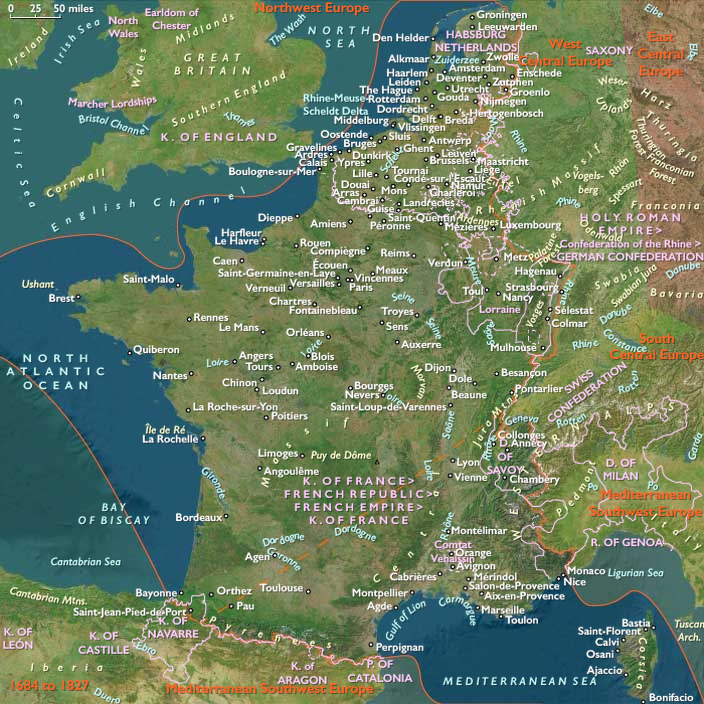
An army had been collected at Vannes, in the south-east of Brittany, and transports had been brought together in the landlocked waters of the Morbihan, which are connected with Quiberon Bay.
The scheme of the French ministers is to combine twenty-one ships of the line lying at Brest under the command of de Conflans, with twelve which are to be brought round from Toulon by de la Clue.
The army is then to be carried to some point on the coast of England or Scotland by the united squadrons.
La Clue, after attempting to sail to the relief of Louisbourg in 1758, had been trapped in the neutral Spanish harbor of Cartagena.
Following the Battle of Cartagena, La Clue had returned to Toulon, abandoning his attempt to relieve Louisbourg.
The task of blockading de la Clue at Toulon has been given to Admiral Edward Boscawen, who has with him fourteen sail of the line.
Boscawen had reached his station on May 16, 1759.
At the beginning of July, want of stores and water, together with the injury inflicted on some of his vessels by a French battery, compel him to go to Gibraltar to provision and refit.
He reaches the port on August 4.
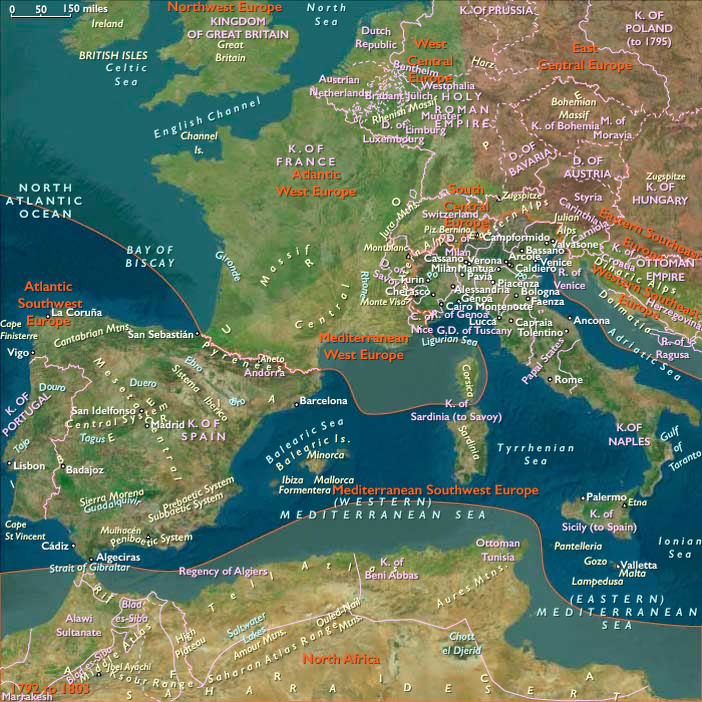
On 5 August de la Clue leaves Toulon, and on 17 August passes the straits of Gibraltar, where he is sighted by the look-out ships of Boscawen.
The British fleet hurries out to sea, and pursues in two divisions, separated by a distance of some miles owing to the haste with which they had left port.
Knowing the British have spotted his fleet, during the night of 17/18 August de la Clue decides not to sail to the original rendezvous point, the nearby Spanish port of Cadiz where he fears his fleet will be blockaded, but instead to head for the open ocean.
His flagship changes course, hoping the rest of the fleet will follow, but in fact only seven ships of the line do so.
The remaining eight ships continue to steer for Cádiz, either because they had not seen the leader's course change in the dark, or because their captains want to find safety in the nearest friendly port.
In the morning de la Clue finds he has only seven ships of the line with him, but is confident the rest will soon rejoin him and so stops to wait for them.
Soon after, his lookouts see eight ships on the horizon, which match the numbers of the missing portion of his fleet.
Only when the ships approach closer and the rest of the British fleet appears on the horizon do the French realize they are being pursued by a superior British force, and turn to flee.
To maintain cohesion, the seven French ships have to sail at the speed of the slowest ship in their grouping, the Souverein, and they are gradually overhauled by the faster British ships in the afternoon of August 18.
One, the seventy-four-gun Centaure, is captured after a very gallant resistance, in which the British flagship Namur is severely damaged.
Boscawen transfers to Newark.
During the night of 18/19 August, two of the French ships (Souverain and Guerrier) alter course to the west, and escape.
The remaining four flee to the north, and into Portuguese waters near Lagos, where Océan, de la Clue's flagship, and Redoutable are driven ashore and destroyed, while Téméraire and Modeste are captured.
De la Clue is seriously wounded, and carried ashore in Portugal.
The five ships in Cádiz are blockaded by Boscawen's second-in-command, Admiral Broderick.
Although the defeat of the French squadron has ruined an integral part of their scheme to invade the British Isles, the French decide to persevere with their attack.
The scheme will finally be put to rest in November after the French naval defeat at the Battle of Quiberon Bay.
After refitting, several of Boscawen's victorious Mediterranean ships are sent to join Admiral Hawke's fleet off Ushant, and five will be with with Hawke when he destroys the Brest fleet at Quiberon Bay.
A young slave named Olaudah Equiano, who will eventually become a prominent abolitionist in England, had participated in the engagement on the English side.
He will include an account of the battle in his autobiography, The Interesting Narrative of the Life of Olaudah Equiano.
View Event