Offa of Mercia
King of Mercia
Years: 720 - 796
Offa is the King of Mercia from 757 until his death in July 796.
The son of Thingfrith and a descendant of Eowa, Offa comes to the throne after a period of civil war following the assassination of Æthelbald after defeating the other claimant Beornred.
In the early years of Offa's reign, it is likely that he consolidated his control of midland peoples such as the Hwicce and the Magonsæte.
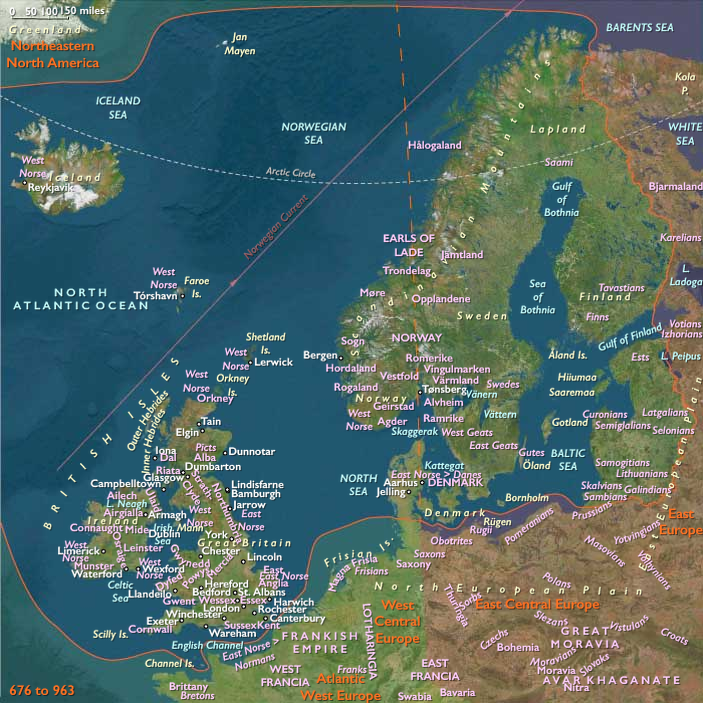
Taking advantage of instability in the kingdom of Kent to establish himself as overlord, Offa is also in control of Sussex by 771, though his authority does not remain unchallenged in either territory.
In the 780s he extends Mercian supremacy over most of southern England, allying with Beorhtric of Wessex, who marries Offa's daughter Eadburh, and regains complete control of the southeast.
He also becomes the overlord of East Anglia and has King Æthelberht II of East Anglia beheaded in 794, perhaps for rebelling against him.
Offa is a Christian king who comes into conflict with the Church, particularly with Jaenberht, the Archbishop of Canterbury.
Offa manages to persuade Pope Adrian I to divide the archdiocese of Canterbury in two, creating a new archdiocese of Lichfield.
This reduction in the power of Canterbury may have been motivated by Offa's desire to have an archbishop consecrate his son Ecgfrith of Mercia as king, since it is possible Jaenberht refused to perform the ceremony, which takes place in 787.
Offa has a dispute with the Bishop of Worcester, which is settled in the Council of Brentford in 781.
Many surviving coins from Offa's reign carry elegant depictions of him, and the artistic quality of these images exceeds that of the contemporary Frankish coinage.
Some of his coins carry images of his wife, Cynethryth — the only Anglo-Saxon queen ever depicted on a coin.
Only three gold coins of Offa's have survived: one is a copy of an Abbasid dinar of 774 and carries Arabic text on one side, with "Offa Rex" on the other side.
The gold coins are of uncertain use but may have been struck to be used as alms or for gifts to Rome.
Many historians regard Offa as the most powerful Anglo-Saxon king before Alfred the Great.
His dominance never extended to Northumbria, though he gave his daughter Ælfflæd in marriage to the Northumbrian king Æthelred I in 792.
His reign was once seen by historians as part of a process leading to a unified England, but this is no longer the majority view.
Offa died in 796 and was succeeded by his son, Ecgfrith, who reigned for less than five months before Coenwulf of Mercia became king.